1 Mistake Most Parents Make During Playtime (And What Toddlers Actually Need Instead)
Most of us don’t realise we’re doing it. We mean well. We’re engaged. We’re present. And without noticing, we turn play into something it was never supposed to be.
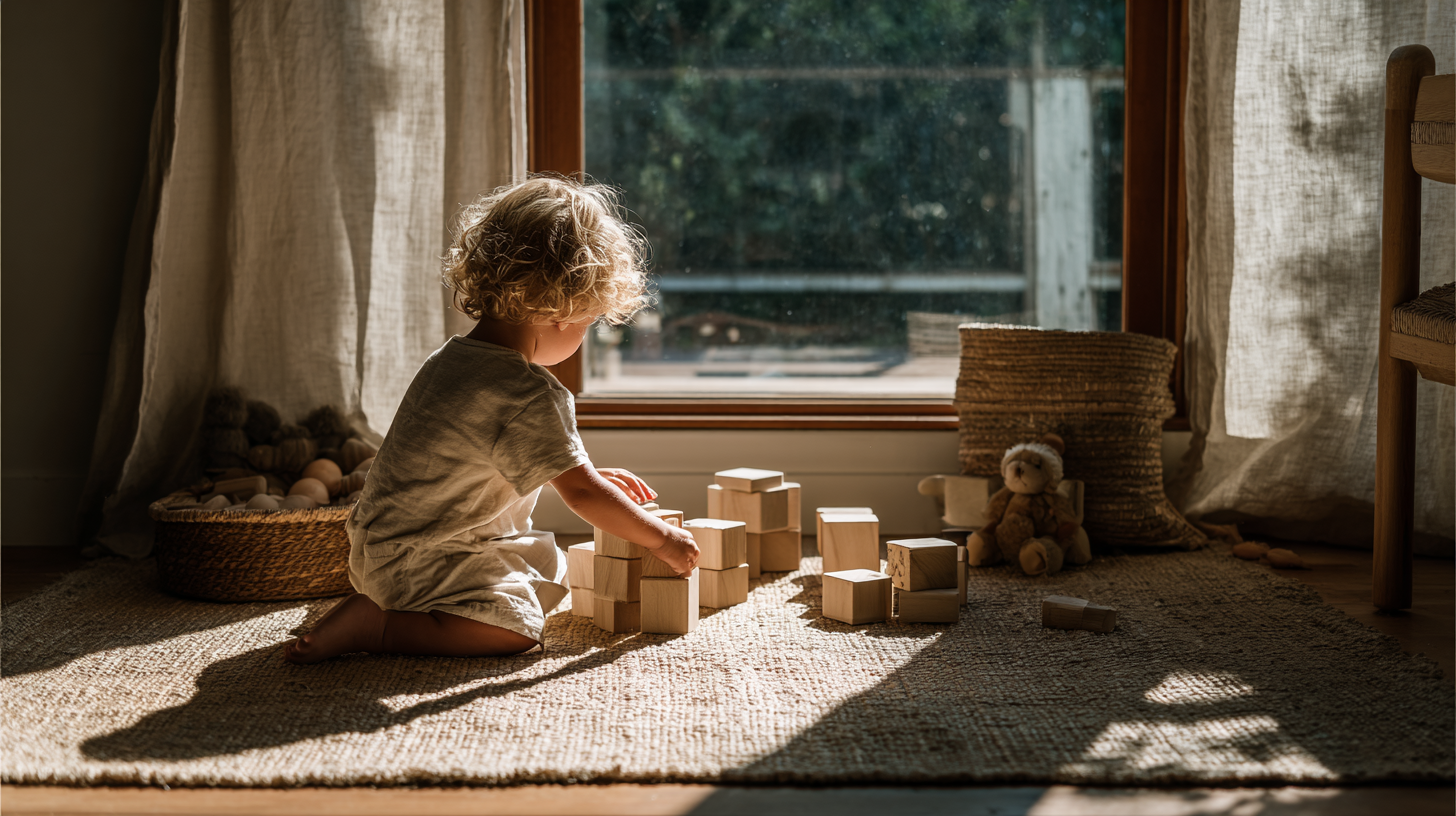
Picture a toddler with a set of blocks.
She picks one up. Turns it over. Sets it down. Picks up another. Tries to balance the two. They fall. She tries again, slightly differently this time.
Now picture the parent nearby.
“What colour is that one?”
“Can you count them? How many do you have?”
“Try building a tower! Can you make it tall?”
“What’s this one? Is this the big one or the small one?”
The toddler answers for a while. Then she glances away. Then she wanders off.
Play over. About four minutes in.
The parent wasn’t distracted. She wasn’t unkind. She was there, engaged, enthusiastic — doing everything she thought good parents do during play.
And without meaning to, she ended the play.
Now picture the same room, the same child, the same blocks.
The parent sits nearby. She doesn’t say anything.
She watches. She is genuinely curious — not performing curiosity, actually curious — about what this child is going to do next.
The child stacks. Things fall. She adjusts. She experiments.
Twenty minutes later, she’s still there. She hasn’t looked up once.
This is the thing almost no one tells you about play.
The mistakeWe accidentally turn play into a lesson
Most parents who do this are not pushy. They are not anxious high-achievers turning their toddler’s bedroom into a classroom. They are loving, curious parents who have absorbed a particular idea about what good parenting looks like during play.
The idea: every moment is a teaching moment.
Name the colours. Count the objects. Ask the questions. Narrate everything. Stretch the vocabulary. Make toddler play educational. Make it count.
There is something true in there. Language-rich environments do matter. Conversation does support development. Words spoken during play do eventually become words a child can use.
But somewhere between the research and the real kitchen floor, it becomes something slightly different. It becomes performance. A quiet pressure. A continuous stream of adult agenda inserted into a child’s private work.
Imagine you are deep in something — reading, cooking, working through a problem. And every four minutes, someone asks you a question. Not a harmful question. A kind one. A curious one.
How long before you stop?
The toddler who wanders away from play is not bored. She is often simply not able to do two things at once: think her own thoughts and answer yours.
What’s actually happeningWhat toddlers are doing when they play
Self-directed play is not entertainment. It is not a gap between meals. It is not the child waiting around until something educational happens.
It is work.
- Concentration
- Persistence
- Flexible thinking
- Problem solving
- Planning
- Self-direction
- Confidence
- Language
Not the words you give them — but the internal narration they are already building. Connecting objects to meaning, actions to outcomes, feelings to experiences.
Play-based learning doesn’t happen after the play. It is the play. The stacking, the falling, the trying-again — that is where it lives.
The play itself is doing the teaching. It does not need you to improve it. It needs you to leave room for it.
Repetition in play is not a sign that a child is stuck. It is often a sign they are close to figuring something out. The tenth attempt is usually the important one.
This is not a reason to disappear from the room. Your presence still matters — the child glances up periodically to check that you are there, that she is safe, that she can keep going. What she is not checking is whether you are impressed.
The shiftWhat changes when you stop leading
The hardest part of this is not logistical. You know how to sit in a room quietly. You do it every day.
The hard part is the silence itself. The part where nothing is happening — or so it appears — and you feel the pull to fill it. To add something. To help.
That pull is very human. It comes from caring. It comes from years of being told that good parents are engaged parents. Engaged parents ask questions. Engaged parents narrate. Engaged parents make the most of every window.
The shift is not about doing nothing. It is about doing something different.
Instead of narrating, observe. Instead of asking, wait. Instead of leading, follow. Instead of teaching in this moment, trust the moment itself.
Before you say anything — pause for fifteen seconds. Not dramatically. Just quietly.
In those fifteen seconds, watch. Notice what the child is actually doing, not what you had assumed they were doing. Notice where their attention is going, what problem they seem to be working on, what they are trying to figure out.
Now, if you speak at all, speak to that — what you just watched — not to the lesson you had in mind before you paused.
Or say nothing. See what happens if the moment gets to complete itself.
The differenceJoining play versus controlling play
There is a real difference between being present in play and taking it over. Both can look like engagement from the outside. They feel very different to the child inside them. Child-led play and adult-led play produce genuinely different experiences — not just different outcomes.
- The adult introduces the idea
- Questions direct where attention goes
- The child follows the adult’s agenda
- Play ends when the adult moves on
- Success is defined by the adult’s goal
- The child introduces the idea
- The adult observes where attention naturally goes
- The adult follows the child’s lead
- Play ends when the child is ready
- Success is defined by the child’s own sense of it
This doesn’t mean you stay silent forever. It means you enter the play on its own terms. You pick up what the child is already holding. You add a word or an idea to something that already exists, rather than redirecting toward something you brought in.
A gentle frameworkFive words for how to be in the room
Not a checklist. Not a system. Just five words that might be useful to come back to.
Children learn through play. They also learn from being trusted inside it.
Every time a toddler plays uninterrupted — every time they solve a small problem without being guided through it — they are practising something that has nothing to do with blocks or colours or towers.
They are practising the experience of being capable.
The message they receive from child-led play is not “I did this with my parent’s help.” It is: I figured this out.
That is what grows, slowly and invisibly, into confidence. Into the willingness to try hard things. Into the quiet internal knowledge that their thinking is worth something.
Not every moment needs to become a lesson. Sometimes the ordinary moment, left alone, is already teaching the thing that matters most.
If today had too much correcting, too many questions, too much narrating — it is fine. It means you were there. You were paying attention. You were trying to give your child something useful.
That is not a mistake. That is care, looking for its right shape.
Tomorrow, try the fifteen-second pause first. That is all. One pause, before the first question. See what you notice in those fifteen seconds that you might not have seen before.
The blocks will still be there. So will the child. And so will you.
“Play is not waiting for your teaching to begin.”
“Sometimes the most helpful thing in the room is an adult doing less.”
“The goal is not better play. The goal is a child who trusts their own ideas.”
“Children learn through play. They also learn from being trusted inside it.”
“Not every moment needs to become a lesson.”
You are not being told to stop talking to your child. You are not being told that language doesn’t matter, or that questions are harmful, or that engaged parenting is too much.
You are being told that your child’s private concentration is something to protect, not interrupt. And that the most language-rich environment you can offer is one where a toddler feels safe inside their own thinking.
That grows everything else.
Somewhere right now, a toddler is deeply focused on something that looks — from the outside — like nothing much.
Stacking. Sorting. Turning an object over and over. Doing the same thing again. And again. Approaching something from a slightly different angle and trying once more.
The adult nearby is watching. Not directing. Not narrating. Just watching, with genuine curiosity, to see what happens next.
This is what growth often looks like. It is quiet. It is slow. It is ordinary. Independent play, child-led play, the ten minutes with the blocks — it does not announce itself, or produce a noticeable outcome, or lead to something that can be photographed.
And it is already, exactly, enough.
Not every moment needs to become a lesson.
Some moments are already becoming a child.
And often, the most important thing we can do is quietly make room for them.
A small set of prompts for mealtimes, play, transitions, and quiet moments at home. Not a script — a gentle reminder for the conversations that are already happening. Free to download, print, and keep nearby.
Get the free prompts →You don’t need another toy. Sometimes you only need a few words nearby.
If the prompts above felt useful, I made a fuller set — the Toddler Language Development System — designed for exactly the moments this article describes: mealtime, toddler play, transitions, and the ordinary spaces in between where language grows.
It isn’t a curriculum. It’s a small collection of cards to keep close and reach for when the moment is already there.
See the full prompt set on Etsy →