
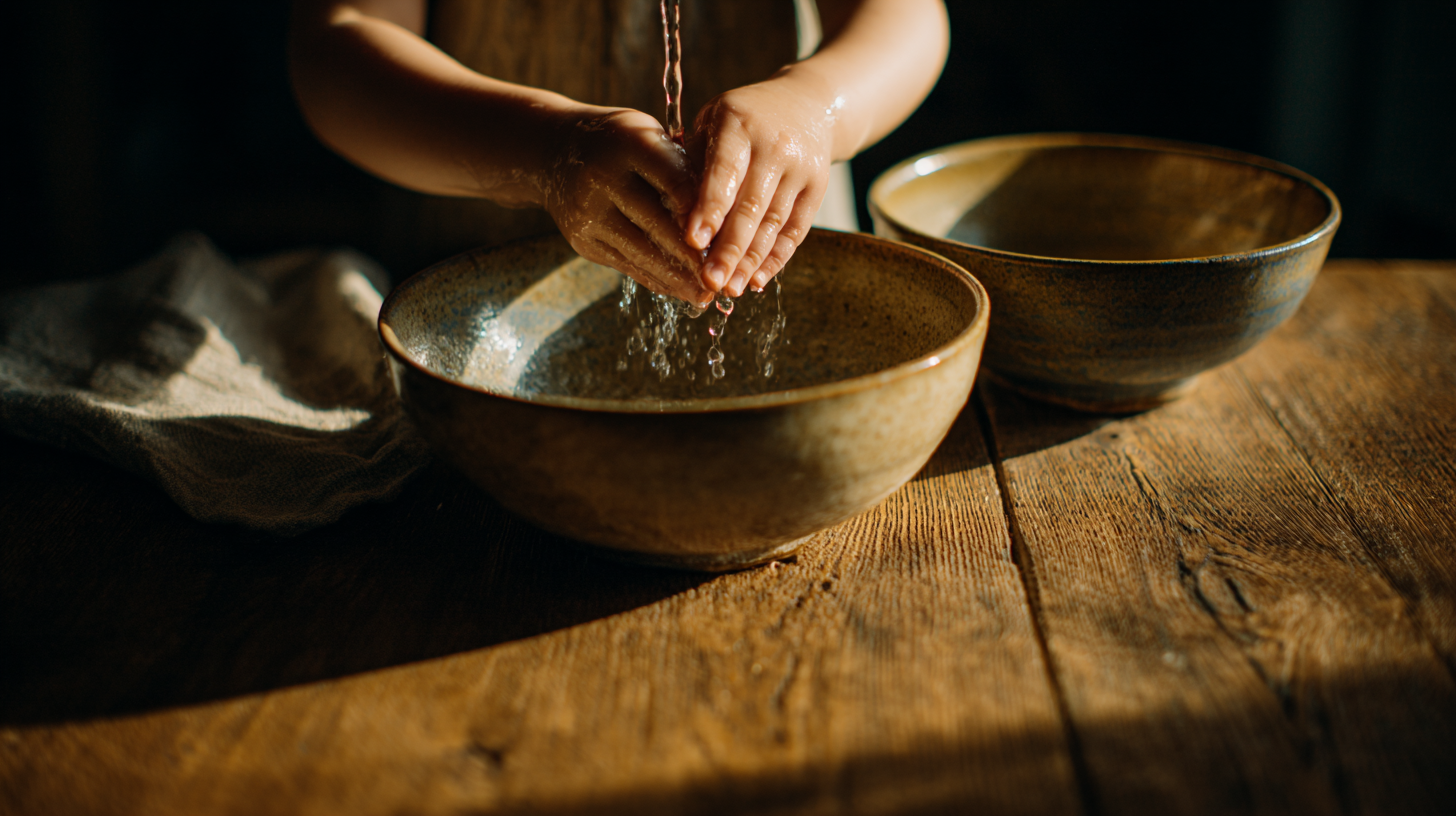
There is a moment that anyone who has lived with a toddler will recognise. You put two bowls on the kitchen floor and fill one with dried beans. You turn to stir dinner. When you look back three minutes later, the child is still there, still moving beans — slowly, deliberately, with the absolute seriousness of someone who has somewhere to be inside this task. The beans are going back now. She has started again.
This is not entertainment. It is something closer to work — the kind of work that is deeply satisfying because it has a beginning, a middle, and a clear physical result. A full bowl becoming empty. A small hand learning to trust itself.
Montessori activities at home, at their quietest and most practical, are not elaborate. They are ordinary. A pitcher. A cloth. A basket of books rotated once a week. A sock to match. What makes them Montessori is not the equipment — it is the invitation: to participate in real life, at your own pace, without being rushed toward a different kind of development than the one that is already happening.
These seven activities are not designed to keep toddlers busy. They are designed around what toddlers are already trying to do.
- A perfect shelf setup
- Expensive materials
- Aesthetic organisation
- The right toy
- Following a sequence
- Repetition without pressure
- Real participation in family life
- Meaningful physical movement
- Work that has a visible result
- Being included, not managed
The goal is not a productive afternoon. The goal is a child who feels capable inside the life that is already happening around her. That is a different kind of aim — and a much more achievable one.
Pouring water slowly between cups
A small ceramic pitcher. Two cups of the same size. A tray underneath. That is the whole setup. The child pours from one cup to the other, and then back again, and then again, for as long as the water stays interesting — which is usually longer than you expect.
There will be spillage. The tray catches most of it. Some water ends up on the floor. Most toddlers spill every single time at first. That’s alright. The spillage is part of the feedback loop. Each pour that lands cleanly inside the cup is information. The hand learns something that the mind does not need to name.
Toddlers return to this activity across weeks and months because it is never quite the same twice. The pour that went perfectly yesterday is harder today because the cup is slightly fuller. The control required is real, and toddlers feel real control as something close to pleasure.
The floor may stay wet for a while. That happens.
Set it up once. They will find it again.
- Fine motor control and wrist rotation
- Visual tracking and spatial judgment
- Concentration across a repeated cycle
- Self-correction without adult direction
Washing fruit at the sink
Pull a step stool to the sink. Put a few pieces of fruit in the colander. Hand over the small brush. Move to the side.
The counter will get wet. That’s fine.
The water, the brush, the slightly rough skin of an apple or the dimpled surface of a lemon — this is a sensory experience that also produces a real result. The fruit is actually being cleaned. This matters to toddlers in a way that is often underestimated: the task has a point.
At the end, the fruit is washed and they washed it.
The act of being included in real food preparation — not a child-proofed version of it, but the actual preparation — is deeply satisfying. It communicates something important about belonging. You are part of how this family feeds itself. That is, for a toddler, a significant thing to know.
Next time you are making dinner, invite your toddler to wash the fruit or vegetables for you. Don’t supervise the technique — just stand nearby. Let the work be theirs.
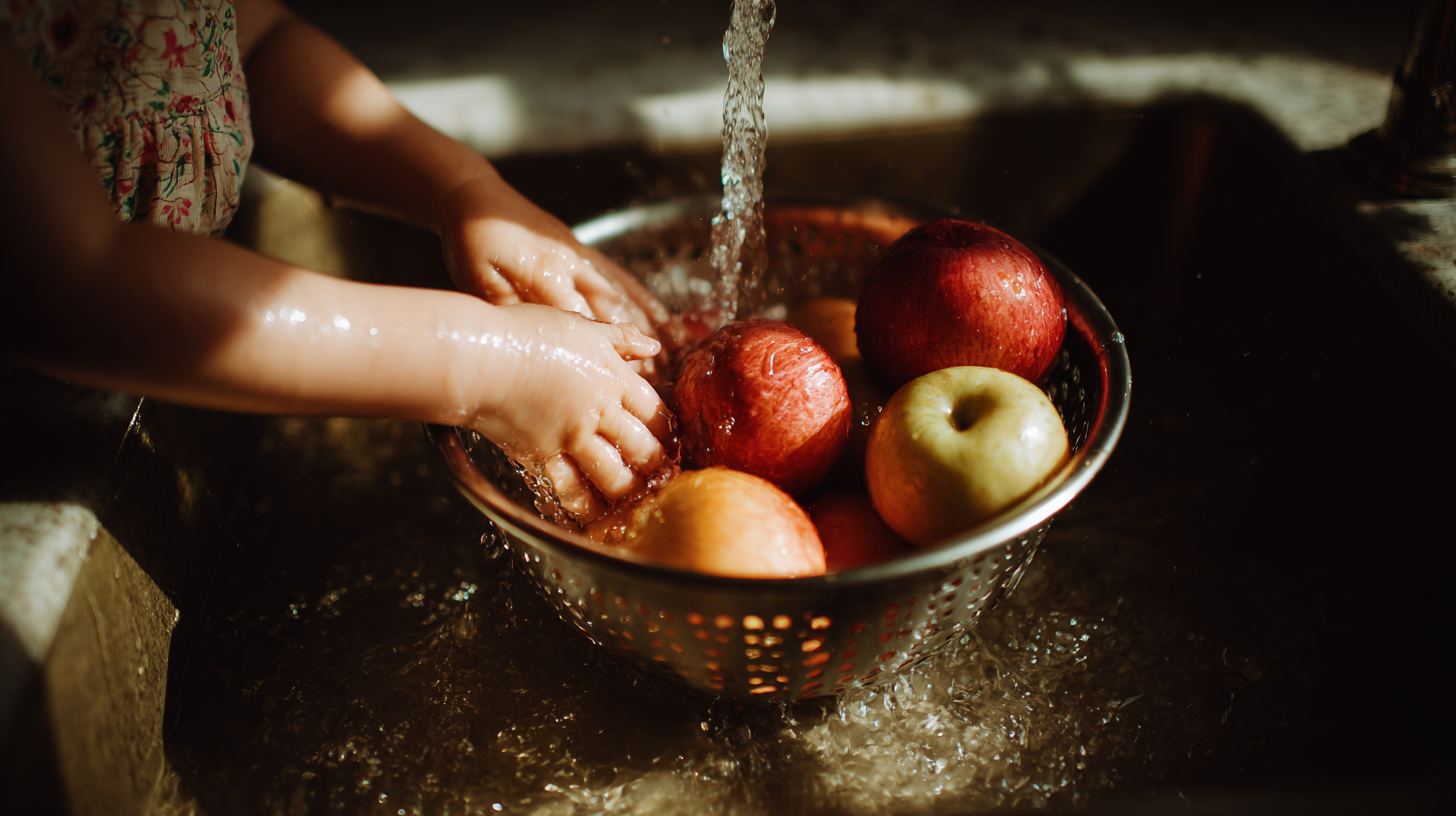
Real work, in a real kitchen.
Matching socks during laundry
Tip a basket of clean, dry socks onto the floor. Sit nearby and fold other laundry. Let your child sort through the pile and find the matching pairs.
The logic of matching — this small one and this small one, the stripe on this one and the stripe on that one — is genuinely absorbing work for a toddler mind.
Pairs are one of the earliest ways young children make sense of the world’s organisation.Finding them is satisfying in the way a small puzzle is satisfying, except the pieces are real objects from real family life. There is no wrong answer here. A toddler who pairs two different socks has still done the task as they understand it. The socks may never actually match, not for weeks. The matching becomes more precise gradually, not because they were corrected, but because they kept at it.
“Instead of narrating what they are doing, try just being present beside them. Your quiet company is the only instruction this moment needs.”
Carrying groceries from the door
The bags arrive at the door. Your toddler picks up one item — a tin of tomatoes, a bag of apples, a box that fits in two hands — and carries it to the kitchen. She sets it down.
She goes back for another.
The heaviness of a real grocery item is part of what makes this different from a toy version of the same task. The weight is honest. Toddlers find this kind of honesty satisfying; they are not being given a pretend version of participation — they are actually participating.
The work has rhythm. Toddlers love that.- Proprioception and body awareness with varying weights
- Sequencing — going, returning, completing a cycle
- Spatial memory: where things belong in the kitchen
- A sense of genuine contribution to family life
Repetition is not boredom. It is what mastery feels like from the inside.
Window washing with a spray bottle
A small spray bottle filled with water. A cloth that is easy to hold. A low window, a glass door, or a mirror at toddler height. That is everything.
The squeezing motion of the spray bottle is satisfying for small hands — it requires just enough strength to feel like effort. The streaks appear. Then the cloth makes them disappear, mostly. The moment when the glass looks cleaner is immediate feedback. Most activities can’t offer that.
Toddlers often return to window washing for weeks. The window never stays perfectly clean, which means the opportunity to clean it is always there.
The work is renewable. That matters.The towel may end up abandoned halfway through. The window may look about the same as it did before. That’s fine. That’s what the first few weeks look like.
Keep a small spray bottle and cloth in an accessible low drawer. When you need ten minutes, point to the window. You will have them.

The streaks and the effort are both part of the work.
- A small ceramic or wooden pitcher for pouring
- A cloth and spray bottle near a low window or mirror
- A basket of 4–5 books, rotated every week or two
- A few ordinary objects in a low basket — stone, fabric, wood
- A space in the kitchen where they can help, even for two minutes
Object-to-object language basket
A small woven basket. Inside: a few ordinary objects — a wooden spoon, a small stone, a piece of fabric, a pine cone, a shell. No rules about how to use them. The basket simply sits on a low shelf or the floor and is available.
Toddlers pick up these objects and put them down, hold them up to the light, tap them against each other, place them in a row. This is not nothing. This is the beginning of classification, of comparison, of the question: what is this, and how does it relate to that?
They will do this for a while. Then they will put everything back in the basket and start again. That’s usually when you know the activity is working.
When you sit near your child while they explore the basket, you can offer a word quietly: “Heavy.” “Smooth.” “Pine cone.” Not a lesson. Just language arriving alongside experience. This is how vocabulary actually grows — not drilled, but offered, at the moment the object is in the hand.
The basket is not a language activity in the instructional sense. It is an environment that makes language feel useful. The words you offer are not corrections or tests — they are small gifts left beside the experience.
- Sensory discrimination — weight, texture, temperature
- Early classification and comparison
- Receptive vocabulary in a low-pressure context
- Independent, sustained attention
Quiet floor book basket rotation
A low basket near the floor. Four or five books inside. Not every book the child owns — four or five. Changed quietly, every week or two, while the child sleeps.
The morning after a rotation, the child often goes to the basket before anything else. The books are familiar enough to be comfortable and new enough to be interesting. She will sit with them for longer than she does with books she has always had access to, because scarcity — even gentle, managed scarcity — creates attention.
The basket should be reachable without asking an adult. This matters. The ability to choose your own book, at your own moment, without needing permission, is a small but real form of autonomy. It teaches a child that her impulse to look at something is a legitimate one — one that can be followed.
After your toddler is asleep, take the books out of the basket and replace three of them with ones that have been out of rotation for a few weeks. Leave two familiar ones. Notice what happens in the morning.
None of these activities require a prepared Montessori environment. They require ordinary objects and a parent who is willing to step slightly to the side and let the work happen. The stepping aside is the whole practice.
The ordinary Tuesday is the real childhood. Not the milestone. Not the documented moment. The Tuesday.
Chichiberry ParentingA toddler given real work to do inside a real household does not need more stimulation. She needs more time inside what she is already doing. Repetition is not boredom — it is mastery in progress. The beans moved back again are not the same as the beans moved forward. Something small has shifted.
These activities are sustainable because they are not invented. They are already embedded in the life you are living. The groceries arrive. The laundry needs sorting. The windows need cleaning. What changes is only that the child is included — unhurried, unjudged, genuinely part of it.
Toddlers are not looking for entertainment. They are looking for inclusion. Most of them, given the chance, will find their own way in.
You do not need to do all seven of these. One activity, returned to again and again over months, is worth more than seven activities tried once. Choose the one that fits your home today.
That is already a meaningful childhood. Nothing more is required.
Everyday Language Prompts for Toddlers
A simple free set of language prompts for ordinary moments — pouring, sorting, washing, carrying. Small cards to keep nearby when words feel just out of reach.
Get the free prompts →Toddler Language Prompt Cards
Forty prompts for the conversations that already happen at mealtimes, during play, on walks, and in the small quiet moments in between. Available on Etsy — instant download.
See the full set on Etsy →Chichiberry Parenting · Ordinary Life Series


