

Connection Happens
In The Small Moments
You don’t need more time, a better plan, or a special activity. You need to notice what is already happening between you and your child every ordinary day.
It was just breakfast.
The toast was almost burning. There was a permission slip somewhere on the counter that needed signing. A work message had already arrived. And in the middle of all of that, your child held something out to you — a piece of their toast, shaped like nothing in particular, but held toward you with both hands and a specific kind of gravity.
You almost didn’t see it.
You almost said mm, yes, lovely without looking up. But you did look up. You took the piece of toast. You said something like thank you, that’s for me? And something happened in that moment — something small and specific and gone before you could name it — that was, without question, the most real thing that happened all morning.
This is what connection looks like. Not the version we planned for.
Children rarely remember what we planned.
They remember how it felt to be with us.
There is a particular kind of pressure that sits quietly on modern parents, and it is this: the belief that connection requires intention. That if you were not present enough during the window you designated for quality time, you missed something that cannot be recovered.
This belief arrives in soft language and warm aesthetics. It does not announce itself as pressure. It arrives as inspiration. As gentle guidance. As a curated image of a parent fully present, down on the floor, entirely available, with no phone, no distraction, no half-thought about dinner.
That image is real, sometimes. But it is not where most connection happens.
Connection is rarely scheduled.
It usually arrives unannounced.
Most connection happens in the in-between. In the accidental pause. In the moment before the next task begins. In the place that is not designated as anything at all.
It asks for more noticing.”
We spend a great deal of energy trying to create meaningful moments with our children. We plan activities, set up invitations to play, make time. And those things matter. But they are not where the deepest trust is built.
The deepest trust is built in the shoe-tying. In the waiting room. In the drive home when neither of you says anything at all. In the kitchen, standing beside each other, each doing something ordinary.

Ordinary objects. Accumulated love.
Here is what connection actually looks like in a real family on an ordinary day.
None of these are activities. None of them were planned. None of them required preparation or a particular state of mind or an optimal version of yourself.
They just happened, as ordinary days happen, and inside them — quietly, without announcement — your child felt something.
Last week I was cleaning up after lunch. My daughter was sitting on the floor nearby, not doing anything in particular. I wasn’t talking to her. I wasn’t engaging her. I was just moving around the kitchen, putting things away, and she was just there, watching.
At some point she got up and came to stand right beside me. She didn’t say anything. She picked up a cloth from the counter and started wiping a patch of the bench that was already clean. Just wiping, slowly, in small circles. Standing next to me.
I kept moving. She kept wiping. We didn’t look at each other.
And I thought: this is it. This small, unremarkable Tuesday moment is the kind that won’t be in any photograph and won’t be described to anyone, and it is exactly the kind that she will carry without knowing she is carrying it. The feeling of being near me while I moved through the ordinary business of the day. The feeling of being included without being instructed. The feeling of just being here, together, in a warm kitchen on a Tuesday afternoon.
There is something worth saying plainly about children and memory, even though the research is not the point here.
Children do not remember our plans. They rarely remember the specific activity, the special outing, the occasion we prepared for. What they retain — what becomes the felt texture of their childhood — is something harder to photograph and easier to miss.
They remember the quality of being with you.
They remember whether the answer to their question felt like an interruption or an invitation. They remember whether you received what they brought you. They remember, at some level they will never be able to articulate, whether they were welcome in the ordinary moments of your day.
They are with the version of you that is here right now.”
This is not a way of saying that the intentional moments don’t matter. They do. The prepared play space, the book read aloud, the walk taken for the pleasure of walking — these matter. They are part of the vocabulary of care.
But they are not the grammar. The grammar is the ordinary. The way you move through the day, and whether your child is invited to move through it beside you.
Every ordinary day is full of invisible invitations.
Most of them come from the child who is already in the room.
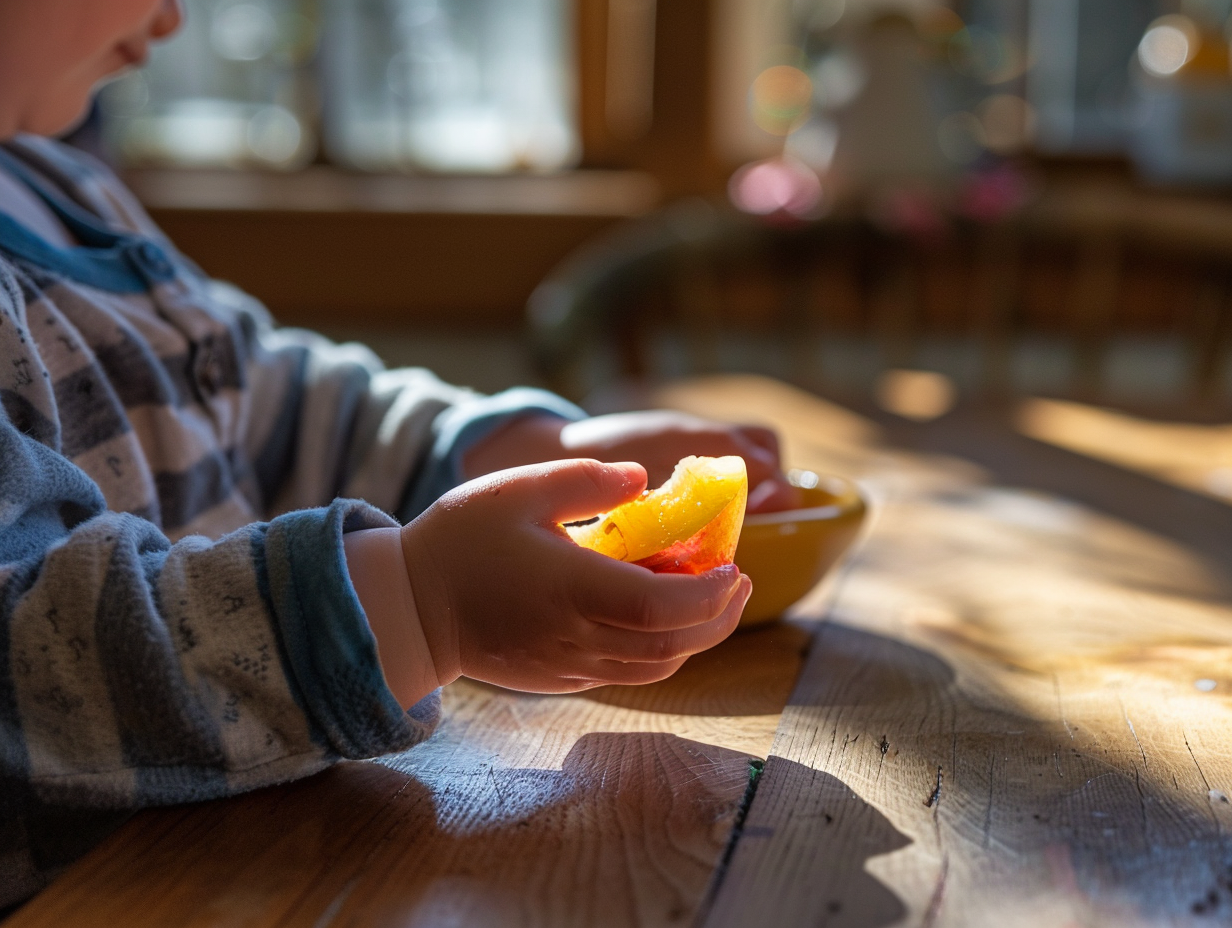

Researchers who study attachment use a specific phrase for this: sensitive responsiveness. It sounds clinical. What it describes is not.
It is the thing that happens when a child reaches for your attention and you turn toward them. When they bring you something and you receive it. When they call your name and you don’t just answer — you actually arrive.
This does not require extraordinary attentiveness. It requires something more modest: the willingness to be present for the small offering. To turn toward the child who is already here, in this moment, doing this particular thing.
It grows from the ordinary turning-toward —
again and again, on ordinary days.
Language grows the same way. The most useful words a child learns do not come from structured teaching. They come from conversation in the middle of other things. From the parent who mentions what they’re doing while they do it. From shared attention — both of you looking at the same leaf, the same cloud, the same dog on the other side of the road.
Emotional safety works the same way too. A child who feels safe with you does not feel that way because of a single important conversation or a perfectly handled difficult moment. They feel it because of the accumulated texture of ordinary days — the way you are with them, in the small moments, over and over, across years they will not consciously remember.
Safety is not built in the dramatic moments.
It is built in the ordinary ones.
One turning-toward at a time.
- When your toddler shows you a rock — that is not about the rock. That is about whether the world they find interesting is interesting to you too.
- When they want you to watch them do something they have already done ten times — they are not showing you the thing. They are checking that you are still there.
- When they cry and reach for you instead of standing still — that is attachment working correctly. You are the answer they already knew.
- When they tell you something small and inconsequential — they are practicing bringing you the real things. The small ones are rehearsals for the ones that matter more.
- When they say your name and wait — they are not interrupting you. They are inviting you into the moment they are in. That invitation has a lifespan.

The things they carry. The things we forget to notice.
You will photograph the birthday. The first day of school. The holiday morning, the cake, the outfit. You will have those images. You will be glad of them.
But there is another category of things — smaller, softer, gone before you thought to reach for your phone — that you will miss most.
The way they mispronounce one particular word. Not all words — one specific one, mispronounced in one specific way, that is entirely their own. You have heard it hundreds of times and you have quietly, privately loved it every time. One day they will say it correctly, because they have been listening and practising, and you will feel something unexpected. A small door closing. The word they used to say, gone.
The object they carry everywhere for three months and then set down one Tuesday and never pick up again. A small plastic dinosaur, or a smooth stone from a car park somewhere, or half a wooden peg that you still cannot explain. They brought it to breakfast. They brought it to the bath. You fished it out of the laundry. Then it was just on the windowsill one day, and then it wasn’t, and neither of you mentioned it.
The way they run into the room when they hear you come home. Not walking. Running. The particular sound of small feet on the floor moving toward you as fast as they can, because you are the most important thing and you just arrived. This will not always be true in this way. For now it is entirely true.
often feel enormous to them.
And the things that feel enormous to them
are often the ones we forget to notice.
The stories they tell at dinner that make no sense. That begin in the middle and end somewhere unrelated and feature people who don’t exist and events that may or may not have happened. You have learned to follow along without asking too many clarifying questions. The story is not for you to understand. It is for them to tell. You are just here, listening, which is the whole point.
The sound of their breathing in the dark. After the book, after the last glass of water, after the final goodnight — that slow, even sound that means they are safe and close and exactly where they are supposed to be. You will stand at the door for a moment longer than you need to, just to hear it. You will not know why until later.
The moments you will miss most
are the ones that didn’t seem worth saving.
These things cannot be photographed, or not in any way that captures them. They live only in the accumulated texture of days. They will not be in the album. They will be somewhere quieter and more permanent than that — in the part of you that knew, even then, even half-noticing, that this was the real thing.
The goal, then, is not more connection.
You do not need to restructure your day. You do not need better activities or more presence or a different version of your morning. What you need — what all of this is really pointing toward — is simpler and harder than any of that.
You need to notice the connection that is already happening.
It is in the breakfast that almost burned. In the shoe-tying. In the walk to the car when neither of you is saying anything important. It is in the way your child moves through space near you — coming close, going away, coming close again — checking that you are still the fixed point. Still the place that holds.
There is a kind of grief that arrives, sometimes, in the middle of an ordinary Tuesday. Not a sharp grief — a soft one. A recognition that this season is moving, that the child who is here right now will not be here this way much longer, and that most of the moments that make up this particular version of them are the ones you were only half-noticing.
This is not an accusation. It is an acknowledgment of what ordinary life costs, and what it is also giving us all the time.
The small moments are not preparation for the important ones. They are the important ones. The connection is already here. It is already happening. It only needs to be noticed.
You do not need to be fully present for every moment of every day. That is not possible, and setting it as the standard only adds weight to the ordinary. You need to be present for some of them. You need to turn toward the small offerings when you can. The relationship is built in the accumulation — not in any single perfect morning.
Before you put your child down, notice one small thing they showed you today. A moment you almost missed. A word they said that you caught just in time. The way they looked at something. Let it be enough that you noticed. It was already enough that it happened.
The Everyday Language Prompts
So many of these moments already happen in ordinary conversation — at breakfast, on a walk, during bath time, at the end of the day. If you’d like a few gentle prompts to keep nearby for those moments, this small printable set is made for exactly that. Not a script. Just a few quiet words for when the moment is already there.
Keep the free prompts nearby →

You are not behind. You are not failing to connect. You are here — in an ordinary home, in an ordinary day — with a child who is learning, slowly and surely, what it feels like to be with someone who stays. That is the whole thing. That is already enough.

What To Say During The Morning Rush
For the 90 seconds between waking and leaving — and the words that can make it feel a little less like a race.
How To Build A Language-Rich Home Without Buying More Toys
Language grows in ordinary materials and ordinary conversations. A guide to noticing what is already there.

Why Toddlers Repeat The Same Word Over And Over
It’s not random, and it’s not worrying. It’s one of the most important things a young child can do with language.