5 Ways To Encourage More Words Before Age 2
A toddler doesn’t learn language during lessons.
They learn it during breakfast, diaper changes, walks, bath time, and play.
These simple shifts can help create more opportunities for words to grow naturally.
You’ve been reading to them every morning. You point at pictures. You name the dog, the cup, the window. You sing the same three songs on every car ride. You narrate the grocery shop. You narrate getting dressed. You narrate things you didn’t even know needed narrating.
And still — somewhere in the back of your mind — the question arrives.
This question is almost universal at this age. It arrives for parents of children who speak a little, a lot, and everything in between. It isn’t a sign that something is wrong. Most of the time, it is simply a sign that you are paying close attention.
Children between 12 and 24 months are doing something extraordinary inside their minds — building the internal architecture for language at a pace that will never happen again in their lives. Many of them are absorbing far more than they can yet express. The words are forming. The connections are being made. The output just takes time.
What follows isn’t a curriculum. It isn’t a milestone checklist. It’s five simple ways to make the everyday interactions you’re already having slightly more language-rich — without adding pressure to family life.
The goal is to create more opportunities for language to happen.
She was standing at the window one morning, pointing at something outside. Her father came over and looked where she was looking. A bird — ordinary, brown, on the fence post.
He said, “Bird.”
She didn’t say anything. She watched the bird for a few more seconds, then turned and walked back toward her blocks. He wondered, briefly, if the moment had meant anything at all.
Four days later, she was in her high chair when a pigeon landed on the windowsill. She looked at it, then at him, then back at the pigeon. And then, quietly, with effort:
“Buh.”
She had been holding the word this whole time. She just needed the right moment to try it out.
Language grows through connection, not correction.
A toddler doesn’t learn a word the way you’d learn it in a classroom. They learn it by hearing it repeatedly, in the same real-world context, attached to something they already care about. The word “banana” isn’t absorbed from a flashcard. It’s absorbed from the fifteen mornings in a row when you said “banana” while handing them a banana.
What helps most isn’t quantity of words — it’s the quality of the interaction around them. Turn-taking matters enormously. When you pause and wait after a child makes a sound or points at something, you’re not just being polite. You’re giving their brain the message that communication is a two-way exchange — that what they express matters, and that a response will come.
Emotional connection is the invisible foundation. Children learn language most efficiently in contexts of warmth, safety, and genuine engagement. The words you say while crouching down to their level, looking at the thing they’re looking at, in an ordinary unhurried moment — those words are absorbed differently than words said while walking past.
Responsive interaction matters more than passive exposure.
Studies on early language development consistently show that children who are spoken with — rather than spoken at — develop larger vocabularies and stronger communication skills over time. A child sitting near a television or audio recording hears many words, but the research suggests they absorb far fewer of them than words spoken in a real back-and-forth exchange. The interaction itself is part of what makes language land.
Conversational turn-taking — even in its simplest form, where a parent responds to a babble or a point — appears to be one of the most significant predictors of early language development. Researchers at MIT found that the back-and-forth of parent-child conversation was a stronger predictor of language outcomes than the sheer number of words a child heard. The exchange matters more than the volume.
Joint attention — two people looking at the same thing together — is the other piece researchers return to again and again. When you follow your child’s gaze and name what they’re already looking at, you’re doing something that learning apps and vocabulary videos simply cannot replicate. You’re making the word feel like it belongs to your child’s world, not an abstract one.
Simple shifts for ordinary moments.
Narrate What You’re Already Doing
You don’t need to turn your home into a running commentary. But a small amount of calm narration — especially during repeated routines — gives your toddler the exact context that makes words stick.
When you’re cooking: “Stirring. Hot pot. Spoon.” When you’re doing laundry: “Wet shirt. In the machine. Lid down.” When you’re getting them dressed: “Arm in. Other arm. There.”
Short, real, connected to what’s physically happening in front of them. You’re not performing. You’re simply naming the world they’re already watching you move through.
Choose one routine that happens every day — breakfast, shoes, or the walk to the car. Add three or four simple words while you move through it. No pressure to make it perfect. The repetition is the whole point.
Connecting words to real objects and actions. Building vocabulary through repetition and real-world context. Learning that language describes what actually exists — not what’s on a card.
Follow Their Attention
This is one of the most powerful shifts you can make, and it asks almost nothing of you. When your toddler points at something, looks at something, or moves toward something — talk about that. Not what you want them to notice. What they’re already noticing.
A child pointing at a passing dog doesn’t need you to say “yes, that’s a dog — and dogs say woof, and this one is brown, and…” They need you to look at the same dog, match their interest, and say “dog” — maybe “big dog” — and let them respond. Then follow wherever they take it next.
Joint attention — the experience of two people looking at the same thing together — is one of the most well-studied predictors of early language development. It doesn’t require any equipment. It only requires following your child’s gaze.
On your next walk, let your toddler stop when they want to stop. When they point at or look at something, say the word for it once, quietly. Then pause. See what they do with that.
Shared attention and turn-taking. The understanding that pointing is communication. The experience of being followed — which is also the experience of being heard.
Today, while putting on socks, name three things your child is touching.
That’s enough.
Pause Before You Answer
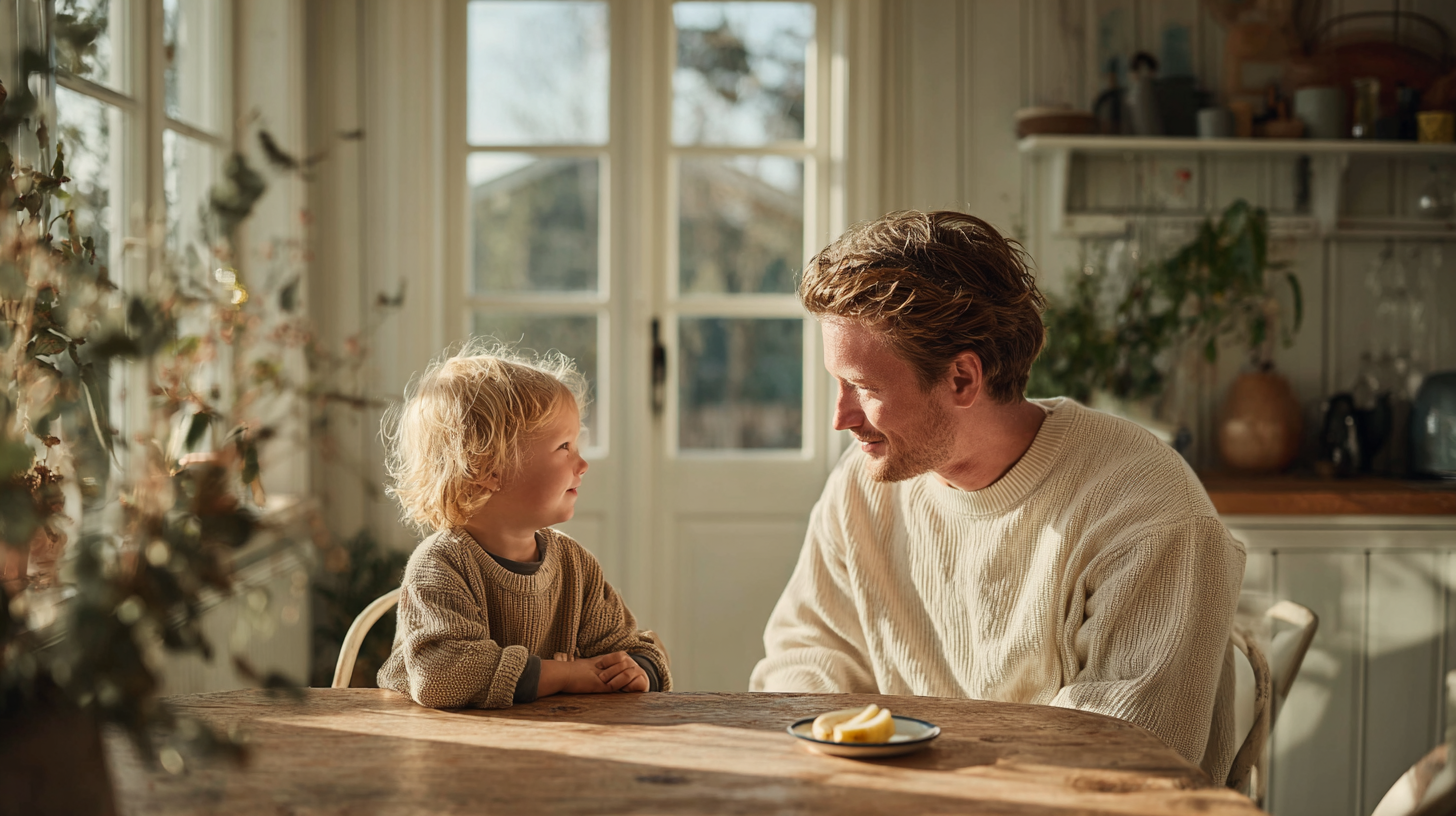
This one feels counterintuitive. When your toddler points at the banana, every instinct says: hand over the banana. But a small pause before you respond — just two or three seconds — creates something important. It creates a moment of communication expectation.
You don’t need to withhold the banana. You’re not creating frustration on purpose. You’re simply waiting — with warm attention, looking at them — to see if they’ll try to say something, make a sound, or gesture more specifically. Whatever they offer, respond to it warmly. Then give them the banana.
The message your child receives in that pause is: I’m waiting for you. Your attempt at communication is what opens this interaction. That message, repeated across hundreds of ordinary moments, becomes the foundation of expressive language.
Next time your toddler reaches or points for something, pause for three seconds with gentle eye contact before responding. No pressure. No quiz. Just a small window for communication to happen.
Initiating communication. Learning that pausing is an invitation, not a withholding. Building the confidence that attempting to express something will result in a response.
Read Together Differently
Reading aloud is wonderful. But at this age, reading together — a different thing entirely — can often do more for language development than reading the text of the book.
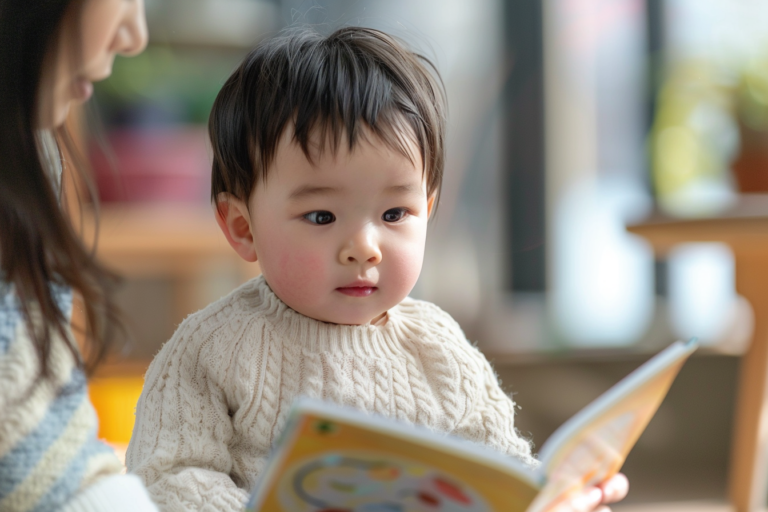
Try this: instead of reading every word on the page, follow your child’s attention within the illustration. Point at what they’re looking at. Name it. Ask simple one-word questions: “Cat?” Pause for their response. Wonder aloud: “Where’s the cat going?” You don’t need to answer it yourself.
Books become conversational spaces rather than performance texts. Your toddler goes from passive listener to active partner. The story matters less than the exchange happening around it.
Choose one book and read it entirely by pointing and wondering, without following the written text. Name what they look at. Wait for their response. Follow their interest. See what the conversation becomes.
Joint attention with a shared object. Turn-taking in a low-stakes, enjoyable context. Vocabulary in a visual and narrative context. The pleasure of shared meaning-making.
Turn Daily Routines Into Conversations
Mealtimes. Bath time. The walk to the shop. Getting in and out of the car. These routine moments happen every single day, which makes them the single most powerful language context in your child’s life — simply because of the repetition.
At meals: name what’s on the plate. Ask simple questions without pressure: “Hot?” Comment on what they’re doing: “You like that.” At bath time: “Bubbles. Warm water. Splash.” On the walk: follow their gaze and name what you both see. In the car: sing, narrate, or simply talk about what just happened at home.
You’re not filling silence. You’re creating a consistent, warm language environment around the exact moments your child experiences every day. This is where vocabulary is built — not in dedicated sessions, but in the accumulated richness of ordinary time together.
Choose one mealtime and make it a conversation — about the food, the room, what happened this morning, what they can see from where they’re sitting. No agenda. Just language inside a moment that’s already happening.
Vocabulary in functional, repeated contexts. The understanding that routine moments are conversational spaces. Connection between language and the trusted relationship at the centre of daily life.
Today, during lunch, pause before handing over the cup.
See what happens.
Children learn language the same way they learn trust: through thousands of small interactions that don’t seem important at the time.
The words arrive later than we expect.
The relationship arrives first.
You’re not building a vocabulary list. You’re building a communicator.
None of these strategies are about getting more words today. They’re about something larger and slower: building a child who believes that communication is worthwhile — that when they try to express something, someone will respond with warmth and attention.
That belief is what becomes expressive language. That belief is what becomes the confidence to try new words in new contexts, with new people, in all the years that follow this one. The ordinary Tuesday you’re in right now is doing something your child will carry forward for their whole life.
You don’t need more. You need to notice what you’re already doing — and trust that it is, in fact, enough.
40 Everyday Language Prompts For Busy Parents
Simple things to say during meals, walks, bath time, and play — even on the days when your brain feels completely empty.
- Never wonder what to say next
- Use everyday moments more intentionally
- Encourage conversation without pressure
Instant download · Print at home · No sign-up required
The Toddler Language Prompt Cards are a fuller printable version of what you’ve just read — forty prompts organised by context: mealtimes, play, transitions, walks, and bedtime. Not a script. A small set of ideas to keep nearby for the moments that are already happening.
See the full card set on Etsy
Language rarely arrives all at once.
It arrives one ordinary moment at a time —
in the pause before the banana,
in the name for the passing bird,
in the conversation at the table
that nobody thought to record.
Similar Posts
7 things to say when your toddler can’t find the word
When toddlers struggle to find words, how you respond shapes whether they keep trying. Here are 7 calm, reassuring phrases that support language without pressure.
Why Your Toddler Repeats The Same Word Over And Over (And What To Do With That)
Why Your Toddler Repeats The Same Word Over And Over | Chichiberry Parenting Language Development · 7 min read · Ages 18m – 3yr Why Your Toddler Repeats The Same Word Over And Over It isn’t stuck. It isn’t a phase to redirect. What’s happening is something quieter — and more deliberate — than it…
What Actually Helps With Toddler Speech Delays
What Actually Helps With Toddler Speech Delays — Chichiberry Parenting Language Development What Actually Helps With Toddler Speech Delays If you’ve been quietly worrying about your toddler’s speech, you’re not alone — and you’re not powerless. Here’s what we know, what helps, and what to do right now. Chichiberry Parenting 9 min read Ages 12–36…
9 mistakes that slow toddler language growth
Chichiberry Parenting — 9 Mistakes That Slow Toddler Language Growth Language development 9 mistakes that slow toddler language growth Most of them come from love. None of them are hard to change. 10 min read · Ages 12m–4 · Language development Nobody teaches a toddler language by doing it wrong on purpose. The mistakes in…
7 Daily Habits That Help Toddlers Talk
7 Daily Habits That Help Toddlers Talk — Chichiberry Parenting Chichiberry Language Development 7 Daily Habits That Help Toddlers Talk Simple things you can do inside your ordinary day — no special activities, no flashcards, no schedule overhaul required. Chichiberry Parenting 7 min read Ages 12–36 months Most of what helps a toddler’s language develop…
How To Build A Language-Rich Home
How To Build A Language-Rich Home — Chichiberry Parenting Chichiberry Early Learning At Home How To Build A Language-Rich Home It doesn’t require special toys, dedicated lesson time, or a redesigned living room. Here’s what it actually means — and what it looks like in a real family’s day. Chichiberry Parenting 8 min read Ages…