
Chichiberry Parenting editorial blog post: 7 Things To Say When Your Toddler Can’t Find The Word
7 things to say when your toddler can’t find the word
The reach for language is already happening. You just need to be somewhere nearby.
She wants to tell you something about the dog. You can see it — the urgency in her face, the arm pointing somewhere, the syllable that comes out almost right and then dissolves. She tries again. You wait. She tries again. And then, because neither of you can hold the silence forever, you say the word for her.
It’s the most natural thing in the world to do. It’s also, very gently, not quite what she needed.
What happens in the gap between a toddler reaching for a word and finding it — that gap is where language actually gets built. What you say inside that gap matters more than most of us realize. Not because there’s a script. But because there’s a difference between filling the silence and holding it open.
“A toddler reaching for a word isn’t asking to be rescued. They’re asking to be witnessed while they find it themselves.”
Chichiberry Parenting
What your toddler is actually doing in that moment
When a toddler reaches for a word, several things are happening at once. They are searching their memory for a sound they’ve heard before. They are connecting that sound to a meaning — a feeling, an image, an experience. And they are preparing to produce it, which involves a whole chain of physical coordination most adults take completely for granted.
This is effortful work. It’s visible effort — you can see it in their face and their hands. What they need in that moment is time, warmth, and a clear signal that the effort is welcome. Not speed. Not a rescue. Just: I’m here, take your time, the word will come.
The word they find on their own settles differently than the word you hand them. Both are useful. Only one is theirs.
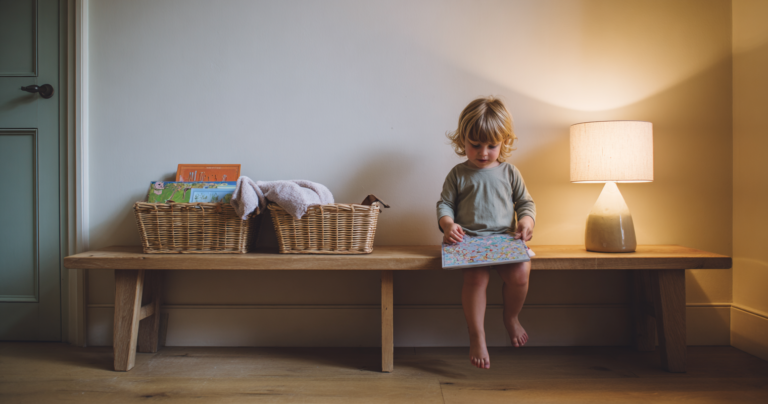
Late afternoon. The wooden animals. The word she’s been turning over in her mind since yesterday.
What to say when the word won’t come
None of these are formulas. They’re orientations — small ways of positioning yourself in relation to your child’s effort. Some will land every time. Some will miss. All of them are better than silence that feels like pressure, or words that arrive before the child is ready.
Wait longer than feels comfortable
Not a technique — a discipline. The instinct to fill silence is strong and loving. But most of us fill it about four seconds too early. The pause that feels long to you often feels just right to a toddler in the middle of searching.
What this sounds like [nothing — hold the silence, keep your face warm and open]Name what you see them reaching for
If they’re pointing at the dog, you can acknowledge the reaching without supplying the destination. This confirms you’re paying attention without short-circuiting the search.
Try saying “You’re trying to tell me something about that, aren’t you.”Offer the first sound, not the whole word
A partial sound gives the child something to push off from without removing the work entirely. It’s the difference between lifting someone over a wall and placing your hand so they can climb.
Try saying “Starts with a… d…”Say the word naturally — without fanfare
When a child has genuinely exhausted their search and looks to you, give the word quietly. Not as a lesson. Not “the word is dog.” Just: use it in a sentence, let it land softly, and move on. The lack of ceremony is part of what makes it stick.
Try saying “Oh, the dog. Yes — he’s right there by the window.”Repeat back what they said, gently corrected
If they produce an approximation — dah for dog — you don’t need to correct them directly. You can just reflect the word back in its correct form, warmly, as part of your response. This is called an expansion, and it works without the child feeling wrong.
Try saying “Yes! Dog. Big dog.”Add one more word to what they give you
Whatever they manage — a point, a sound, an approximate word — take it and add one thing. Not a full sentence. Not a lecture. Just: one small extension that models where the language can go next.
Try saying “Dog running.” or “Big dog.” or “Soft dog.”Let it be enough for now
Sometimes the word doesn’t come. The child moves on. The moment closes without resolution. This is fine — more than fine. The reaching was the thing. The reaching always counts, even when it doesn’t land anywhere visible today.
What this sounds like “That’s okay. You’ll have it next time.”Children learn words in the direction of the people who wait for them.
When it happens every day and it still feels hard
If you’ve been doing this for a while — watching your child reach and miss, waiting, expanding, waiting again — and some days it feels like nothing is landing, that’s normal. Language development is rarely visible in the moment it happens. It tends to surface three weeks later, at dinner, when a word appears out of nowhere and your child says it like they’ve always known it.
They have always known it. You gave it to them, quietly, on a different afternoon. It just took this long to settle.
Worth keeping
“Every time you wait instead of filling the silence, you teach your child that their search is worth finishing.”
Save this for the moments when the silence feels too long. It rarely is.
Language prompt cards for everyday moments
Seven small prompts — one for each situation in this article. Printed and kept where you actually are.
Sent once. Nothing else unless you want it.