
How To Build A Language-Rich Home
It doesn’t require special toys, dedicated lesson time, or a redesigned living room. Here’s what it actually means — and what it looks like in a real family’s day.
“Language-rich environment” is one of those phrases that sounds straightforward until you start wondering what it actually means for your home, your routine, and your particular child. Does it mean more books? Flashcards? Structured talking time? Signing up for something?
It means none of those things, exactly. A language-rich home is built out of the ordinary moments you’re already living — it just involves being intentional about how language moves through them.
First: what it’s not
It helps to clear away a few common misconceptions, because they tend to create unnecessary pressure.
A language-rich home has a lot of educational toys, labeled shelves, and structured learning activities.
The environment matters far less than the interactions inside it. An ordinary kitchen can be more language-rich than a room full of educational materials.
You need to spend dedicated time “doing language” with your toddler every day.
Language develops through thousands of brief, natural exchanges woven into your day — not scheduled sessions.
You need to talk constantly, narrate everything, and never have a quiet moment.
Quality and responsiveness matter more than quantity. Listening is as important as talking.
A language-rich home means your toddler will speak early and speak a lot.
The goal is to build the foundation — comprehension, vocabulary, confidence in communicating — which unfolds at every child’s own pace.
What it actually means
A language-rich home is one where your child is immersed in words that connect to real things — objects they can touch, feelings they’re having, events they’re watching unfold. Where their attempts to communicate are received and responded to consistently. And where language is woven into your existing rhythms, not added on top of them.
That’s it. The three elements are: connection to real experience, responsive communication, and natural integration into daily life.
“The richest language environment is one where the child feels safe to try, and where trying always gets a response.”
The four areas of your home that matter most
Instead of thinking about your whole home as one project, focus on four areas where language naturally lives. In each one, there are small, concrete things you can do.
- Name foods as you prepare them — color, texture, smell, what it does (“this is an onion — it’s sharp and it makes your eyes water”)
- Let your toddler watch what you’re doing and narrate your actions simply as you cook
- Give them simple jobs: hand me the spoon, put this in the bowl, stir this slowly
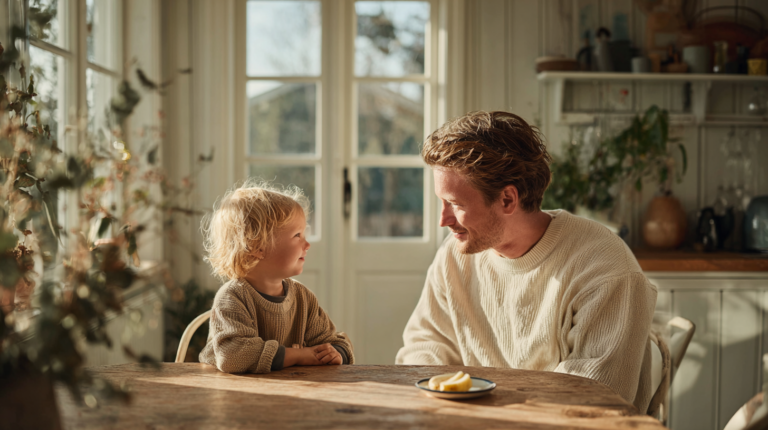
- Mealtimes are conversation time — no screens, just talking about the day, what you’re eating, what you notice
- Ask questions with actual answers: “do you want more?” “which cup?” “is it hot or cold?”
- Rotate books regularly — a small, visible selection beats a large hidden collection
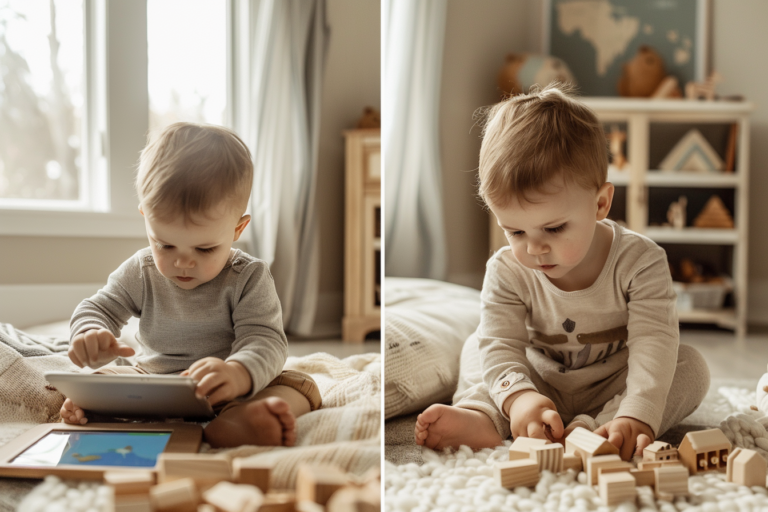
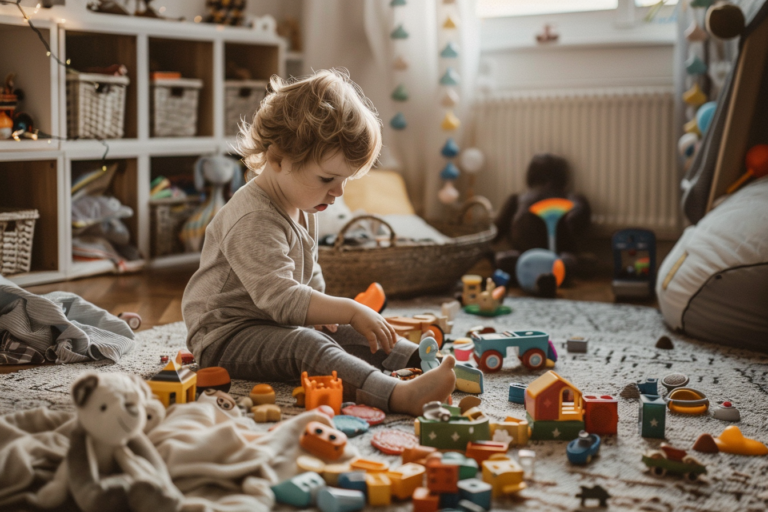
- Keep one or two baskets of open-ended toys accessible: blocks, a few figures, cloth pieces, simple containers
- When you sit with your child during play, follow their lead and narrate what they’re doing (“you’re stacking the blue one on top”)
- When you read, slow down — ask “what’s that?” and wait, point at details, let them respond however they can
- Label objects naturally in conversation — not on sticky notes, but in use
- Say the same words in the same order for the same tasks — repetition is how toddlers learn words
- Name body parts during dressing and bathing — every time, simply, without pressure
- Narrate what’s about to happen: “now we’re washing your hair — water is going on your head”
- Use sequencing words naturally: first, then, next, after — these build language structure over time
- Bedtime reading is one of your most consistent language windows — protect it even when it’s short
- On walks, name what you see — trees, dogs, cars, people — without quizzing
- Let your toddler set the pace and follow their attention (“you’re looking at that dog — it’s big and brown”)
- At the grocery store, name foods, colors, and what they’re for — simple participation, not a lesson
- Describe sensory experiences: cold, rough, loud, soft — the more specific the word, the better
- Talk about other people: “that man is running — he looks like he’s in a hurry”
The one habit that ties it all together
Of all the things that make a home language-rich, one habit matters more than any other: responding.
When your toddler makes a sound, points at something, babbles in your direction, reaches toward you, or makes any gesture that looks like communication — respond. Consistently. Not perfectly, not elaborately, but consistently.
“You want up? Okay, up you go.” “You’re pointing at the bird. Yes — that’s a bird, a big bird.” “You said something — I didn’t quite get it. Show me?”
This means that a home where a parent is tired, occasionally distracted, and imperfect but genuinely responsive is more language-rich than a home with expensive materials and scheduled activities but few real exchanges.
How to start — if this feels like a lot
It doesn’t have to be built all at once. Pick one area of your home or one time of day and make it more intentional. The rest will follow naturally as it becomes habit.
- Start with mealtimes. Turn off screens, sit together, and talk about what you’re eating and what happened today. Even ten minutes of this daily adds up significantly over weeks.
- Make one daily routine more language-rich. Choose bath time, getting dressed, or the walk to the car. Narrate it simply, every time, for two weeks. The repetition alone builds vocabulary.
- Slow down book time. Read one book per day, but read it slowly — with pauses, questions, and responses to whatever your child does. This matters more than reading many books quickly.
- Practice the pause. After you say something or ask a question, wait five seconds before moving on. This one shift can change the quality of your interactions significantly.
- Respond to everything. For one full day, try to respond to every communicative attempt — babble, gesture, point, sound. Notice what changes.
Most families find that once they start paying attention, they’re doing more of this than they realized. The goal of this kind of intentionality isn’t to start from scratch — it’s to make visible what’s already working, and gently fill in the gaps.
What to do when it doesn’t feel natural
Some people are natural narrators — they talk easily while moving through their day. Others find it stilted, awkward, almost performative. If that’s you, start smaller. You don’t need running commentary. You just need a few genuine exchanges at the right moments.
Find the moments in your day when you’re naturally at your child’s level — bathtime, reading, putting on shoes — and focus your energy there. Quality interactions in two or three daily windows are enough to build a language-rich foundation.
Want a practical starting point?
Our Toddler Language Cards support exactly this kind of natural daily interaction — forty language situations, Montessori-inspired, designed to live in your everyday routines rather than replace them.
See the Language Card Set →