
9 mistakes that slow toddler language growth
Most of them come from love. None of them are hard to change.
Nobody teaches a toddler language by doing it wrong on purpose. The mistakes in this list are the ones that happen in ordinary loving homes — because someone was trying to help, or was exhausted, or just didn’t know. That’s worth saying plainly before anything else.
But some of the most common things parents do — things that feel instinctively kind or efficient — quietly slow the process down. The child still learns. Language still comes. It just comes more slowly, and with less confidence, than it might have.
These nine patterns are the ones that appear most consistently in the research, and in homes. Recognising them is most of the work. The adjustment, in most cases, is small.
“The most common language mistakes aren’t made by inattentive parents. They’re made by attentive ones moving too fast.”
Chichiberry Parenting
How to read this without feeling guilty
Every parent on this list has done most of these things this week. Probably today. The point of naming them isn’t to add to the weight of parenting — it’s to make visible something that usually stays invisible, which is how ordinary adult behaviour shapes a child’s language environment without anyone intending it to.
Read it as you would a field guide, not a report card. The question isn’t whether you’ve made these mistakes. It’s whether, having named them, you can notice them more easily — and sometimes choose differently.
A mistake you can name is no longer a pattern you’re trapped in. It becomes a choice.
A Montessori shelf in the early afternoon. The objects are the same ones from yesterday. The child always returns to the heavy cylinder first.
What to watch for — and what to try instead
Each of these is common, each is correctable, and each comes with a small reorientation — not a script, but a direction.
Finishing their sentences
When a toddler pauses mid-thought and reaches for a word, the loving impulse is to supply it. The child wanted dog and you said dog and the moment continued. But the gap was where the work was. Each time you close it, you reduce the child’s practice at retrieval — the most essential language skill of all.
Asking too many questions at once
Two questions in one breath is already too many for a toddler. “Did you have a good day? What did you do? Did you play with Mia?” — by the time you finish, the child has lost the thread of each one. Questions asked in sequence don’t stack up as input. They cancel each other out.
Correcting pronunciation directly
A child who says pasghetti is not making an error — they are producing the closest sound their motor system can currently manage. Direct correction (“no, it’s spaghetti”) rarely helps and sometimes increases self-consciousness around speaking. A child who begins to monitor their own speech too early speaks less freely, which is the opposite of what language development needs.
Speaking about the child rather than to them
In a room with another adult, it becomes natural to describe the child rather than address them. “She’s tired, that’s why she’s doing that.” The child hears this and understands more than we expect. Speaking around a child — particularly in interpretive or limiting terms — shapes how they understand themselves before they have the language to push back.
Simplifying too far — or not enough
Toddlers can handle more vocabulary than most parents offer them. The instinct to use simple words protects against overwhelm but can also create a language ceiling — a ceiling they absorb and begin to replicate. Conversely, using language pitched several years above the child creates confusion without the scaffolding needed to make sense of it.
Mistakes six through nine tend to feel more structural — less about individual moments and more about the shape of the language environment you create over time. They’re slower to notice and slower to change, but they carry more weight.
Underestimating what they understand
Comprehension develops six to twelve months ahead of production. The toddler who speaks thirty words almost certainly understands three hundred. Speaking to a child as if their understanding matches their output means the richest language input — the kind that accelerates acquisition — never reaches them.
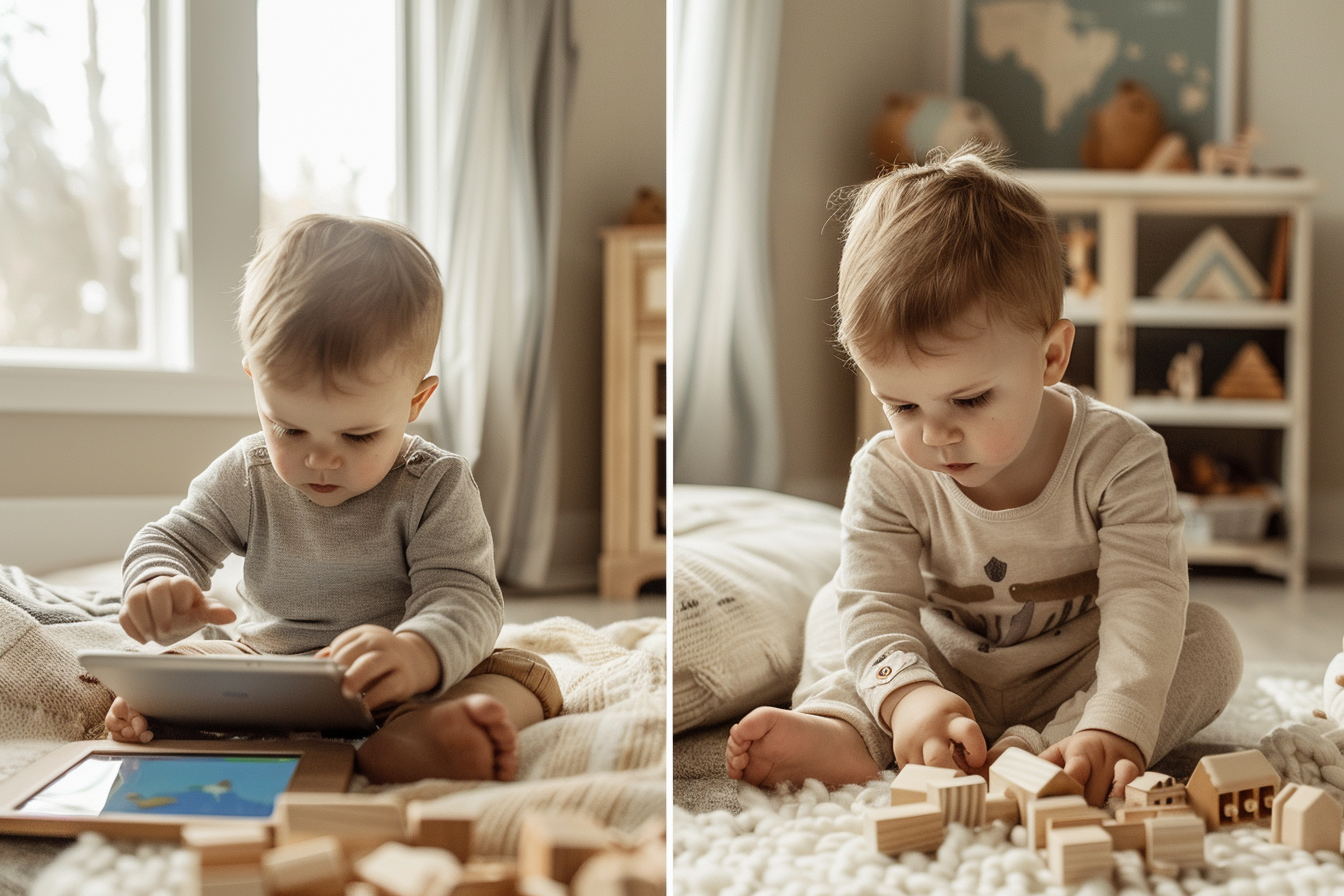
Letting screens carry the language load
Language learning requires contingency — the back-and-forth rhythm of communication where a child’s signal produces a human response that adjusts to them specifically. Screen language is non-contingent. It speaks to everyone and no one. It cannot pause when the child looks confused. It cannot repeat only the word they almost had. Human interaction, even imperfect and distracted, does all of this automatically.
Rushing transitions without language
Transitions — the space between one activity and another — are among the richest moments for language. A child moving from play to lunch, from inside to outside, from waking to dressed, is navigating a small world of change. When transitions happen in silence or urgency, that opportunity closes. When they’re narrated calmly, the child builds both vocabulary and the cognitive map of sequenced time.
Treating silence as failure
When a child doesn’t respond to a question, the impulse is to re-ask, rephrase, or fill the void. But silence after a question is rarely emptiness — it is often processing. A child who is given ten seconds of genuine quiet may produce something far richer than the child who was offered only three before the adult started again. The silence is doing something. Let it.
The silence after a question is rarely empty. It is usually the busiest moment in the room.
What to do with this list
Don’t try to fix all nine. Pick the one that felt most familiar — the one you recognised most quickly, the one that made you think of a specific moment from last week. Work with that one. Notice it. Let it become visible without turning it into a source of shame.
Language development is slow and patient work. It responds to accumulation, not perfection. One small adjustment, held lightly, over many ordinary days, is almost always enough to shift the pattern.
Worth saving
“You don’t have to stop doing all nine things. You just have to notice one — and choose, sometimes, to do it differently.”
Save this for the days when the list feels long. The work is smaller than it looks.
The quiet language prompt cards
One small reorientation for each of the nine patterns. Printed, folded, kept somewhere you’ll actually see it.
Sent once. No inbox clutter. Just the cards.
More for this season
A few more quiet things.
Language development
7 things to say when your toddler can’t find the word
Read →
Montessori at home
A simple Montessori language routine for ordinary days
Read →
Daily routines
What to say during the morning rush — when you have 90 seconds
Read →
Stay nearby.
Occasional resources and quiet observations for parents who pay attention to the small things.
Chichiberry Parenting — Connection over instruction. Presence over perfection.