
Toddler Language · Everyday Routines
What to Say to Your Toddler During Everyday Routines
Socks, spoons, blocks, bath water. The ordinary parts of the day already give you places to talk, and places to listen.
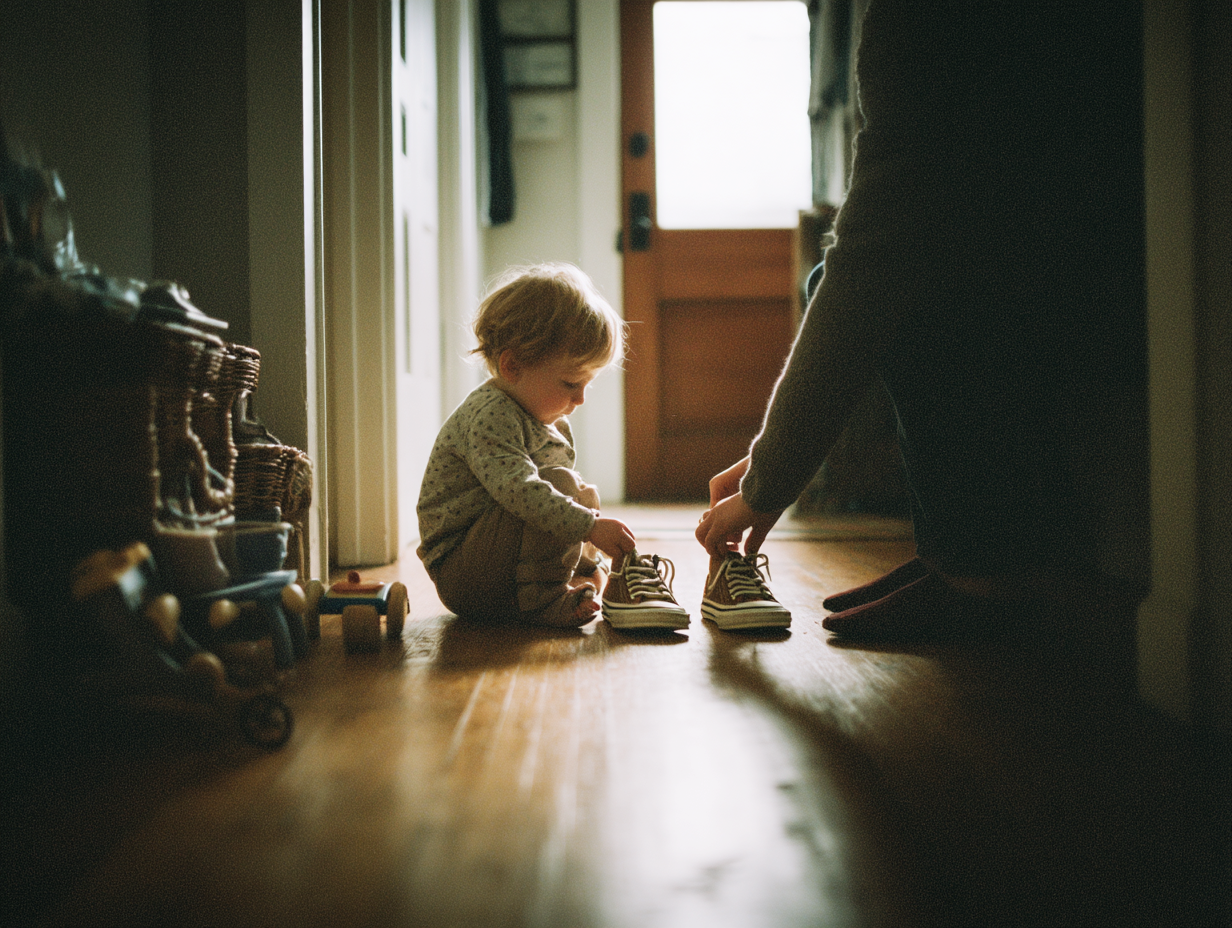
It’s 7:40. The bag is packed, the shoes are by the door, and one sock is missing. Your toddler is sitting on the hallway floor holding the other one, turning it over slowly as if they’ve never seen it before. You are thinking about the time. They are thinking about the sock.
Most of the talking we do with toddlers happens in moments like this: not during a planned activity, but in the middle of getting somewhere. It can feel as though there’s only room for “Come on, shoes on.”
But often there is room for one small thing. “You found a sock. Where’s the other one?” Then a pause, long enough for your child to look around, point, or wander off to check under the chair.
This guide gathers that kind of language for six routines that happen in most homes every day: getting dressed, meals, cleanup, leaving the house, bath time, and bedtime. There’s no script to memorize, just natural things to say and ways to answer whatever your child gives back.
Start with what your toddler notices
Underneath every example here is one small pattern. It isn’t a rule for every moment of the day.
-
Notice
What is your child looking at, holding, or reaching for right now?
-
Say
One short, relevant thing about it. A comment you might make anyway, not a question to test them.
-
Pause
Wait a few seconds. The pause is an invitation, not a demand to perform.
-
Respond
Answer whatever comes back: a word, a sound, a point, a look, or an action.
Here’s how that might sound on an ordinary morning.
You“A blue sock. You found it.”
You wait. Your toddler points to their foot.Toddler“Boo.”
You“Blue. On your foot? Okay, blue sock on.”
Nobody was asked to repeat anything. The point and the “boo” were answered as real parts of the conversation.
Getting dressed
Getting dressed is full of small, physical problems: a sleeve that won’t let go of an arm, a head stuck halfway through a shirt, a sock that has disappeared. It’s also a common place for toddlers to insist on doing things themselves, often on the mornings you’re running late.
You might say- “One sock is on. Where’s the other one?”Describes what’s happening and leaves space for them to look.
- “You want to try first. I’m here if you need help.”Invites them to take part.
- “You pulled the sleeve. Your hand came out!”Responds to what they just did.
If your toddler… tugs at their shirt and says “Me!”, you can step back a little: “You’re doing it. Arm in.” If they get stuck and look up at you, that look is the request. “Stuck? I’ll hold the bottom. You push.”
When time is short, do most of the dressing yourself and save “you try” for one item, such as the hat or a shoe with a strap.
Mealtime
At the table, toddlers are busy. They squish, drop, reach, taste, and watch what’s on your plate. There’s plenty to talk about without turning the meal into a quiz about colors or a negotiation over bites.
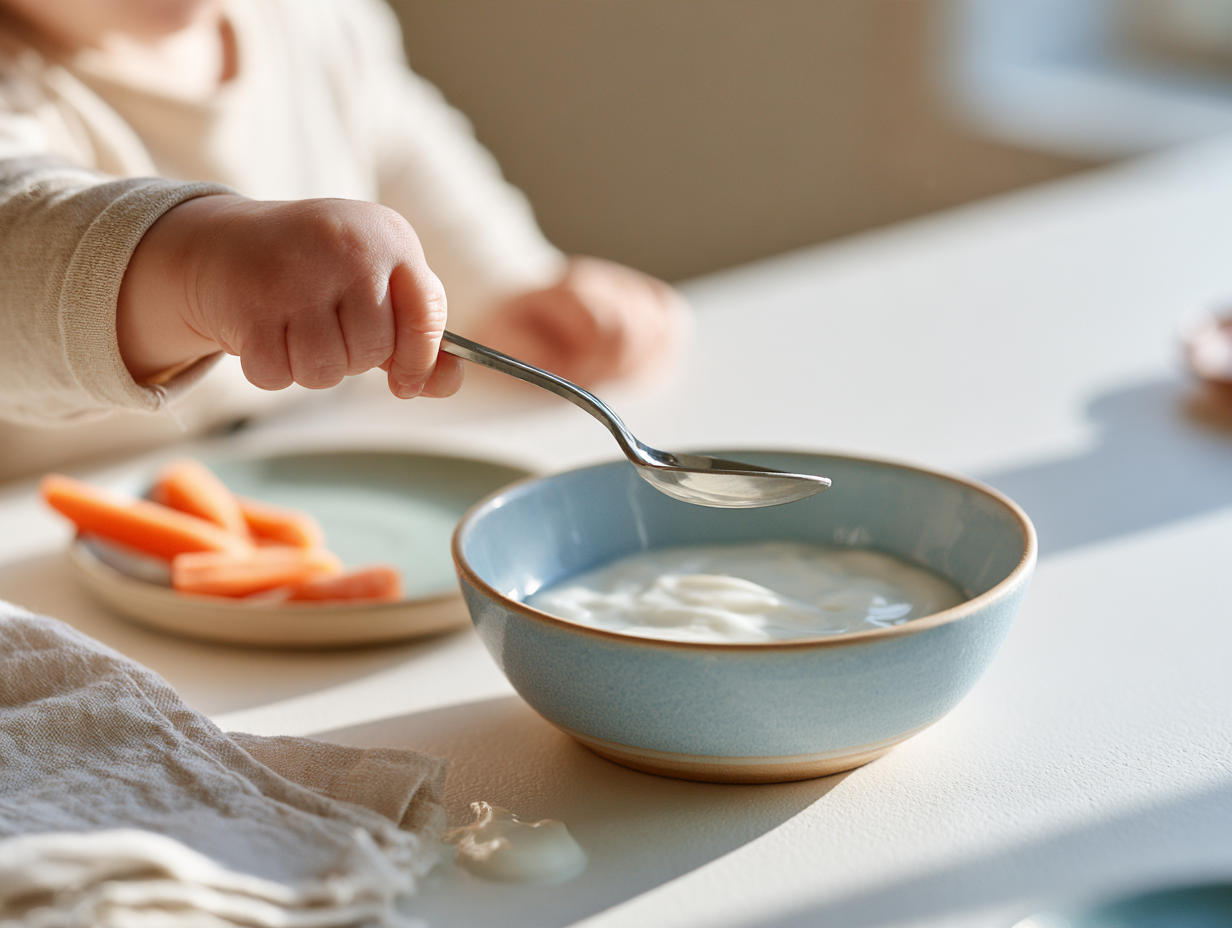
- “That carrot made a crunch.”Describes something they just noticed too.
- “You’re pointing to the yogurt. More yogurt?”Puts words to a request and lets them confirm it.
- “Oh, that was sour. You scrunched up your nose.”Responds to their expression.
If your toddler… pushes the plate away, you can name it simply: “All done with the peas.” The push was a clear message, and you can answer it without adding “just one more bite.”
A comment here and there is plenty; the meal doesn’t need running commentary. The same phrases work for a snack in the car or at the park.
Cleanup
Blocks across the floor, a basket nearby, and a toddler who may or may not be interested in putting anything away. Cleanup can go more smoothly as something you do together than as an instruction from across the room.
How it might goYou“The blocks go in this basket.”Describes the shared job.
You“I put one in. Your turn.”Invites them to join.
Your toddler finds a block under the sofa and holds it up.You“You found another one. In it goes.”Responds to what they did.

If your toddler… tips the whole basket back out, that may be part of the fun: filling and emptying can be absorbing. You might say “All out! Now back in” and keep going for a few more, or decide that most of the blocks is enough for today.
Aim for side by side rather than finished. Some days you’ll put away twenty blocks and they’ll put away two.
A response doesn’t have to be a word
Sometimes you say something, pause, and nothing seems to come back. Before asking again, look at what your child is doing. A response can be easy to miss: a glance at the thing you mentioned, a point, a sound, a shake of the head, or carrying a shoe over to you.
Those count. You can answer them the same way you’d answer a word:
- They look at their cup. “Yes, that’s your cup.”
- They reach for the banana and make a sound. “Banana. You want the banana.”
- They bring their shoe to the door. “You brought your shoe. We’re going outside.”
Repeated requests to “say it” can make the exchange feel like a test. You can offer the word naturally and leave room for a response.
If you have questions about how your child is communicating, whether that’s understanding, sounds, gestures, or words, your pediatrician or a speech-language pathologist can look at the whole picture. The ideas here are for everyday life, not a substitute for that conversation.
Leaving home and other transitions
You have your keys and the bag. Your toddler is kneeling at the window watching a garbage truck, or deep in a game of lining up cars. From where they sit, nothing about this moment says it’s time to go.
You might say- “You want to finish looking at the truck. One more look, then it’s time to go.”Acknowledges their attention and says what happens next.
- “Your car can come with us, or it can wait on the shelf.”Offers a real choice inside the transition.
- “You waved. Bye, truck. Now, shoes.”Responds to what they did and moves one step on.
If your toddler… still cries when it’s time to leave, keep it short and warm: “You didn’t want to stop watching. It’s hard to leave the truck.” Then carry on with the next step together. A warning can help, but it won’t prevent every protest.
Give the one-more-look warning while you’re still finding your keys, so there’s a little room before you reach the door.
Bath time
The bath is full of things to notice: warm water, dripping hands, bubbles that vanish, a cup that fills and empties again and again. Short words fit well here, said alongside whatever your child is doing.
You might say- “The water is running over your hand. Drip, drip.”Describes what they can feel and see.
- “Your cup is empty. Fill it up again?”Invites the next pour.
- “You poured it all out. Splash!”Responds to what just happened.
If your toddler… pours the same cup twenty times, you don’t need something new each time. “Full… pour… empty,” said as it happens, is plenty.
On tired evenings, keep the talk light. Sit close, within arm’s reach, and let them play.
Bedtime
By bedtime, most toddlers, and most parents, have less left to give. This is a place for fewer words, a lower voice, and things said the same way each night.
You might say- “Book back on the shelf. Night-night, book.”Describes the small tidy-up that closes the day.
- “The bear book or the moon book?”Offers one easy choice.
- “The moon book again. I like that one too.”Responds to their choice.

If your toddler… wants the same book every night, that familiarity may be part of the appeal. You might leave a gap before a word they know, or let them point to the picture before you turn the page. There’s no need to ask what’s on every page.
“Night-night. I’ll see you in the morning.”
Save new questions for daytime. At night, keep to the same few quiet words.
What to say when the routine gets hard
Some days the routine won’t go smoothly, and no phrase will change that. What words can do is help you stay steady: say what you see from your child’s side, say what happens next, and offer help that fits the moment.
When they don’t want to put on shoes
- What happened
- It’s time to leave. Your toddler sees the shoes, says “No!” and walks the other way.
- What you might say
- “You don’t want shoes on right now. We’re going outside, and feet need shoes. Do you want to sit on the step or on my lap?”
- What to notice next
- Did the small choice give them somewhere to go? Some toddlers settle once they can decide one thing. Others need a moment. If they’re still upset, you can help with the shoes calmly and keep talking about where you’re going.
When they want to do it themselves and you’re short on time
- What happened
- Your toddler wants to zip their own coat. You have five minutes, and the zipper could take ten.
- What you might say
- “You want to zip it yourself. We need to be quick today, so I’ll start it and you pull it up.”
- What to notice next
- Did they still get a real part of the job? Sharing the task can keep things calmer. If they’re very disappointed, you can name it, “You really wanted to do it all,” and offer another try later, when nobody is rushing.
Choose just one moment tomorrow
Start small:
- Pick one routine that already happens every day. Breakfast, the bath, putting on shoes. Choose whichever usually feels least rushed.
- Use one or two natural phrases about what your child is focused on. Say them the way you’d say anything else to them.
- Pause, and notice how your child responds. A look, a sound, a word, a turn of the head. Answer that, and adjust from there.
You don’t have to fill the day with words. Most of what matters is already happening in small exchanges: a sock handed over, a spoon pointed at, the same book chosen for the fourth night in a row. Say one thing, wait a moment, and see what comes back. Then answer it.