What To Say To Your Toddler At Mealtime
12 gentle phrases that build language, body awareness, and calm at the table — without pressure, negotiations, or the word “bite”

Dinner is ready. You’ve put something on your toddler’s plate that isn’t pasta or the two foods they have eaten reliably since October. They look at it. They look at you. They push it to the edge of the plate and announce — with the confidence of someone who has made a very considered decision — “No.”
And you say what most parents say in this moment: “Just take one bite.” Or you say nothing and quietly accept that tonight will be a bread night.
Neither of these responses is wrong, exactly. But they don’t quite help. And over many meals, many negotiations about what counts as a bite — the table starts to feel like a place of low-grade tension. For your toddler, for you, sometimes for everyone eating with you.
What if the issue isn’t the food, and it isn’t the toddler — but the language around the food?
This article offers twelve phrases that work differently at mealtimes. Not scripts designed to trick a toddler into eating more. Not techniques from a feeding manual. Just words that tend to keep the table calmer, give your child more agency, and quietly build language, body awareness, and food confidence over time — dinner by ordinary dinner.
Mealtime is not just about getting food into a toddler. It is one of the ordinary places where toddlers learn language, how family life feels, and that their body’s signals are worth listening to.
Mealtime isn’t just about eating
A toddler sitting at the dinner table is doing a remarkable number of things that have nothing to do with calories. They are noticing textures. They are smelling something unfamiliar and running it through whatever classification system their brain has built so far. They are deciding whether this moment feels safe, whether you seem calm or tense, whether they are allowed to say no without something unpleasant following.
They are also learning the words for what their body is doing. “More” and “all done” are among the first communicative phrases many toddlers acquire precisely because they arise so reliably, in such high-stakes moments. “Hot.” “Crunchy.” “Not yet.” These are real vocabulary items, acquired in context, through repeated experience at the table.
And they are learning how family life feels. The rhythm of sitting down together, who passes what to whom, when the meal ends — all of this is becoming familiar, becoming home. That belonging matters enormously to a young child, even when they spend most of the meal moving food around the plate.
Understanding this changes what feels like a failed mealtime. A toddler who described a new vegetable as “slimy” in a tone of extreme suspicion and then ate only bread still had a mealtime experience. The vocabulary. The sensory encounter. The fact that the vegetable appeared and nobody made them eat it. These accumulate.
“Toddlers learn about food through presence long before they learn through eating. The food on the plate is doing something even when it goes untouched.”
Language is one of the most direct tools parents have for shaping what that accumulation feels like. Not to control what a child eats — language can’t reliably do that — but to shape whether the table feels like a place of curiosity or confrontation, of ordinary family rhythm or nightly negotiation.
What helps most isn’t more pressure — it’s better language
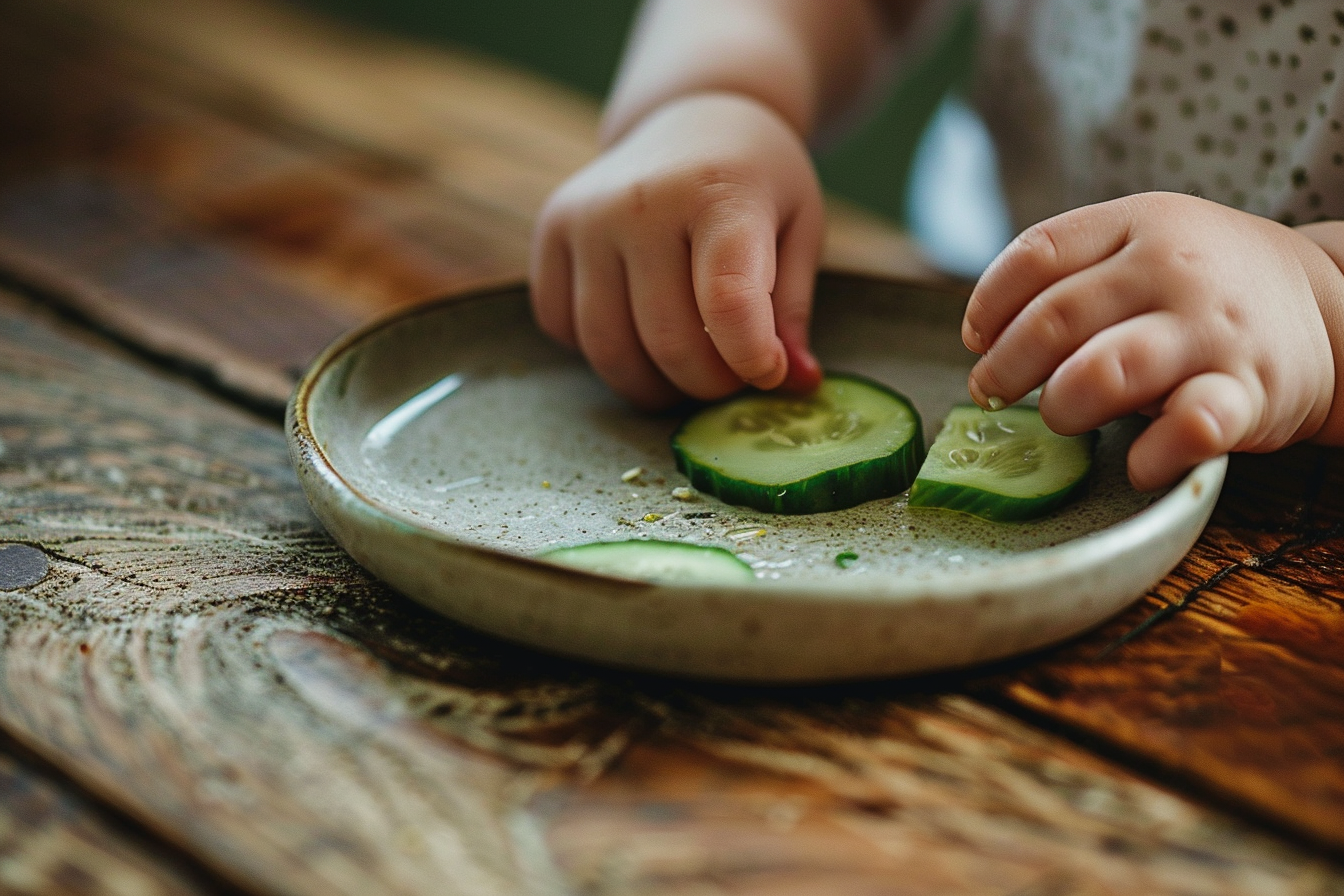
“Just take one bite.” This phrase has been offered to generations of toddlers with the best intentions. The reasoning is sound: exposure leads to familiarity, familiarity leads to acceptance, and surely a single bite is not too much to ask. But it often makes things worse — in a specific and predictable way.
When we ask a toddler to take one bite, we put a spotlight directly on them. The food that was previously just sitting on the plate has become the subject of a negotiation, a test. The toddler now knows that their response to this food is being watched. For a child already ambivalent about a new texture or a strange smell, that kind of focused attention usually increases resistance rather than lowering it.
There is also the matter of toddler autonomy. Between roughly eighteen months and three years, children are deeply invested in asserting their own will. “No” is practice for self-determination. When we pressure a toddler to eat, we’re asking them to override a strong developmental drive. Many resist simply because the request itself feels like a removal of choice.
None of this means parents should be passive at mealtimes. It means the most effective mealtime language tends to be descriptive rather than directive, open rather than pressuring, and patient enough to let a toddler move toward food in their own time. The phrases below are designed to give you practical, usable alternatives — words you can actually say at a real dinner, in the middle of everything else mealtimes involve.
A toddler who feels watched tends to resist more. A toddler who feels free to explore tends to approach. The goal of mealtime language is not persuasion — it is a lower temperature at the table.
12 gentle phrases to use at mealtime
These phrases are not magic. A toddler who is tired, overwhelmed, or firmly in a “safe food only” phase is not going to suddenly eat broccoli because of the words you choose. What they do is reduce friction, build vocabulary, and keep the relational temperature between you and your child steady — across hundreds of ordinary dinners. Read through them once first. Use the ones that fit your voice.
Use this as soon as a new or refused food appears on the plate — before any tension has started. It communicates, plainly and immediately, that eating is not the goal right now. Looking is enough.
Toddlers who are given this kind of permission often find curiosity creeping in on its own. They reach out to touch the food, smell it, poke it with a fork — without being asked to do any of those things. The invitation asks nothing, and that is precisely what makes it work.
Instead of food being pushed off the plate, thrown, or becoming the center of a standoff — it goes to a designated corner. The toddler has somewhere to put it that isn’t “gone” and isn’t “in their mouth.”
The language here is deliberate. “Not right now” is different from “don’t like” or “yucky” or “hate it.” It keeps the door open. It treats reluctance as a temporary state rather than a permanent verdict — which prevents the “I don’t eat vegetables” self-concept from forming quite so early.
Use this when a toddler is already interacting with a food — touching it, staring at it with intense concentration, turning it slowly on their fork. You’re inviting them to name what they’re noticing, which shifts the frame from “will you eat it” to “what do you observe about it.” These are very different questions. The first requires a decision. The second requires only attention — something toddlers do naturally and genuinely enjoy.
Texture and temperature words built here (crunchy, slippery, warm, squishy) extend far beyond mealtime. They become part of how a child describes the world.
Use this when a toddler has tried something, reacted strongly, and is communicating clearly that this food is not for them today. It validates what they’re experiencing and puts language on a body signal they don’t yet have words for.
Toddlers are just beginning to notice signals from inside the body. Naming those signals out loud — “your mouth is telling you something” — is genuinely developmental. It also avoids turning a sensory reaction into a moral one. The food isn’t bad. The toddler isn’t bad. Their mouth is just not ready yet.
This offers a ladder of engagement — from the most gentle (smell) to the most committed (bite) — and gives the child the choice of which rung to stand on. It is an invitation, not a demand.
A child who chooses to smell a food has done something real. A child who chooses to lick it has done more. Neither of these steps looks like eating, but both are genuine progress. Over many meals, this ladder tends to get climbed — slowly, self-directedly, without anyone asking them to hurry.
Use this when adding a food to the plate or when a toddler has initially refused something. The phrase keeps food present and available without attaching any expectation to it. It also introduces something gently interesting: the idea that the body might want something in five minutes that it doesn’t want right now.
This is sometimes surprisingly effective. Toddlers who have definitively refused something often quietly eat it a few minutes later, once the pressure has dissipated and they’ve stopped being observed about it. The phrase creates space for exactly that to happen.
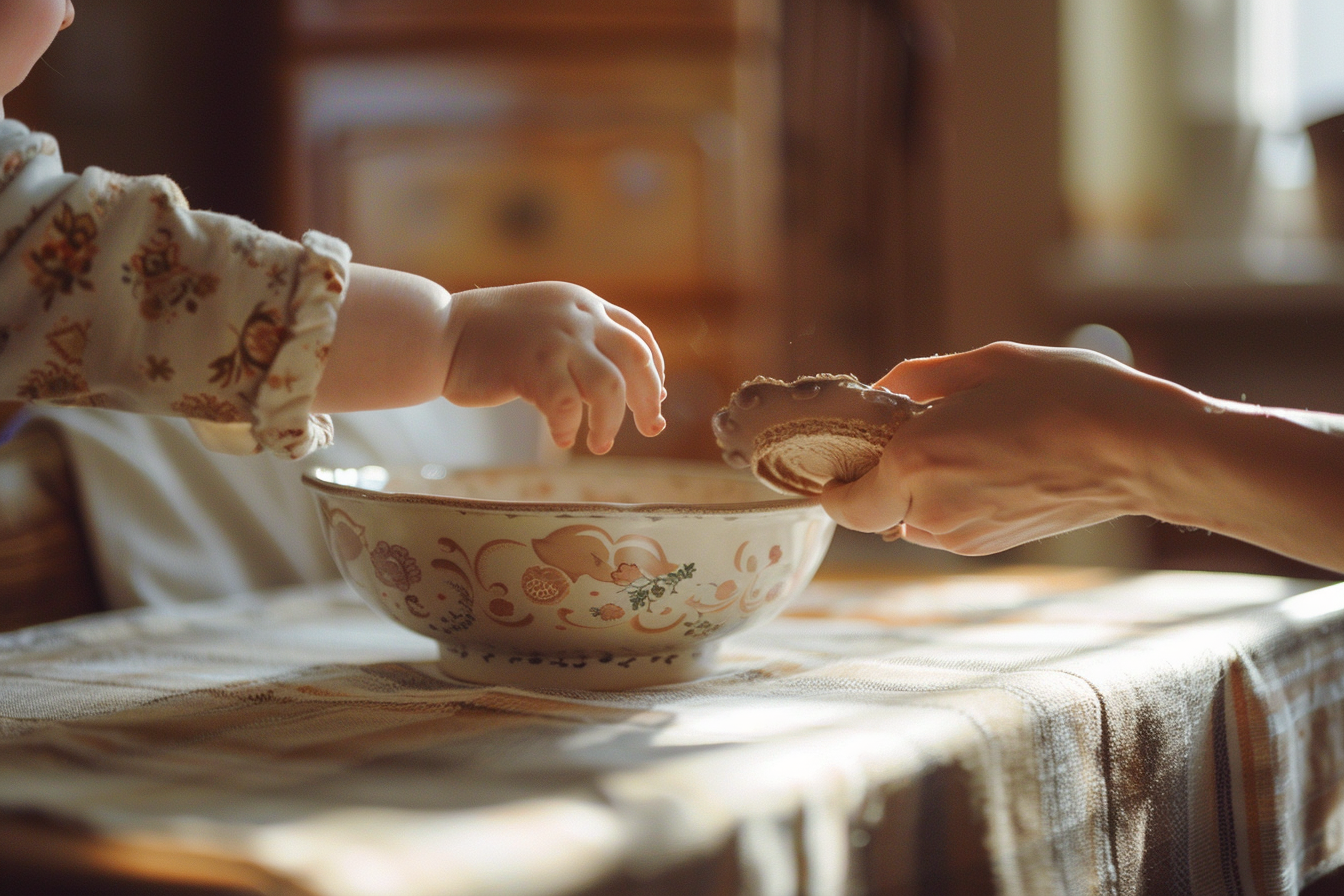
Four words. Use them as a quiet observation — not a correction, not a lesson, just a statement of fact.
Toddlers who are told “you don’t like that” or “you’re a picky eater” often begin to organize their behavior around that identity. “You’re still learning this taste” offers a different self-concept: someone who is growing, who is in the middle of a process that takes time, whose relationship with this food is not yet decided. Across months and years of repeated exposure, that open door makes a difference.
The invitation here is to participate in the meal — to carry, place, pass — not necessarily to eat. But participation changes the relationship between a child and the food in front of them.
A toddler who helped carry the salad bowl to the table has a different kind of familiarity with that salad than one who simply found it on their plate. They touched it. They moved it. They were part of bringing it to the family. This doesn’t guarantee they will eat it — but it is a form of engagement that accumulates, gradually, into something that looks like food confidence.
Use this when a toddler is signaling the end of the meal through behavior — throwing food, climbing down, going slightly limp in the chair. It reflects their communication back to them in words, which is one of the most natural ways to build early expressive vocabulary.
Many toddlers communicate “done” long before they have the word for it. Responding to the behavior with language — rather than ignoring it or pushing back — eventually gives them the vocabulary to tell you directly next time. It also treats the signal as legitimate. The meal ends without drama.
Two sentences doing two different things. The first gives a genuine concession: their preferences are valid, they are not required to like this food. The second holds a simple, enforceable expectation about behavior at the table.
Many mealtime power struggles happen because parents are trying to enforce eating, which they cannot ultimately control, rather than behavior, which they can. Separating those two things — in the same breath — tends to defuse a moment surprisingly quickly.
Say this while eating your own food, as ordinary dinner conversation. Describe what you’re tasting. Then move on to something else. Don’t watch for a reaction.
The moment this becomes a tactic — a deliberate performance — toddlers notice. But said genuinely, as a running commentary on your own meal, it models both the eating and the language without asking anything of them. A trusted adult eating something while describing it in sensory terms is some of the most effective food exposure there is.
Use this at the end of a meal where a new food went untouched — as a matter-of-fact close to the encounter, with no weight attached. The food was there. Nobody was hurt. The meal is over. This will come up again, without drama.
For the parent, this phrase can also be a quiet release. Food acceptance in toddlers often takes ten, fifteen, or twenty separate encounters. “We can try again another day” normalizes that timeline, makes the current refusal neither a failure nor a permanent statement, and keeps tomorrow’s dinner from needing to be the one that finally works.
What to stop saying at mealtime, if you can
Most parents have said all of these at some point. They come from care — wanting a child to eat enough, to try something new, not to leave the table hungry. There is nothing shameful about having said them. But if any have become a nightly feature of dinner, they are worth noticing.
| Instead of saying… | Try… |
|---|---|
| “Just take one bite.” | “You can look at it first. You don’t have to eat it yet.” |
| “You used to like this.” | “You’re still learning this taste.” |
| “Why aren’t you eating?” | “Your body might not be hungry right now. That’s okay.” |
| “Eat for Mommy / Daddy.” | “I’m eating mine too. It tastes a bit like lemon.” |
| “If you eat this, you get dessert.” | “Dessert comes after the meal for everyone.” |
| “Come on, just finish it.” | “You’re telling me you’re all done? Okay.” |
| “Your sister eats it.” | “Different people are learning different tastes.” |
| “That’s yucky? Don’t be silly.” | “Your mouth is telling you ‘not yet.’ That’s okay.” |
None of the alternatives in the right column are guaranteed to immediately improve the meal. What they do over time is lower the temperature at the table, remove the pressure that tends to increase resistance, and keep a toddler’s relationship with food curious rather than adversarial.
A simple mealtime conversation rhythm
If memorizing twelve phrases feels like too much, this three-part rhythm might be easier to hold. It isn’t a script — it’s a loose structure for how mealtime conversation can move. Notice what’s happening. Invite engagement at whatever level the child is ready for. Respect the answer, whatever it is.
- “That sounds really crunchy when you tap it.”
- “You put all the peas in one corner.”
- “The rice is still a bit warm.”
- “You’re looking at that one carefully.”
- “Do you want to smell it first?”
- “Can you help pass this bowl?”
- “Would you like it on this side of the plate?”
- “You can try it or leave it — your choice.”
- “You don’t want it right now. Okay.”
- “Your body is saying all done.”
- “We can try again another day.”
- “That’s the ‘not right now’ side.”
The sequence is loose. Sometimes you’ll go straight to “respect” and the meal ends quickly. Sometimes “notice” opens into a long conversation about whether a food is more orange or more yellow. The framework is not a formula — it’s a way of staying oriented during the inevitable chaos of an actual toddler dinner.
If your toddler is picky at mealtime, start here
A note before the starting points: “picky eating” in toddlers covers a wide range. Mild food selectivity is almost universal in this age group. More significant sensory or feeding concerns do genuinely benefit from professional support — if mealtimes cause regular distress, or you’re worried about growth or nutrition, a conversation with your pediatrician is worthwhile.
For the majority of toddlers who eat a narrow range of foods and treat vegetables with deep suspicion, the starting point is almost always the same: lower the pressure, lengthen the timeline, and stop measuring success by what gets eaten at any individual dinner. If you’re in a particularly difficult stretch, these three phrases tend to do the most to stabilize mealtimes:
- “You can look at it first. You don’t have to eat it yet.”
- “I’m putting some here in case your body wants it later.”
- “We can try again another day.”
These three do something specific together: they keep food present, remove pressure from the current meal, and open a door to the future. Use them consistently for two or three weeks before adding anything else. Consistency in mealtime language — even more than the specific phrases — is what builds familiarity and gradually, calm.
Keep routines predictable where you can. Sit at the same table, at roughly the same time. Offer a familiar food alongside the unfamiliar one. Let the meal end when it needs to end. The goal of any individual dinner with a picky toddler is not “they ate the broccoli.” It is “we sat together, the food was there, the table felt safe, and we’ll do this again tomorrow.”
What these mealtime phrases are really teaching
None of the twelve phrases above are primarily about getting a toddler to eat more food. They are about what happens around eating — the vocabulary being built, the body awareness developing, the emotional safety being established. Here is what is actually accumulating at the table, dinner by dinner, when language like this becomes the norm.
Language
- More, all done, not yet, not right now
- Warm, cold, crunchy, soft, slippery, sour
- Too much, a little, done, later
- Describing sensory experience in words
- Turn-taking in conversation at the table
Body Awareness
- Recognizing and naming hunger and fullness
- My mouth is saying not yet
- This feels too hot / too cold / too sharp
- My body might want this later
- Connecting internal signals to language
Emotional Safety
- I can say no at this table without shame
- Refusing food doesn’t mean I’m in trouble
- New foods can come slowly, on my terms
- Mealtime does not feel like a test
- My preferences are taken seriously
Participation
- I help carry, pass, serve, and set up
- My contribution to the meal is real
- I belong at this table
- The meal is something we do together
- Family rhythms include me
“The toddler who grows up believing their body’s signals are worth noticing — and that the table is a place where those signals are respected — has been given something that lasts far longer than a clean plate.”
What this can sound like in real life
In theory, all of this makes sense. At an actual dinner table, with an actual toddler who has strong opinions about things being the wrong color, it can feel harder. Here is a small scene — imperfect, ordinary, the kind of dinner that happens most evenings — with a few of these phrases in use.
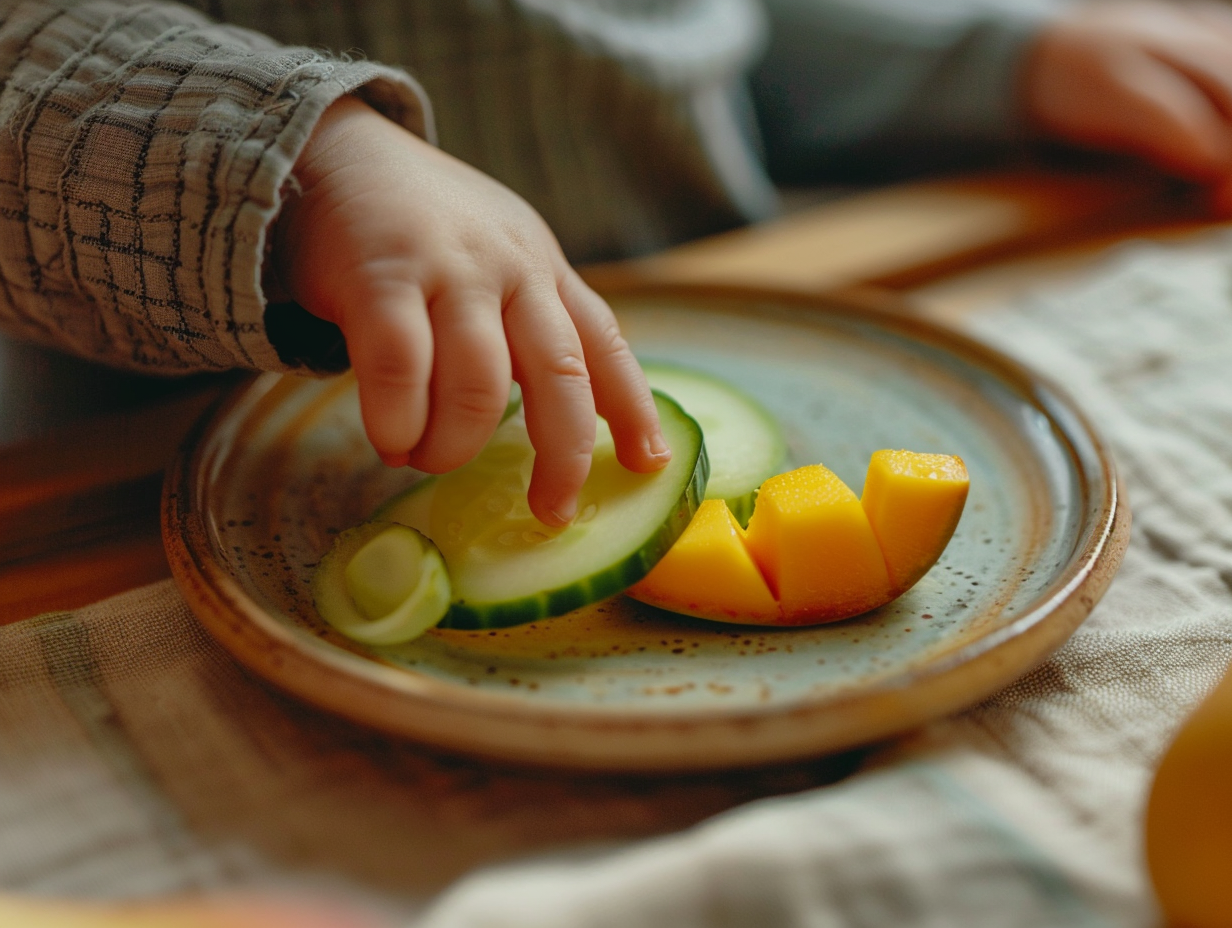
The salmon went uneaten. The cucumber was investigated, named, tapped, and eventually eaten. The toddler said “all done” and was believed. This is a successful mealtime — not because everything was consumed, but because nothing broke.
You don’t need to say all the right things
There is no script that guarantees a calm dinner. There is no phrase that will make a toddler in a difficult sensory phase eat a new food, or sit still for twenty minutes, or respond predictably from one night to the next.
The goal here isn’t a perfect eater. It is a child who returns to the table willing to try again tomorrow — because the table has felt, most of the time, like a place where their preferences were heard, their body was trusted, and something ordinary and good was happening around the food regardless of what they ate.
You are eating together. You are noticing things. You are keeping it calm enough. That is more than enough.
Toddler Mealtime
Phrase Cards
Printable prompt cards for the most common mealtime moments — new food refusal, all-done signals, throwing food, helping at the table, and more. Keep them on the fridge. Glance at them before dinner. You don’t need to memorize anything.
- 12 printable phrase cards for common mealtime scenarios
- Cards for new food refusal and all-done signals
- Sensory language prompts and body-signal phrases
- Notice / Invite / Respect reminder card
- “What to stop saying” quick-reference guide
- Space to note which phrases work for your family

Mealtime Language — Common Questions
Keep the door open without pressure. “You can look at it first — you don’t have to eat it yet” or “I’m putting some here in case your body wants it later” both acknowledge the refusal without making it a confrontation. That’s what keeps mealtimes safe over time.
The “one bite” rule often backfires — when a toddler feels cornered, it creates tension rather than curiosity. Repeated low-pressure exposure, where the food is simply present and never forced, builds familiarity far more reliably than negotiated bites.
Describe new foods as if they’re interesting, not as something your child needs to eat. “This one is really slippery” or “It smells a bit like lemon” keeps curiosity alive. Sensory words — warm, crunchy, cold, soft — give toddlers vocabulary for what they’re already noticing.
Food throwing usually signals the meal is winding down or the child is overwhelmed. A calm, brief response — “You don’t have to like it, but the food stays on the table” — sets a boundary without shaming. Said once, at low energy, it tends to pass quickly.
Yes — mealtime is one of the most language-rich routines in a toddler’s day. Food offers natural vocabulary around textures, temperatures, and preferences, and toddlers practice turn-taking and making requests at the table without even realizing it.
Very common, and rarely permanent. Serve the preferred food alongside other foods without comment, and let familiarity build gradually. Even when a toddler isn’t eating the other foods, they’re seeing them, smelling them, and getting used to their presence — which is how food acceptance actually develops.
Power struggles intensify when too much attention is on whether the child eats. Lower your investment in any single meal, offer small elements of choice, and let your language become descriptive rather than pressuring. When a child feels less observed, they tend to engage more freely.