Practical Life Activities For 2 Year Olds At Home
Simple real-life tasks that build independence, focus, coordination, language, and confidence — using what you already have at home.
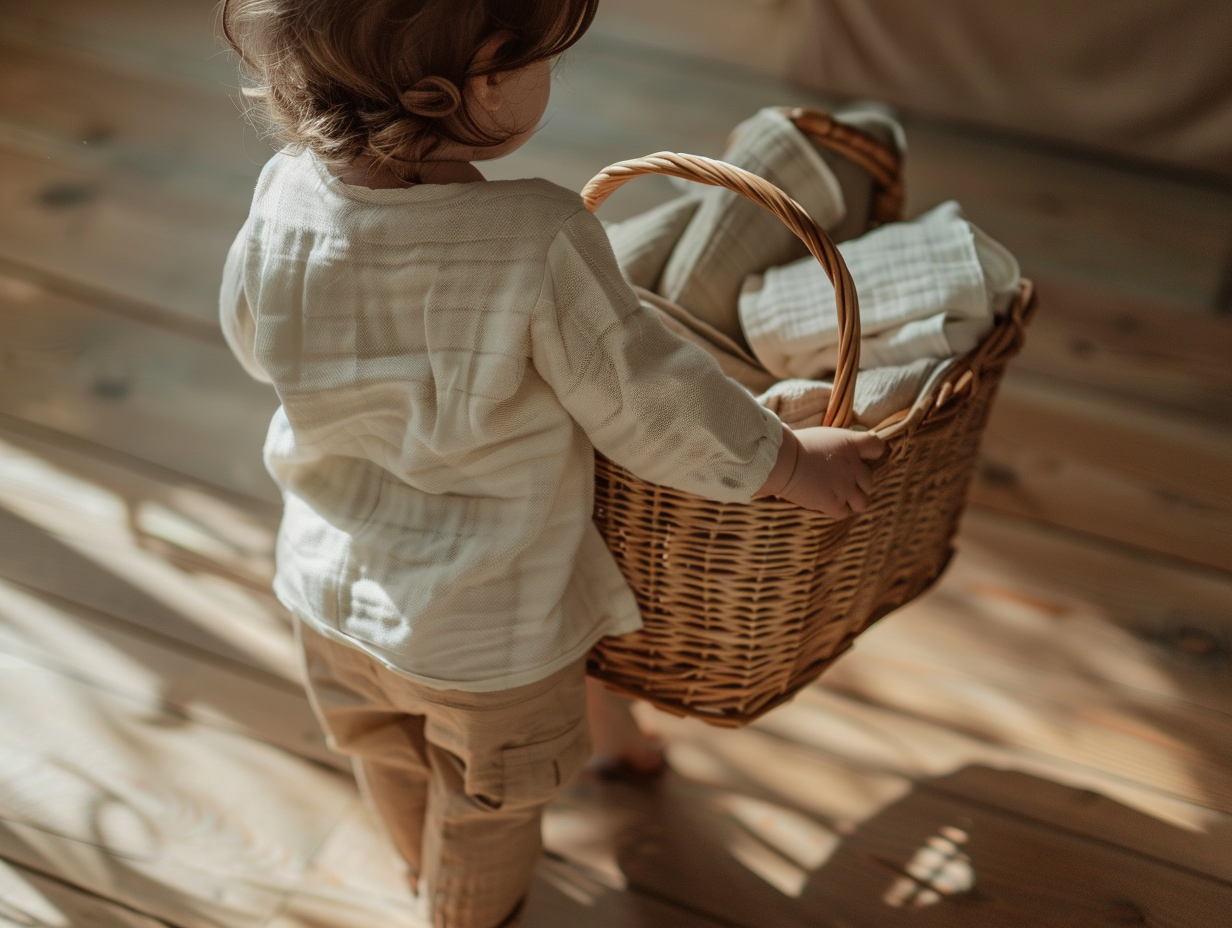
You are unloading groceries. Your two-year-old appears beside you, arms up, wanting to carry something. You hand over the apples and they stagger forward with tremendous seriousness. If you try to take them back, there will be protest. If you let them carry them all the way to the counter, there will be something that looks a lot like pride.
This is not a phase to be managed. This is development asking, clearly and persistently, for participation.
Toddlers do not only want entertainment. They want meaningful participation — to be inside the real work of the household, not watching it happen around them. Practical life gives that instinct somewhere to go.
“Toddlers don’t only want entertainment. They want meaningful participation.”
What Practical Life Means At Age 2
Practical life is a term from Montessori education, but the idea behind it is older than any pedagogy. It means: real tasks that support the care of self, the care of home, and the care of others. Not pretend tasks. Not educational exercises. The actual work of living.
At two, it looks like carrying something light across a room. Wiping a surface after a meal. Putting clothes in a hamper. Sweeping crumbs. These are real contributions — and a two-year-old’s body and attention are more ready for them than most parents expect.
- Care of self — dressing, self-hygiene, managing belongings
- Care of home — tidying, wiping, sorting, carrying
- Care of others — setting the table, helping prepare food, tending plants
- Movement with purpose — carrying, pouring, folding, sweeping, transferring
The goal is not a perfect result. The table will not be perfectly wiped. The socks will not match. The goal is what happens while the child is working alongside you on something real.
What Makes A Good Practical Life Activity For A 2-Year-Old
Not every household task is suitable for a two-year-old body and attention span. The ones that work tend to share a few qualities.
-
1
Real over pretend
A toy kitchen does not satisfy the same need as the real sink. Toddlers feel the difference. Give them real objects made safe and small — a real cloth, a real pitcher, a real brush.
-
2
One clear action at a time
Not “set the table” but “put this spoon here.” Not “do the laundry” but “carry this towel to the basket.” Break tasks to their smallest possible unit.
-
3
Repeatable
Repetition is not boredom for a two-year-old — it is how coordination and confidence develop. The same small job offered again tomorrow is always a new opportunity to do it a little better.
-
4
Fits the child’s body
Heavy is frustrating. Tiny is fiddly. The right task is just within reach — physically and developmentally. A child-sized cloth leads to genuine wiping. An oversized pitcher leads to discouragement.
-
5
Participation before perfection
The job does not need to be done well. It needs to be done together. Quality and completeness come with time and repetition, not with correction.
What Practical Life Builds At Age 2
These are the kinds of skills practical life can genuinely support at this age — not through drills or structured lessons, but through the small, real work of an ordinary day.
Independence
When a child carries out a real task, they discover they are capable of contributing — not just of being looked after. That feeling of capable-ness is a foundation for self-reliance that grows over time.
A child who puts their shoes on the mat every day learns they can be responsible for something that belongs to them.
Fine Motor Skills & Hand Strength
Pouring, wiping, folding, squeezing, and transferring all ask for precise, controlled movement — the same muscle patterns that gradually develop toward drawing, writing, and self-dressing.
Transferring chopped food from a board to a bowl works the same pincer grip used later with pencils.
Coordination & Body Control
Carrying without dropping, walking slowly with something full, sweeping in a directed line — all of these build the relationship between what the child intends and what their body does.
Carrying a colander of fruit to the sink draws on balance, grip, and spatial awareness at once.
Focus & Attention
Real work with a clear endpoint can naturally anchor a toddler’s attention in a way that open-ended play sometimes does not. The task provides its own structure.
Even a 3-minute job repeated daily builds the habit of settling into something purposeful.
Language Growth
Practical life is rich in contextual vocabulary: action words (pour, carry, fold), descriptive words (wet, heavy, soft), and sequence language (first, next, now). Working side by side invites natural conversation.
Washing fruit introduces words like slippery, squeeze, rinse, and ready in direct context.
Confidence & Belonging
Being given a real job communicates trust. It tells a child they are part of the family’s work — not just being cared for, but genuinely contributing. That sense of inclusion tends to stay.
A child who puts napkins on the table before dinner is not helping. They are a member of the household.

20 Practical Life Activities For 2 Year Olds At Home
These are not special activities. They are ordinary household tasks made small enough for a two-year-old to actually do. No Montessori materials needed — only what is already in your home.
Category A · Kitchen Practical LifeWash fruit in a bowl or colander
A low bowl or colander, a small amount of fruit, a little cool water. Place on a low table or the floor on a towel.
Hand strength, sensory processing, and language (wet, clean, ready) — with a real contribution to mealtime.
Water plus a real outcome makes this one of the most engaging kitchen jobs. A towel underneath handles the mess.
Carry produce from table to fridge
After unpacking groceries, hand over one item at a time — an apple, a small bag of carrots — and ask your child to carry it to the fridge.
Coordination, balance, and genuine participation in a recurring family task.
The walk from table to fridge is the whole task. Do not rush it. Let them open the drawer if they can reach it.
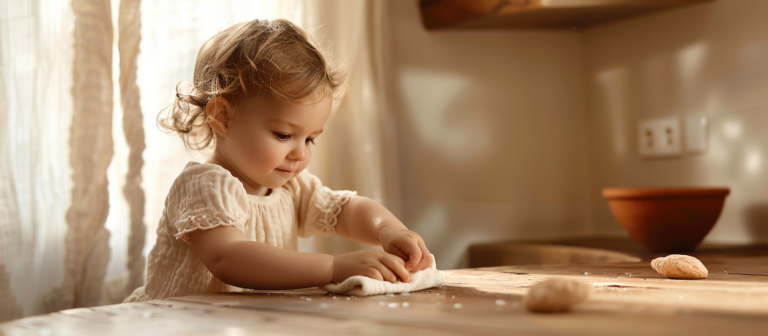
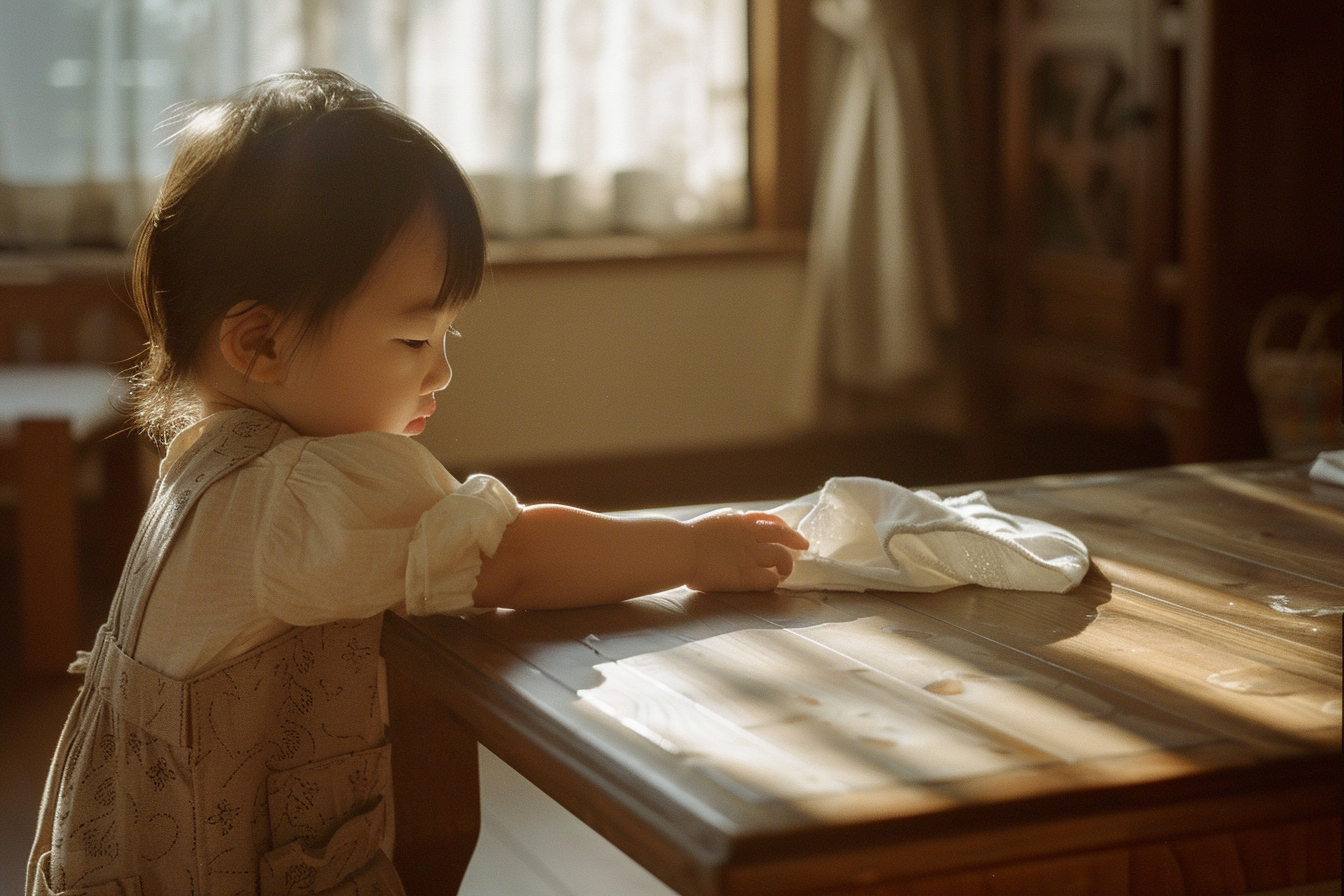
Wipe the table after meals
A small damp cloth kept somewhere accessible. After meals, hand it to your child and ask them to wipe their area.
Fine motor skills, bilateral coordination, and a simple post-meal routine that gradually becomes genuinely useful.
The table will not be clean when they finish. That is fine. Offer it again tomorrow.
Put napkins or spoons on the table
Before meals, ask your child to carry napkins or spoons to the table. Keep items in a low drawer or shelf they can reach on their own.
Early counting, one-to-one correspondence, and a clear sense of belonging to the family mealtime.
When the family sits down to eat, the napkins your child placed are there. That visibility matters to them.
Throw food scraps into a compost bowl or trash
A small bowl in the center of the table for scraps, or show your child where the trash is. After meals, ask them to collect their scraps and drop them in.
Order, care of home, and fine motor coordination in picking up small items.
One scraps bowl in the center of the table. Most two-year-olds will want to use it once they notice it.
Transfer chopped food into a bowl
A cutting board and bowl at a low surface. Push pre-chopped soft foods — banana slices, soft fruit — across the board for your child to move into the bowl.
Pincer grip, hand coordination, and the sense of being genuinely inside the kitchen work.
This can become a quiet 5-minute ritual during meal preparation — child beside you, working alongside.
Pour water from a tiny pitcher
A small pitcher (100–150ml) with a little water. A low table with a tray underneath. Ask your child to pour into a cup or bowl.
Wrist control, visual tracking, and concentration — the satisfaction of managing something liquid.
Smaller pitcher, more control. Start with a tablespoon of water. Keep a cloth nearby for spills.
Put dirty clothes in the hamper
A hamper low enough to open and reach. At changing time, hand the child their just-removed item and point to the hamper.
Order, sequencing, and a small daily routine that builds toward independent self-care.
Once established, many children will walk straight to the hamper without being asked.
Help pull socks off or push arms into sleeves
You do the difficult part; give your child the last small movement — the final pull of a sock off, the last push of an arm through a sleeve.
Body awareness, motor coordination, and the genuine experience of dressing themselves — one step at a time.
Start with almost all the help, then withdraw it gradually. This unfolds naturally at this age.
Bring diaper, wipes, pajamas, or bib
Keep care items in low, reachable storage. Before changing or bedtime, ask your child to fetch what’s needed — by name.
Receptive language, memory, and a sense of participating in their own care.
Being asked to help with your own care shifts the experience from something done to a child, to something they take part in.
Wipe face or brush hair with help
A small face cloth or soft brush kept at the child’s height. Invite them to wipe their own face after meals, or hold the brush while you guide their hand.
Body awareness, fine motor coordination, and the habit of attending to their own appearance.
Works best immediately after meals — motivation is clear, cloth is already out.
Put shoes on the mat or shelf
A small mat or low shelf near the door. When you come inside, take shoes off together and ask your child to place theirs on the mat.
Order, transitional routines, and a growing sense of responsibility for their own belongings.
A consistent spot for shoes quietly shapes a child’s sense of order over weeks and months.
Sweep crumbs with a toddler brush
A small brush and dustpan set stored somewhere accessible. After meals, invite your child to sweep crumbs from their area. A handheld brush works better than a full-sized broom.
Bilateral coordination, visual tracking, and a clear cause-and-effect experience — crumbs in, floor cleaner.
Sweeping into a dustpan is genuinely challenging at two. Celebrate the attempt, not just the result.
Spray and wipe a small surface
A small spray bottle with plain water and a cloth. Assign one low surface — a coffee table, a windowsill. Show them: spray once, then wipe.
Hand strength (the pump action), sequencing, and the satisfaction of a visible outcome.
Use only water. The spray bottle is compelling enough — most toddlers will want to spray more than once.
Match and fold washcloths
A small pile of clean washcloths. Fold in half once, then again — or start with matching by color.
Fine motor coordination, visual discrimination, and a genuine contribution to laundry over time.
Washcloths are the right size and weight. Towels too large; socks too fiddly.
Carry clean washcloths or bibs to a basket
After folding, hand your child a small pile and ask them to carry it to the right basket.
Purposeful movement and the complete satisfaction of a small task: carry, arrive, place.
Do not underestimate the carrying. Moving something to where it belongs is a complete and satisfying action at two.
Help unload safe items from a drying rack
Hand small items — cloths, bibs — to your child and ask them to place them in the basket or on a low shelf.
Real domestic participation and upper body strength — especially when reaching up to pull items off the rack.
Let them reach up for items independently where possible.
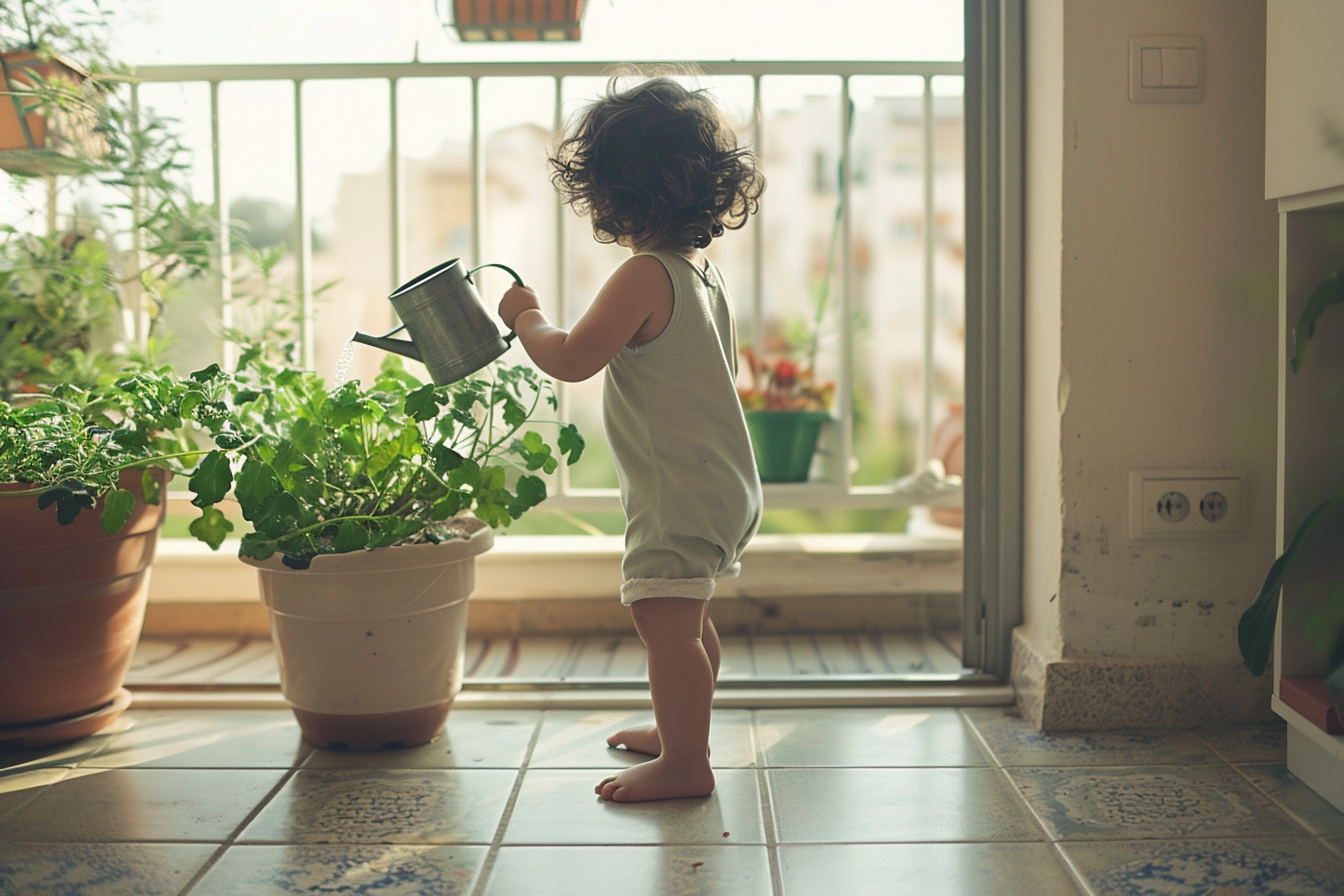
Water one or two plants
A small watering can (300–500ml) with a little water. Choose one specific plant and show your child where to pour.
Care of living things, wrist control, and a daily ritual that most toddlers begin to take seriously.
Assign them one plant. Over weeks, many toddlers will water it unprompted — because it is theirs.
Collect leaves or carry small outdoor items home
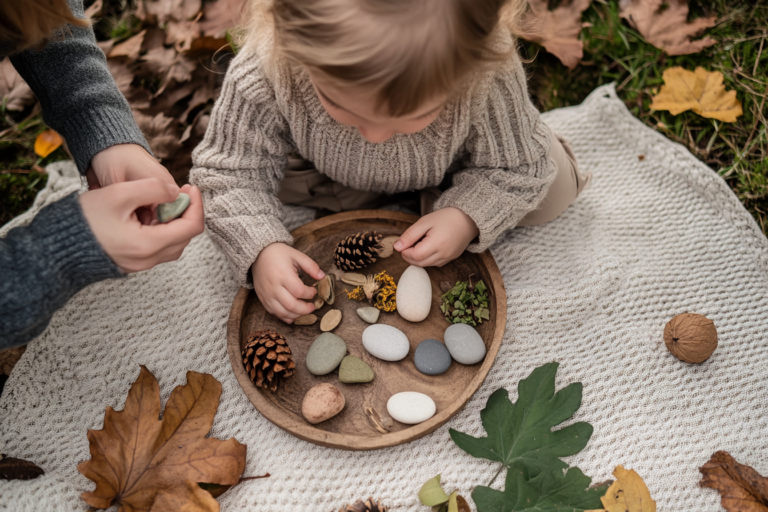
A small basket or bag for walks. Invite your child to collect what they find — leaves, seed pods, smooth stones — and carry it home.
Observation, curiosity, language (texture, color, size), and the experience of carrying something with a purpose.
The collecting is the whole point. What they bring home becomes sorting material — the outcome is a bonus.
Wipe muddy shoes or clean a small outdoor mess
A damp cloth or old toothbrush. After outdoor play, bring shoes to a low step and invite your child to scrub off the mud.
Care of belongings, hand strength, and a purposeful transition from outdoor to indoor time.
Ending outdoor time with an action rather than an argument tends to make transitions easier.
“A two-year-old does not need a perfect activity. They need a real job small enough to hold.”
Quick Reference: 20 Activities At A Glance
| Activity | Best for | What it builds | Mess level |
|---|---|---|---|
| Wash fruit in a bowl | All 2-year-olds | Hand strength, language, sensory | Medium |
| Carry produce to fridge | Active movers | Coordination, balance, belonging | Low |
| Wipe table after meals | All 2-year-olds | Fine motor, bilateral coordination | Low |
| Put napkins on table | All 2-year-olds | Counting, belonging, sequencing | Low |
| Throw scraps in compost | All 2-year-olds | Order, fine motor, environment | Low |
| Transfer chopped food | Children who love to cook | Pincer grip, concentration | Medium |
| Pour from tiny pitcher | Water-lovers | Wrist control, visual tracking | Medium |
| Put clothes in hamper | All 2-year-olds | Order, body awareness, routine | Low |
| Help with dressing steps | Independent children | Body awareness, motor coordination | Low |
| Bring care items | All 2-year-olds | Language, memory, participation | Low |
| Wipe face / brush hair | All 2-year-olds | Body awareness, fine motor | Low |
| Shoes on the mat | All 2-year-olds | Order, belonging, routine | Low |
| Sweep crumbs | Active, hands-on children | Bilateral coordination, care of space | Low |
| Spray and wipe surface | Water-lovers, active children | Hand strength, sequencing | Medium |
| Fold washcloths | Methodical, focused children | Fine motor, visual discrimination | Low |
| Carry laundry to basket | All 2-year-olds | Purposeful movement, sequencing | Low |
| Unload drying rack | Active movers | Shoulder strength, participation | Low |
| Water plants | Water-lovers | Care of living things, coordination | Medium |
| Collect outdoor items | Curious, outdoor children | Observation, language, carrying | Low |
| Clean muddy shoes | Outdoor children | Care of belongings, transition | Medium |
If you want somewhere calm to begin
A small starter list of real-life jobs for 2-year-olds, with setup notes and things to look for — free to download.
How To Start Without Buying Anything
Practical life does not require a Montessori shelf, a child-sized kitchen, or a specialized material set. The only things you need are already in your home and happening every day.
-
Start with what already happens. Look at the next 24 hours of your household. What do you do that could involve a small pair of hands? Unloading groceries, setting the table, folding laundry, watering a plant. Any one of these is a starting point.
-
Make the job visible. If you want your child to put clothes in the hamper, the hamper needs to be somewhere they can see and reach it. The task should not require asking for help to begin.
-
Reduce the task until it fits. If “help with laundry” feels too vague, reduce it to: carry this one washcloth to that basket. The smaller the task, the more likely a two-year-old can complete it successfully the first time.
-
Repeat the same job for 1–2 weeks. Repetition is not boring to a toddler — it is satisfying. The same task offered again tomorrow gives the child another chance to do it better, with more confidence. Do not rotate too quickly.
-
Expect slower and messier at first. This is not an inconvenience. This is the whole point. The task being done imperfectly alongside a child is where coordination, confidence, and belonging are actually built.
Practical life often starts as an inconvenience before it becomes a rhythm. The first few weeks will be slower, messier, and more effortful than doing it yourself. Then, one day, it won’t be.
Match Activities To Your Child
Two-year-olds are not interchangeable. The child who loves to splash in the sink is not the same child who prefers careful, methodical work. These suggestions help you choose a starting point.
Always moving, hard to settle
- Carry produce to the fridge
- Carry laundry to the basket
- Sweep crumbs with a small brush
- Collect leaves or items on a walk
- Clean muddy shoes after outdoor play
Loves water and sensory play
- Wash fruit in a colander
- Pour from a small pitcher
- Spray and wipe a surface
- Water a single plant
- Wipe their face with a damp cloth
Gets frustrated easily
- Put shoes on the mat (one clear action)
- Put dirty clothes in the hamper
- Bring care items (diaper, bib)
- Put napkins on the table
- Throw scraps into a bowl
To do everything by themselves
- Help pull off socks independently
- Wipe their own face after meals
- Water their own plant
- Fold washcloths solo
- Carry produce all the way to the fridge
Troubleshooting & Common Questions
What if my toddler makes everything messier?
They will — and that is developmentally expected at age two. The mess is part of the process. A tray under water activities, a towel under fruit washing, and a cloth nearby handles most of it. Over weeks of repetition, the mess naturally reduces as coordination improves.
What if they only do it for 30 seconds?
A two-year-old’s attention span is not a flaw. If the task holds their interest briefly and then they move on, that is appropriate. The aim is not duration — it is genuine engagement while it lasts, and returning to it tomorrow.
What if my child gets frustrated mid-task?
Frustration usually means the task is slightly beyond their current capacity. Reduce it: instead of folding the washcloth, just carry it. Instead of pouring a full pitcher, start with a tablespoon of water. Do the difficult part yourself and give them only the final step to complete.
What if they refuse to help?
Practical life is an invitation, not a requirement. Sometimes a child is tired, overwhelmed, or simply not interested. Offer it without pressure, and move on if they decline. A child who refused yesterday often asks to help tomorrow — because they have been watching you do it.
What chores can a 2-year-old actually do?
Carrying light items, putting away objects that have a defined home, wiping surfaces, putting clothes in a hamper, placing a napkin on the table, sweeping crumbs. The key is a single clear action with a visible outcome — the 20 activities in this article all fit that description.
Is practical life good for language development?
Yes — and differently from books or songs. Practical life creates natural conversation about what is happening right now, in the child’s hands, with real objects. Words like pour, carry, heavy, wet, clean, fold, rinse arise from the task in direct context, which tends to make them stick.
Do I need Montessori materials to do practical life?
No. A small pitcher from your kitchen works as well as a Montessori-branded one. A cloth, a brush, a colander, a basket — these are all the materials a two-year-old’s practical life needs. The thoughtfulness is in how you offer the task, not in what brand of object you use.
A Realistic Daily Rhythm
A practical life routine does not need a Montessori block in your schedule. Three to five tiny jobs woven into what is already happening is more sustainable — and more meaningful — than an activity set up separately from real life.
- Pajamas in the hamper
- Spoon or napkin to the table
- Wipe a small spill after breakfast
- Carry cup to the sink
- Scraps in the compost bowl
- Wipe their area of the table
- Carry cup or bowl to the sink
- Sweep crumbs if they’re around
- Shoes on the mat by the door
- Clothes in the basket
- Water the plant if it needs it
- Bring pajamas or a bedtime book
You do not need all of these every day. You need two or three that your household already does, offered consistently to the child. The repetition is what builds the rhythm — and the rhythm is what makes the job feel like theirs.
“Practical life begins when a child is trusted with something real.”
When a two-year-old carries something across a room and arrives without dropping it, when they wipe a table and look up to check that you saw it, when they put their shoes away without being reminded — none of this is productivity. None of it is getting chores done faster.
These are moments of a child discovering they are capable. That the household includes them. That they are not just a person being carried through the day, but one who contributes to it.
The goal is not to raise a helpful toddler. The goal is to let a small child experience what it feels like to be trusted with real life. You only need to slow down enough, when your two-year-old appears beside you wanting to carry the apples, to let them carry them.
Practical Life Starter List For 2 Year Olds
If you want a calmer way to begin, I made a simple printable with toddler-friendly jobs, setup ideas, and a place to notice what your child is ready for.