Motor Activities Hidden Inside Everyday Chores
What parents often miss when toddlers help around the house
Most parents think of chores as something that happens alongside childhood.
Something children grow into eventually.
Something you manage around their learning.
Developmental science suggests something different.
For toddlers, the ordinary work of keeping a home — wiping surfaces, carrying objects, pouring water, folding cloth — is not a break from learning. It is often where the most meaningful learning of the day takes place. Not despite its ordinariness. Because of it.
This article is not a list of age-appropriate chores. It is an invitation to look at the chores you already do — the ones happening in your kitchen, your laundry room, your dining area — and see what your toddler’s body is actually doing when they participate in them.
Once you see it, you cannot unsee it.
Why Toddlers Want To Help
There is a moment most parents recognize.
You are mopping the floor. Your two-year-old appears beside you and reaches for the mop. You redirect her to a toy. She returns to the mop. You give her a cloth instead. She follows you around the kitchen for the next ten minutes, wiping sections of the floor you have already mopped.
This is not about the floor.
Toddlers are not primarily attracted to chores because they enjoy cleaning. They are attracted to something deeper and more urgent: participation in the life of their family. They want to be where the work is. They want to do what the people they love are doing. They want to belong — not by watching, but by contributing.
Before toddlers want independence,
they want participation.
This is worth sitting with, because it changes the nature of what we are doing when we include toddlers in household work.
We are not teaching cleaning skills. We are not running a motor development program. We are doing something more fundamental: we are allowing a small child to take their place inside the life of the people they are most attached to. And that sense of belonging — of being needed, of contributing something real — is one of the most powerful developmental forces in early childhood.
Children who feel like contributing members of their family — not just recipients of care, but active participants in the household — develop stronger sense of self, higher cooperation, and greater intrinsic motivation in later years. The chores are the vehicle. Belonging is the destination.
Imitation is the engine that drives it. Toddlers learn by replicating the people they love most — not because they have been asked to, but because copying the important adults in their lives is how they understand what it means to be a person in this world. When a toddler wipes a table, they are not just wiping a table. They are practicing being someone who takes care of things. Someone who contributes. Someone who matters to the functioning of the home.
This is the Chichiberry lens through which the rest of this article is written.
Not: how do we use chores to build motor skills?
But: when we include children in ordinary life, what is actually happening — and how can we see it more clearly?
Everyday life is the curriculum. Not because we designed it that way, but because toddlers are designed to learn from it. Every surface wiped, every sock matched, every vegetable carried is a small act of real participation — and real learning — already happening inside your home.
The Development Most Parents Don’t Notice
Picture a two-year-old wiping a table after lunch.
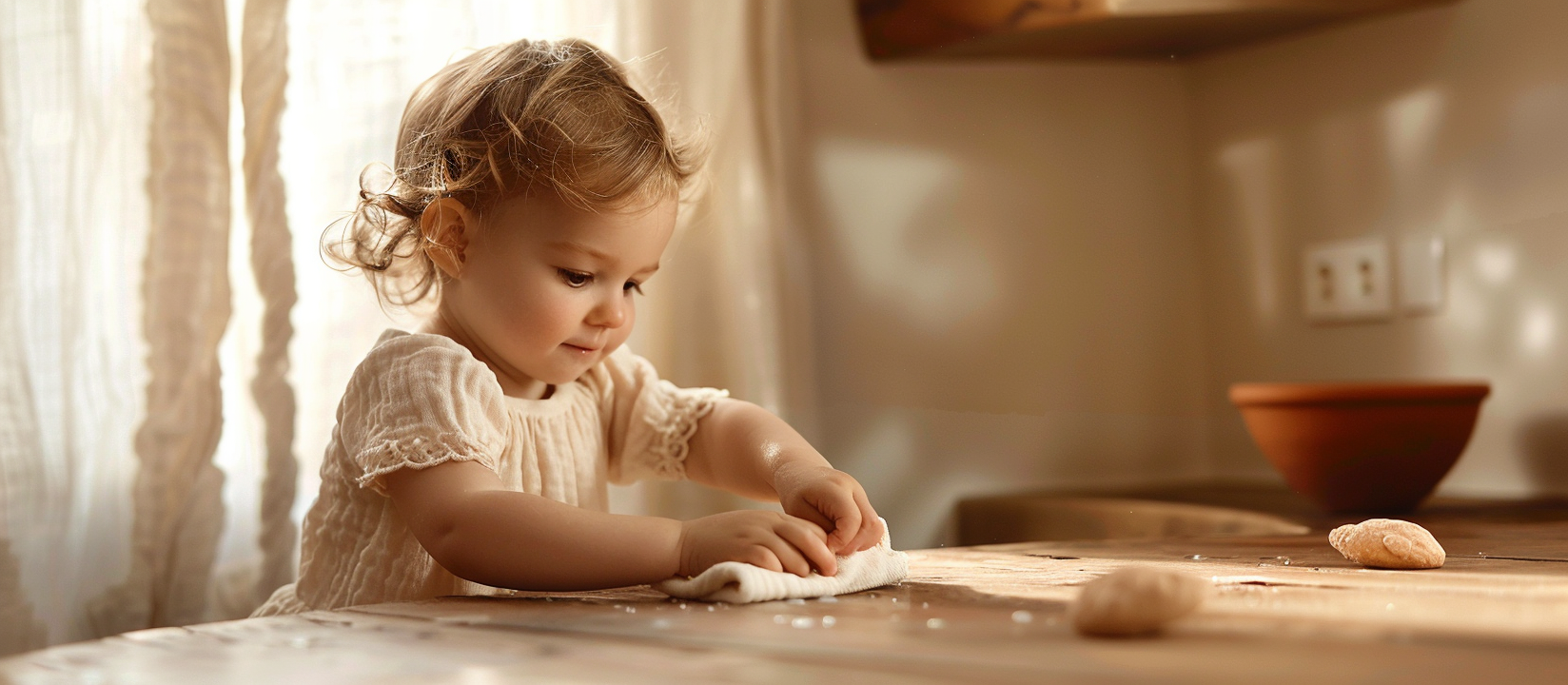
She takes the cloth. She presses it down. She moves it slowly across the surface — forward, back, in circles. She lifts it, resoaks it at the sink, returns. She does this four times before she is satisfied.
A helpful child. A cleaner table. A moment of cooperation that makes the afternoon feel lighter.
All of this is real. And it is also incomplete.
What the developmental lens sees is something richer — a full motor curriculum happening inside what looked like a simple household task.
Helpful behavior
- Child wiping a table
- Participating in a task
- Following an instruction
- Being cooperative
Motor curriculum in motion
- Grip strength — pressing cloth to surface
- Wrist rotation — circular and directional movements
- Visual tracking — following the cloth across a plane
- Bilateral coordination — one hand guides, one stabilizes
- Motor planning — choosing where to start, where to go
- Sequencing — understanding the steps of the task
- Core stability — maintaining posture while reaching
- Crossing midline — reaching across the body’s center
The table wiping took four minutes. In those four minutes, the child exercised more motor skills than she would have in a structured fine motor activity specifically designed for her age group.
And she did it with full engagement. Because it was real. Because the table actually needed wiping. Because she was doing what the adults around her do.
Chores are not interruptions to learning.
They are learning.

Why Chores Build Motor Skills So Well
Occupational therapists have known for decades what Montessori observed a century ago: motor skills develop most reliably not through isolated practice, but through purposeful, meaningful activity.
The fine motor toy on the shelf has value. But it cannot offer what household work offers, because it lacks the one thing that makes motor development stick: it does not matter.
Designed fine motor exercises
- Performed once or twice
- Purpose is practice itself
- Engagement is task-dependent
- Repetition requires adult motivation
- Isolated skill target
- No emotional investment in outcome
Purposeful daily chores
- Repeated naturally every day
- Purpose is the real outcome
- Engagement is intrinsic and high
- Repetition is built into life
- Multiple skill domains at once
- Deep emotional investment in helping
Consider what the research on motor development consistently shows: skill consolidation happens through repetition in varied, meaningful contexts. Not through repetition alone. The variation and the meaning are what make the skill transferable — what allow a hand strengthened by scrubbing vegetables to also grip a pencil steadily a year later.
Toddlers who regularly participate in household work are not just being helpful. They are building the neurological foundation that underlies handwriting, self-care, and fine motor control — through tasks that require no special materials, no scheduling, and no separate curriculum.
There are five reasons real household work outperforms designed fine motor activities for toddler development:
Meaningful purpose. The cloth actually cleans the table. The sock actually belongs to a person. The water actually fills the glass. Toddlers’ brains are calibrated to engage deeply with tasks that have real consequences. When the outcome matters, concentration deepens and motor control improves.
Daily repetition. Chores happen every day. Every day the table is wiped. Every day the laundry is folded. The toddler who participates even occasionally gets far more practice than any dedicated fine motor program could offer, simply because life keeps asking for the skill.
Whole-body engagement. Most household tasks recruit multiple motor systems simultaneously. Carrying a basket engages grip, bilateral coordination, core stability, and visual attention all at once. Fine motor toys rarely recruit more than one or two.
Emotional connection. Helping matters to toddlers. The desire to be included in family life is one of the strongest motivational forces in early childhood. When motor work is embedded in belonging, the engagement quality changes entirely.
Natural progression. Household tasks scale beautifully with development. The same chore that challenged a two-year-old becomes effortless at three, and is ready to receive a new layer of complexity at four. The curriculum updates itself.
The Invisible Curriculum Of Home
Every child enrolled in preschool is being exposed to a curriculum. There are learning objectives. Materials chosen to develop specific skills. A sequence someone designed.
What most parents do not realize is that the same is true of their home. Not a curriculum written anywhere. Not one designed by anyone. But a curriculum nonetheless — present in every room, available every day, updating itself as the child grows, asking for nothing except that the child be included.
The reason most parents cannot see it is that we have learned to locate learning in designated spaces and designed objects. We recognize the value of a puzzle because someone made it for children. We do not always recognize the value of a washcloth because it was made for a table.
But the washcloth does not know the difference. And neither do a child’s hands.
Here is what that invisible curriculum looks like, in the moments that already exist inside your ordinary day:
The curriculum was never hidden in a workbook.
It was hidden in the ordinary life of the home.
The Hidden Motor Curriculum Inside Your Home
Every home already contains a motor development curriculum. It does not need to be purchased or printed. It is present in every room, available every day, and self-regulating in its difficulty.
Here is what that curriculum looks like — first as a visual map of room to skill to outcome, then broken into the eight motor domains household work consistently develops.
Here is each domain in full:
Fine Motor Control
The ability to isolate and coordinate small muscles of the hands and fingers. Built through tasks requiring precise grip, pinching, and controlled release.
→ HandwritingGross Motor Strength
Large muscle control, postural strength, and whole-body coordination. Built through carrying, pushing, reaching, and transferring weight.
→ Physical confidenceGrip Strength
The foundation of tool use and self-care. Built through wringing, pressing, gripping handles, and maintaining hold under resistance.
→ Pencil grip, scissorsHand-Eye Coordination
The integration of visual information with precise hand movement. Built through tasks that require hitting a target — pouring, sorting, stacking.
→ Reading, drawingBilateral Coordination
Using both hands together in a coordinated way — one often leading, one stabilizing. Built through tasks that require each hand to have a different job.
→ Cutting, tying lacesCrossing the Midline
Reaching across the body’s vertical center. Critical for left-right brain integration. Built through wiping, sweeping, and reaching across surfaces.
→ Writing fluencyCore Stability
The foundation beneath all other motor skills. Built through tasks requiring balance while reaching, carrying, or maintaining awkward positions.
→ Sitting still, focusMotor Planning
Figuring out how to organize a body to accomplish a goal. Built through multi-step tasks that require anticipating what comes next.
→ Executive functionNone of these skills are assessed here. They are simply present in ordinary household participation. A toddler who helps regularly is not “ahead” — they are simply practicing something that their body needs and their development is ready for.
Your Home, Room by Room
What follows is not a task list. It is an invitation to look at the rooms you already live in — the kitchen, the laundry room, the dining area — and see what a toddler’s body is quietly practicing inside them.
The kitchen is the richest motor environment in most homes. It asks for grip, wrist rotation, weight management, bilateral coordination, and hand-eye precision — often all in a single task. A toddler who participates regularly in kitchen life is receiving what no fine motor toy shelf can replicate: genuine, purposeful, high-stakes hand work.

She is sitting on the floor beside the laundry basket, pulling socks out one by one. She holds two up, comparing them — turning one over, examining the heel. She sets one down, reaches back in, pulls out another. She holds them next to each other. Something registers. She places them together.
She does not know she is crossing her midline every time she reaches across the basket. She does not know she is building the visual discrimination that will later help her distinguish between letters. She knows only that the socks need to match, and that she is the one matching them.

A child “helping” with the laundry
Visual discrimination, reaching across a surface (crossing midline), sustained attention on a sorting task
Crossing midline, visual-spatial processing, sustained attention
Midline + VisualA toddler playing with the clothespins more than actually hanging laundry
Intensive pincer grip, hand strength against spring resistance, coordination of squeeze and position simultaneously
Pincer strength, hand muscle development, bilateral coordination
Grip Strength + PincerImperfect little squares that will need refolding later
Both hands working symmetrically, spatial reasoning applied to a three-dimensional object, motor planning across multiple steps
Bilateral symmetry, spatial reasoning, sequential motor planning
Bilateral + PlanningA small child wobbling down the hallway with a basket half their size
Gross motor coordination under load, core engagement for postural stability, grip endurance, visual navigation around obstacles
Core stability, gross motor strength, spatial navigation, endurance
Core + Gross MotorThe dining table is where toddlers most visibly want to participate. They have watched adults set it hundreds of times. By the time they reach for the napkins, they already know the sequence. They are not learning the task. They are joining a ritual that belongs to the whole family — and feeling what it means to contribute to it.

The living room tends to hold the quieter work — the tasks that ask a child to move slowly, to think about where they are going before they get there, to adjust when something is not quite right.
These are the tasks that build not just physical capability, but something harder to name: the willingness to care for a shared space. The understanding that a home requires tending. The sense that tending it is something a child can do too.
What Is Actually Happening
Underneath the ordinary participation — the wiping, the carrying, the folding — something is quietly being built. Not because anyone designed it that way. Because a child’s body is designed to practice real work, and real work was, for most of human history, how children grew up.
Here are the six things that household participation builds most reliably, and why they matter far beyond the kitchen:
Grip Strength
Grip strength is one of the most reliable predictors of later fine motor skill, including handwriting control and tool use. It develops not through squeezing exercises but through sustained, purposeful holding — particularly against resistance.
Household chores that build grip strength include wringing out a wet cloth, pressing firmly while wiping, clipping clothespins, carrying objects of genuine weight, and maintaining hold on handles (pitchers, watering cans) during a full pour.
Hand-Eye Coordination
The integration of vision with fine motor action is what allows a child to place a cup on a shelf without knocking it over, pour water into a glass rather than onto the counter, and eventually form letters within lines. It develops through tasks that require hitting a target under real consequence.
Household chores that build hand-eye coordination include pouring water, setting objects precisely on shelves, folding and aligning cloth edges, and placing items into containers.
Bilateral Coordination
Many foundational life skills — cutting with scissors, tying shoes, buttoning clothing, opening containers — require both hands to work together with different but coordinated roles. Bilateral coordination rarely develops from activities where both hands do the same thing. It develops when one hand must lead while the other stabilizes.
Household tasks are extraordinarily rich in bilateral coordination demands. One hand holds the bowl; the other stirs. One hand holds the garment; the other clips the pin. One hand guides the watering can; the other braces the pot.
Crossing the Midline
Crossing the body’s midline — the imaginary vertical line running head to toe — is a neurological milestone that underlies reading fluency, writing, and coordinated movement. Children who have difficulty crossing the midline often switch hands mid-task rather than reaching across their body. Sweeping and wiping tasks are among the best natural opportunities for midline crossing because the surface demands it.
Core Stability
Core strength is not about abdominal muscles alone. It is about the deep postural muscles that allow a child to maintain upright stability while their limbs are active. Without adequate core stability, children find it difficult to sit still, concentrate, and perform fine motor tasks — their bodies are spending energy on staying upright rather than on the work at hand. Carrying, reaching, and kneeling tasks all recruit the core in ways that seated activities cannot.
Motor Planning
Motor planning — called praxis in occupational therapy — is the ability to figure out how to organize the body to carry out a new or complex action. It is one of the most important skills for academic readiness, because it underlies the ability to approach a new task, break it into steps, and execute it in sequence. Multi-step household tasks are uniquely valuable for developing motor planning because they are complex enough to require it, but familiar enough to allow success.
Today’s Chores, Tomorrow’s Learning
Here is the thing no one says in the kitchen when a two-year-old is stirring batter for the fourth time in a row, asking to stir again, making a small mess, stirring again:
That repetition is rehearsal. And what it is rehearsing will matter far more than the batter.
Motor development researchers have traced a consistent path from early childhood household participation to the foundational skills that support formal learning. Not because someone designed it that way. Because the physical demands of household work happen to map almost perfectly onto the neural architecture that writing, reading, and sustained attention require.
Notice what is not on this list: flashcards, apps, subscriptions, workbooks. Every bridge in that table runs from an ordinary household task to a foundational academic skill. Not because someone designed them to connect. Because a child’s body was designed to practice real work — and real work was, for most of human history, the only curriculum that existed.
You have almost certainly already watched your child build the grip that will one day hold a pencil. You may not have known that is what you were watching. Now you do.
What to Expect at Each Stage
These are tendencies, not timelines. What follows is not a checklist of what your child should be doing — it is a gentle orientation to what is typically possible and meaningful at each stage, so you can offer participation that feels right rather than forced.
- Carrying small, light objects
- Wiping spills with a cloth
- Moving items between containers
- Dropping objects into a bin
- Helping carry washcloths
- Very short task windows (1–3 min)
- Single-step actions only
- High interest, low follow-through
- Parallel participation (doing alongside)
- Stopping is not failure — it is enough
- Walking away mid-task is developmental
- Imprecision is the expected outcome
- Pouring water from small pitchers
- Matching socks
- Peeling bananas or soft foods
- Wiping a table with guidance
- Carrying small laundry items
- Two-step sequences beginning to emerge
- Strong interest in doing what adults do
- Spills and imperfection are normal
- Speed is slow and often inconsistent
- Slowness is concentration, not confusion
- Asking to help again is the goal signal
- A spilled pour is still successful pouring
- Folding washcloths and small towels
- Watering indoor plants
- Setting places at the table
- Clipping clothespins
- Dusting low shelves
- Helping prepare simple snacks
- Multi-step tasks with verbal support
- Stronger sense of ownership of “their” job
- Greater persistence toward completion
- Beginning to notice quality of work
- Insisting on doing it “their way” is healthy
- Wanting to do a task alone is progress
- Slower than adult pace is still correct pace
- Sweeping a section of the floor
- Preparing simple snacks with minimal help
- Organizing a shelf or drawer
- Filling a watering can and using it independently
- Folding larger items with practice
- Full task completion increasingly possible
- Strong pride in visible contribution
- Ability to self-correct with reflection
- Beginning to generalize skills to new tasks
- “I want to do it myself” is the ideal outcome
- Inconsistency is still completely normal
- The work still matters more than the result
Developmental age ranges are wide and varied. A child who isn’t folding washcloths at three is not behind. A child who wants to sweep at two may be completely ready. Trust what your particular child reaches for. That reaching is information.
Five Mistakes That Interrupt the Learning
The chores themselves are rarely the obstacle. These patterns are.
Doing it faster yourself
This is the most common interruption to toddler motor development through household work. The slowness is the point. The three minutes it takes a two-year-old to fold a washcloth is three minutes of motor consolidation. When we take over to save time, we save time at the cost of exactly the learning we were hoping to create.
Expecting perfection
A toddler wiping a table has done the motor work of wiping a table — regardless of the residual crumbs. The motor system does not know the difference between a perfect wipe and an imperfect one. Correcting behind children, or redoing what they did while they watch, teaches something very different from what we intend: that their effort was not enough.
Turning chores into lessons
There is a meaningful difference between showing something once, quietly, and correcting a child through a task with running instruction. Toddlers disengage from tasks that become lectures. The most effective learning happens when the adult participates quietly alongside, demonstrates without narrating, and lets the child discover their own approach.
Giving tasks that are too difficult
The sweet spot for motor learning is just at the edge of current ability — not beyond it. A task that is too difficult produces frustration, not growth. Start with the simplest version of the task (one napkin, one cup, one shelf) and allow the task to grow with the child rather than ahead of them.
Thinking motor development only happens through activities
Activities develop skills in isolation. Household work develops skills in context — with meaning, with repetition, with emotional investment, and with the full complexity of a real-world task. Both have value. But the belief that structured activities are sufficient — and that household participation is optional — misunderstands where motor development does its deepest work.
A Week of Motor-Building Through Home Life
This is not a schedule. It is a possibility — a visual reminder that the motor curriculum is already present in a typical week of family life.
- Match socks
- Fold washcloths
- Carry small items
- Wash fruit
- Stir or pour
- Carry veg
- Water plants
- Fill can
- Wipe leaves
- Carry napkins
- Set cups
- Wipe table
- Peel soft foods
- Pour snacks
- Stir or mix
- Dust shelves
- Carry basket
- Return books
- Organize toys
- Fold laundry
- Sweep corner
Today’s Chore Is Enough
There is a version of this article that could become a new source of pressure.
A parent reads it and thinks: I should be doing more. I should be including my toddler in more tasks, in more rooms, with more intention. I should be tracking what they can do. I should have a plan.
That is not what this is for.
You do not need a chore curriculum. You do not need a developmental checklist. You do not need a special activity every afternoon or a new routine added to your week. One meaningful opportunity to participate in real family life — one — is enough.
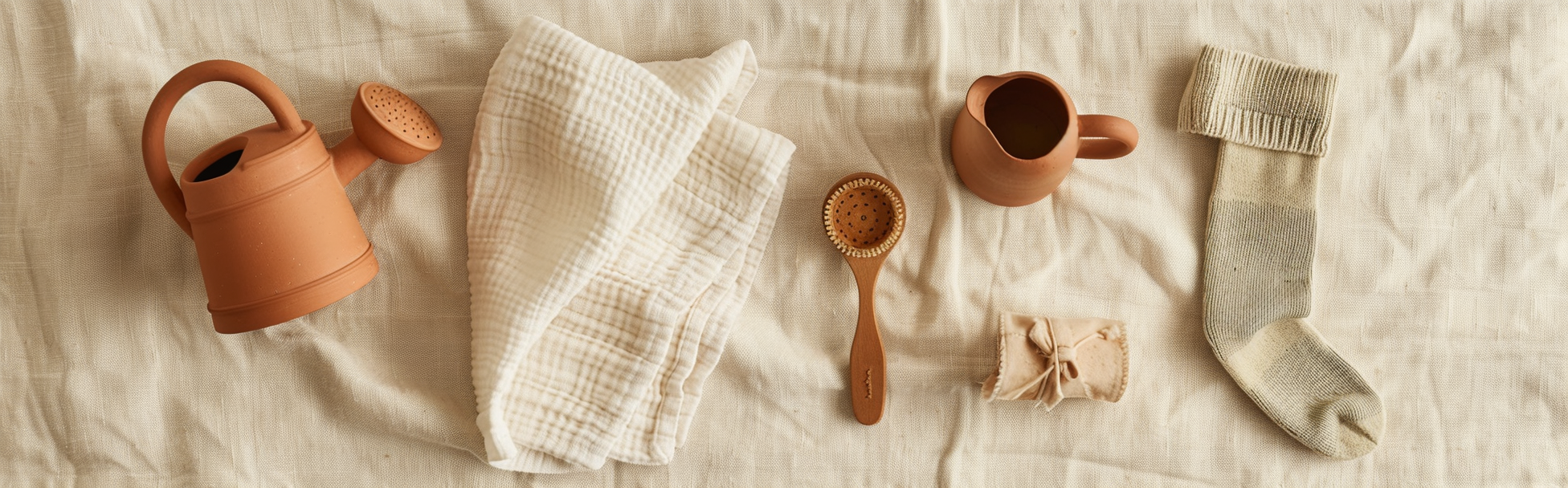
One washcloth handed over at lunch.
One napkin carried to the table.
One small pitcher of water poured — slowly, carefully, occasionally onto the counter.
That is the whole thing. That is all of it. The motor system does not require volume or consistency or intentional sequencing. It requires repetition inside a life that already offers it naturally, on ordinary days, inside the family the child already belongs to.
Children do not need a curriculum to grow.
They need a home where they are included in real life
— and adults who understand what that inclusion is quietly doing.
The days when your toddler wipes the table are not more developmentally valuable than the days they don’t. The days when participation happens naturally are not a success. The days when everyone is tired and dinner just needs to happen are not a failure.
What this article asks for is not a new system. It asks only for a slightly different quality of attention — the kind that looks at a child carrying a laundry basket and understands, without needing to do anything differently, that something important is already happening there.
What Matters Most
There is a truth underneath all the motor development in this article — underneath the grip strength and the bilateral coordination and the midline crossing — that is more important than any of it.
Toddlers do not help because they love cleaning. They help because they love the people who are cleaning. They carry the washcloth because you carry the washcloth. They pour the water because you pour the water. They set the table because the table belongs to all of you, and setting it is how they take their place in that belonging.
The motor development is real. The physical benefits are real. But they are not the reason a two-year-old insists on carrying the laundry basket themselves, even though it takes four times as long and the basket ends up on its side in the hallway.
The reason is identity. The reason is family. The reason is the deep, ancient pull toward participation in the life of the people they love most.
The goal is not a perfectly cleaned table. The goal is a capable child. And beneath capability: confidence. Beneath confidence: contribution. Beneath contribution: belonging. Beneath belonging: identity. Every washcloth. Every spoon. Every sock. Every tiny act of helping is a child practicing who they are becoming.
You do not need to curate this. You only need to include them.
Tomorrow morning, your toddler may carry a washcloth across the kitchen.
It will take longer than doing it yourself.
The cloth may fall. The table may still be wet when they are finished.
But in those two minutes, they are not just learning to wipe a table.
They are learning that they are someone who helps. Someone who is needed. Someone who belongs to this family and knows it — in their hands, in their body, in the quiet confidence of a task completed.
My child is not helping because I need help.
My child is helping because helping is how children
learn to become part of a family.
Try Observing This Week
You do not need to change what you are doing. You do not need to introduce new chores or create a participation system. The only invitation here is to notice what is already happening — and to look at it with a slightly different eye.
These prompts are not a checklist. They are questions worth carrying quietly into your ordinary days.
These prompts are not assessments. You are not looking for what your child cannot do. You are looking for what they are drawn toward — which is always the most useful information a parent can gather.
For parents who want to see what is already happening inside their ordinary day.
Inside Everyday Chores
This is not a chore chart. It is not a curriculum to implement or a milestone checklist to complete. It is a lens — designed to help you look at a washcloth, a laundry basket, a small pitcher of water, and understand what a child’s body is practicing when they use them.
- 30 everyday household tasks, each with its developmental skill mapping
- Room-by-room visual guide: kitchen, laundry, dining, living room
- Skill domain explainer: grip, bilateral, midline, planning, core
- Open-ended observation pages — never evaluative, always curious
- Age progression reference across 18 months to 4 years
- Gentle weekly planner: one invitation per day, nothing more
- Reflection space: what did I notice this week that I hadn’t seen before?
No spam. Unsubscribe anytime.
Questions Parents Often Have
Most children show interest in household tasks well before their first birthday — reaching for a cloth, trying to carry objects, wanting to be where the action is. Meaningful participation in simple, one-step chores (carrying a cloth, wiping a spill) is typically possible from around 15–18 months. What changes with age is not the interest, but the complexity of tasks the child can sustain.
Refusal is normal and worth respecting. Toddlers are not employees, and participation in household work should feel like an invitation, not an obligation. What usually works better than asking is simply doing the task nearby and allowing the child to join naturally. Most children who consistently see adults working will want to participate — on their own terms and timeline.
Meaningful participation in family life is developmentally appropriate. What becomes problematic is expectation — when a child is expected to perform tasks to an adult standard, on an adult timeline, or when refusal has consequences. The goal is inclusion, not labor. A toddler who spends five minutes helping with laundry and twenty minutes playing has had an excellent motor morning.
School readiness is not primarily about academic content. Research consistently identifies grip strength, fine motor precision, bilateral coordination, motor planning, and sustained attention as the physical foundations that allow children to engage with formal learning tasks. All of these develop through the kind of meaningful, whole-body, repetitive work that household participation naturally provides.
The developmental value of a chore lies in the motor experience — not the outcome. A table wiped imperfectly still provides all the grip, wrist, and bilateral coordination practice of a table wiped well. Correcting in the moment, or redoing the task visibly, communicates that the effort was insufficient. When intervention is genuinely needed, showing once — calmly and wordlessly — is almost always enough.
For most children, household participation provides a rich and sufficient motor environment that reduces the need for isolated fine motor activities. For children with specific developmental concerns or occupational therapy referrals, household work is an excellent complement to — but not a replacement for — professional support. An OT can help identify which household tasks are most therapeutically valuable for a specific child.
Yes — almost entirely. The spilled water, the unevenly folded cloth, the crooked place setting: these are all evidence of motor work happening at the edge of current ability. Children who are making messes during purposeful household tasks are not failing at the task. They are succeeding at the development.
Montessori referred to household participation as “practical life” — one of the four core curriculum areas in any Montessori classroom, regardless of the child’s age. The philosophy holds that real work with real materials and real consequences is more developmentally valuable than any toy or designed activity. This includes cleaning, cooking, caring for plants and animals, and self-care. What makes it Montessori is not the task itself but the approach: child-sized tools, unhurried time, genuine responsibility, and adults who trust the process.