
Late Talker? What Your Toddler May Be Learning Before The Words Come
Many toddlers are learning a tremendous amount long before they begin speaking. This is not a story about delay. It is a story about everything that happens first.
“He Barely Says Anything.”
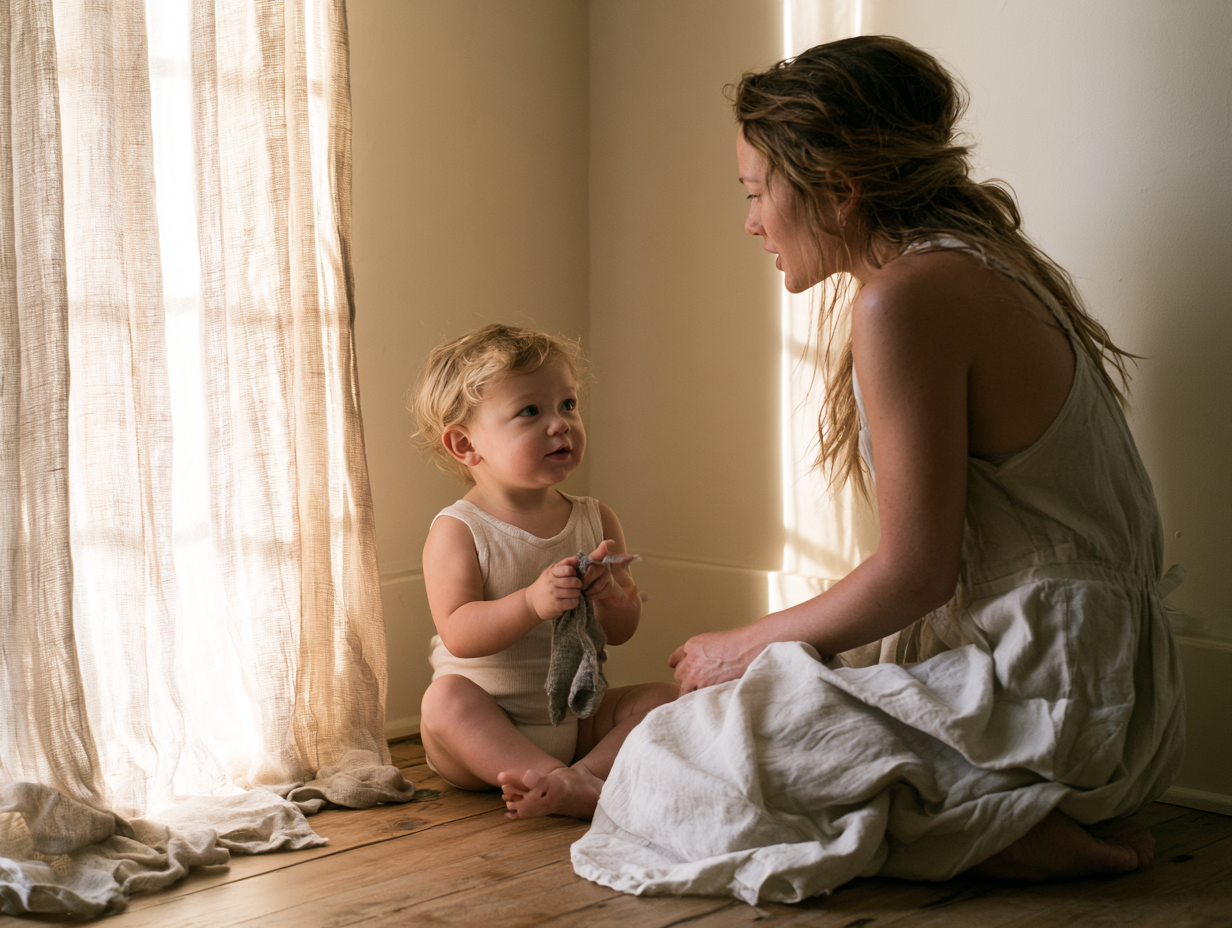
That is the sentence that keeps circling back. Not in a panic, exactly — more like a low hum underneath an otherwise ordinary day. You say it to your partner over dinner. You think it while scrolling past another parent’s video of a toddler reciting the alphabet. You said it out loud, finally, at the pediatrician’s office, and watched her write something down without quite meeting your eyes.
He is twenty months old. He has maybe six words you would call clear. Some days it feels like four.
So you start watching more closely — not the easy, background kind of watching, but the kind that comes from worry. You watch for words. You wait for them. You count them, almost without meaning to.
And because you are watching so closely for words, here is what you almost miss on an entirely ordinary Tuesday.
It would be easy to skip past this day. Nothing about it looks remarkable from the outside. There’s no milestone moment, no video worth sharing, nothing that would make it into a baby book. But slow it down, and a different picture starts to form — one built almost entirely out of things that have nothing to do with talking.
None of that involved a single word. And all of it involved understanding, memory, attention, timing, and connection — the architecture that words eventually get built on top of.
If you only measured this day by what came out of his mouth, you would have measured almost nothing. If you measure it by what went in, and what came back out in every form other than speech, the day looks completely different. That gap — between what gets counted and what’s actually happening — is where this article lives.
What if words are only one small part of communication?
The Invisible Learning That Happens Before Speech
Imagine language as an iceberg. The part everyone can see — the part that gets commented on at the playground, compared at family gatherings, tracked in baby books — is the tip. The words.
But an iceberg’s tip is only ever a small fraction of its total mass. Beneath the surface, invisible to anyone glancing past, sits the much larger structure holding it up.
Every one of those invisible pieces is real developmental work. A toddler who is listening closely, watching carefully, remembering accurately, and reading social cues correctly is not behind on language. They are building the foundation language will eventually stand on.
The words arrive last. The learning often begins much earlier — quietly, beneath the surface, in a thousand small moments that rarely get counted.
This doesn’t mean every late talker is simply “doing the invisible work” and nothing more — development varies, and so do its reasons. But it does mean that word count, on its own, tells you very little about what is actually happening inside a child’s mind. To understand what’s really going on, it helps to look beneath the tip.
Understanding Comes Before Speaking
Language develops in two directions, and they do not move at the same speed. Receptive language is what a child understands when they hear it. Expressive language is what a child can produce themselves. In almost every toddler, receptive language runs well ahead of expressive language — often by a wide margin.
A toddler who says only a handful of words aloud may understand many dozens, sometimes hundreds, of words and short phrases when you say them. The gap between what a child understands and what a child can say is one of the most consistently underestimated facts of early development.
This happens constantly and rarely gets noticed, because understanding doesn’t announce itself the way speech does. A spoken word is an event — something a parent can hear, mark, and celebrate. Comprehension is silent. It lives entirely inside the moment of correct action: the right object retrieved, the right direction followed, the right pause taken before a familiar phrase.
A child who follows complex instructions correctly is not failing at language. They are demonstrating a working, sophisticated understanding of it — using the only channel currently available to show it.
I remember the week I started actually testing this with my own daughter, rather than just hoping it was true. She was speaking maybe a dozen words at the time, all of them simple — ball, up, more, mama. I stopped simplifying my sentences to match her output. I started talking to her the way I’d talk to anyone, full sentences, real vocabulary, no slowing down. Within days, she was responding correctly to instructions I never would have guessed she understood — finding specific items in other rooms, following sequences I hadn’t tested before. The words hadn’t changed. My assumption about what she could handle had.
Try noticing this for one ordinary afternoon. Give a two-step instruction without gesturing: “Put your cup in the sink and bring me the towel.” Watch what happens before you assume anything about what your child does or doesn’t know.
Watching Before Speaking
Some children move quickly into participation. They babble early, narrate constantly, try out new words the moment they hear them. Other children spend a longer stretch of time simply watching — gathering information before they ever attempt to use it themselves.
This is not avoidance. It is often the opposite: a child taking in more than they are ready to act on yet. Watching siblings. Watching adults. Watching the shape of a routine before stepping into it. Watching a social exchange closely enough to understand its rhythm, long before they can produce one of their own.
Children who watch longer before they speak or participate are often doing something quietly sophisticated: building an internal model of how something works before testing it out loud. The pause is not empty. It is full.
Communication Starts Long Before Words
Speech is one form communication can take. It is not the only one, and for most toddlers, it is not even the first one. Long before the first real sentence, children are already communicating — clearly, intentionally, and often more precisely than parents give them credit for.
A child using six or seven of these channels fluently, while using very few spoken words, is not a child who isn’t communicating. They are a child who is communicating constantly, through a wider range of channels than speech alone — while one particular channel is still under construction.
What Parents Often See vs What May Actually Be Happening
Two parents can stand in the exact same room, watching the exact same toddler, and walk away with two entirely different stories. One story is built from worry. The other is built from a closer look. Both are looking at the same child — they’re just measuring different things.
- —Few words
- —Quiet at playgroup
- —Watches more than talks
- —Doesn’t answer verbally
- —Observes from a distance
- —Seems slower than peers
- ✓Building vocabulary
- ✓Studying social rules
- ✓Strengthening memory
- ✓Practicing listening
- ✓Learning routines
- ✓Reading emotions
- ✓Understanding conversations
- ✓Building communication foundations
Neither column is wrong. The left column is simply what’s visible from a distance, in passing, on the days worry is loudest. The right column is what tends to show up once you slow down and look for it directly — which is exactly what the rest of this article will help you do.
What Your Toddler May Be Learning Right Now
Eight kinds of learning are almost always happening underneath a quiet exterior, whether or not a single word gets spoken aloud. Here is what each one tends to look like, and why it matters more than it first appears.
A Letter To The Parent Who Is Waiting
I know the habit you’ve fallen into, because most of us fall into it eventually. You count. Quietly, almost without meaning to. Three words yesterday. Maybe four today, if “uh-oh” counts. You hear another toddler at the park say a full sentence and something in your chest tightens before you even decide to let it.
You compare, too, even when you promise yourself you won’t. Your sister’s daughter was talking in phrases by now. The kid down the hall already says “I want juice please.” You smile and say something kind about it, and then you go home and you count again.
Underneath the counting is a quieter, harder question: am I missing something? Is there a sign I should be seeing and I’m just too close to see it? That question can sit with you at 2 a.m. when everything else is silent and there’s nothing left to distract you from it. It is exhausting in a way that’s hard to explain to anyone who hasn’t carried it.
Here is what I want you to know, not as reassurance exactly, but as something closer to fact: a quiet child is very often a child who is taking in more than anyone around them can see. Watching, sorting, remembering, listening — building, in total silence, a structure that words will eventually climb up and stand on. The absence of speech is not the absence of work. Some of the most extraordinary learning a small mind ever does makes no sound at all.
You are not failing to notice a sign. You are standing very close to something that hasn’t finished happening yet. That’s a different thing entirely, and it deserves a different feeling than the one you’ve been carrying.
Your child may not be behind. They may simply be somewhere you can’t hear yet.
When To Observe More Closely
Everything above is true and worth holding onto. It is also true that every child’s development unfolds differently, and that understanding the invisible learning behind speech is not the same as ruling out every possible reason for a delay.
Parents are often given two extremes: either “don’t worry, he’ll talk when he’s ready,” delivered as a dismissal, or a long list of red flags delivered as a warning. Neither extreme is especially useful on its own. The more honest answer sits in the middle — most late talkers are simply on a wider timeline, and a smaller number benefit from extra support, and the only way to know which applies to a specific child is to look closely, not to guess from a distance.
Some children who talk later are simply taking a longer route to the same destination — quietly absorbing, then arriving all at once. Others benefit from additional support along the way, and that support tends to work best when it starts early rather than after a long wait. Neither possibility is something to fear. Both are simply worth knowing.
If a child shows little interest in pointing, rarely seeks eye contact, doesn’t respond to their name, or seems to understand very little of what’s said to them — not just says little, but understands little — that combination is worth discussing with a pediatrician or a speech-language professional. Not because something is necessarily wrong, but because a closer look, early, only ever helps.
This article isn’t asking you to stop noticing concerns. It’s asking you to notice everything else, too — the full, layered picture, rather than the word count alone.
The Observation Journal Exercise
Here is a small, gentle exercise. For one week, instead of counting words, try counting everything else. Keep it loose — a few lines a day, nothing formal. The goal isn’t data. The goal is a shift in what you’re looking for.
Each day, notice one example in each of these four categories:
By the end of the week, most parents find they have a longer list than expected — and a noticeably different feeling about where their child actually stands.
Questions Parents Ask
Can a toddler understand more than they say?+
Do late talkers always have delays?+
Why does my toddler follow directions but not talk much?+
What counts as communication before speech?+
Why does my toddler point instead of speak?+
Should I be worried if my toddler understands everything?+
How can I support language naturally?+
If you’ve made it this far, you’ve probably already started replaying your own ordinary Tuesday in your head — looking for the moments you might have missed while you were busy counting words. That instinct, to look again, more closely, is the whole point of this article.
Observation changes what parents see, not because it changes the child, but because it changes the lens. Once you start looking for understanding instead of vocabulary, for memory instead of milestones, for the quiet communication already happening instead of the words that haven’t arrived yet — you start to see a much fuller picture of who your child already is. That’s the entire reason this journal exists: not to replace a professional opinion when one is needed, but to make the invisible learning visible, one small observation at a time, for the parent who is ready to look.
A simple week-long companion for noticing everything your toddler is learning beneath the surface — built around the four questions in this article.



A gentle way to notice what’s already there.
If you take only one thing from this: the words are not the whole story. They’re just the part that finally becomes visible.
Sometimes the most important learning is happening in the quietest part of the story.
Similar Posts
What To Say Instead Of “Stop Crying” When Your Toddler Is Overwhelmed
Toddler Emotions What To Say Instead Of “Stop Crying” When Your Toddler Is Overwhelmed A gentle phrase guide for crying, frustration, disappointment, and tired meltdowns — because the words that help most are not the ones that try to stop the feeling. By Chichiberry Parenting 14 min read In this article 01Why “Stop Crying” Usually…
What To Say At Bedtime To Build Toddler Language
What To Say At Bedtime To Build Toddler Language — Chichiberry Parenting Language Development · Bedtime Routine What To Say At Bedtime To Build Toddler Language Bedtime is not a lesson. It is one of the softest language windows in the day — if we know how to use it. 15 min read · Ages…
Tiny Moments Matter More Than Perfect Teaching
Ordinary Life Series · Language & Connection Tiny Moments Matter More Than Perfect Teaching There is a version of parenting that feels like a second job — one where every breakfast needs a vocabulary word, every walk needs a question prompt, every bedtime needs to count for something measurable. This is not that version. This…
What To Say To Your Toddler At Mealtime
Chichiberry Parenting · Mealtime + Language What To Say To Your Toddler At Mealtime 12 gentle phrases that build language, body awareness, and calm at the table — without pressure, negotiations, or the word “bite” Language Development Practical Life Mealtime In This Article 01 Why mealtime language matters 02 The pressure-reducing reframe 03 12 gentle…
The Routine That Turns Chaos Into Calm Before 8am
The Routine That Turns Chaos Into Calm Before 8am | Chichiberry Parenting Daily Routines The Routine That Turns Chaos Into Calm Before 8am You don’t need a perfect morning. You only need a few predictable anchors — small, returnable moments your child can count on when everything else feels unpredictable. Chichiberry Parenting Daily Routines 5 min…
Why Toddler Walks Are So Slow — And Why That’s a Good Thing
TODDLER DEVELOPMENT / OUTDOOR PLAY Why Toddler Walks Are So Slow — And Why That’s a Good Thing Your toddler isn’t stalling on the way to the car. They’re noticing, testing, touching, listening, and balancing their way through the real world — and a walk that takes forty-five minutes is doing more than it looks…