TODDLER DEVELOPMENT / OUTDOOR PLAY
Why Toddler Walks Are So Slow — And Why That’s a Good Thing
Your toddler isn’t stalling on the way to the car. They’re noticing, testing, touching, listening, and balancing their way through the real world — and a walk that takes forty-five minutes is doing more than it looks like from the curb.
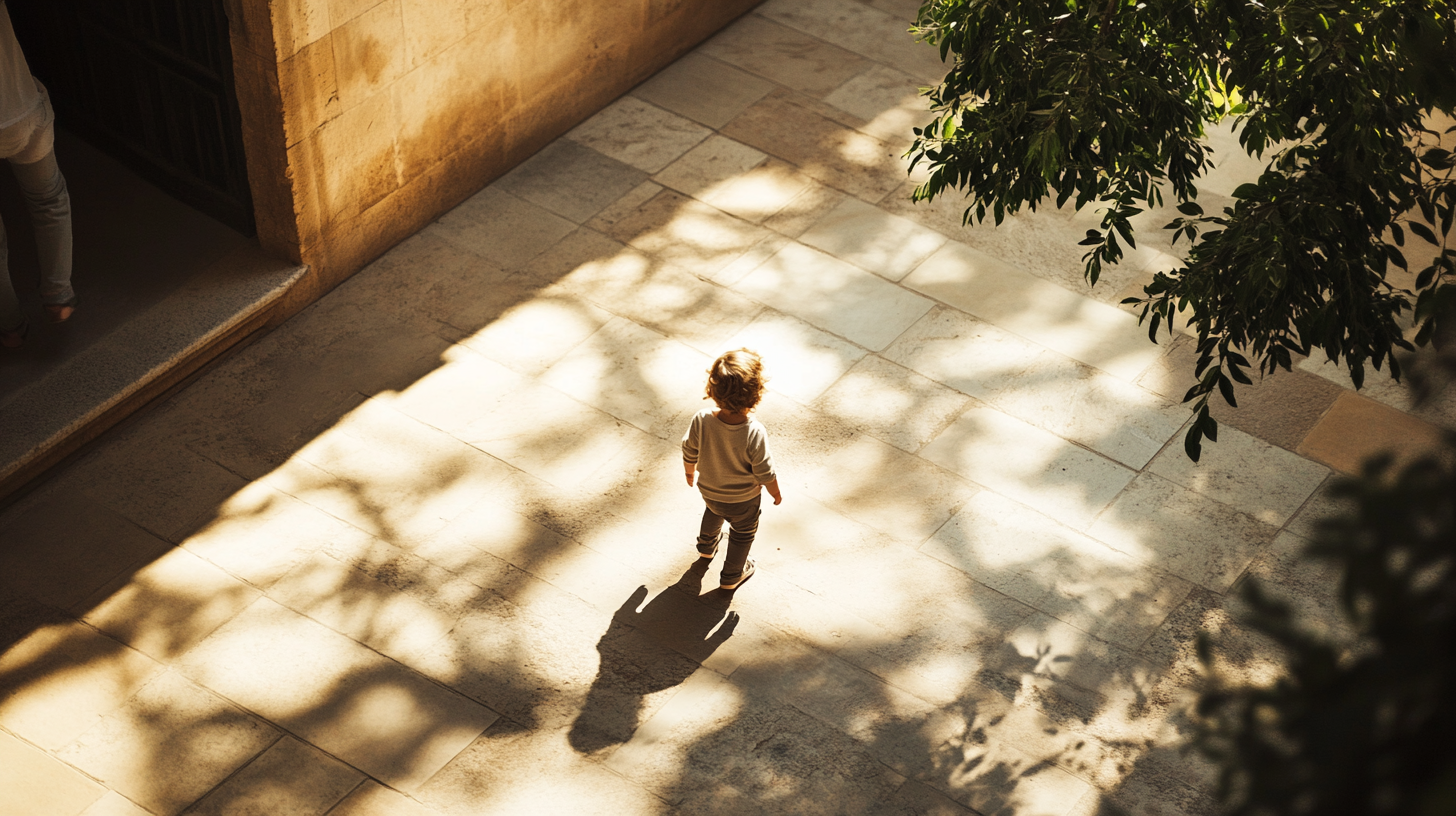
You are trying to get from the preschool gate to the car. It is twenty steps, maybe thirty. You know this because you have counted them before, standing at the curb with the diaper bag sliding off your shoulder, keys already in hand.
Your toddler takes four of those steps and stops.
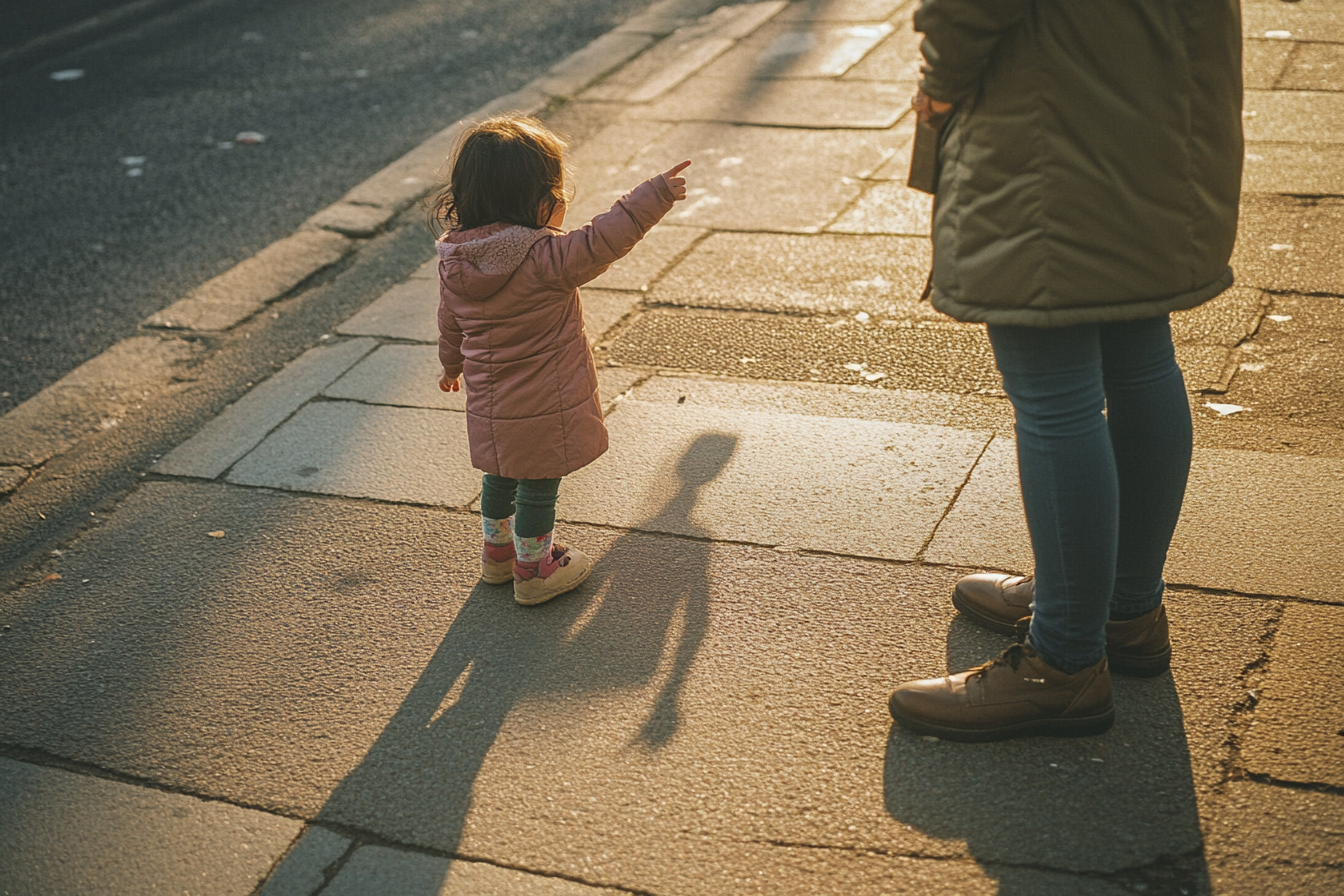
They crouch near a crack in the sidewalk. There is nothing there, as far as you can tell — a shadow, maybe a few grains of gravel — but they are looking at it the way you might look at something written in a language you almost understand. Then they stand, take one more step, and drop into a crouch again, this time near a drain cover, tapping it once with a flat palm to hear the sound it makes.
You have somewhere to be. The car is right there. Dinner needs to happen. And your toddler is now watching a beetle cross a slab of concrete as if nothing else in the world is currently scheduled.
A Reminder
It is fine to feel impatient here. You are not a bad parent for wanting to get to the car. Twenty minutes for a thirty-second walk is a real cost — to your schedule, your energy, sometimes your last bit of patience for the day.
But something else is also true, and it is worth knowing before the next slow walk starts.
You thought you were going for a walk. Your toddler thought they were entering a laboratory.
In This Article
- Why toddler walks feel so slow to adults
- Your toddler is not wasting time
- What toddlers are actually doing when they stop
- Why this is Montessori, even without a shelf
- What to say during a slow toddler walk
- What not to do on toddler walks
- A more realistic way to plan toddler walks
- 12 things toddlers learn on a slow walk
- When slow walks are hard
- The parent’s role on a slow walk
- Get the Slow Walk Observation Card
- FAQ
Why Toddler Walks Feel So Slow to Adults
An adult walk has a shape. You know where it starts and where it ends, and most of your attention goes toward the space in between — how much time is left, whether the light will stay green, whether you remembered the diaper bag. Distance is the whole point. The walk is a means to somewhere else.
A toddler does not experience the walk this way. They are not tracking the destination. They are tracking texture, sound, slope, shadow, and repetition — data about the world that has nothing to do with how many minutes are left before dinner.
The crack in the sidewalk is not a delay to a toddler. It is new information. So is the sound the drain cover makes. So is the way a shadow moves when a cloud passes overhead.
The adult walk is about getting somewhere. The toddler walk is about finding out what somewhere is made of.
Once you see the walk this way, the slowness starts to make a different kind of sense. This is really the answer to why toddler walks are so slow: your toddler is not behind schedule. They are working on a different project than you are.
Your Toddler Is Not Wasting Time
When a toddler stops walking, it can look like distraction — like they have lost the thread of what they were doing and wandered off into something irrelevant.
Often, it is closer to the opposite. A toddler stopping is frequently a sign of attention, not the absence of it. They have noticed something specific enough to interrupt movement for it: a detail an adult would walk past without registering at all.
What Actually Stops a Toddler
- A drain cover
- A crack in the sidewalk
- A puddle after rain
- An ant changing direction
- Leaves stuck to the curb
- A delivery truck reversing, beeping
- A shadow moving across a wall
- A small slope in the pavement
- A gate swinging open and shut
None of these are remarkable to an adult. All of them are new enough to a toddler to be worth a full stop.
It’s worth naming something honestly here: not every slow walk feels calm from the outside. Some are wet, sticky, interrupted by a toddler refusing to move at all, or spent negotiating over a rock that absolutely cannot be left behind. Slow does not always mean peaceful. But even in the messy versions, a real amount of development is usually happening underneath the friction.
What Toddlers Are Actually Doing When They Stop
Every pause on a toddler walk is doing more than one job at once. Here is what is actually happening in eight of the most common ones.
1. Sensory Mapping
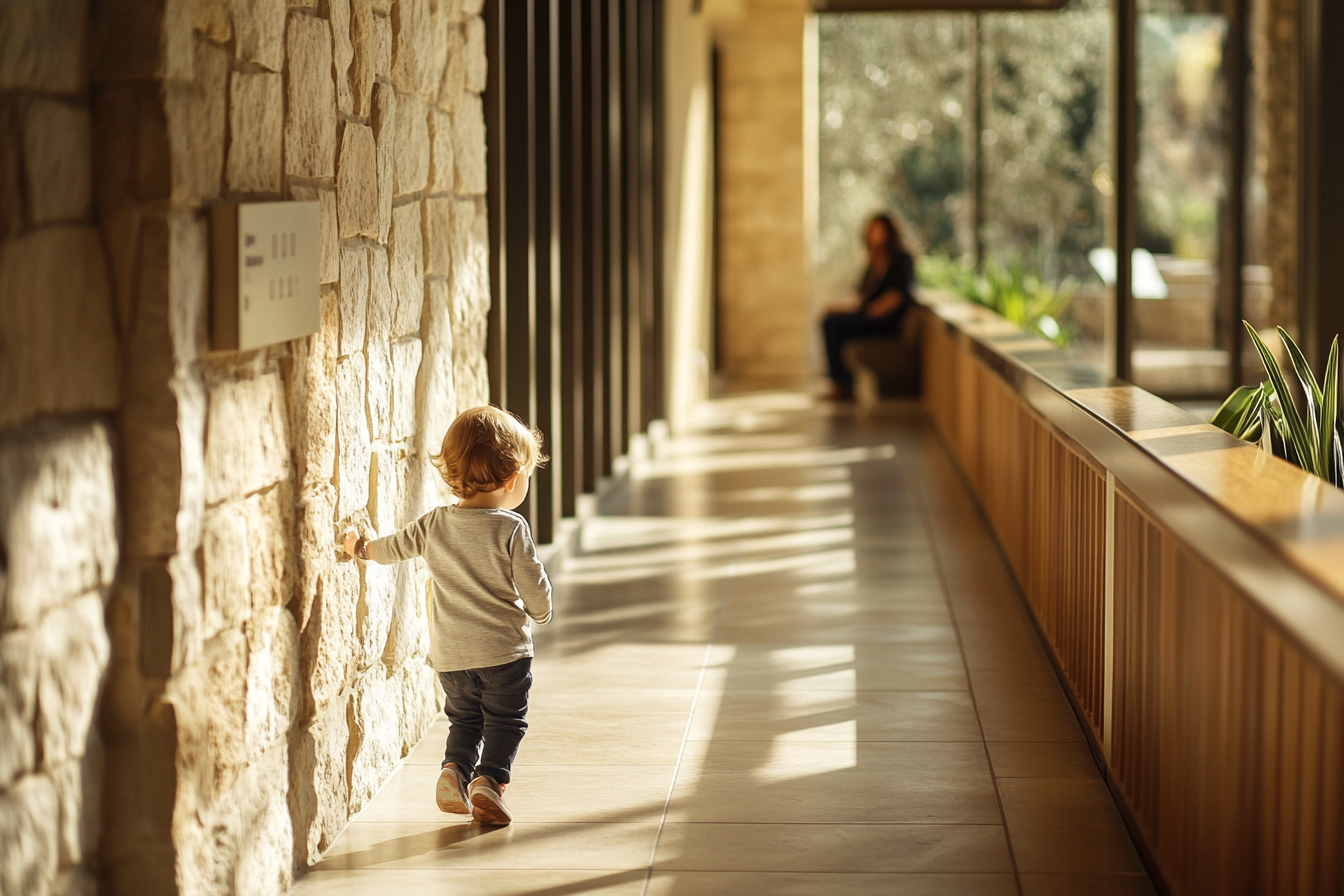
Every surface a toddler touches on a walk adds to a private, physical map of how the world feels. Rough bark. Cool metal railing. Gritty pavement. The give of wet sand versus the resistance of packed dirt. Warm brick that has been sitting in the sun.
This is not idle touching. It is how a toddler’s body learns what different materials are, long before they have words for rough, smooth, cold, or warm. A hand pressed flat against a wall is doing quiet, physical research.
2. Gross Motor Calibration
Every curb, slope, and uneven patch of ground is an adjustment problem for a body that is still learning how to move through space. Stepping down off a curb, balancing along the edge of a planter, squatting to look at something low and standing back up — these require constant small recalibrations of balance, strength, and coordination.
A flat, predictable sidewalk asks very little of a toddler’s body. A path with texture, slope, and obstacles asks a great deal — which is exactly why it is useful.
3. Fine Motor Investigation
Picking up a stone small enough to disappear between two fingers. Pinching a leaf off its stem. Turning a stick over to see the other side. Transferring a pebble from one hand to the other so the first hand is free to pick up something else.
These are precise, deliberate movements, and toddlers get very few chances to practice this kind of small-object control indoors. Outside, the materials are endless, and nobody minds if they get dropped.
4. Early Science
Dropping a pebble into a puddle and watching the ripple spread. Noticing that a stick scratches a line into dry dirt but not into wet dirt. Watching a leaf float instead of sink. Hearing that a shout sounds different against a wall than it does in the open.
None of this is being taught. It is being discovered, through direct contact with cause and effect — which is, for a two-year-old, actual science. It is also, quietly, an early form of counting and comparing: more ripples, fewer leaves, one stone versus three. There’s a whole outdoor version of this in Nature Counting For Toddlers, and if this kind of everyday quantity noticing interests you more broadly, What Math Really Looks Like Before Preschool goes further into what that actually looks like day to day.
5. Language Development
A word like wet often does not mean anything to a toddler until their hand has actually been in a puddle. That is why language on a walk tends to land better in the moment than in a book: big truck, tiny leaf, again, it fell, loud, same, gone.
A parent does not need to quiz or narrate constantly. Naming what a toddler is already looking at, in a short phrase, is usually enough. The moment does the teaching. The word just gives it a shape. And if walks are one of the few places your toddler seems to talk more, or you’ve been wondering whether their pace of talking is on track, What Actually Helps When You’re Worried About Toddler Speech Delay is worth reading.
6. Attention and Concentration
Stopping every few steps can look like a short attention span. Often it is the opposite — a very deep, very narrow attention aimed at one small thing at a time.
Toddler attention is not shaped like adult attention. It is not linear or forward-moving. It circles back to the same puddle, the same stone, the same drain cover, sometimes for days. That repetition is not boredom. It is closer to mastery in progress.
7. Independence and Agency
A walk hands a toddler a string of tiny choices: where to pause, what to look at, what to carry, when to crouch down, how close to stand to something new. Almost none of these choices exist inside a stroller ride or a rushed errand.
Each one is small. Together, they build something larger — a sense that a toddler’s own attention is worth following, and that their noticing matters enough to change what happens next.
8. Emotional Regulation
Rhythmic movement, repetition, fresh air, and real sensory input can help a toddler’s nervous system settle. A slow walk sometimes does more for a hard afternoon than anything said out loud.
That said, a walk is not a fix for every big feeling, and it would be dishonest to promise that. It is simply one more tool — a physical, sensory one — that can help, some of the time, alongside everything else a parent is already doing.
Why This Is Montessori, Even Without a Shelf
A slow toddler walk quietly checks nearly every box on a Montessori list, without a single wooden material in sight: real objects instead of toys designed to represent them, freedom within limits, movement, repetition, child-led attention, observation before interruption, practical independence, sensory learning, and an adult acting more as a quiet guide than an instructor.
Before there was a shelf, there was a path. Before there were materials, there were stones, puddles, leaves, steps, shadows, and doors.
None of this is an argument against shelves or trays or carefully prepared materials — those have their own real value. It is simply a reminder that the ordinary, unprepared world outside the front door is already rich with the same kind of learning, free of charge, on the walk to the car. It is also, in many ways, where this whole way of seeing a child starts — Why Nature Is The Original Montessori Classroom goes deeper into that idea, if you want to keep reading in that direction.
What to Say During a Slow Toddler Walk
Language on a walk works best in small doses. Some moments need a phrase. Many moments need none at all.
When They Stop
“You noticed something.”
“Let’s look for a moment.”
“I see it too.”
“You found a tiny one.”
“Your eyes saw that.”
When They Repeat the Same Action
“Again.”
“Same place.”
“You’re testing it.”
“It changed.”
“You wanted to see what would happen.”
When You Need to Keep Moving
“One more look, then we walk.”
“Carry it with you.”
“Let’s check the next corner.”
“Your feet can keep going while your eyes look.”
“We can stop at the tree, then we keep moving.”
When They Want to Collect Everything
“Choose one treasure.”
“This one can stay here.”
“Let’s put it back where it lives.”
“You can hold it until the gate.”
“We’ll leave it for another child to notice.”
None of this needs to be said every time. The goal is not to narrate every second of the walk. Sometimes the most useful thing a parent can offer is a short phrase. Sometimes it’s quiet.
What Not to Do on Toddler Walks
None of this is about doing everything right. It’s more a set of things worth noticing, when possible.
- When possible, try not to rush every single stop.
- When possible, try not to turn every observation into a quiz — “what color is that,” “what sound does it make.”
- When possible, try not to name everything before there has been time to actually look.
- When possible, try not to interrupt deep concentration with a stream of words.
- When possible, try not to judge a walk only by the distance it covered.
- When possible, try not to turn every walk into a planned activity.
- When possible, try not to make outdoor time feel like one more thing to perform well.
A Reminder
The walk does not need to become a lesson to be educational.
A More Realistic Way to Plan Toddler Walks
Not every walk can or should be led entirely by a toddler’s pace. It helps to think in two categories instead of one.
Destination Walk
For preschool drop-off, errands, appointments, getting home before dinner. You can set the limits ahead of time.
“This is a walking walk.”
“We can stop at the corner.”
“One treasure today.”
Discovery Walk
For the 10–20 minutes when there’s nowhere to be. The goal isn’t distance. It’s noticing. No checklist, no materials, nothing to prepare.
A small framework, depending on what you actually have that day:
- If you have 3 minutes: let them notice one thing, then move on together.
- If you have 10 minutes: let them choose the pace for part of the walk.
- If you have 20 minutes: bring nothing, and follow their attention.
- If you are exhausted: stand in one safe place and let them explore around you.
12 Things Toddlers Learn on a Slow Walk
Worth saving, for the next time a slow walk feels like it isn’t going anywhere.
Balance
Adjusting weight over a curb, a slope, or an uneven patch of ground, in real time, with no one holding them up.
Distance
What “far” actually feels like through their own legs, rather than through a stroller ride.
Texture
Rough bark, smooth stone, gritty pavement, cool metal — felt directly, not described.
Weight
A heavy stone versus a light leaf, compared in the hand rather than explained in words.
Sound
The hollow knock of a drain cover, the crunch of gravel, the rustle of a hedge in wind.
Cause and Effect
A pebble dropped makes ripples. A shout against a wall echoes. Nothing needs to be explained for this to land.
New Words
Wet, gone, again, big, tiny, loud — attached to something real instead of a flashcard.
Patience
Waiting for an ant to move, a puddle to still, a truck to finish reversing.
Body Awareness
Where their feet are, how close they are to an edge, how to squat down and stand back up.
Risk Judgment
Deciding, with supervision nearby, what feels safe enough to step on or reach for.
Observation
Noticing the kind of detail an adult would usually walk straight past.
Confidence
The quiet sense that their own noticing is worth following, and worth some of the walk’s time.
For a longer, saveable version of this list built around a single walk home, 40 Things Toddlers Learn On A Walk is a good next read.
When Slow Walks Are Hard
Some real constraints, said plainly: sometimes you are late. Sometimes the baby is crying in the carrier. Sometimes it is too hot, too cold, or raining sideways. Sometimes the toddler refuses to move at all. Sometimes there is no patience left to offer, and that’s honest too.
Scripts for Hard Moments
- “I know you want to stop. Today we need to keep walking.”
- “You can look while we move.”
- “I’ll carry you to the gate, then you can walk.”
- “We can come back to puddles another day.”
- “One more touch, then all done.”
Being a responsive parent does not mean every walk is child-led. It means knowing when there is room to slow down, and when you need to lead — and both of those are still good parenting.
The Parent’s Role on a Slow Walk
The parent’s job on a slow walk is smaller than it feels. Not to entertain, teach, or explain every single thing along the way, but to keep the child safe, offer time when there is time to give, notice what the child notices, add simple language here and there, protect the rhythm of the walk, and set a limit when a limit is actually needed.
You are not doing nothing. You are holding the space where attention can grow.
If you’re also curious about what this stage tends to look like more broadly — outside of walks, across a whole day — Learning Goals for 2 Year Olds is a calmer, non-milestone-anxious way to see the bigger picture.
Free Printable
The Slow Walk Observation Card
A simple printable for noticing what your toddler is learning outside.
If slow walks feel hard to appreciate in the moment, this one-page card can help you see what is happening underneath the stopping, touching, collecting, and repeating.
- 6 things to notice on a toddler walk
- 10 phrases to say instead of rushing
- 5 phrases for when you need to keep moving
- A tiny observation box: “Today my child noticed…”
One email. No spam. Unsubscribe any time.
Frequently Asked Questions
Why does my toddler stop so much on walks?
Toddlers are gathering sensory and observational information the whole time they’re outside — texture, sound, motion, cause and effect. Stopping is usually a sign that something has caught their attention, not that they’ve lost interest in walking. It tends to ease gradually as they get older and the world feels more familiar.
Is it normal for toddlers to walk very slowly?
Yes. A slow pace with frequent stops is typical for toddlers between about 12 and 36 months, especially on new or interesting paths. This is really at the heart of why toddler walks are so slow — it reflects how they explore the world at this age, not a developmental concern on its own.
How long should a toddler walk be?
There’s no fixed length that applies to every child or every day. A short walk with real time to notice things is often more valuable than a longer walk rushed from start to finish. Matching the walk’s length to the time and patience available that day tends to work better than a strict rule.
Should I let my toddler pick up rocks and leaves?
In most everyday settings, yes, with normal supervision for choking hazards and safety. Handling small natural objects supports fine motor skills and sensory learning. Setting a simple limit, like choosing one treasure to keep, can help contain the collecting without shutting it down entirely.
What should I say when my toddler keeps stopping?
Short, simple phrases usually work better than long explanations — things like “You noticed something” or “One more look, then we walk.” Sometimes no words are needed at all. If you have somewhere to be, an early “This is a walking walk today” can help set expectations before you leave.
Is a slow walk really learning?
Yes, in a practical, physical sense. Slow walks involve balance, sensory input, cause and effect, and language tied to real objects, all of which support development in an ordinary, unstructured way. If you have specific concerns about your child’s development, a pediatrician or a qualified specialist is the right resource for that conversation.
One day, this same walk will become ordinary to them too. They will pass the puddle, the crack, the ant, the wall, the flower growing out of the sidewalk, without a second glance — the way you already do. Familiarity will do what it always does, and the noticing will quiet down.
But right now, they are still new enough to the world to stop for all of it. For a little while, we get to walk beside that kind of attention, even when it makes us twenty minutes late.
The walk was not wasted. It was where the learning happened.
— Chichiberry Parenting