

Learning Goals For 2 Year Olds: What Growth Often Looks Like In Everyday Life
The most important developmental work at age two rarely looks like learning at all. It looks like puddles, wooden spoons, and a thousand small attempts to figure out how the world works.

The Question Most Parents Are Really Asking
There is a particular kind of worry that settles in around a child’s second birthday. It arrives quietly, usually through a conversation at a playgroup, a comment from a well-meaning relative, or a chart glimpsed at the pediatrician’s office.
Should my two year old know colors? Should they be counting to ten? Should they recognize letters by now?
These are reasonable questions. They come from a real place — from love, from wanting to do right by a child who can’t yet tell you what they need. But they are also questions that, if taken too literally, can send a parent looking in entirely the wrong direction.
Because the most significant learning goals for 2 year olds don’t live in flash cards or alphabet magnets. They live in the way a child crouches to examine a beetle. In the way they insist on carrying their own bowl to the sink. In the way they announce “more” and then, a few weeks later, “more milk please” — that tiny addition of one word that carries inside it months of language work.
This article is about what developmental goals for 2 year olds actually look like — not as a checklist to measure against, but as a landscape to observe. It will not tell you when your child should do something. It will show you what meaningful growth often looks like when it happens, so you can notice it, name it, and trust it.
That shift — from measuring to observing — is often enough to change the whole feeling of the toddler years.
What Makes Age Two Different
If the developmental work of 18–24 months was primarily about exploration — touching, tasting, dropping, carrying, repeating — then the work of 24–36 months begins to shift toward something more deliberate. Call it investigation.
The difference is subtle but worth understanding. A child who explored puddles at eighteen months splashed through them, got wet, felt the texture underfoot. The same child at two years old pauses at the edge of a puddle and looks. They pick up a stick and poke it. They crouch down and watch the ripples spread. They drop a leaf in and track it. The puddle hasn’t changed. The child’s relationship to it has.
This is not incidental. It is the emergence of intentional inquiry — a child moving from “what is this?” to “what does this do when I do that?” That shift is the beginning of scientific thinking, of mathematical reasoning, of language precision. None of which requires worksheets. All of which requires time, materials, and a parent who understands what they’re watching.
Age two also brings a child who is more communicative — not always in words, but in intention. Who is more observant, catching details that adults walk past. More independent in their wishes, if not always in their capacity to act on them. More imaginative, beginning to use one thing to represent another. And more emotionally present, aware of their own states in a way that is new and often overwhelming for them.
These shifts are the architecture of the second year. They are not problems to solve. They are developmental landmarks, and they deserve to be seen as such.
10 Signs Learning Is Already Happening
Before we look at each learning domain in detail, here is what 2 year old learning goals often look like in real domestic life. Not in a classroom. Not in a structured activity. On an ordinary Tuesday.
These are not warm-up activities. They are not the things that happen before the learning. They are the learning. Understanding this is, perhaps, the most useful reframe a parent of a two year old can make.
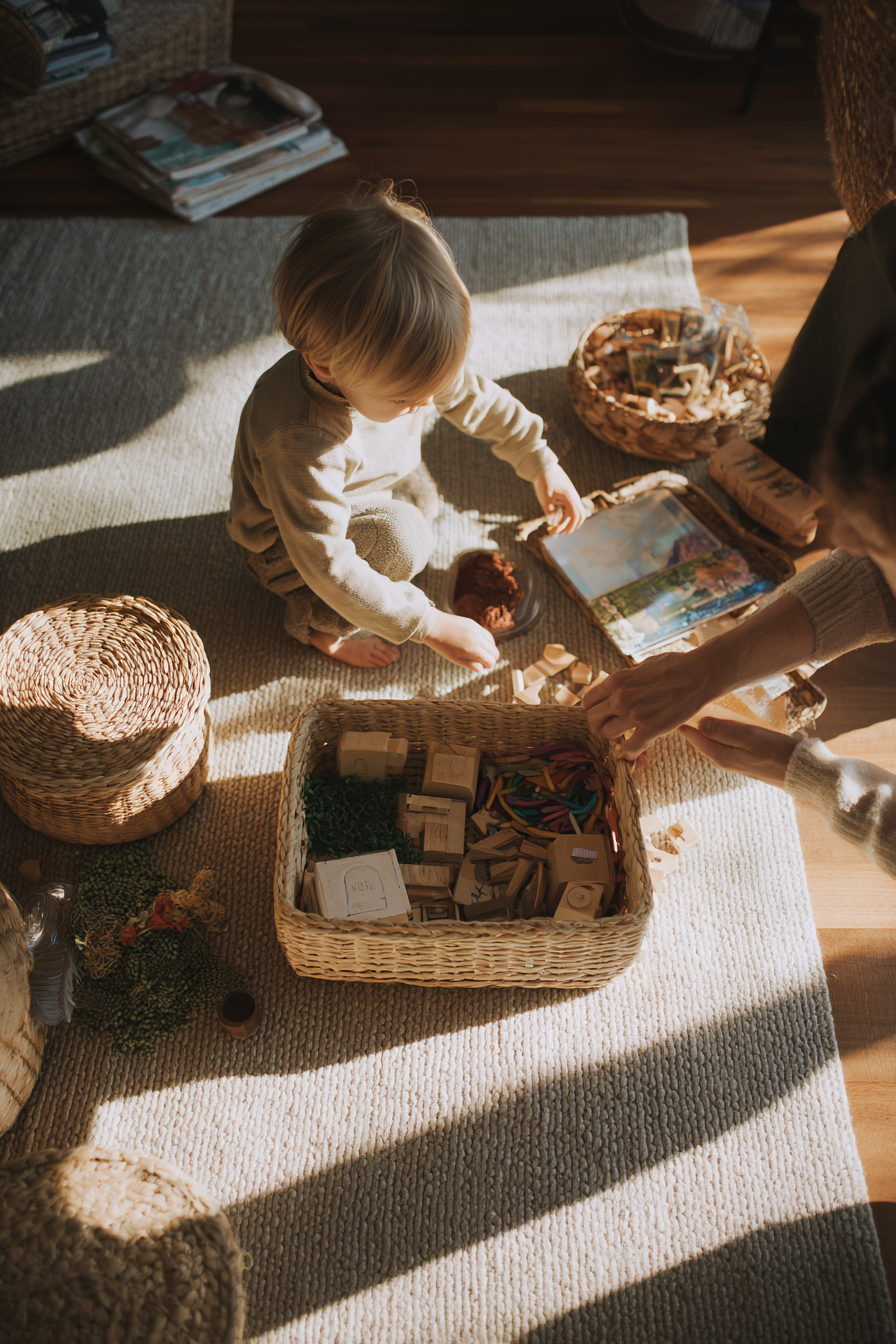
A Day In The Life Of A Learning 2 Year Old
This is not a schedule. It is not a routine to replicate. It is an account of one ordinary day — the kind that looks, from the outside, like not much is happening. And yet.
She wants to pour her own cereal. The bag is heavy and slightly unpredictable. She holds it with both hands, tilts it slowly, watches the pieces fall. Some miss the bowl. She looks at the ones on the table. Lines three of them up, parallel, before putting them in her mouth one by one.
This took four minutes. A parent who was watching closely noticed sorting, fine motor control, spatial attention, and early mathematical thinking. A parent who was running late noticed the mess.
Both were right. Neither was wrong. But only one of them saw the learning.
He stops at the same gate he stopped at yesterday. And the day before. He wraps his hands around the metal bars and looks through. Then he crouches down and looks through at a different height. Then he tries to fit his shoe through the gap at the bottom.
There’s a puddle further along. He moves around the edge of it three times before finding the shallowest point and stepping through. He looks at the marks his shoes leave. He steps again, deliberately, in exactly the same spot.
He is not bored. He has not run out of things to do. He is doing the most important thing he could be doing, which is investigating the specific properties of this gate and this puddle, today, at this moment, with his whole body.
She has taken the wooden blocks from the shelf and sorted them by size — largest to the left, smallest to the right — without being asked to and without any awareness that she is doing something remarkable. She is now constructing something that is either a house or a road or possibly both. The construction falls. She rebuilds it with the same pieces in the same sequence.
She is deep in what Montessori described as “the work of the child” — the kind of concentrated self-directed activity that looks, to an adult eye, like playing, and is, in fact, the most cognitively sophisticated thing she will do all day. The twenty minutes of quiet in the room is not incidental. It is the necessary condition for this kind of focus.
He insists on carrying the laundry basket. It is almost as big as he is. He tips it slightly, figures out the angle, and moves across the room with careful, deliberate steps. He drops it once. Picks it up. Continues.
At the washing machine, he wants to put the clothes in himself. Each item is examined briefly — a sock, a t-shirt, his father’s jumper — before being pushed through the door. He watches the door close. He presses the button when asked, then stands with his face close to the glass for a long moment, watching the clothes begin to turn.
He did not need an activity. He needed a task. There is a difference, and he feels it.
She wants the red cup. Not the blue one that is identical in every meaningful way. The red one. She names it — “red cup, red cup” — and this is not just a preference; it is language being used with precision and purpose to communicate an internal state. She is getting better at this every week, though it doesn’t feel like it from where her parent is standing.
At the table she distributes peas: two on her plate, two on the plate beside her, one that rolls away. She looks at the uneven distribution with a brief expression of concern. The counting, the fairness, the noticing of imbalance — these are early mathematical instincts, present and working, without a single lesson.
The same book. Again. For the eleventh night in a row.
He has memorized parts of it. He fills in words before they are spoken. He corrects a minor deviation when a parent reads the wrong word. He asks about the bird on page four, the same question he asked last night, and listens to the same answer with fresh attention.
This is not obsession. It is comprehension deepening — the same text yielding something new each time because he is new each time he comes to it. The language is settling in. The story is becoming a known world. He will carry it with him into other stories, other language, other understanding he does not yet have words for.
It was an ordinary day. Nothing special happened. He learned constantly.
What follows is a tour through ten developmental domains — the territories where a two year old’s growth most often lives. Each one deserves to be understood not as a goal to achieve, but as a direction a child is naturally moving toward, given time and space.
What 2 Year Old Learning Goals Look Like Across Ten Areas
These ten domains don’t operate separately. A child pulling carrots from the garden is exploring, observing, counting, describing, helping, and moving — simultaneously. The domains are a map, not a menu. They help us see what might otherwise be invisible.
At two, exploration becomes less about novelty and more about depth. A younger toddler picks up every object once. At this age, a child returns to the same object again and again, each time extracting something different from it.
This is the beginning of sustained inquiry — the cognitive predecessor to research, to science, to art. It doesn’t look impressive from the outside. It looks like a child who has been playing with water and a funnel for twenty minutes and is still not finished.
- Returns to the same corner of the garden to dig for several days in a row
- Tests what happens when different objects are dropped into water
- Carries things from one container to another, refining the process
- Investigates their food before eating it — texture, smell, structure
- Notices when something looks different from how they left it
What parents often misunderstand about this domain is that repetition is not boredom and not stalling. Repetition is how a two year old consolidates understanding. When a child rolls the same ball down the same ramp eighteen times, they are not failing to move on. They are conducting an experiment until they understand it.
You don’t need to extend or enrich this kind of play. You need to protect it — to not redirect it too quickly, to resist the urge to add more when what the child needs is more time.
Observation is probably the most undervalued of all the developmental goals for 2 year olds, precisely because it looks like nothing.
The child standing very still at the window. The child who stops mid-walk to crouch down and examine a crack in the pavement. The child who watches another child playing for a long time before joining, or before deciding not to join. These are not passive moments. They are active, concentrated data collection.
- Notices small changes — a moved object, a different color, a missing shoe
- Watches a process with sustained attention — water draining, birds eating
- Points things out that an adult would walk past without seeing
- Describes what they see with precision: “bird sitting” rather than just “bird”
- Stops and looks before acting — considering rather than charging
The Montessori tradition places observation at the center of early learning precisely because it is the prerequisite for everything else. A child who has learned to look carefully has already begun to learn how to think carefully.
You support this by pausing with them when they pause. By following their gaze. By saying, quietly, “I see it too.” Nothing more is required.
Sorting is early mathematics. Not the kind that requires numbers, but the kind that precedes numbers — the capacity to group, to categorize, to find the rule that makes some things the same and some things different.
Children this age sort compulsively and joyfully. They sort laundry. They sort stones. They sort toys by color, by size, by a logic that is entirely their own and which may shift mid-activity. What looks like disorder often has an internal structure that becomes visible if you watch long enough.
- Puts “big ones here, little ones there” without being taught to
- Separates food by type before eating — eats all of one thing first
- Lines objects up or groups them by properties you didn’t specify
- Notices when something is “wrong” — a shoe in the sock drawer, a spoon in the fork section
- Creates collections: “my rocks,” “my sticks,” “my things”
What parents often underestimate here is that this isn’t tidying — it’s thinking. The child who insists on sorting the crayons before drawing is not stalling the creative process. They are engaging the cognitive process. The sorting is the work.
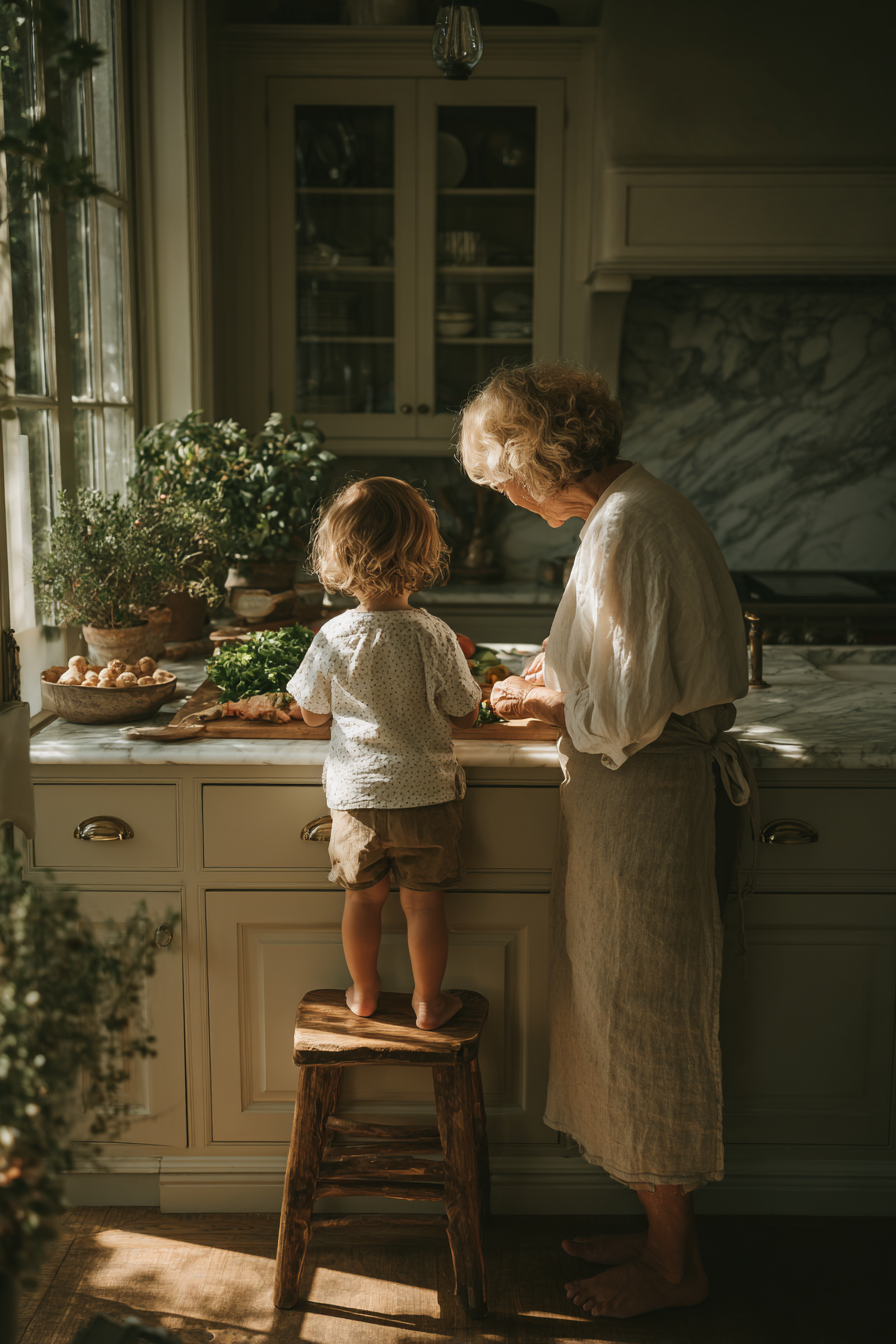
This is where the pressure tends to concentrate for many parents. And it is where stepping back is most worth the effort.
Counting to ten — reciting the sequence — is not number sense. A child can sing “one two three four five” with perfect rhythm and have no concept of what three means as a quantity. Real early mathematical development is about something quieter and more fundamental: the lived experience of more and less, one and many, enough and not enough.
- Distributes items — “one for you, one for me” — with real attention to fairness
- Notices when someone has more of something they want
- Counts two or three objects with one-to-one correspondence, touching each as they go
- Uses “more,” “all gone,” “lots,” “only one” with accuracy
- Engages in nature counting on walks — collecting leaves, stones, sticks — without any instruction to do so
Nature counting — gathering and grouping objects found outside — is one of the most developmentally rich number activities available to a young child, and it requires nothing except a walk and a pocket. The article on nature counting for toddlers explores this in more detail if you’d like to follow this thread further.
This is the language learning goal that matters most at age two — not vocabulary lists, not color drills, but the growing capacity to name what is actually there. To give the world language, and in doing so, to understand it more fully.
A child who says “soft” while touching a blanket and then says “rough” while touching bark is not showing off. They are doing something cognitively significant: categorizing sensory experience through language, building the neural architecture for description, comparison, and eventually, written expression.
- Finds new words for textures, temperatures, sizes without being prompted
- Applies known words in new contexts — “heavy” said while lifting a bag of groceries
- Uses two-word descriptions: “big truck,” “cold water,” “baby bird”
- Asks for the word for something by pointing and waiting
- Narrates their own actions: “pouring,” “mixing,” “going down”
The most supportive thing a parent can do in this domain isn’t to teach words. It’s to use them — to narrate, to name, to describe what’s happening in ordinary moments as they happen. Creating a language-rich home without buying anything new is one of the most accessible ways to support this. The words are already in every room. They just need to be spoken.
Connection at age two operates on two levels simultaneously. There is cognitive connection — the child who notices that the picture in the book looks like the dog next door, or who understands that the sound of keys means someone is about to come inside. And there is relational connection — the developing capacity for empathy, for reading other people, for beginning to understand that other minds exist and feel things.
Both of these are learning goals. Both of them develop through ordinary life, not structured activities.
- Makes connections between images, objects, and real experiences spontaneously
- Notices and responds to another person’s emotional state — “sad?” said to a crying adult
- Begins to understand cause and effect in relationships: “mama tired, go sleep”
- Refers to absent people and things — evidence of representational thinking
- Uses information from one context to navigate another
The Montessori concept of practical life is built on a simple and often counterintuitive conviction: that children learn through participating in real work, not in simulated versions of it.
A child who helps set the table — really helping, not playing at it — is developing concentration, fine motor control, spatial understanding, sequencing, and a sense of contribution. The fact that it takes four times as long and two napkins end up on the floor is beside the point. The point is the participation.
- Insists on carrying something — the bag, the book, their own shoes
- Wants to be involved in kitchen tasks: stirring, pouring, washing
- Asks to help with laundry, sweeping, wiping — real household rhythms
- Concentrates deeply while doing a practical task, more focused than during “play”
- Becomes upset when excluded from a task they feel belongs to them
Independence, in Montessori thinking, grows through participation rather than withdrawal. A child who is allowed to do real things with real materials is building something that a child who is always helped, always accommodated, is not. The work of practical life is the development of the self. Many of the most effective Montessori activities for toddlers are simply opportunities for this kind of real participation — nothing more elaborate than a sponge, a small pitcher of water, or a dustpan within reach.
Emotional expression at this age is often described as a problem: the tantrums, the crying, the disproportionate response to small frustrations. It is more accurately understood as a developmental edge — the place where a child’s emotional experience has outpaced their language for it.
The feelings are real and large. The vocabulary and regulated nervous system needed to navigate them gracefully are still being built. The meltdown at the grocery store is not misbehavior. It is an undeveloped system meeting an oversized experience.
- Names a feeling unprompted: “scared,” “happy,” “cross” — however approximately
- Comes for physical comfort when overwhelmed rather than escalating alone
- Uses language to negotiate rather than immediately resorting to physical action
- Shows empathy — adjusts their behavior in response to another’s distress
- Begins to recover more quickly from big emotions, with support
The developmental work here — naming feelings, regulating them, expressing them in ways that can be heard — is perhaps the most important work of early childhood. It does not happen through worksheets or feelings posters. It happens through being seen, named, and met in the difficult moments. The connection between language development and emotional regulation is closer than most parents realize.
Movement at two is not energy to manage. It is cognition in action.
The child who climbs the same small slope over and over, the child who carries a heavy object with full concentration, the child who insists on going down the stairs one step at a time without holding the railing — these children are doing motor planning, spatial problem-solving, proprioceptive learning. Their bodies are their primary instruments of understanding.
- Navigates uneven ground with deliberate attention — stones, grass, stairs
- Carries objects with increasing precision: not spilling, not dropping
- Uses the full body to solve spatial problems — ducking, turning sideways, backing up
- Demonstrates growing fine motor control: pinching, threading, pouring
- Returns to a challenging physical movement until they master it — then moves on
The richest environment for this domain is simply outside, often. Uneven surfaces, natural materials, weather, and the open spatial complexity of a garden or park provide physical challenges that no indoor activity can replicate. There is nothing to buy. There is only time to give.
Symbolic thinking is one of the great milestones of human development, and it arrives quietly, usually sometime in the second or third year, through a banana held up to an ear as a telephone or a stick waved through the air as a magic wand.
When a two year old uses one thing to represent another, they have crossed a significant threshold. They can hold two realities in mind simultaneously: the object as it is, and the object as they imagine it to be. This is the foundation of reading, writing, mathematical abstraction, and every other symbolic system that education is built on.
- Uses objects as substitutes for other objects: a box becomes a car, a cloth becomes a cape
- Engages in role play with genuine commitment: feeding dolls, doctoring toys, cooking in the mud
- Creates and repeats narratives: the same scenario played out many times
- Involves a parent or sibling in their imaginary world with specific, firm instructions
- Blurs the line between real and pretend — and isn’t yet bothered by this
Imaginative play is not a luxury domain or a break from real learning. It is, by many accounts, the most cognitively and emotionally sophisticated thing happening in a toddler’s day. Protecting the time and space for it is one of the most meaningful contributions a parent can make.

How These Experiences Prepare Children For Preschool
There is sometimes a fear, underneath all the questions about 2 year old learning goals, that ordinary play isn’t enough. That without explicit academic preparation, a child will arrive at preschool behind.
The research is consistent and reassuring on this point: what predicts preschool readiness is not early letter knowledge or number recitation. It is developmental readiness — the capacity to attend, to regulate, to communicate, to persist through difficulty, to engage with other people. All of which is built, domain by domain, in the experiences described above.
There is a persistent pressure in modern parenting to get there first. To start the letters early, to know the numbers before preschool, to give a child every advantage before the calendar pages turn and some imagined window closes.
Developmental science — and Montessori philosophy, and forty years of attachment research — consistently suggests the opposite. That the learning which sticks, which builds real capacity, which becomes the foundation for everything that follows, is the learning that happened in the right sequence, at the right developmental moment, because a child was ready for it.
You cannot rush this. You can, however, create the conditions for it. Outdoors often. Real materials. Meaningful participation in household life. Conversations about what’s actually happening around you. A parent who can say, quietly, “I see what you’re doing,” and mean it.
Curiosity matters more than performance at this age. Participation matters more than accuracy. Connection matters more than output. A two year old who is curious and confident is building the internal architecture that will carry everything else.
What You Can Do At Home
Nothing on this list requires purchasing anything. Nothing requires a particular setup or a particular kind of home. These are ideas that work in small apartments and large gardens, on complicated days and quiet ones.
An outdoor walk with a two year old, taken slowly and without a destination in mind, may be the single richest learning environment available. Uneven surfaces for the Move domain. Insects and birds and weather for Observe. Sticks and stones for Sort and Count. Space to run, space to climb, space for the body to understand itself through real terrain.
Ten minutes outside is worth more than an hour of structured indoor activity. Not because indoor activities are bad, but because the outside offers a complexity that no room can replicate.
Identify one household task that happens regularly — setting the table, folding small cloths, watering plants, sweeping — and make space for your two year old to participate in it. Not a simplified version. The real thing, with the expectation that it will be slow and imperfect.
The learning that happens inside a real task — concentration, sequencing, physical control, contribution — cannot be manufactured through an activity designed to look like a task.
Language development for 2 year olds doesn’t require flashcards. It requires a parent who talks during the real moments — at the kitchen counter, on the walk, while washing hands. “The water is cold today.” “That’s a very heavy bag.” “I can hear a bird — can you hear it too?” These are not lessons. They are language in context, which is the only form that truly sticks.
A box of natural objects — pinecones, shells, smooth stones, sticks, seed pods — set out on a tray is one of the most generative things you can offer a two year old. It invites sorting, counting, describing, connecting, imagining. It doesn’t instruct. It offers. The child brings the learning.
Simple, open-ended materials consistently outperform complex, purpose-built toys in terms of the depth and duration of a child’s engagement. This is not a theory. It is one of the most reliably observed patterns in developmental research.
Perhaps the most useful practice a parent of a two year old can develop is the habit of pausing. Of watching what a child is doing before deciding it needs to be redirected, extended, or improved. Most of what a two year old does that looks like not much is, in fact, learning. The watching is the learning. The sorting is the thinking. The refusal is the development of the self.
Observation, in the Montessori tradition, is not passive. It is the active work of truly seeing a child. And a child who is truly seen — whose work is noticed and respected — learns more deeply than a child who is constantly instructed.
The common thread across all of these: they center the child’s curiosity rather than the parent’s agenda. They create conditions for learning rather than delivering learning. They trust that the developmental work is happening, even — especially — when it doesn’t look like anything particular.
A printable journal designed to help you slow down and notice the learning that’s already happening in your child’s everyday life — without turning observation into a checklist or development into a performance.
This is not a tracking tool. It is a place to notice what your child is becoming.
- Observation pages for each of the 10 learning domains
- Weekly “what I noticed” journal prompts
- Monthly reflection pages for the 24–36 month window
- Preschool readiness reflection prompts — for when that season approaches
- A gentle reminder for the weeks when development feels invisible
Printable. Free to download. No certification required — just a parent who is paying attention.
Frequently Asked Questions
What Two Looks Like
There are children right now, in homes and gardens and kitchen floors all over the world, who are doing the most important work of their young lives. They are pouring water. They are sorting stones. They are repeating a word they discovered this morning and trying it in six different sentences to see if they understand it properly. They are feeding a small plastic elephant with a leaf and taking this very seriously.
None of it looks like what we have been told to expect from learning. And yet it is exactly what learning at this age looks like.
The learning goals for 2 year olds that matter most are not about what a child knows how to name. They are about how a child relates to the world — with curiosity or with anxiety, with confidence or with fear, with the sense that their observations are worth something or with the sense that the only thing that matters is the correct answer.
Those orientations — toward curiosity, toward confidence, toward the intrinsic pleasure of understanding something — are built in ordinary moments. Not in lessons. Not in drills. In a parent who pauses with them at a puddle. In work that is real and meaningful. In a home where the exploring is respected even when it is inconvenient.
You are likely already doing more of this than you know.