Learning Goals For 3 Year Olds — Chichiberry Parenting
Development · Age 3 · Learning Through Play
Learning Goals For 3 Year Olds: What Growth Often Looks Like When Curiosity Starts Connecting Everything
At three, children are not preparing for school. They are doing something far more interesting — learning how ideas connect to one another. Here is what that often looks like on an ordinary Tuesday.
Category Development
Age 3 Years
Reading time 22 min
chichiberry.com
Something shifts quietly around a child’s third birthday. The questions change. Where a two-year-old pointed and named things — dog, car, that — a three-year-old starts asking why. Why does the moon follow us home? Where does the water go? What are clouds made of inside?
For parents, this is a genuinely delightful time. It is also the age at which the noise about learning goals, preschool readiness, and developmental milestones tends to get louder. Suddenly the question is not what your child can do, but what they should be doing — and whether they are doing enough of it.
This article is a reframe. Not because learning goals for three-year-olds are unimportant, but because the way we tend to measure them — through academic performance, letter recognition, or standardised assessments — misses where most of the meaningful growth is actually happening.
At three, children are learning through curiosity. They are building understanding through stories, questions, pretend play, and relationship. They are learning how ideas connect. That is a serious developmental project. It simply does not look like sitting at a desk.
You Are Not Alone In Wondering
The Question Most Parents Are Really Asking
When parents search for learning goals for three-year-olds, they are rarely looking for a developmental framework. What most of them are really asking is something quieter and more personal than that.
Is my child learning enough?
Are we doing enough?
Is there something we should be doing that we are not?
These are not anxious questions, exactly. They are the questions of parents who care — who notice that their child has just turned three and that the wider world suddenly seems to have opinions about what that means. Preschool applications. Readiness assessments. Friends whose children are already doing phonics. Apps that promise to accelerate development. A general cultural sense that if you are not doing something deliberate, you might be falling behind.
This article is a gentle answer to all of those questions at once.
The most important learning at age three often cannot be measured on a checklist. It does not show up in a two-minute assessment or reveal itself in a classroom observation. It appears in the questions a child asks at breakfast, in the story they are narrating quietly to a toy rabbit at 7am, in the way they stand at a window for two minutes watching nothing in particular, in the connection they make between a sad bear in a story and a friend who cried yesterday.
What this article offers
Not a milestone list. Not a readiness checklist. A way of seeing what is already happening — so that the next time your child stops to study a spiderweb for ninety seconds, you recognise it for what it is: a child in the middle of learning something.
If you have read our articles on learning goals for 18–24 month olds or learning goals for 2 year olds, you will recognise this framework. The investigating child of age two — touching, tasting, dropping, repeating — becomes the connecting child of age three. Same child, same ten domains, same ordinary days. A different kind of work underway.
What follows is that work, described as carefully as we can.
What To Look For
10 Signs Learning Is Already Happening
Before we talk about learning goals for three-year-olds, it is worth pausing on this: the learning is almost certainly already happening. You may just not be seeing it for what it is. Here are ten things a three-year-old does that are, in developmental terms, very significant indeed.
Observable behaviours · No checklist required
10 Signs Your Three-Year-Old Is Already Learning
None of these require a worksheet. All of them are worth noticing.
1
They ask a question nobody can answer.
Why is the sky blue at night when it’s dark? This is not a gap in knowledge. It is the beginning of scientific thinking.
2
They connect two unrelated experiences.
The puddle today reminds them of the puddle at grandma’s three weeks ago. They are building a mental web of the world.
3
They invent a story while looking at a cloud.
Unprompted narrative is a sign of symbolic thinking, language development, and imagination operating together.
4
They notice something everyone else missed.
The chip in the tile. The different coloured leaf. Sustained, independent observation — one of the rarest forms of attention.
5
They explain something incorrectly but logically.
The sun goes behind a cloud because it’s cold. Wrong, and completely logical. Hypothesis formation, built from available evidence.
6
They pretend one object is another.
A stick becomes a spoon, a block becomes a phone. Symbolic substitution is the cognitive root of reading, mathematics, and language.
7
They create a rule for a game.
You have to step on the squares, not the lines. Rule-setting is logic, social negotiation, and abstract structure — all at once.
8
They negotiate.
If I eat the broccoli, can I have one more story? Negotiation is conditional reasoning, empathy, and executive function in one sentence.
9
They remember something from days ago.
And bring it back at the exact right moment. Episodic memory, temporal awareness, and emotional salience are all developing here.
10
They ask “why?” again after already receiving an answer.
The follow-up why is not defiance. It is the purest sign of a mind that wants to keep going — that is not satisfied with the surface of things.
If any of these sound familiar, you are already watching learning happen. The question is not whether your child is learning. The question is whether you can recognise it when it is in front of you.
The question is not whether your three-year-old is learning. The question is whether you can recognise it when it is right in front of you.
Chichiberry Parenting · chichiberry.com
A CCBR Signature Idea
The Year Connections Begin
There is a distinction that matters more than most developmental language captures. At two, children investigate. They are the world’s most dedicated empiricists — touching, tasting, dropping, watching what happens. Learning at two is fundamentally physical and sensory.
At three, something new begins. Children start to connect things that were previously separate. Not just the physical properties of objects, but the relationships between experiences, ideas, people, and stories. The world is no longer just a collection of things to examine. It is a web of things that relate to one another.
A child connects
The moon in a storybook to the real moon outside the window
Symbol and reality beginning to map onto one another. This is the root of symbolic thought — and eventually, of reading.
A child connects
Yesterday’s walk in the rain to today’s grey clouds
Temporal reasoning and cause-and-effect thinking, built from personal experience rather than instruction.
A child connects
The pretend shop in the playroom to the real market they visited on Saturday
Experience becomes material for imagination, which then deepens understanding of the experience. A loop that builds both ways.
A child connects
A sad character in a picture book to a friend who cried at nursery
Empathy through narrative — one of the most powerful ways the human mind learns to understand other people’s inner lives.
These are not random observations. Each of them is the beginning of a specific kind of thinking that will matter across the child’s entire intellectual life.
Abstract thinking
When a symbol stands for something real
Narrative thinking
When events connect across time into a story
Scientific thinking
When observation leads to hypothesis
Symbolic thought
When one thing can mean another thing
None of this requires a lesson. It requires a child who is embedded in a rich environment — stories, conversations, outdoor time, pretend play, and the ordinary texture of a lived day. The connections happen because the child’s mind is ready to make them, and because the experiences are there to connect.
The CCBR view
Age three is not the beginning of preparation for school. It is the beginning of the kind of thinking that makes a person genuinely interesting to talk to for the rest of their life. That is worth protecting more than it is worth accelerating.
Where Age 3 Fits
From Age 2 To Age 4: The Bridge
Age three sits in an important position within the arc of early childhood development. To understand what is happening now, it helps to see it in relation to what came before and what will follow.
Age 2
Age 3
Age 4
Investigates
Connects
Explains
Touches and tastes
Relates and compares
Reasons and argues
What is it?
Why?
How does it work?
Sensory understanding
Relational understanding
Conceptual understanding
I notice this thing
This thing connects to that thing
Here is a theory about both of them
Object permanence
Causal thinking
Hypothetical thinking
Age three is the bridge between exploration and explanation. The child arriving at this stage has spent the previous year building an incredibly rich sensory map of the world. Now they begin to draw lines between the points on that map — to ask what one thing has to do with another, and why.
This is why the questions change so dramatically around the third birthday. What is that? gives way to why does that happen? It is not a bigger question. It is a different kind of question. It means the mind is operating at a new level.
Across the cluster
This progression — from investigation at two, to connection at three, to explanation at four — is the signature arc of the Chichiberry Age Learning Goals series. Each stage builds on the one before it. No stage needs to be accelerated, because each one is doing exactly the work it is supposed to do.
Development
What Makes Age 3 Different
Between the ages of two and three, most children move through a stage of what researchers sometimes call functional investigation — picking things up, tasting, dropping, repeating. The world is physical. Understanding comes through hands.
At three, something changes. Curiosity becomes more connected. Children begin to ask questions that link cause to effect, sequence to outcome, and their own experience to the wider world around them. Why does the bread go hard? What happened to the butterfly? If I pour this here, does it come out there?
This shift matters because it means learning is no longer purely sensory — it is becoming conceptual. The child is building a mental model of how things work. And they are doing this not in structured activities, but in every conversation, story, trip to the garden, and hour of pretend play.
What to notice
Questions are not interruptions to learning at this age. Questions are the learning. When a three-year-old asks why the sky is blue, they are not waiting for a correct answer. They are practising the act of wondering — which is the foundation of every intellectual skill that follows.
A three-year-old who has never been handed a worksheet, but who has spent the year cooking alongside a parent, building with blocks, hearing stories, playing in mud, and being listened to — that child is developing extraordinarily rich cognitive and social architecture. The growth just happens to be invisible on a checklist.
Learning Goals For 3 Year Olds
The 10 Learning Domains
Rather than a milestone checklist, what follows is a framework for observing development across ten domains — the same ten that run through the Chichiberry approach to early learning. For each domain, we describe what growth often looks like in a three-year-old, offer a real-life example, and note the common misconception that can get in the way of seeing it clearly.
01Explore
Following curiosity into the world
What growth often looks like
A three-year-old explores with intention now, not just impulse. They return to the same places repeatedly — the crack in the pavement, the puddle after rain, the corner of the garden where the snail lives — because they are tracking change over time. Exploration at this age is slow and sustained.
Real-life example
Your child notices the worm on the path every morning for a week. One day it is not there. They ask where it went and check again the following day. This is exploratory thinking. It involves observation, memory, and hypothesis — in a three-year-old carrying a backpack to the park.
Parent observation note
Notice what your child returns to. Repeated interest is not boredom — it is depth. The child who wants the same garden walk every afternoon is building a detailed internal map of that space and everything living in it.
Common misconception
That exploration needs to be structured — a nature activity, a planned experiment, a science kit. It doesn’t. Free outdoor time, with a parent nearby and no particular agenda, is one of the richest exploratory environments that exists for a three-year-old.
What you might notice this week
returning to the same spotasking follow-up questionstracking something over dayspausing before moving on
02Observe
The art of paying sustained attention
What growth often looks like
Three-year-olds develop the capacity to observe without touching — to watch something unfold and hold that attention. They begin to notice detail: the ladybird on the leaf, the change in a person’s expression, the way the light moves across the floor in the afternoon.
Real-life example
Your child stands at the window for several minutes watching a pigeon on the roof. They do not ask for anything. They are simply watching. This is sustained observation — a capacity that will serve them in reading, science, friendship, and every discipline that requires patience with detail.
Parent observation note
Resist the urge to narrate or teach during moments of quiet observation. A child watching a beetle walk across a stone does not need commentary. They need the space to watch.
Common misconception
That a quiet, still child is disengaged. Often the reverse is true. Some of the most active cognitive work at this age happens during stillness.
What you might notice this week
standing still for longer than usualnoticing detail before you dowatching without touchingdescribing what they see unprompted
03Sort
Building the logic of categories
What growth often looks like
Three-year-olds begin to sort by multiple attributes — not just colour, but colour and shape, or size and texture. They also start to notice when things don’t fit a category and express that discomfort: that doesn’t go there. This is early logical thinking.
Real-life example
Your child unpacks the dishwasher and sorts the spoons separately from the big spoons, and tells you the teaspoons are different from the tablespoons even though you haven’t named them that. They noticed the distinction themselves. That is categorical thinking emerging through real life.
Parent observation note
Sorting appears in tidying, cooking, play, and conversation. It does not require a Montessori sorting tray to develop — though that can be a lovely provocation if the child is interested.
Common misconception
That sorting is a maths activity to be done at a table. Sorting is a thinking strategy that shows up everywhere — including in the stories children tell, where they sort characters into good and not-good, old and young, here and gone.
What you might notice this week
organising by more than one rulesaying “that doesn’t belong”creating their own categoriesre-sorting after changing their mind
04Count
Understanding quantity, not reciting numbers
What growth often looks like
Three-year-olds develop one-to-one correspondence — the understanding that each number word applies to exactly one object. They also begin to grasp that the last number counted tells you the total. This is a significant conceptual step. Many three-year-olds can recite to 10 but still count the same object twice — that gap between recitation and understanding is entirely normal.
Real-life example
Your child hands out plates at dinner, placing one in front of each person and announcing proudly that there are four. This is not just counting — it is counting with purpose, in a real context, connected to people they love. That is richer developmental soil than a worksheet.
Parent observation note
Count things that matter in your household — stairs, fruit in the bowl, shoes at the door. Embedding numbers into daily life builds numerical understanding far more effectively than drilling number sequences.
Common misconception
That being able to count to 20 means a child understands number. Recitation and conceptual understanding develop separately, and the latter matters more.
What you might notice this week
counting things with purposedistributing items one-to-onenoticing “not enough” or “too many”checking their own count
05Describe
Language as a tool for making sense of experience
What growth often looks like
Vocabulary expands rapidly at this age — often by several new words a day. But more interesting than the number of words is the quality of description. Three-year-olds begin to use comparative language (bigger, softer, more orange), temporal language (before, after, yesterday), and emotional language (sad because, happy when, scared of).
Real-life example
Your child tells the grandparent on the phone about the dog at the park, and uses three separate descriptors — it was big, and fluffy, and it licked my hand and it was warm. This is descriptive narration. They are learning to translate experience into language, which is the foundation of both reading comprehension and emotional intelligence.
Parent observation note
Expand your own vocabulary gently in conversation — not to teach, but to model. The sky is very still today. That fabric feels almost velvety. Children absorb the texture of language they hear regularly.
Common misconception
That vocabulary is built through flashcards or word drills. Language grows in conversation — in the gap between one person’s words and another’s response.
What you might notice this week
using comparison wordsnarrating past eventsdescribing feelings with contextreaching for new words
06Connect
Understanding that things relate to one another
What growth often looks like
Three-year-olds begin to build mental maps of relationships — between people, between events, between cause and effect. They start to understand because in a more genuine way. They also begin to notice when someone is upset and make a connection between the feeling and a possible reason.
Real-life example
Your child notices you sigh and says, are you tired from work? This is connection. They have linked an observable signal (the sigh) to a remembered context (work) to a feeling state (tired). That is sophisticated relational thinking for a person who has been alive for three years.
Parent observation note
Connection grows through story — picture books, family stories, and the small narrations of daily life (we’re going to the market because we need tomatoes for dinner). These micro-narratives teach causality without a lesson plan.
Common misconception
That social-emotional development is separate from cognitive development. They are the same thing. A child learning to read emotions is building the same neural architecture as a child learning to read text.
What you might notice this week
linking today to yesterdaynoticing another person’s moodusing “because” correctlyconnecting a story to real life
07Help
Independence through genuine participation
What growth often looks like
Three-year-olds are capable of real contribution to family life — not pretend helping, but actual tasks done alongside adults. Sweeping, pouring, folding, preparing food, caring for plants. This participation builds confidence, sequencing skills, physical coordination, and a sense of belonging that no worksheet can replicate.
Real-life example
Your child is given the job of adding the salt to the pasta water every evening. They take this seriously. They wait for the invitation, add it carefully, and watch it dissolve. This is practical life learning — physical, sequential, real, and deeply satisfying to a child who wants to matter in the household.
Parent observation note
The investment in slowing down to include a three-year-old pays compound interest. The child who folds napkins at three often sets the table independently at five. The skill is secondary. The sense of capability is primary.
Common misconception
That children this age are too young for real tasks and will only make a mess. Some mess is part of learning the task. The child who never pours from a jug never learns to pour from a jug.
What you might notice this week
helping without being askedfollowing a multi-step taskwanting to do it themselvescorrecting their own mistakes
08Express
Finding words for inner experience
What growth often looks like
Emotional vocabulary develops rapidly at three — not just the basic words (happy, sad, scared) but the more nuanced ones (frustrated, proud, nervous, disappointed). A child who has emotional language available can use it instead of a tantrum. Not always. But more often.
Real-life example
Your child starts to cry when you leave a playground and then, after a moment, says, I feel sad because I wasn’t finished yet. This is emotional expression with narrative structure. They have identified the feeling, found a word for it, and connected it to a cause. That is significant development, and it happened through ordinary life.
Parent observation note
Emotion is not separate from learning. A child who feels seen and named in their inner experience develops more trust, more language, and more capacity to regulate — all of which affects how they learn everything else.
Common misconception
That emotional expression at this age means meltdowns need to be eliminated. Some emotional intensity is part of having large feelings and a limited nervous system. The goal is not to eliminate the feeling, but to gently expand the vocabulary around it.
What you might notice this week
naming a feeling with a reasonasking “are you sad?”using nuanced emotion wordsrecovering with words rather than behaviour
09Move
The body as the first instrument of learning
What growth often looks like
At three, gross motor skills become more confident and coordinated — running, jumping, climbing with intention rather than effort. Fine motor development also continues: scissors begin to make sense, mark-making becomes more deliberate, and children start to grip writing tools with a three-finger hold. Physical development and cognitive development are not separate systems.
Real-life example
Your child spends 20 minutes carefully transferring water between two containers using a small ladle. The floor gets wet. They do not mind. This is fine motor development, concentration, physics exploration, and practical life skill — all in one puddle.
Parent observation note
Movement is not a break from learning. For three-year-olds especially, it is the primary medium through which many kinds of learning happen. A child who has been still and quiet all morning may need an hour of climbing before they are able to focus again.
Common misconception
That a child who cannot sit still is not ready to learn. At three, sitting still is a skill in development — not a prerequisite for development.
What you might notice this week
precise handling of small objectsclimbing with more confidencesustained fine motor focusseeking physical challenge intentionally
10Imagine
The developmental work happening inside pretend play
What growth often looks like
Pretend play becomes deeply elaborate at three. Children construct narrative scenarios with roles, rules, plot, and emotional stakes. They assign characters to toys, maintain story continuity across days, and resolve conflicts in play before they can resolve them in real life. This is not entertainment. It is a primary developmental workspace.
Real-life example
Your child has been playing the same game with two wooden bears for three weeks. The bears have names, they live in a particular house, and one of them is sometimes sick and needs looking after. Inside this game, your child is processing empathy, narrative structure, care, routine, and probably something from their own life that they are working to understand.
Parent observation note
Protect long periods of uninterrupted play. The most complex imaginative scenarios take time to build. A child interrupted during the construction of a play world is a child interrupted during significant cognitive work.
Common misconception
That imaginative play is less educational than structured activities. Research consistently suggests the opposite: open-ended pretend play in early childhood is among the strongest predictors of later language, emotional regulation, and creative thinking.
What you might notice this week
play continuing across daysinventing story rulesassigning roles to othersone object becoming another
A three-year-old who spends the year in conversation, play, and ordinary participation is building something that no worksheet could measure — and nothing could replace.
Chichiberry Parenting · chichiberry.com
A Gentle Reframe
What Three-Year-Old Learning Often Does Not Look Like
Learning goals for three-year-olds get distorted when they are modelled on older-child or school-age benchmarks. Some of what is sometimes recommended for children this age is, at best, neutral — and at worst, actively works against the developmental agenda that is already underway.
—
Worksheets
Three-year-olds learn through movement, relationship, and sensory experience. A worksheet requires a child to translate living understanding into marks on paper — a skill they are still developing. It measures the output, not the learning.
—
Flashcards
Memorisation and understanding are different processes. A child who can identify a flashcard letter has learned a visual symbol. A child who has heard a thousand stories has begun to understand what words do.
—
Early formal academics
Reading instruction before four is not recommended by most early childhood researchers, and evidence for its long-term benefits over play-based learning is weak. The foundations for literacy are built through conversation, story, and rich language environments — not through early reading drills.
—
Performance-based learning
When learning becomes about demonstrating competence for an adult’s reassurance, it stops being self-directed. Three-year-olds have a natural drive to explore and understand. That drive is more valuable than any particular skill it might produce — and it needs protection, not testing.
What parents often feel at this age
There is real social pressure around preschool learning goals — from other parents, from apps and screen-time programmes marketed as educational, and from a culture that equates early academic exposure with later advantage. The research does not consistently support this. What consistently predicts positive outcomes in later childhood is early language richness, warm responsive relationships, and the freedom to play.
Narrative
A Day in the Life of a Curious Three-Year-Old
Here is what a day of learning actually looks like. No lesson plan. No curriculum. No educational app running in the background. Just a child, a household, and the ordinary hours of an ordinary Tuesday. Every moment that follows is real — the kind of real that happens in every home, invisibly, all the time.
Morning · Noticing
7:02 am
She wakes before her parents and lies in bed narrating something quietly to a stuffed rabbit. The story has a beginning, an escalating problem, and what sounds like a resolution involving a very small boat. She has been refining this story for four days. Each morning the boat is slightly more important. (Imagine, Express, Describe)
7:35 am
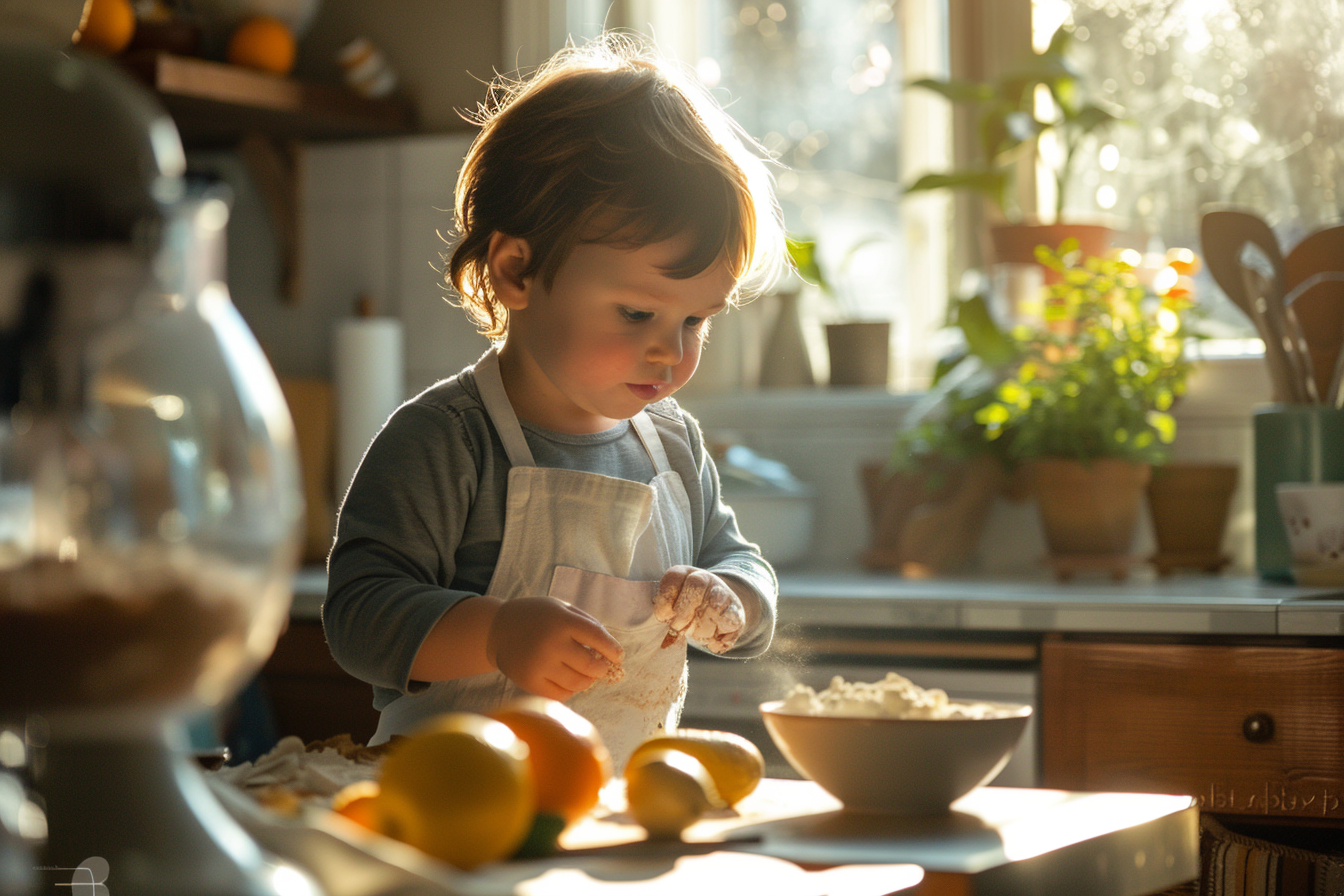
At breakfast she wants to pour her own milk. Her parent watches without intervening. She pours too much and the cereal overflows onto the mat. She watches this with genuine scientific interest — not distress, not self-criticism, just observation. Too much, she says. She mops it with a cloth without being asked. Tomorrow she pours less. (Move, Count, Explore, Help)
7:58 am
She notices the light is different this morning. She cannot name what is different — the angle, the quality, something. She stands at the window for nearly two minutes looking at it. Her parent does not interrupt. Whatever she is working out, she is working it out. (Observe)
The Walk · Observation
8:20 am
On the walk to her childminder, she stops at the same lamppost she has stopped at every day this week. There is a spider web in the hinge. Yesterday it was complete and symmetrical. Today it has a large gap on the left side. She studies this for a while. Something ate it, she says. Her parent says, maybe. They stand together for ninety seconds that nobody planned. (Observe, Connect, Describe, Explore)
8:34 am
She asks why pigeons walk the way they do. Her parent does not know. Maybe they’re looking for something, her parent says. Or maybe that’s just how their feet work, she replies. She has not accepted the first answer. She is holding both possibilities. This is exactly what three-year-old thinking is supposed to do. (Connect, Explore, Describe)
Play · Imagination at Work
10:00 am
At the childminder’s, she builds a structure from wooden blocks, then announces it is a hospital. The hospital has a waiting room, a kitchen, and a special room for animals. A younger child wants to join. She assigns them a role: you are the one who brings the food. She has just created a rule, delegated a task, and built a social structure — in a game. (Imagine, Sort, Connect, Help)
10:40 am
She sorts a pile of mixed buttons for fifteen minutes — first by colour, then she changes her mind and resorts by size, then she makes a third pile she calls ones I like best. The third category is subjective and she knows it. She defends it when challenged by another child. (Sort, Describe, Express, Connect)
Lunch · Helping as Learning
12:10 pm
She helps set the table for lunch — counting out six cups and six plates, matching them carefully to the six chairs. She puts one plate on the wrong side and notices before anyone else does. She corrects it quietly. (Help, Count, Sort, Move)
12:25 pm
During lunch she tells the childminder about the spider web and the gap in it. She uses the words yesterday and before correctly. She compares the two webs — whole versus broken — and uses the word different without prompting. This narration is language development, temporal reasoning, and descriptive vocabulary all at once. (Describe, Connect, Express)
Afternoon · Making Connections
2:15 pm
Back at home, she spends forty minutes alone in the garden with a stick and a patch of damp earth. Nobody knows precisely what she is working on. She wasn’t saying. But the quality of attention is unmistakable — the particular stillness of a child who is deeply inside something. This is the attention that adults spend years trying to recover. (Explore, Observe, Move)
3:00 pm
She brings her parent a leaf and explains that it fell off the tree because the tree didn’t need it anymore. This is incorrect, biologically. It is also a completely reasonable hypothesis built from the evidence available to her — the leaf fell, trees sometimes lose things, things are let go when they are no longer needed. She has made a cause-and-effect connection. The content is wrong. The thinking is right. (Connect, Describe, Explore)
Evening · Storytelling
6:40 pm
At dinner she tells her other parent everything that happened today — the spider web, the pigeon, the button sorting, the leaf. The narrative is roughly chronological. She uses and then repeatedly and with increasing confidence. The events of her day have become a story, and she is its narrator. (Express, Describe, Connect, Imagine)
7:30 pm
At bedtime, during the story, she asks why the bear in the book doesn’t have a mother. Her parent pauses. They talk about it for a while. She is quiet after. When she goes to sleep, she is still carrying the question. There are few more powerful signs of developing empathy and emotional reasoning than a question that a child keeps after the light goes off. (Connect, Express, Imagine)
In this ordinary Tuesday, she moved through all ten learning domains before dinner. The learning was not happening despite the ordinary day. The learning was the ordinary day.
No worksheet contributed to what happened today. No flashcard, no app, no structured lesson. What contributed was: a parent who stood at a lamppost for ninety seconds, a morning with enough time to notice the light, a childminder who let her sort buttons her own way, and a bedtime story followed by a conversation that didn’t rush toward sleep.
Preschool Learning Goals
How This Learning Prepares Children For Preschool
There is a version of the preschool readiness conversation that focuses on what a child can do before they arrive: whether they can write their name, recognise letters, count to twenty. That version of the conversation is not well supported by research — and it tends to create anxiety in families whose children are doing exactly what three-year-olds are supposed to do.
The more useful question is: what do the ten learning domains — the ones building right now, through play and conversation and ordinary participation — actually prepare a child for? The answer is: everything that matters.
Domain
Builds
What this means at preschool
Explore
→
Curiosity
A child who has been allowed to follow their own interest freely becomes a child who approaches a new environment with engagement rather than anxiety.
Observe
→
Attention
The capacity to watch something unfold without needing to act — to sustain focus on a process — underpins every group activity in an early childhood setting.
Sort
→
Logical thinking
Sorting is the foundation of both mathematical and scientific reasoning. A child who naturally sorts by multiple attributes is already thinking in categories.
Count
→
Number sense
Genuine numerical understanding — built through real contexts rather than recitation — gives a child stable ground for every formal mathematics concept that follows.
Describe
→
Language fluency
Rich oral vocabulary and the confidence to use it are among the strongest predictors of literacy development. A child who speaks in full sentences has an enormous advantage.
Connect
→
Comprehension
Understanding narrative — cause and effect, character motivation, sequence — is the heart of reading comprehension. It begins years before a child encounters written text.
Help
→
Independence
A child who participates in household tasks at three manages transitions, follows multi-step instructions, and completes activities independently at four and five.
Express
→
Emotional communication
A child who has words for their feelings is a child who can navigate a new social environment — conflicts, disappointments, excitement, and all of it — with language rather than behaviour.
Move
→
Physical confidence
Fine and gross motor development directly affects writing readiness, physical self-regulation, and the ease with which a child navigates a busy physical environment.
Imagine
→
Symbolic thinking
The child who can pretend a block is a car already understands that one thing can represent another — which is precisely what letters and numbers require.
This is preschool readiness. Not letter drills. Not sight words. The deep foundations — the ones that hold up everything built on top of them — are built through play, through conversation, and through the everyday developmental work of being three.
A note on school readiness
The children who struggle most in early formal schooling are rarely the ones who didn’t learn their letters. They are more often the children who were not allowed to develop self-regulation, independent curiosity, or confidence in their own capacity to navigate difficulty. Those things grow in play. They do not grow in worksheets.
For Real Homes
What Parents Can Focus On Instead
If learning goals for three-year-olds are better observed than administered, what does that mean for parents in practice? It does not mean doing nothing. It means choosing the right kinds of environments and interactions — ones that support the developmental agenda the child is already running.
Conversation
Talk with your child about what you are doing, what you notice, what you wonder about. Not narrating everything — just being present in words. I wonder why that cloud looks so dark. The question matters more than the answer.
Outdoor Exploration
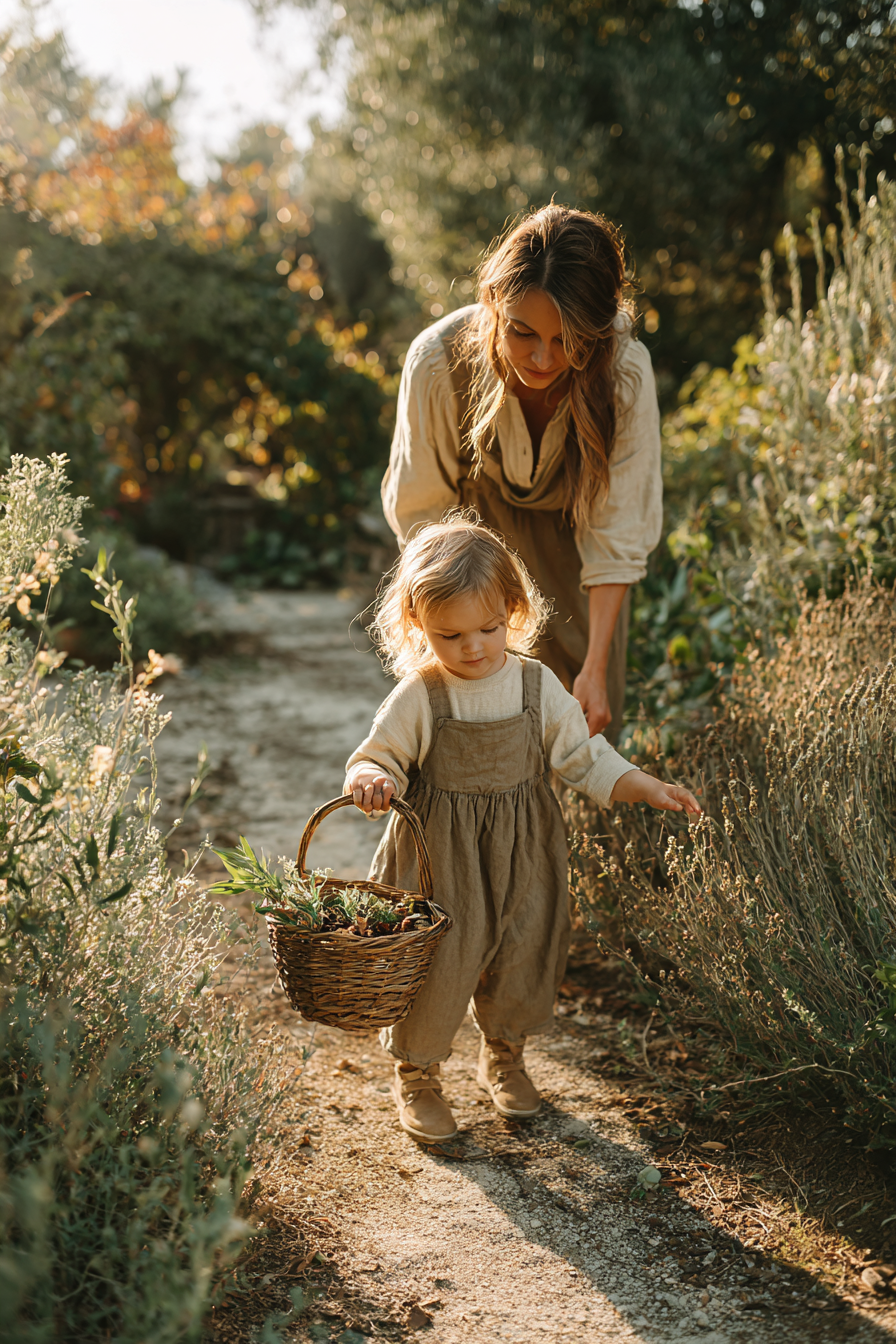
Time outside with minimal agenda. The park is enough. The garden is enough. A walk with no destination is enough. Three-year-olds are doing serious observational work in unstructured outdoor time.
Pretend Play
Protecting long, uninterrupted stretches of imaginative play is one of the most developmentally significant things a parent can do at this age. Resist the urge to join, guide, or add educational content.
Participation in Family Life
Cooking, cleaning, gardening, shopping, caring for others — these are not distractions from learning. They are the curriculum. A three-year-old who participates in the household is developing across every domain simultaneously.
Reading Together
Not to teach letters or sounds — simply to build the world of story. Reading aloud builds vocabulary, emotional comprehension, narrative understanding, and the quiet habit of attention. The book does not need to be educational. It needs to be loved.
Being Present
Responsive attention — noticing, acknowledging, following the child’s lead in conversation — builds the kind of attachment and trust from which all learning grows. You do not need a curriculum. You need presence.
Observation Over Assessment
Try Watching For These This Week
Before reaching for a checklist, try this instead. Spend a week simply noticing — not directing, not assessing, just watching. These prompts are not a test of your child’s development. They are an invitation to shift from worrying about what your child should be doing to seeing what they are already doing.
What questions appeared more than once?
Repeated questions reveal genuine curiosity — a mind returning to something unresolved.
What stories were invented?
Unprompted storytelling — at play, at bedtime, in the bath — is language, imagination, and emotional processing at work simultaneously.
What small details were noticed?
The thing you walked past without seeing. The colour you didn’t know had changed. A child who notices what adults miss is building scientific attention.
What connections were made?
Anything that reminded them of something else. A book character who is like a friend. A shape that is like a thing they saw last week.
What helping behaviours appeared?
Did they offer to carry something, set something out, tidy without being asked? Self-initiated helping is a sign of growing agency and belonging.
What surprised you?
The most important observation of the week. Whatever it was — write it down. It will not feel small in ten years.
The 3-Year-Old Curiosity Observation Journal below was designed exactly for this kind of watching — not as a developmental tracker, but as a record of ordinary moments that are, quietly, anything but ordinary.
Free Download · Chichiberry Parenting
3-Year-Old Curiosity Observation Journal
A journal that helps you see what is already growing. Printable pages for recording your child’s development across all ten domains — in the language of everyday life, not developmental checklists.
Three-year-olds are not preparing for school. They are learning how ideas connect to one another — and that is a more important project.
The child who spends this year in conversation, in story, in play, in outdoor exploration and household participation will arrive at four with something more durable than early academic skills. They will arrive with curiosity that knows how to reach toward the world. That is not a preparation for learning. That is learning itself.
Gentle Conclusion
What This Year Is Really About
If you have been wondering whether your three-year-old is learning enough, the question worth sitting with is: enough for what?
Enough to pass an assessment, meet a milestone, or perform on a checklist — perhaps not. But three-year-olds are not built for those things yet, and building them early carries a cost that research is increasingly clear about: the cost to intrinsic motivation, to self-directed curiosity, to the sheer pleasure of wondering without being graded on it.
The child who at three asks why the stars are there, who makes up stories about two wooden bears, who carefully counts six cups at snack time and pours from the jug until they get it right — that child is doing exactly what they are supposed to be doing.
They are learning how everything connects. And they are doing it in the only way that works at this age: through curiosity, relationship, and ordinary time.
3 Year Old Milestones
Beyond Traditional 3 Year Old Milestones
Developmental milestones are useful tools. They exist to help clinicians and families identify when something might warrant a closer look — and that is genuinely valuable. This article is not arguing against milestones as a screening concept.
But milestones are not the same thing as development. A milestone is a threshold: can this child do this thing by this age? Development is a direction: how is this child’s understanding of the world growing, moment to moment, in the particular texture of their own life?
The distinction matters most at age three, because many of the most important forms of growth at this stage are not the kind that show up in a structured assessment. They are forms of growth that are difficult — sometimes impossible — to standardise.
Curiosity
The drive to keep wondering after a first answer. The willingness to sit with a question that has no answer. Cannot be measured on a checklist.
Imagination
The richness of the worlds a child constructs in play. The continuity of stories that run across days. No standardised assessment captures this.
Empathy
The capacity to connect a story character’s sadness to a real person’s sadness. To bring a leaf to a parent as a gift. To notice something in another’s face before it is named.
Connection-making
The moment a child links yesterday’s rain to today’s puddles, or a picture book moon to the one outside the window. The web of meaning they are building, invisibly, all the time.
Storytelling
The way a child narrates their day at dinner, with a beginning and a middle and something that mattered. This is language, memory, and emotional architecture — all at once.
Self-direction
The child who initiates their own play, pursues their own interest, corrects their own errors, and returns to the same patch of garden every afternoon because it is theirs. No test for this.
If your child’s development concerns you — if there are specific things you are noticing around language, hearing, or social engagement — please do speak with your paediatrician. Milestones exist for good reason. But if your worry is more general — a feeling that your child should be doing more, learning faster, showing more academic readiness — this article is the answer to that worry. They are doing more. You may simply be looking in the wrong places.
Questions Parents Often Ask
About Learning Goals For 3 Year Olds
What are realistic learning goals for a 3 year old?
Realistic learning goals at three centre on process rather than product: growing curiosity, building language, developing the capacity to play imaginatively for sustained periods, learning to express emotion with words, participating in practical life, and spending time in outdoor exploration. A three-year-old who is curious, communicative, and capable of pretend play is meeting every significant developmental target — whether or not they can recognise letters.
How do I know if my child is ready for preschool?
Preschool readiness is less about specific academic skills and more about the foundational capacities that allow a child to function in a group environment: the ability to separate from a parent without distress (or to manage distress with adult support), some capacity for independent self-care, enough language to communicate needs, and an emerging ability to engage with others in play. A child with a rich play history and warm relationships has usually developed these capacities — regardless of whether they can count or recite the alphabet.
What skills matter most before age 4?
The skills that research most consistently links to positive outcomes in later childhood are: oral language richness, narrative comprehension (understanding and creating stories), self-regulation (the ability to manage impulses and frustration), social confidence, and intrinsic motivation — the drive to keep exploring and trying even when things are difficult. All of these grow most effectively through play, relationship, and ordinary life. None of them require formal instruction before four.
What should a 3 year old be learning?
At three, the most meaningful learning happens across ten broad domains: exploring, observing, sorting, counting, describing, connecting, helping, expressing, moving, and imagining. Rather than specific academic targets, the focus at this age is on building curiosity, language, and a sense of agency through everyday experiences. Learning through play at age 3 is not a compromise — it is the most effective method available.
What are the most important preschool learning goals for this age?
The most research-supported priorities for three-year-olds include: rich oral language development, strong attachment and emotional security, opportunities for pretend and imaginative play, fine and gross motor development, and real-life participation in household and community life. Academic targets like letter recognition, while not harmful in small doses, are not the developmental priority that matters most at three.
Are there 3 year old milestones I should be watching for?
Rather than a checklist of milestones, it is more useful to observe patterns of engagement: Is your child curious and willing to explore? Are they building language and using it to describe their experience? Can they sustain attention on something that interests them? Are they beginning to play imaginatively with narrative and character? These developmental directions are more meaningful than any specific skill at a specific age.
Is learning through play really enough at age 3?
Yes — and the evidence supporting play-based learning in early childhood is extensive. Play at this age is not the absence of learning. It is the primary vehicle through which three-year-olds build language, emotional regulation, executive function, narrative thinking, social understanding, and physical coordination. A child in rich play is doing serious developmental work.
My child seems behind other three-year-olds. Should I be concerned?
Development at three varies widely and does not proceed in uniform steps. A child who seems quieter, slower to speak, or less interested in structured activities than peers may simply be developing differently in that area while making significant progress elsewhere. If you have persistent concerns about language, hearing, or social engagement, speaking with your paediatrician is always a reasonable step — but comparing children of this age can obscure more than it reveals.
How much structured activity does a 3 year old need?
Very little. Most early childhood researchers suggest that free play — both indoors and outdoors, with and without other children — should make up the majority of a three-year-old’s day. Structured activities, if chosen, work best when they are brief, child-led, and without performance expectations. The most valuable structured time at this age is often simply reading together.
What does 3 year old development look like in the Montessori approach?
In the Montessori framework, three-year-olds are in the first plane of development — characterised by an absorbent mind that learns through movement, sensation, and real experience. The emphasis is on practical life skills, sensorial exploration, and prepared environments that allow self-directed activity. The goal is not academic achievement but the development of independence, concentration, and intrinsic motivation.
Should a 3 year old be able to read or write?
Most three-year-olds are not developmentally ready for formal reading or writing instruction, and most early childhood researchers do not recommend it at this age. The foundations for literacy — rich vocabulary, narrative comprehension, phonological awareness, fine motor control — are most effectively built through conversation, stories, songs, and play. These foundations matter more, and last longer, than early formal instruction.
Toddler Age Learning Goals Series
The Complete Series
Each article follows the same ten-domain framework across different ages.
Learning Goals For 2 Year Olds: What Growth Often Looks Like In Everyday Life — Chichiberry Parenting Chichiberry Parenting · Toddler Development Learning Goals For 2 Year Olds: What Growth Often Looks Like In Everyday Life The most important developmental work at age two rarely looks like learning at all. It looks like puddles, wooden…