

What To Say At Bedtime To Build Toddler Language
Bedtime is not a lesson. It is one of the softest language windows in the day — if we know how to use it.

Why Bedtime Is One of the Richest Language Moments in the Day
The room is dim. Your toddler is finally still, tucked under something soft. The day — with all its noise and motion and transitions — has slowed to almost nothing. And in that slowness, something opens up.
You say, quietly: We had a long day today. You played in the garden. You got so muddy. Your child looks at you. Maybe they don’t say anything. Maybe they repeat muddy in a small voice before closing their eyes. Maybe they just listen.
That is language. Real language. Not a lesson, not a quiz — just a parent putting words around a child’s experience at the exact moment the world has gone quiet enough for those words to land somewhere.
Bedtime is one of the most consistently underused language moments in a toddler’s day, not because parents don’t talk at bedtime — most do — but because the words often get swallowed by urgency. Time to sleep. Lie down. Stop wiggling. Close your eyes. These are useful phrases, but they mostly move a child through a transition. They don’t leave much room for the slower, richer language that builds vocabulary, emotional understanding, and a sense of the day as a story that made sense.
The reason bedtime works so well for language — when we let it — comes down to a few things happening at once.
The first is the body. A toddler at bedtime is physically settling. Their nervous system is decelerating. That slower state means incoming language has fewer competing signals. The room isn’t full of things to grab or run toward. Their eyes are soft. They are, in one of the rarest states of the day, genuinely available to listen.
The second is repetition. Bedtime happens every night. That means whatever you say tonight, you can say again tomorrow, and the night after, and the night after that. Repetition is how toddler language builds. Not novelty, not variety — repetition. The same phrase about being tired, the same sentence about what happened today, the same goodnight sequence — these become familiar, then expected, then eventually something a child can fill in themselves. The phrase comes first. The word follows weeks later.
The third is one-on-one space. Many toddlers spend their day in the company of siblings, caregivers, other children, noise. Bedtime is often the only moment in the day that is just the two of you. That intimacy creates a different quality of attention. A toddler who barely looked up at language spoken across a busy room may absorb a quiet bedtime phrase completely.
And finally — bedtime naturally touches things that are hard to find language for elsewhere in the day. Tiredness. Disappointment that the day is ending. The feeling of being cozy, or safe, or proud of something small that happened. These aren’t words toddlers have yet. Bedtime is when a parent can quietly begin to offer them.
Five Kinds of Bedtime Phrases That Build Toddler Language
You don’t need a script. You don’t need to work through all five of these categories every night. What you’re looking for are small moments, scattered through the last twenty minutes of the day, where words can settle into your child like warmth from a bath.
Think of these as five different types of language that bedtime naturally makes space for. Each one does something slightly different developmentally. Together, they make bedtime one of the richest, most consistent language experiences in your toddler’s week.
At bedtime, a toddler’s day has just happened but hasn’t been made sense of yet. Narration phrases do exactly that — they put the day into words. Simple, concrete, ordinary words. Not a summary, not a lesson. Just: here is what we did, and here is what your body did, and here is what happened next.
What this supports developmentally is significant. Memory language — the ability to hold and retrieve and talk about experiences — begins here. Verbs, sequencing words (first, then, after), and real-life comprehension all grow through this kind of language. A toddler who hears their day narrated back to them three or four times a week starts to understand that experiences have shape, that words attach to real things, and that what happened to them is worth talking about.
These phrases don’t need to be full sentences. They can be fragments. They can be wrong. They can miss things. What matters is that the language exists, is calm, and references something true from your child’s actual life today.
- “We went to the market this morning. You carried the little bag.”
- “You played with the water in the sink for so long today.”
- “First we had lunch, then you had a rest, then Nana came.”
- “You climbed up the big step by yourself. Your legs are getting so strong.”
- “That was a big day. A lot happened.”
- “You were upset when we had to leave the park. You really wanted to stay.”
One of the most important — and often missing — layers of bedtime language is the vocabulary for what is happening inside the body right now. A toddler at bedtime is often experiencing very specific physical and emotional states that they have no words for yet: the heaviness of tired limbs, the specific sadness of a day ending when you weren’t ready, the particular comfort of a familiar blanket, the longing for one more book.
When we name these states out loud, calmly and without commentary, we are not teaching the child to perform emotion. We are offering them a vocabulary for what is already happening inside. Over time, that vocabulary becomes something a child can reach for themselves — I’m tired or I feel sad instead of a meltdown — and for the kind of emotional language that makes relationships possible as they grow.
You don’t need to be certain about what your child is feeling. You can guess. You can offer the words gently, without insisting. The offer is the thing. Even if the word is wrong, you have demonstrated that feelings have names, and that someone is paying attention to them.
This is also where the same feeling-naming approach that helps during big daytime moments shows up at its softest — because the stakes are lower and the body is already settling.
- “Your body is so tired. Your eyes want to close.”
- “It can feel sad when the day ends, even after a good one.”
- “You feel cozy under your blanket.”
- “You seemed a little frustrated this afternoon. That kind of day is tiring.”
- “Your legs are heavy now. All that running.”
- “You really wanted another book tonight. I know. It’s hard to stop.”
These are the phrases that matter most and are said least. Not because parents don’t feel them — most do — but because they get swallowed by the logistics of putting a child to sleep. Connection phrases are simply: I saw you today. I was paying attention. Here is something specific about you that I noticed and loved.
This isn’t about praising achievements. It’s not good job. It’s the more intimate thing: noticing. Noticing the way a toddler tried something hard and didn’t give up. Noticing the way they were gentle with a friend, or delighted by something small, or brought something to show you even though you were busy. Noticing that being with them is genuinely meaningful.
Developmentally, connection phrases build relational language — the vocabulary of being in relationship with someone. They also create what might be the most important thing bedtime can give a child: the felt sense of being truly seen by someone who loves you. There is something about emotional safety that seems to make children more open to language — not because security is a teaching strategy, but because when a child feels held, their whole system is simply more available.
These phrases also expose a toddler to rich, complex sentence structures in the most emotionally available moment of the day. A child listening to I loved the way you tried to zip up your jacket yourself, even though it took a long time is hearing subordinate clauses, time language, and emotional vocabulary — without a lesson in sight.
- “I loved being with you today.”
- “I noticed how carefully you carried the eggs from the shop.”
- “You were so kind to the cat this afternoon. You were very gentle.”
- “When you laughed at the pigeon, I thought — I love this child so much.”
- “You tried something hard today. I was watching.”
- “You make ordinary days feel full.”
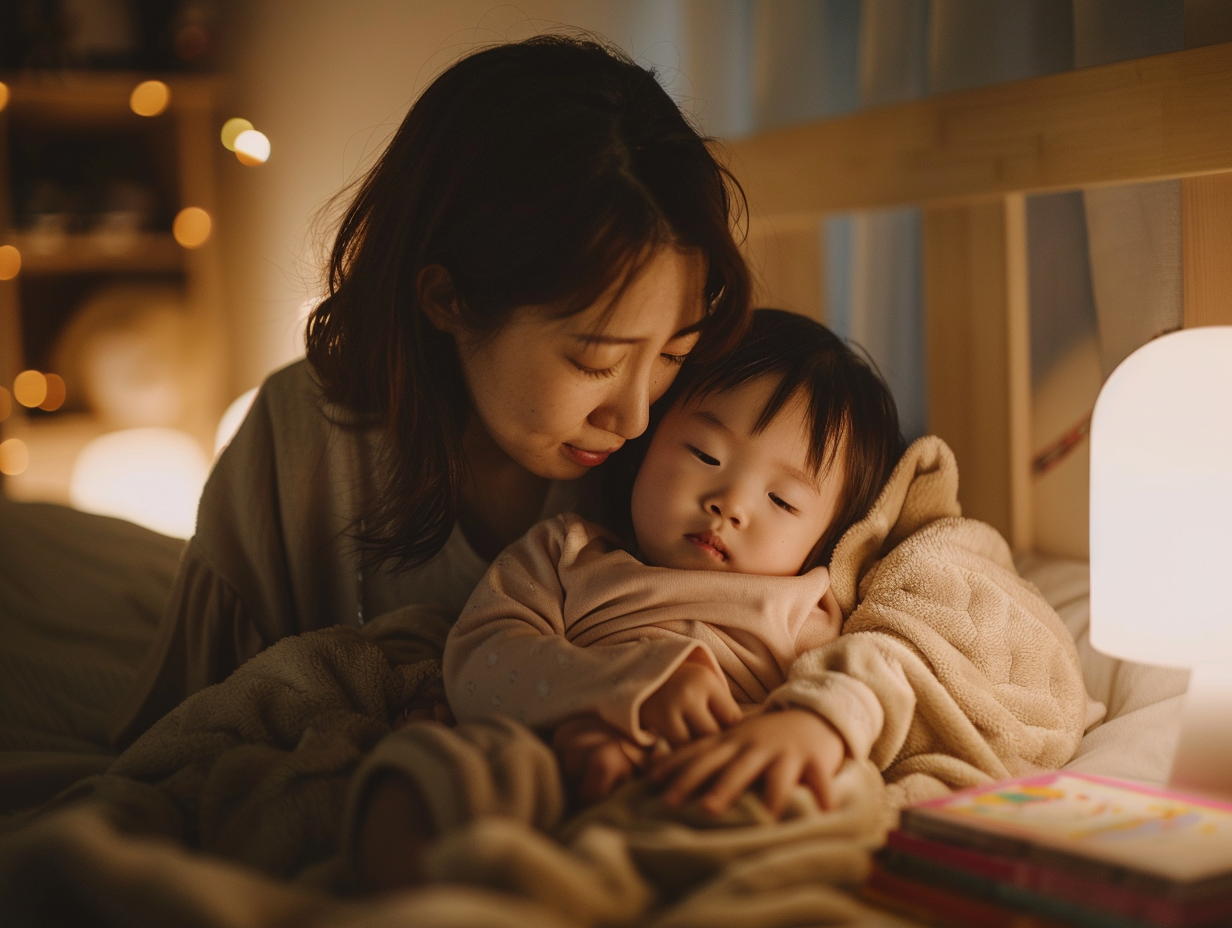
Toddlers live very much in the present — which is wonderful, and also sometimes anxiety-producing, because transitions and what-comes-next can feel formless and therefore frightening. One of the quietest gifts of bedtime is a brief, simple preview of tomorrow: not a full schedule, not a list, but a few anchoring words that give tomorrow a beginning.
Language like first, then, after, when you wake up, in the morning — this is sequencing and time language, and it’s some of the most complex grammatical territory a young toddler is working to understand. Hearing it calmly and repeatedly at bedtime, attached to real and familiar events from your family’s actual life, helps these words become meaningful rather than abstract.
There’s also a co-regulation element here. A child who is told, in a calm voice, exactly what will happen first in the morning — when you wake up, I’ll be in the kitchen, and we’ll have porridge — often settles more easily than one left to face the unknowable next day alone. Predictability is not dull. For a toddler brain, predictability tends to be calming, and a calmer body is generally more open to language.
- “When you wake up, I’ll be right here.”
- “Tomorrow we’re going to see Grandma. First breakfast, then we get in the car.”
- “In the morning, the sun will come in that window.”
- “After you sleep, it will be a new day. A fresh one.”
- “Tomorrow we’ll have rice and the soup you like.”
- “First you sleep. Then morning comes. Then we’re together again.”
This is the one category that asks something of the child — and the most important thing to understand about it is that it does not require an answer. An invitation phrase is just that: an open door. Your toddler can walk through it or not, and either is completely fine.
These phrases are low-pressure, short, and tied to concrete experiences from the day. They leave room for a single word, a point, a gesture, a nod, a sound, a repetition of the question itself — any of these count. You are not trying to elicit a report. You are offering a small conversational space and then honoring whatever your child does with it.
What this supports: back-and-forth conversational turn-taking, voluntary language use, and the understanding that language can be a tool for sharing experience rather than a performance that adults judge. A toddler who is never pressured to answer eventually begins to answer — sometimes weeks after you first offered the question, sometimes in the middle of a completely different part of the day.
Bedtime is not a performance. Your child does not need to produce language to benefit from hearing it.
- “What was your favorite part of today?” (Any answer — or none — is fine.)
- “Do you remember the dog we saw? The big one?”
- “Which book did you love the most tonight?”
- “Was it a good day or a hard day?”
- “What do you want to dream about?”
- “Anything you want to tell me before you sleep?”
How to Say These Phrases So They Actually Help Language
The specific words you choose matter less than you might think. What matters more — what determines whether bedtime language reaches a toddler or just washes past them — is how it is delivered. These aren’t rules. They’re small adjustments that make a real difference.

What Bedtime Language Is Not
There’s a version of bedtime that many parents know well: the questions that become demands, the corrections that follow sleepy mispronunciations, the pressure to say one last thing properly before lights out. These come from a good place — the genuine wish for a child to speak more, better, sooner. But they tend to have the opposite effect.
The distinction worth holding is this: language at bedtime can either fill the air with things for a child to absorb, or it can put a child on the spot. One of those creates a language-rich environment. The other creates a performance environment. And children, like most humans, tend to speak less when they feel they’re being tested.
- “Say it properly.”
- “Tell me what you did today.” (as a demand)
- “What color was the ball? You know this.”
- “Say ‘goodnight’ properly.”
- “Can you say — no, say the whole word.”
- “Don’t you remember what we talked about?”
- “The ball was red. Such a bright red.”
- “We went to the garden today. I loved watching you run.”
- “Goodnight, little one.” (no response required)
- “That word is so hard to say. You almost had it.”
- “We saw something purple today — remember? The flower.”
- “We played by the water. Your favorite.”
Bedtime is not the place for corrections, for output demands, or for the subtle pressure of show me what you know. It’s the place for language to exist without consequence — which paradoxically is where a child is most likely to use it freely.
The same kind of language-rich approach that works at mealtime — naming, narrating, wondering aloud without requiring an answer — works here too, just softer, and slower, and at the end of the day instead of the middle of it.
What If My Toddler Doesn’t Say Much at Bedtime?
Many parents reading this will be thinking about a child who doesn’t answer. Who mostly listens. Who points instead of speaking, or who asks for the same book night after night and says nothing except perhaps the last word of each familiar sentence. Some will be thinking about a toddler who is late to talk, who seems to understand so much more than they can say, who is quiet in a way that sometimes feels worrying.
This section is for you.
Bedtime language doesn’t require your toddler to produce words to work. The input — the steady, calm, repeated language flowing from you — is doing its job whether your child responds or not. A child who listens at bedtime and says nothing has still heard your sentences. A child who only fills in the last word of a familiar phrase has still heard the whole phrase, night after night, until the pattern became predictable enough to step into.
Language comprehension consistently outpaces language production in toddlers — often by months, sometimes longer. The child who points at the dog after you say look at the dog understands what you said. The child who pulls your hand toward their cup understands do you want water? even without answering. These are language moments. They count. And bedtime is full of them.
There are signs that bedtime language is working even in quieter children. When a toddler who never answers what did we do today? suddenly says market three weeks after you’ve been narrating the market every Wednesday night — that’s the phrase emerging. When a child who rarely talks at bedtime starts requesting the same goodnight song in their own small way — pointing at you, or making the first sound — that’s language organizing itself in the dark.
For children who are late talkers or not yet very verbal, bedtime language may be especially valuable precisely because it is low-pressure, repetitive, and intimate. These tend to be the conditions where language feels most natural — not demanded, not performed, just offered.
You are not failing if your toddler doesn’t respond at bedtime. You are filling the room with language they will eventually use.
A Simple 5-Minute Bedtime Language Routine
You don’t need to rethink bedtime. You just need a loose sequence — something you can return to on nights when you’re tired, or when bedtime didn’t go well, or when you can’t think of what to say. This isn’t a script. It’s a shape. Use as much or as little of it as tonight allows.
-
1Settle first. A few moments of quiet touch — hand on back, forehead to forehead, or just lying close.Let the body come down before any words.
-
2“We had a full day today. We went to the garden in the morning, and then we had lunch with Bà, and then you helped me fold the towels.”One narration sentence. Real and concrete.
-
3“Your body is tired now. Your eyes are heavy. That’s what sleepy feels like.”One body or feeling sentence.
-
4“I noticed you today. You were so patient when we waited. I saw you.”One connection phrase — specific, genuine, small.
-
5“Tomorrow, when you wake up, I’ll be in the kitchen. We’ll have breakfast first, and then we’ll see what the day brings.”One tomorrow-preview. Simple and anchored.
-
6“What was your favorite thing today?” (Pause. Wait. Any answer — or none — is fine.)One invitation. Then let it go.
-
7The same goodnight phrase you always use. Every night. Without variation.“Goodnight, little one. I’ll be here in the morning.” — or whatever yours is.
The whole thing takes perhaps four or five minutes. Some nights it happens naturally. Some nights only steps one and seven occur, and that is still a bedtime routine with language in it. You are building a pattern, not performing a curriculum. The pattern, over weeks and months, does more than any single perfect night.
If you find yourself forgetting what to say, or wanting a set of phrases to glance at in the dim room — that is exactly what the Toddler Bedtime Phrase Cards are for.
Toddler Bedtime Phrase Cards

Some nights you won’t remember what to say. The words don’t come, bedtime is already harder than you hoped, and you’re running on the last of your energy. That’s why these cards exist — a gentle, printable set of bedtime phrases organized by the five types in this article, designed to sit on your bedside table and be there when you need them.
They’re not a script to follow perfectly. They’re a starting point — phrases you can reach for, adapt, or simply read once and put down. Small prompts for the end of the day, when your child is close and the room is quiet and it matters what you say.
- Narration phrases — for putting the day into words
- Body and feeling phrases — for naming the inside world
- Connection phrases — for the moments of being truly seen
- Tomorrow-preview phrases — for making the next day feel safe
- Invitation phrases — for leaving room without pressure
- A sample bedtime sequence you can use as-is or adapt
Frequently Asked Questions
You Don’t Need a Perfect Script
The most powerful thing about bedtime language is not any particular phrase. It’s the accumulation. It’s the fact that you said something warm and true and real on a Tuesday night when you were tired, and then again on Wednesday, and again the week after, and again — until the shape of it became familiar to your child in the way that all repeated things become familiar: like a landmark, like a smell, like the weight of a particular blanket.
You are not trying to engineer a language milestone. You are creating a room where language lives calmly, where feelings have names, where the day has shape, where a small person is reminded — every single night — that someone is paying attention to their life.
That is the thing language grows inside. Not lessons. Not drills. Not the perfect phrase delivered at the right developmental moment. Just the steady, unhurried presence of someone who puts words around what matters, night after night, in a dim room, at the end of the day.
A few phrases. A little warmth. The same goodnight, every night. That is enough.
More From the Language Development Collection
Similar Posts
Toddler Language Development: What Actually Helps In Everyday Life
Toddler Language Development Toddler Language Development: What Actually Helps In Everyday Life Language does not grow only during “teaching time.” It grows at the table, by the door, on the sidewalk, during cleanup, inside books, and in the small moments when a toddler is trying to be understood. Age: 12–36 months · Reading time: 12–15…
Emotions
Emotions + Connection Sometimes children know exactly what they feel — but don’t yet have the language to hold it. Why correcting usually doesn’t help When a child is overwhelmed, too many questions can feel like pressure instead of support. The goal isn’t to get the perfect word immediately. The goal is helping them feel…
Why Toddler Walks Are So Slow — And Why That’s a Good Thing
TODDLER DEVELOPMENT / OUTDOOR PLAY Why Toddler Walks Are So Slow — And Why That’s a Good Thing Your toddler isn’t stalling on the way to the car. They’re noticing, testing, touching, listening, and balancing their way through the real world — and a walk that takes forty-five minutes is doing more than it looks…
What A Toddler Should Learn Before Preschool
Preschool Readiness · Real-Life Learning What A Toddler Should Learn Before Preschool Most preschool-readiness lists focus on letters, numbers, and worksheets. But the day-to-day work of a preschool classroom asks for something broader: a child who can communicate a need, take part in a routine, separate with support, and try again after something goes wrong….
Kitchen Practical Life Activities For Toddlers
Practical Life · In The Kitchen Kitchen Practical Life Activities For Toddlers You do not need a learning tower full of prepared trays. A low drawer, a small bowl, or one meaningful kitchen job, offered alongside you, can be enough for a toddler to feel like a real part of the family kitchen, before, during,…
Learning Goals For 18–24 Months: What Learning Really Looks Like In Everyday Life
Learning Goals For 18–24 Months: What Learning Really Looks Like In Everyday Life Toddler Learning · Ages 18–24 Months Learning Goals For 18–24 Months: What Learning Really Looks Like In Everyday Life A calm, observation-based guide for parents who want to understand what is already happening inside ordinary moments. Chichiberry Parenting Montessori-Inspired Ages 18–24 Months…