
Toddler Language Development
Secrets of Toddler Language Development Parents Don’t Always Know
The quiet, everyday patterns that help toddlers understand, repeat, connect, and eventually speak — long before it looks like teaching.

Most parents notice what their toddler is not yet saying. The missing word, the moment they expected a reply and got silence, the comparison to another child who already seems to be talking freely. It is a natural thing to notice. But it can make it easy to miss what is already happening.
Language development in toddlers often begins quietly — not in words, but in everything that comes before words. Before a toddler says “bird,” they have watched dozens of birds. They have heard the word dozens of times, in different tones, from different people, in different moments. The word builds up inside them long before it comes out.
And before the word, there are signs. A turn of the head. A reach. A pause. An excited sound that carries meaning even if it carries no dictionary definition. Language may already be growing through:
- looking
- pointing
- waiting
- repeating
- understanding routines
- using one sound for many meanings
- gestures
- emotional connection
- turn-taking
Language does not begin with lessons. It begins inside ordinary moments — breakfast, bath time, the walk to the corner, the way a parent responds when a toddler points at the sky. This article is about those moments. What they look like. Why they matter. And what parents can do — or stop worrying about doing — inside them.
A gentle note on timing
A gentle note about toddler language windows
Toddler language changes considerably across the 12–36 month window. The three ranges below are offered as orientation, not a checklist. Many toddlers arrive at different points at different times — and that is entirely normal. Use these as a loose guide, not a measure.
- Gestures — pointing, reaching, giving, showing
- Imitation of sounds and simple actions
- First words or consistent meaningful sounds
- Understanding familiar routines and simple phrases
- Eye gaze and back-and-forth social exchange
- More consistent word use
- Repeated words to request and connect
- Simple requests: “more,” “up,” “that”
- Pointing alongside naming or looking
- Following simple directions reliably
- Beginning to combine words: “mama sit,” “more water”
- Language in pretend play — narrating, naming, directing
- Simple emotion words: “sad,” “mad,” “happy”
- Back-and-forth exchanges around a shared topic
- More flexible language use across routines and new situations
01 — Understanding
Understanding comes before talking
There is a common assumption that language development is measured in words. How many does your toddler have? How clearly can they say them? Are they combining two words yet? These are reasonable questions, but they focus on output — what comes out of a toddler’s mouth — rather than what is happening inside their mind first.
Comprehension almost always grows before speech. This is normal and expected. The pathways that allow a toddler to understand a word — to connect a sound pattern to a meaning — develop earlier and more quietly than the pathways that produce speech. A toddler can know what “shoes” means, feel something when they hear it, move toward the shoe rack, hold one shoe up toward you, and do all of this without being able to say the word aloud yet.
Parents who know this can start looking for different evidence. Instead of counting words, they can look for signs of comprehension: a toddler who follows a two-part instruction, who laughs at the right moment in a familiar story, who goes to the right drawer when asked for a spoon, who knows that “wash hands” means what comes before dinner. All of this is language growth.
Quiet sign to notice
Your toddler may understand more than they can say if they pause, look toward the right object, move appropriately, follow a familiar routine, or react with expression before they can form an answer.
A toddler who does not yet say many words but responds to tone, anticipates familiar sequences, and clearly understands requests is already working hard at language. The speaking will follow — and it will come more easily because of everything already built underneath.
What to notice — signs of comprehension
Turns toward a familiar sound or name · Moves toward the right object when asked · Follows a two-step routine without a demonstration · Laughs or reacts at the expected moment in a familiar story · Looks for the right person when a family member’s name is said
Read more: 7 Signs Your Toddler Understands More Than They Say
02 — Repetition
Repetition is not being stuck
A toddler who says the same word ten times in a row is not malfunctioning. They are working. Repetition is one of the most powerful mechanisms in early language learning, and it is frequently misread as a problem by anxious parents who wonder if something is wrong.
When a toddler repeats a word, several things might be happening simultaneously. They are practicing the physical movements their mouth and tongue need to produce that sound. They are checking whether the word reliably produces a response from the people around them. They are anchoring the sound to its meaning through sheer exposure. They may also be using the repetition as a kind of emotional steadiness — a familiar sound in a world that still contains a great deal they cannot yet name.

The most useful thing a parent can do when their toddler repeats a word is to respond — with expansion. Not correction. Not a quiz. Just a gentle, natural addition of meaning.
How this sounds
Toddler: “Ball.”
Parent: “Yes, the ball rolled under the chair.”
Toddler: “Ball.”
Parent: “You want it back. I’ll get the ball.”
Toddler: “Ball!”
Parent: “Here it is. The ball is back.”
The parent is not performing a lesson. They are answering. That answer — given warmly, without impatience, with slightly more language than the toddler offered — is one of the most effective language-building interactions that exists. It is also just a normal conversation.
What to say back
“You said ball. The ball rolled.” · “More? You want more bubbles.” · “Mama is here. You wanted me.” · “Up. I’ll lift you up.” · “Dog! You see the dog.”
Read more: Why Toddlers Repeat The Same Word Again And Again
03 — One word
One word can carry many meanings
Very young toddlers often operate with a small vocabulary that has to work very hard. A single word might be their entire sentence. “Mama” might mean: come here, help me, look at this, I’m scared, where are you, and I love you — all depending on tone, context, and body language. This is not a sign of limited language. It is a sign of sophisticated communication within limited tools.
Linguists sometimes call this a “holophrase” — a single word that functions as a full utterance with embedded meaning. Understanding this can help parents shift from trying to teach toddlers the “right” word to trying to understand which meaning the toddler is currently expressing.
The parent’s job, in these moments, is not to correct the word. It is to read the intent and reflect it back with a little more language than the toddler used.
| Toddler says | It might mean | Parent can say |
|---|---|---|
| “Mama” | Look at this | “I see it. You found the spoon.” |
| “Up” | Help me reach | “You want up. I’ll lift you.” |
| “No” | I need control | “You don’t want that one. You want to choose.” |
| “More” | Keep doing that | “More tickles? Okay, more tickles.” |
| “That” | I want to tell you something | “That one? The blue cup. You see the blue cup.” |
| “Uh-oh” | Something changed unexpectedly | “Uh-oh. The water spilled. It’s okay, we’ll wipe it.” |
Responding to intention rather than sound helps toddlers feel heard — which in turn makes them more likely to try again. Language grows faster inside the experience of being understood.
Read more: One Word Can Carry A Whole Conversation
04 — Response
Toddlers learn language through response, not testing
One of the most common — and well-meaning — mistakes parents make is to turn ordinary moments into small quizzes. “What color is this? Say apple. What’s that?” These feel like teaching. They are active, they are engaged, they seem like they should work. But research on how toddlers actually learn language suggests that this approach is considerably less effective than what it replaces: natural conversation.
Quiz-style prompts often put toddlers in an evaluative position — where the “right” answer exists, where the parent is waiting to see if they get it, where silence or the wrong word can feel like failure. This kind of pressure may actually slow language attempts in children who are still building confidence.
What works better is what many early childhood professionals describe as “serve and return.” The parent notices what the child is attending to, follows that attention, names what’s there, and waits. The toddler leads. The parent follows. Language gets offered in the context of genuine shared attention — and that is when it tends to stick most naturally.
Instead of
“What is this?”
Try
“You found the red cup.”
Instead of
“Say banana.”
Try
“Banana. You’re peeling it.”
Instead of
“What color is that?”
Try
“That blue truck is loud.”
Instead of
“Can you say cat?”
Try
“Cat. She’s sleeping by the door.”
The difference between these is not about effort — both parents are engaged, both are trying. The difference is in the posture: one asks the toddler to perform, one invites them to share a moment. That difference matters more than most parents realize.
Tiny shift
Replace one quiz question with one observation today. Instead of “What’s that?” try “You found it.” Notice what changes in how your toddler responds.
05 — Routines
Daily routines teach more than special activities
There is no need to create extra language-teaching time. You already have it. It runs through every ordinary hour of the day, repeated reliably enough that toddlers begin to predict and then participate in it. The morning routine, mealtimes, getting dressed, shoes on, bath time, bedtime — these are not gaps between the important moments. They are the important moments.
Routines repeat naturally. That repetition is not boring to a toddler — it is exactly what they need. A word heard in the same context, in the same order, connected to the same sensory experience, day after day, builds a much stronger and more flexible understanding than a word seen on a flashcard or in an app.

A parent does not need to narrate constantly. But offering simple, natural language inside the rhythm of these moments — tied to what is actually happening — creates exactly the kind of repeated, meaningful exposure that builds language.
Language in daily moments
During dressing: “One arm in. Now the other.” / During meals: “Crunchy carrot. Soft rice.” / During bath: “Pour, splash, warm water.” / During bedtime: “Light off. Blanket on. One more hug.”
None of these require extra time. None require preparation. They only require noticing that the moment is already there, already happening, and offering a few natural words inside it. That is enough.
Routine words to borrow
Shoes on / shoes off · Open / close · Pour / wipe · Warm / cold · More / all done · First / then · Up / down · In / out · Ready / wait
Read more: What To Say At Bedtime To Build Toddler Language
Also in this cluster: What To Say During The Morning Rush · Language Grows In Moments
Free Resource
The Toddler Language Moments Guide
10 ordinary moments that quietly build words, understanding, and connection.
You do not need a new curriculum to support toddler language. This free guide gives you 10 everyday moments, what your toddler may be learning, and simple words to try when the moment is already happening.
Free. No spam. Unsubscribe anytime.
06 — Pauses
Pauses help toddlers process and try
Most adults talk faster than toddlers can process. This is simply a feature of how adult conversation works — we are fluent in a language we have had decades to master, and we respond at the pace that feels natural to us. But for a toddler who is still organizing what they want to express, decoding what you said, and deciding whether to attempt a sound, that pace can feel very fast.
Silence, after an offer or a prompt, is not awkward. It is working time. When you pause after saying something to a toddler — or after they gesture toward something — you give them the space they need to form a response, attempt a sound, point, try a word, or simply make a decision. Many toddlers will try to communicate in that space if it is given to them. Without it, the adult has already moved on.
Try this today
When your toddler points at something, pause before naming it. Watch their face. Let three to five seconds pass. Then offer one simple sentence. Notice what happens in that space.
The pause is also an invitation. It communicates: I am waiting. I expect you to have something. I have time. That expectation, offered gently without pressure, often encourages a toddler to try something they might not have tried if the conversation moved too quickly past them.
Three to five seconds can feel like a long time when you are waiting. But for a toddler organizing their first words, it may be exactly what they need.
What a 3-second pause looks like
Toddler points at the window. Parent looks where they are pointing.
… one … two … three …
Toddler says: “Buh.” (bird)
Parent: “Yes. A bird. It flew up to the branch.”
The pause gave the toddler space to try. Without it, the parent might have named it first.
07 — Gestures
Gestures count as communication
A toddler who points at the window is saying something. A toddler who takes your hand and pulls you toward the refrigerator is making a very specific request. A toddler who holds up an object toward your face is sharing something — perhaps excitement, perhaps uncertainty, perhaps the desire to hear you name what they are holding. These are not pre-language behaviors. They are language.
Gesture is one of the earliest and most reliable pathways into spoken language. Many speech and developmental professionals pay close attention to gestures because they are part of the early communication pathway — the richness of a toddler’s gesture use often connects meaningfully to vocabulary growth later. A toddler who points at many things, who waves, who gives and shows and reaches and directs, is building the same communicative foundation that spoken language will eventually rest on.
This is especially important for parents of toddlers who are not yet saying many words. A toddler who communicates richly and meaningfully through gesture, eye gaze, and body movement is not failing to develop language. They are developing language. The speaking may still be coming. The communication is already here.
What to notice
Pointing, reaching, waving, giving objects, showing things, pulling a parent’s hand, and using eye gaze to share attention are all genuine acts of communication. Treat them as what they are: the toddler is talking to you.
When you respond to a gesture — with warmth, with language, with acknowledgment of what the toddler was communicating — you validate that communication and make it more likely to happen again. That is the foundation from which words grow.
| Toddler gesture | Parent can say |
|---|---|
| Points at a dog | “Dog! You see the dog walking past.” |
| Reaches toward cup | “You want the cup. Here it is.” |
| Pulls parent’s hand toward door | “Outside? You want to go outside.” |
| Holds up shoe to parent | “Your shoe. You want help putting it on.” |
| Points at bird and looks at parent | “Bird! You spotted a bird up there.” |
Read more: Late Talker? What Your Toddler May Be Learning Before The Words Come
08 — Emotions
Emotions need words too
Toddler behavior — the throwing, the crying, the sudden full-body protest on the floor of the grocery store — is often a language problem as much as anything else. Not a discipline problem. Not a manipulation. A language problem. The toddler has a feeling they cannot name, a need they cannot express, a frustration that is too big for the vocabulary they have available. The feeling has to go somewhere, and the body is often where it goes.
Emotional vocabulary is part of language development. When a parent offers simple, accurate words for what a toddler is experiencing — not to stop the feeling, but to name it — they are doing something very real: giving the toddler a tool. A word for a feeling is a way to carry it, to communicate it, to eventually manage it. That process takes years to develop fully, but it begins in the earliest toddler conversations.

The language does not need to be complex. It needs to be honest and close.
Simple phrases that name the moment
“You wanted that.”
“That was hard.”
“You’re not ready to stop.”
“You wanted help.”
“You’re mad. I’m here.”
“That was a big feeling.”
“You didn’t want it to end.”
These phrases do not fix the moment. They do not stop the crying. But they do something different and more lasting: they model that feelings can be named. That they can be communicated. That the parent can be trusted to receive difficult emotions without withdrawing. Over time, this is one of the deepest contributions to language development a parent can make.
Five toddler-friendly emotion phrases
“That was really hard.” · “You wanted to keep going.” · “Something doesn’t feel right.” · “You’re not sure yet — that’s okay.” · “Big feeling. I’m right here.”
Read more: Phrases To Help A Toddler Express Feelings · What To Say When Your Toddler Gets Frustrated · What To Say Instead Of Stop Crying
09 — Real objects
Real objects build stronger words than flashcards
Toddlers learn words most deeply when words are tied to real sensory experience. Not to a picture of a thing. Not to a digital image. To the actual thing — the weight of it, the texture, the sound it makes, the context in which it normally appears. That multi-layered encounter creates a memory that is much richer and more lasting than anything a card or screen can build.
Think about what the word “wet” means on a flashcard: a picture, probably of water or rain. Think about what “wet” means after a toddler splashes their hands in a bowl of water, has the water drip off their fingers, and hears you say “wet” in exactly that moment. The word is not just a label. It is an experience.
The same is true for words like:
- Heavy — when they try to carry the laundry basket
- Sticky — when the banana is overripe
- Cold — when they hold a cup from the refrigerator
- Open and close — when they work a door or a box
- Empty and full — when they pour water from cup to cup
- Muddy — after the walk, looking down at their shoes
- Crunchy — the first bite of toast
- Pour — water into the bath, water into the plants
Flashcards are not harmful. They are simply a thinner version of what daily life already provides. If you find yourself worrying that you are not “doing enough” for your toddler’s language — look at what is already in the kitchen, the garden, the walk to the corner. It is more than enough. It has always been.
Real-life word pairs
These pairs come alive in daily moments — use them when they naturally fit: wet / dry · full / empty · heavy / light · open / closed · warm / cold · sticky / clean · rough / smooth · loud / quiet
10 — Relationship
Language grows inside relationship
Behind every section in this article, there is a single thread: language is not primarily a cognitive skill that develops in isolation. It is a relational one. It develops inside connection — inside the experience of being noticed, answered, held in mind, and responded to with warmth.
A toddler who feels safe to attempt a sound, to repeat a word, to gesture toward something, to make a face and wait and see what you do — that toddler is in the best possible conditions for language growth. Not because a curriculum is being followed. Because a relationship is being built.

The goal is not just more words. The goal is shared meaning. Language is how toddlers eventually say: see me, help me, watch this, I remember, I want, I don’t want, I love you, I need you. Long before those words are precise or complete, the gestures and sounds and turns and responses are already carrying those messages — and parents are already receiving them, often without realizing it.
You do not need to become a speech teacher. You are something more useful: the person your toddler is most motivated to communicate with. That motivation is the engine. The vocabulary comes after.
“Your toddler does not need every moment turned into a lesson. They need ordinary moments answered with presence.”
Chichiberry Parenting
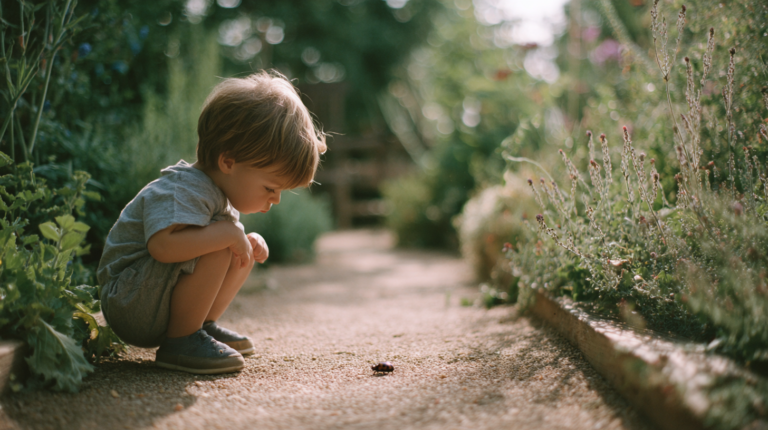
Parents often underestimate how much they are already doing. The conversation across the table. The walk where they name what they pass. The moment they crouch down to look at a bug together. The bedtime when they say the same words in the same order and the toddler settles because they already know what comes next. These are language moments. They count.
One ordinary moment today
Choose one routine moment — breakfast, the walk out, bath time — and try to follow your toddler’s attention instead of leading it. Name what they notice. Wait for what they do next. That is the whole thing.
A note on guidance
This article offers general educational guidance on toddler language development. It is not a clinical assessment, a diagnosis, or a substitute for professional advice. Every toddler develops differently, and what is described here reflects broad patterns — not a checklist your child must meet. If you have any concerns about your toddler’s development, speech, hearing, or communication, speaking with your pediatrician or a qualified speech-language professional is always the right step. Early support, when it is needed, is a resource — not a reflection of anything you have done wrong.
Questions parents ask
Common questions about toddler language development
What age does toddler language development usually begin?
Language development begins long before a toddler says their first word. From birth, babies are already taking in voices, tones, rhythms, and faces. By 6 to 12 months, many infants are babbling, pointing, and using eye gaze meaningfully. The toddler years — roughly 12 to 36 months — bring rapid growth in both understanding and speaking, though the timing varies considerably and normally between children.
What if my toddler understands but does not say many words?
Comprehension almost always develops ahead of speech. A toddler who follows directions, anticipates routines, responds to their name, and reacts to simple questions is showing real language growth — even without many spoken words. This gap between understanding and speaking is entirely normal in the early toddler years. If you have concerns about your specific child, speaking with your pediatrician is always a good step.
Is repeating the same word a good sign?
Yes. Repetition is how toddlers practice sounds, anchor meaning, test whether words work reliably, and build memory. When a toddler says “ball” five times in a row, they are not stuck — they are working. Responding each time with a gentle expansion (“Yes, the ball. It rolled away.”) supports this process naturally and without pressure.
Should I use flashcards to teach toddler words?
Flashcards are not harmful, but they are not the most effective way to build language for very young children. Toddlers learn words most deeply when they are connected to real sensory experiences — the weight of a cup, the texture of wet sand, the sound of running water. Real daily life provides this far better than any card or screen. You likely already have everything you need.
How can I encourage my toddler to talk without pressuring them?
The most powerful thing a parent can do is notice and respond — rather than test and prompt. When you name what your toddler is looking at, pause to give them space to try, expand their words gently, and follow their attention rather than redirecting it, language grows naturally within the relationship. You do not need special teaching moments. You need presence inside the ordinary ones.
Do gestures count as communication?
Yes, fully. Pointing, reaching, waving, giving objects, showing things, pulling a parent’s hand, and using eye gaze to share attention are all genuine acts of communication. Gestures often come before words and are an important part of the pathway toward spoken language. A toddler who communicates richly through gesture and body movement is actively developing language — even if words are still coming.
When should I ask a professional about toddler speech?
It is always worth speaking with your pediatrician or a qualified speech-language professional if you notice any of the following: possible hearing concerns; loss of words or social communication skills your toddler previously had; very limited response to their name by 12 months; very limited gestures such as pointing, showing, or waving by 12 months; very limited understanding of simple familiar requests; or no clear words around 16 to 18 months — especially when paired with limited gestures or limited understanding. Early support is not a failure. It is information. A speech-language pathologist can offer a calm and thorough assessment and help you understand what your toddler may need.
You are already doing this
Toddler language development does not ask parents to perform. It does not require special materials, dedicated sessions, or structured curricula. It grows inside the attention parents are already giving — the moments they notice what their toddler is looking at, the times they slow down to respond instead of redirect, the ordinary sentences spoken during the ten-thousandth breakfast together.
What helps most is not more teaching. It is more noticing. Noticing what your toddler is already trying to communicate. Noticing the gestures, the pauses, the repeated sounds, the moments of shared attention. Responding to those moments with warmth, with a word, with a second’s worth of genuine contact.
Language grows because it is used for something real — because it works, because it connects, because it is answered. The parent who answers their toddler’s pointing, who follows their attention, who sits with them in the ordinary moments and names what’s there — that parent is doing the most important language work there is.
You do not need to start something new. You only need to notice what is already happening.
Start with one word, one pause, one ordinary moment. That is often where language begins.
Continue reading
Where to go next in this cluster
This article is the starting point. If one section sounded especially familiar, choose the next guide from there.
If your toddler understands more than they say
If your toddler repeats the same word
If your toddler uses one word many ways
If you want practical phrases for daily moments
If you are worried about few words