
The 5 Everyday Language Routines That Build Communication Naturally
Language doesn’t grow during teaching sessions. It grows at breakfast, during transitions, while reading together, while singing in the car — inside the ordinary moments that are already happening every single day.
There’s a version of language development that involves flashcards and apps and carefully sequenced activities. And then there’s the version that actually happens — at the kitchen table, while you’re getting shoes on, while you’re reading the same book for the fourteenth time this week.
Most parents who worry about speech development share a quiet fear: that they’re not doing enough. That there are activities they haven’t tried, words they haven’t introduced, windows they’ve already missed. It’s a particular kind of exhaustion — loving a child intensely while also feeling, in the background, that loving them better requires more.
One thing I’ve noticed with both of my children is that language never seemed to arrive during the moments I expected it to.
It arrived later. At breakfast. During play. While we were walking somewhere together and I happened to name something out loud — almost to myself, not really to them.
And then, sometimes weeks later, I’d hear that word back from a small voice and remember exactly when I’d said it.
What’s worth knowing is this: children’s language doesn’t grow because parents add more. It grows because parents notice what’s already there and meet it warmly. The moments you already have — the messy breakfast, the transition resistance, the bath-time splashing — are already full of language opportunity. You’re not behind. You’re already in the middle of it.
The five routines below aren’t new activities. They’re orientations inside the ordinary ones you’re already doing.
You don’t need to turn every moment into a language lesson. The goal isn’t more talking all day — it’s more presence inside the talking that’s already happening. One small shift, in one ordinary moment, is enough to start.
Talk Through Daily Life
This is the simplest one, and the most underestimated. It doesn’t require preparation or the right moment. It just requires narrating — gently, unhurriedly — what you’re doing as you do it.
While you’re making breakfast: “I’m cutting the banana. Look — little pieces. In the bowl.” While you’re getting dressed: “Here’s your sock. One sock. Now the other one.” While you’re walking to the car: “It’s cold this morning. The car is right there — I can see it.”
This isn’t a performance. You’re not teaching. You’re simply giving your child’s world a soundtrack of language. The words are landing somewhere, even when there’s no visible response. Over days and weeks and months, that accumulation matters enormously.
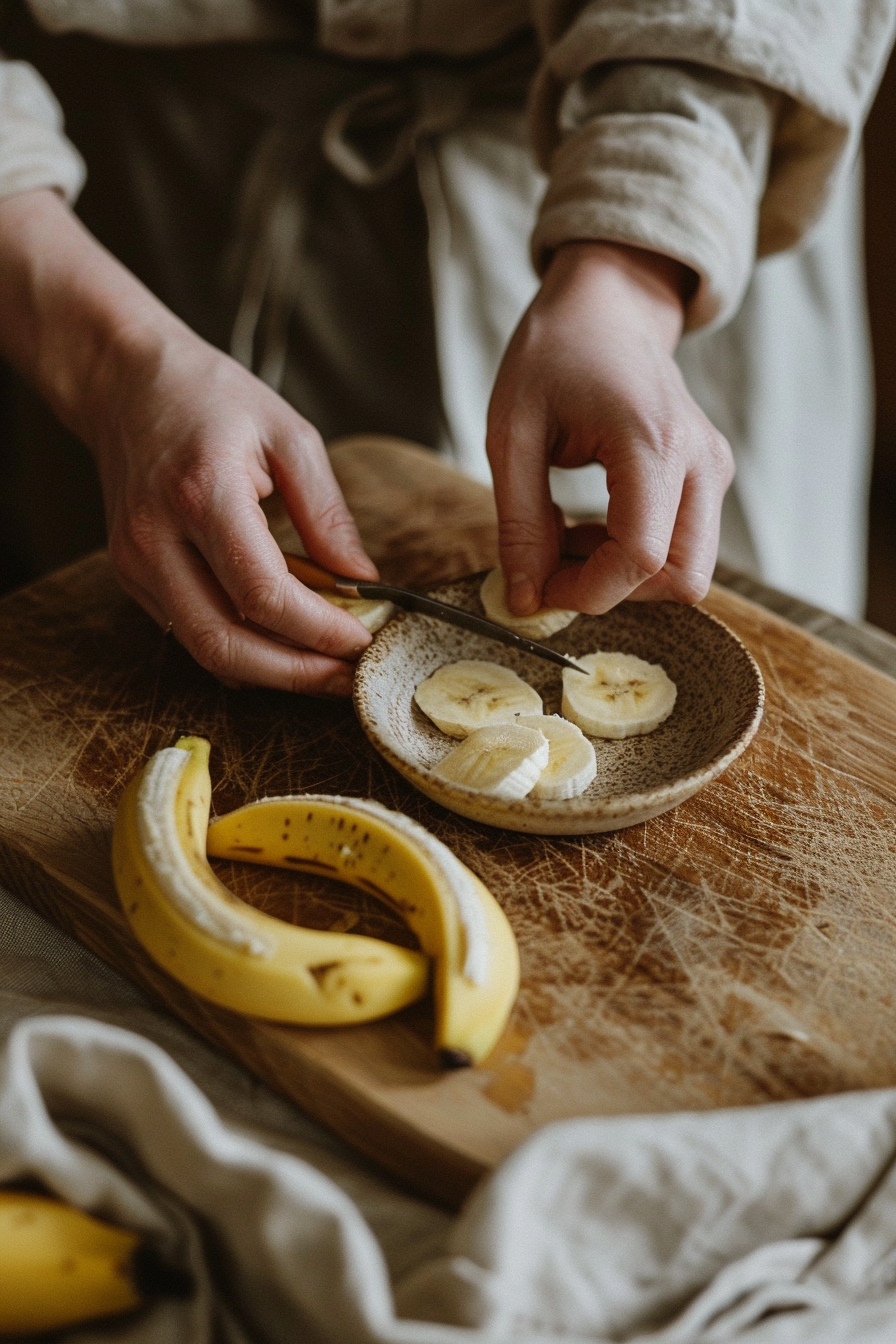
The common mistake parents make here is waiting until they have something important to say. But daily commentary — even about things that feel too ordinary to name — is exactly what toddlers need. The word for banana becomes real through repetition, not through a lesson. The word for cold lands when they’ve felt the cold morning air and heard you name it at the same moment.
Some days you’ll remember to narrate everything.
Other days you’ll realize at bedtime that you barely thought about language at all — that the morning was too rushed, the afternoon too hard, and the evening just about getting through.
Both kinds of days count. The accumulation is long and forgiving.
Choose one moment that already happens every single day — getting dressed, setting the table, walking to the car. For one week, narrate it. Just that one moment, just that one week. Notice what happens in your child’s face.
Read Together Every Day
Not to test. Not to see how many words they know. Just to be in a book together.
Reading daily — even the same book, especially the same book — is one of the most quietly powerful things you can do for a young child’s language. But the way you read matters more than how many minutes you spend. A fifteen-minute reading session where a parent asks “what’s that? what colour is it? can you point to the dog?” is a very different experience from ten minutes of pointing together, wondering together, and following what your child is looking at.
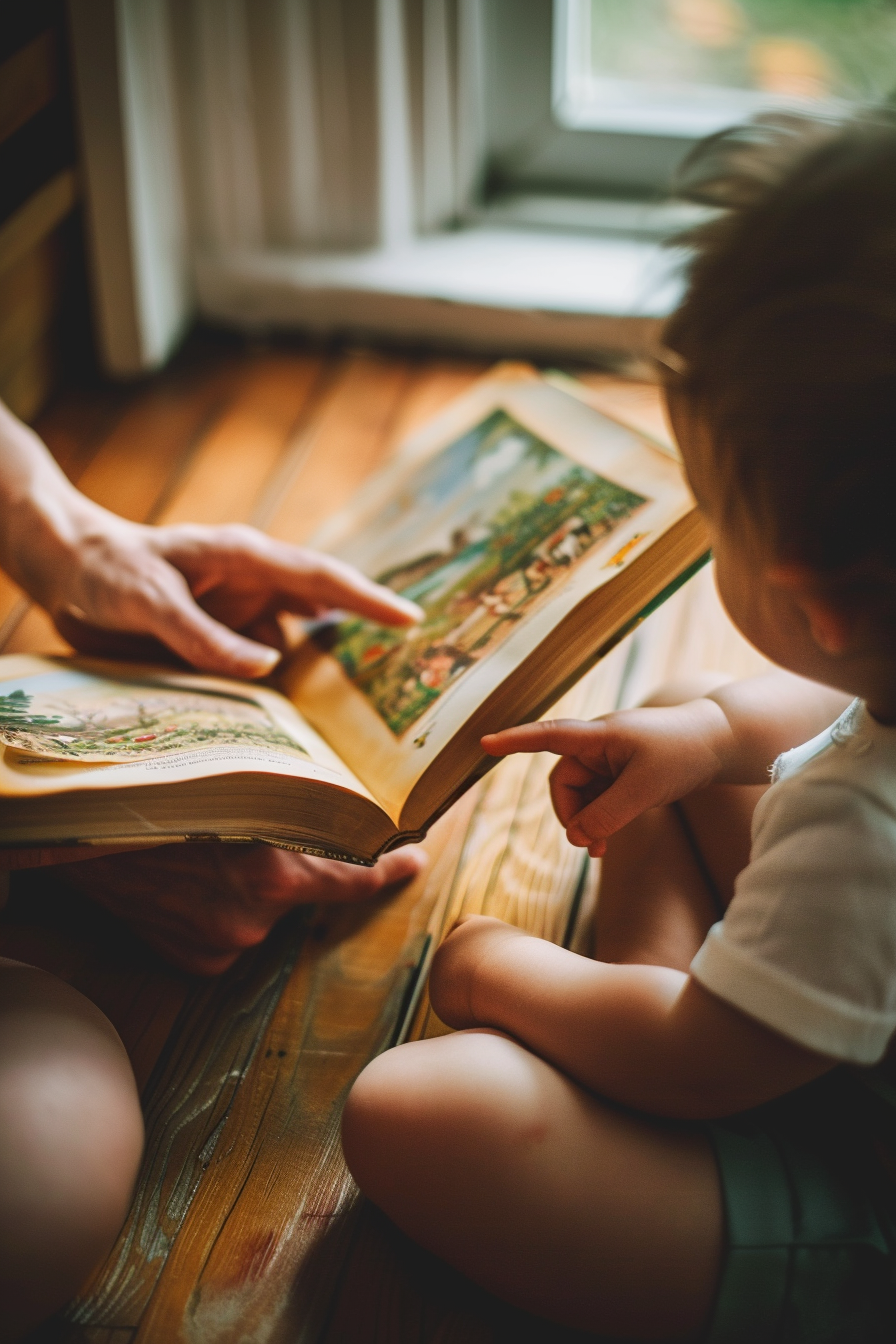
Try pointing at what they point at, rather than directing their attention to what you want them to see. “Oh — you’re looking at the bird. The little bird on the fence.” Try pausing on a page and saying nothing, letting them land somewhere before you add words. Try wondering aloud: “I wonder where the rabbit is going.” Not as a quiz — as a genuine question, asked by someone who also wants to know.
- Connecting spoken words to pictures and then to real objects in the world
- The rhythm and pattern of language — even before words come
- Shared attention: the experience of looking at something together
- That books are a source of pleasure, not a test of readiness
- Vocabulary that doesn’t appear in everyday life — animals, places, feelings, magic
Follow Their Lead
Children talk more when we enter their world first.
This one asks something slightly counter-intuitive of parents who want to support language. Instead of directing the play toward something educational — naming shapes, sorting colours, building a specific thing — you join whatever is already happening, on their terms.
Your child is lining up small wooden animals along the edge of a rug. You sit nearby. You don’t redirect, you don’t introduce a new idea. You watch for a moment. Then: “The giraffe is at the front. He’s first.” Your child moves the giraffe. You follow: “Now the elephant. The big elephant is moving.”

When a parent follows rather than leads, something quietly important happens: the child becomes the expert. They’re showing you something. You’re receiving it. The language that follows — both theirs and yours — is built on that foundation of being genuinely seen. It’s not a technique. It’s a relationship.
I used to find it hard to just sit on the floor and not do anything. There was always something else that needed attending to — and play felt passive, like I wasn’t contributing anything.
What changed my mind was noticing how much more my daughter spoke during those floor sessions when I simply followed her, compared to when I was directing the play toward something. She had so much more to say when she was the one who knew what was happening.
- Using language to direct an interaction — I want you here, look at this
- That their interests are worth naming and worth sharing
- Turn-taking in conversation: I say something, you respond, I say something again
- New vocabulary attached to things they already care about
- Play as communication — before words are full, play is how children speak
The next time you join your child on the floor, wait thirty seconds before saying anything. Just watch. Let them show you what they’re doing. Then add one word to what they’re already focused on — not a redirect, just a name for something that’s already there.
Sing More Than You Think You Need To
Not because you have a good voice. Not because it’s educational. Because rhythm and repetition are among the most effective tools for language acquisition, and because singing is how those two things arrive in a way that feels like joy instead of work.
Young children don’t tire of the same songs. They return to them because repetition is a learning mechanism — the brain is meeting those words again, in a slightly different moment, attaching them to feeling and sound and memory. The words of Wheels on the Bus aren’t just words to a two-year-old. They’re a familiar territory that belongs to her.

The repertoire doesn’t need to be extensive. Five songs known well, sung often, with variations — silly versions, slow versions, versions where you pause before the last word and let them fill it in — are worth far more than twenty songs introduced and forgotten. Sound games matter too: making animal sounds during dinner, echoing a sound your child makes back to them, finding the rhythm in ordinary words. Spa-ghet-ti. Spa-ghet-ti. The line between silly and language-rich is thinner than it seems.
Repetition isn’t boredom. For a toddler, it’s mastery in progress. Every time your child asks for the same song again, they’re not failing to move on — they’re doing the work of language from the inside.
Pause and Wait
This one is harder than it sounds.
Many toddlers need significantly more processing time than adults instinctively allow. A question is asked. Silence follows. An adult — feeling the weight of that silence — fills it. Another question. An offer. A redirection. And the child, who was still working on the first one, never quite got the chance to arrive.

The practice is simple to describe: ask, then wait. Count silently to five — or ten. Resist the urge to rephrase or redirect. Look at your child with an open, expectant face that says I believe something is coming — because something often is, if the space is held long enough.
What happens in that pause is real work. A child is reaching for a word, assembling something, deciding whether this is a moment where language is worth the effort. Your willingness to wait communicates, quietly but clearly: your words are worth the time it takes you to find them.
Sometimes the pause lasts seven seconds and a word arrives.
Sometimes it lasts two and nothing comes and that’s also fine.
Parenting isn’t performed in ideal conditions. The practice is in the trying, not the outcome.
- Word retrieval — finding the word that belongs to this moment
- Risk-taking in language — attempting a word even if it might come out wrong
- The experience of being listened to completely, not provisionally
- That communication is worth the effort — because someone is genuinely waiting for it
Tomorrow, after you ask your child something, count silently to seven before adding anything. Not eight, not ten — just seven. See what happens in the gap. You may be surprised how much was already there, waiting for room.
What Most Language Growth Actually Looks Like
It looks like a word repeated fifteen times before it’s said correctly. It looks like pointing instead of naming, gesturing instead of speaking, attempting a sound and abandoning it halfway through. It looks like enormous pauses, unexpected bursts, and periods of apparent stillness where nothing seems to be happening — and then suddenly, unprompted, a sentence that wasn’t there yesterday.
The moment I stopped looking for language development and started noticing it, I found it everywhere.
In the word my son used incorrectly for three weeks and then, quietly, corrected himself one morning at breakfast. In the way my daughter started asking for specific songs by humming the melody before she had the words. In the gestures that arrived before speech and stayed long after it wasn’t needed anymore.
Progress almost never looks the way we expect it to. It tends to arrive sideways, in moments we weren’t watching for.
Language development is not linear. It doesn’t follow a predictable path, and it doesn’t respond on schedule to the activities you provide. What it responds to, over time, is the quality of the language environment — the consistency of narration, the warmth of shared attention, the patience of a parent who waits and receives and stays.
Pointing at something repeatedly — requesting a name for it. Language coming.
Repeating the same word — not stuck. Practising. Mastering it.
Saying a word once and then not again — testing. Filing it. Will return.
Understanding without speaking — comprehension runs ahead of expression. Always.
Babbling with more intention — conversation practice. The form before the words.
Going quiet after a burst — consolidation. The brain is integrating what it just learned.
Progress is happening in the moments you’re not measuring it. In the songs you’ve sung forty times. In the breakfast narration that felt too ordinary to count. In the pause you held long enough for a word to arrive.
If you’re reading this, you’re already the kind of parent whose attention to language will make a real difference. Not the perfect script, not the ideal activity — your attention. That’s what language grows inside.
Language development doesn’t need more activities.
It needs more language inside the activities you already have.
Language doesn’t grow because we found the perfect activity. It grows because somebody stayed in the moment long enough to listen.
After dinner, before the evening routine begins, spend five minutes on the floor with your child and whatever they bring to you — a toy, a book, a sound they want you to make. Follow them completely. Add one word to what they’re already doing. Then wait. Let the evening be slow for five minutes. That’s enough.