
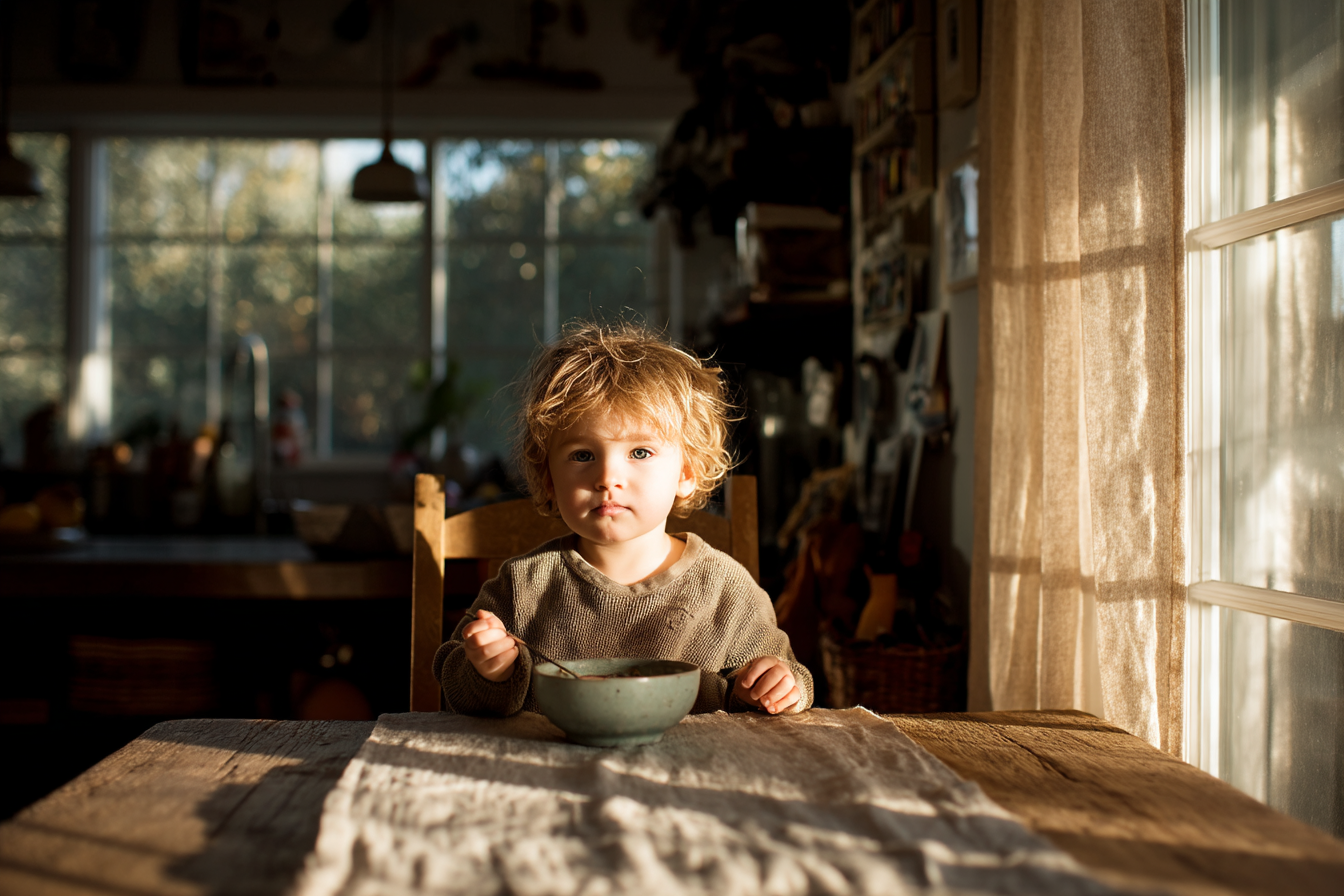
The Routine That Turns Chaos Into Calm Before 8am
You don’t need a perfect morning. You only need a few predictable anchors — small, returnable moments your child can count on when everything else feels unpredictable.
Shoes missing. Breakfast half-eaten. One child refusing to put on pants. Someone crying — possibly you. The clock says 7:53 and it already feels like the day has gone wrong.
This is the toddler morning. Most parents know it intimately. The chaos is not a sign that you are doing something wrong. It is simply what early mornings with small children look like when transitions are hard and everyone is still arriving into the day.
The thing that helped — and it wasn’t waking earlier, or making a colour-coded chart, or reorganising the shoe rack — was noticing that certain small moments could hold the whole morning together if they were predictable enough. Not a schedule. Not a system. Just a few anchors the child could feel before she could name them.
For a while I thought the answer was waking earlier. If I could just get twenty minutes ahead of everyone else, I reasoned, the morning would stop feeling like something happening to me. So I tried it. Set the alarm back. Made coffee before anyone stirred.
It helped, a little, for about three days. Then a sleep regression happened, and then a cold, and then the early alarm became just another thing I was failing to maintain. The mornings were still chaotic. I was just more tired inside them.
What actually changed things was smaller and less heroic than a new schedule. It was noticing that certain moments — specific, tiny, returnable — seemed to hold the whole morning differently when they were there. Not because they solved the chaos. Because they gave the chaos a shape it could move through.
A calm morning routine for toddlers isn’t built from efficiency. It is built from a handful of moments that keep showing up.
Why mornings feel so hard
Toddlers don’t experience time the way we do. They are not watching the clock. They are absorbed in whatever is happening right now — and then suddenly, without warning from their perspective, an adult appears and requires them to stop, move, change, hurry.
That gap — between where they are and where we need them to be — is where most morning stress lives. Not in bad behaviour. In transition.
The research-approved answer is to build more structure. The honest answer is gentler: toddlers are not trying to make mornings difficult. They are simply not built yet to hold the shape of a morning in their heads. They need us to hold it for them — calmly, repeatedly, in ways they can begin to expect.
The toddler who won’t get dressed isn’t being defiant. She is being a toddler — a person whose nervous system is still learning how to shift between states. The stress of a rushed transition is real stress for her, even when it looks like stubbornness from the outside.
You cannot eliminate transitions. But you can soften them. And the way you soften them is not by adding more instructions. It is by building in small moments of predictability — anchors the child can feel before she can fully understand them.
The four anchors we return to every morning
These are not steps in a morning routine for toddlers. They are not items on a checklist. They are moments — small, returnable, gentle — that hold the shape of a morning without controlling it.
You will not use all four every day. Some mornings only one makes it through. That is still enough.
Four moments. Any order. Every one enough on its own.
Save this as a reminder for the mornings that feel harder than they should.
Connection before correction
There is a particular kind of morning where you walk into your child’s room already thinking about shoes, breakfast, time. You are already in logistics mode. And your child feels that — not as a thought, but as an atmosphere. The first thing she experiences is urgency.
What changes when you pause — even for thirty seconds — to greet her before you begin directing her, is that she feels you arrive before she feels the morning’s demands arrive. It is a tiny thing. It lands significantly.
When a toddler’s morning begins with connection rather than instruction, her nervous system can settle into the day rather than brace against it. The transition into waking is itself a transition — and it asks for the same gentleness as any other.
“Good morning, you.” A hand on her back before you say anything else. Her name, once, warmly. Nothing that needs an answer yet.

One predictable breakfast moment
It doesn’t have to be the same food. It doesn’t have to be elaborate or intentional in any visible way. It just needs to be something small and consistent — a ritual your child begins to expect.
In some homes it is the same bowl, the same placement. In others it is a question asked the same way every morning: “What should we look for on the way to nursery today?” It could be a song played while toast cools. It could be a small, ordinary exchange that both of you know belongs to this time of day.
Predictability at the breakfast table gives a toddler a sense that the morning has a known shape. She may not be able to articulate it, but she feels it — and a morning that has a felt shape is a morning she can move through rather than resist.
“What can you hear right now?” Or simply naming what she’s eating, slowly. Or a question with no right answer: “What do birds eat for breakfast?”
Some mornings the ritual lasts about twenty seconds before someone spills the milk or loses interest entirely. That still counts. The returning to it is the thing, not how long it holds.

Instead of narrating the morning to your child — “shoes on, coat on, let’s go” — try giving her one piece of the morning to hold. “Can you choose the cup?” The belonging that comes from having one small role in the routine is often more effective than the most detailed instruction.
The transition warning
Two minutes. The phrase that does not promise two actual minutes, but offers something more important than accuracy: notice. Something is coming. You are not being ripped away without preparation. I am telling you in advance.
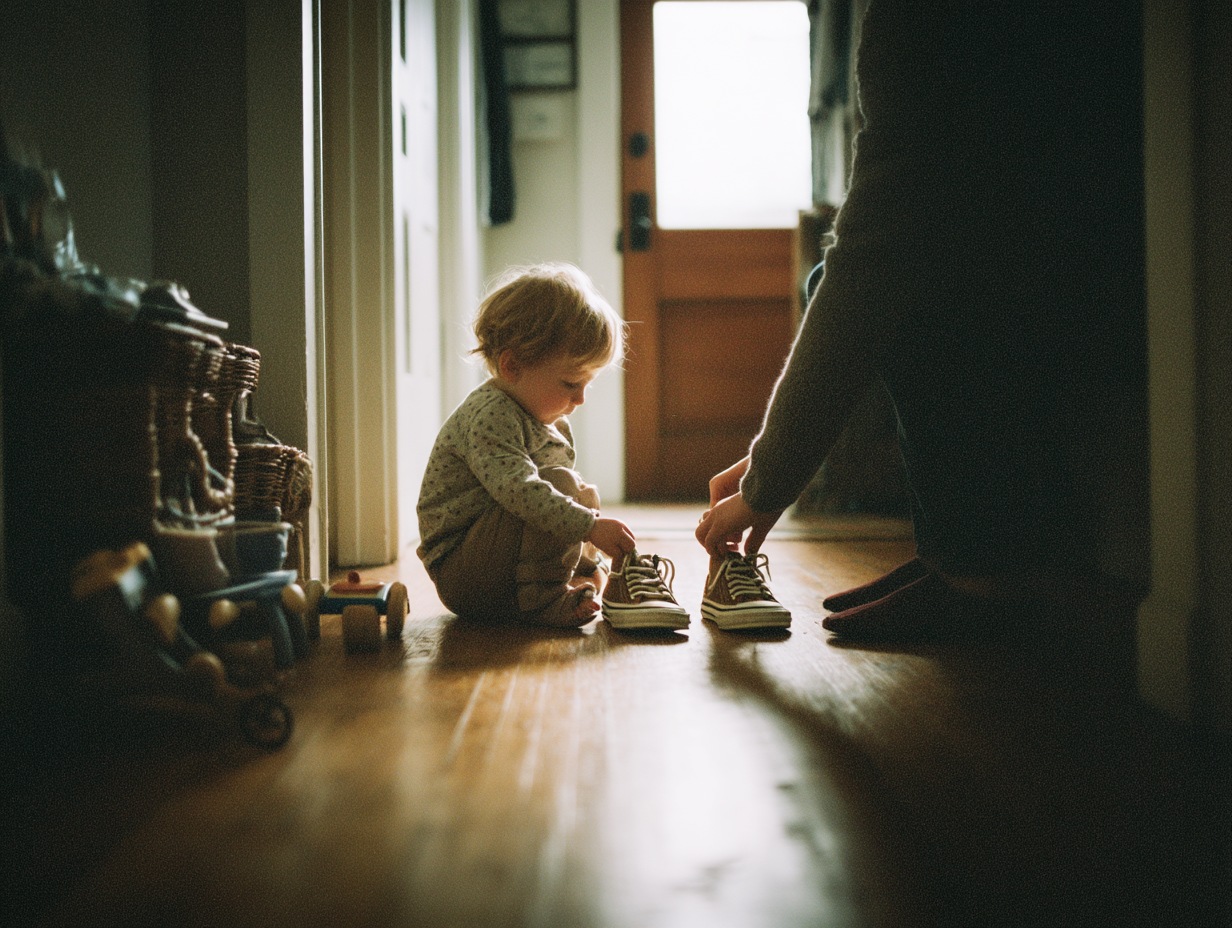
Toddlers cannot manage time, but they can manage awareness of change if we give them enough lead-up. “Two more minutes, then we get shoes on” is not a deal, a negotiation, or a threat. It is a gentle announcement that the current thing is ending.
Transitions are harder when they arrive without warning. The warning doesn’t remove the difficulty — it reduces the shock. And a toddler whose system isn’t in shock is a toddler who is more likely to co-operate with what comes next.
“Two more minutes, then shoes.” Not: “Get your shoes on NOW.” Not even: “It’s time to go.” Just the quiet heads-up that something is shifting.
Sometimes the two-minute warning lands and sometimes it doesn’t. Sometimes she cries anyway. The warning isn’t a guarantee of a smooth transition — it is a practice of giving notice. Even when it doesn’t prevent the tears, it is still kinder than the abrupt version.
The goodbye ritual
Goodbye is a transition too. One of the harder ones. And like all the others, it holds up better with a little ceremony — something small and returnable that signals: this is how we part. Not in confusion. Not in a rush. In a way that has a shape.
For some families it is three kisses, always. For others it is a wave from the window. A phrase: “I’ll see you after orange-snack time.” A song fragment. A specific, private gesture that belongs only to the two of you.
Children — especially toddlers — do not naturally have a model for separation. The goodbye ritual teaches them one. Over time it becomes a container for the hard feeling of parting, rather than leaving the feeling formless and frightening.
“Two hugs and a wave” said the same way, every morning. Or a phrase the child can begin to repeat: “See you after nap.” The repetition is the point. She learns the shape. The shape holds the goodbye.
The goodbye ritual does not mean goodbye without tears. It means goodbye with a shape. She may still cry. You may still leave with a slightly broken heart. But both of you knew how the parting was supposed to go, and that matters even when feelings overflow it.

The goal isn’t a perfect morning
Children rarely remember efficient mornings. They remember atmosphere.
They remember the hug that happened even when everyone was late. They remember being told they were loved at the door. They remember the small ritual — whatever it was — that meant something and came back reliably.
A calm morning routine isn’t the absence of chaos. It is a few moments of warmth inside it. An efficient morning where both of you arrived at the car in nine minutes but no one felt seen is a morning that happened. A slower morning where one small connection occurred before you left — a real greeting, a question that mattered, a goodbye that had a shape — is a morning that was held together by something.
“Your child doesn’t need a perfect morning. She needs to feel you in it — even briefly, even imperfectly — before the day takes you both.”
The anchors are not a method for producing better mornings. They are small acts of presence inside mornings that are already happening. A toddler morning routine built on four returnable moments asks less of you than a schedule. It simply requires that, at certain predictable moments, you arrive.
Before tomorrow morning, choose one anchor to return to
- Decide on a greeting — something small you can offer before any instruction. A hand on her back. Her name said warmly. Thirty seconds of just arriving.
- Think of one small breakfast ritual that already almost exists. Name it. Bring it back deliberately tomorrow.
- Practise the transition warning tonight at bedtime: “Five more minutes, then bath.” Let her hear the shape of it before she needs to co-operate with it.
- Talk through tomorrow’s goodbye, if she is old enough. “Tomorrow when we say goodbye, we’ll do two hugs and a wave.” The predictability begins tonight.
You will not use all four anchors every morning. Some mornings only one makes it through. Some mornings none of them do, and everyone arrives at the door in a state of chaos and mild distress, and that is a real morning that real families have. The anchors are not a standard to meet. They are something to come back to when the morning allows it.
The Calm Morning Routine Cards
A printable set of gentle visual reminders for the mornings that feel harder than expected. Not a checklist. Not a schedule. A quiet reminder of the four anchors — to keep nearby, to return to, to use when the morning needs holding together.
Download the free cards