
What Screens Are Actually Doing To Toddler Speech
Most parents worry that screens teach the wrong things. The bigger question may be what screens quietly replace.
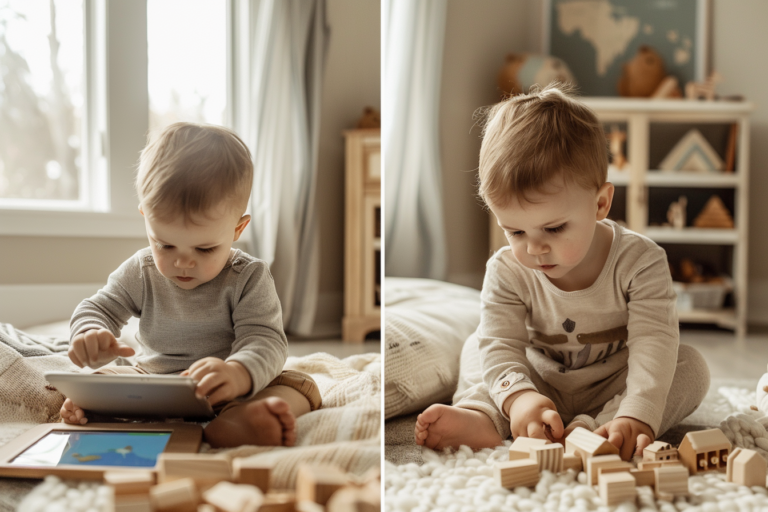
It is a Wednesday morning. Breakfast needs to be ready in ten minutes. Your toddler is on the rug behind you, watching a cartoon they have seen at least a dozen times. They are quiet. They are settled. The morning is holding together.
You glance over. They look completely fine.
Nothing looks wrong in this scene. And in most ways, nothing is. You are nearby. They are content. Breakfast will happen. The day will begin.
And yet something is not happening — something small, ordinary, and quietly important.
The issue is not what your toddler is watching.
It is what the screen has quietly replaced.
The Question Most Parents Are Asking — And The One That Matters More
When screen time comes up in parenting conversations, the question is almost always about content. Is this educational? Is this age-appropriate? Is this one of the good ones?
These are reasonable questions. But they sit at the edge of the actual issue.
The more useful question — the one that maps most directly onto how toddler language actually develops — is not about what the screen is offering.
It is about what the screen is replacing.
Language does not grow inside passive reception. It grows inside interaction — the small, imperfect, back-and-forth moments that happen between a child and the people around them. Screens, almost by definition, cannot provide this. Not because they are harmful, but because they are one-directional.
A show can give a child hundreds of words. Only people can give a child language.
What I Started Noticing
I want to be careful here, because this is observation — not causation. But it is worth naming, because I think many parents have noticed the same thing without quite having words for it.
The biggest thing I noticed wasn’t fewer words.
It was fewer questions.
On days with more screen time, my toddler still talked. Still pointed at things. Still made herself understood. But there seemed to be less wondering. Less of that particular quality of attention that makes a toddler suddenly stop on the pavement and stare at something that most adults have stopped seeing.
Less “Mama, what’s that?” pointing at a shadow on the wall.
Less wandering into the kitchen to watch what was happening at the stove.
Less noticing the small things — the beetle on the windowsill, the sound the radiator makes, the way light moves across the floor in the afternoon.
I noticed it most at the end of screen-heavier days. Not that she was behind. Not that anything was wrong. Just — a little less curiosity in the room. A little less reaching toward the world.
That noticing was the beginning of understanding what screens were actually doing.
Curiosity is where language begins. The wondering comes first. The words come after. And anything that holds a toddler’s attention so completely that the wondering slows down is worth paying attention to — gently, without alarm.
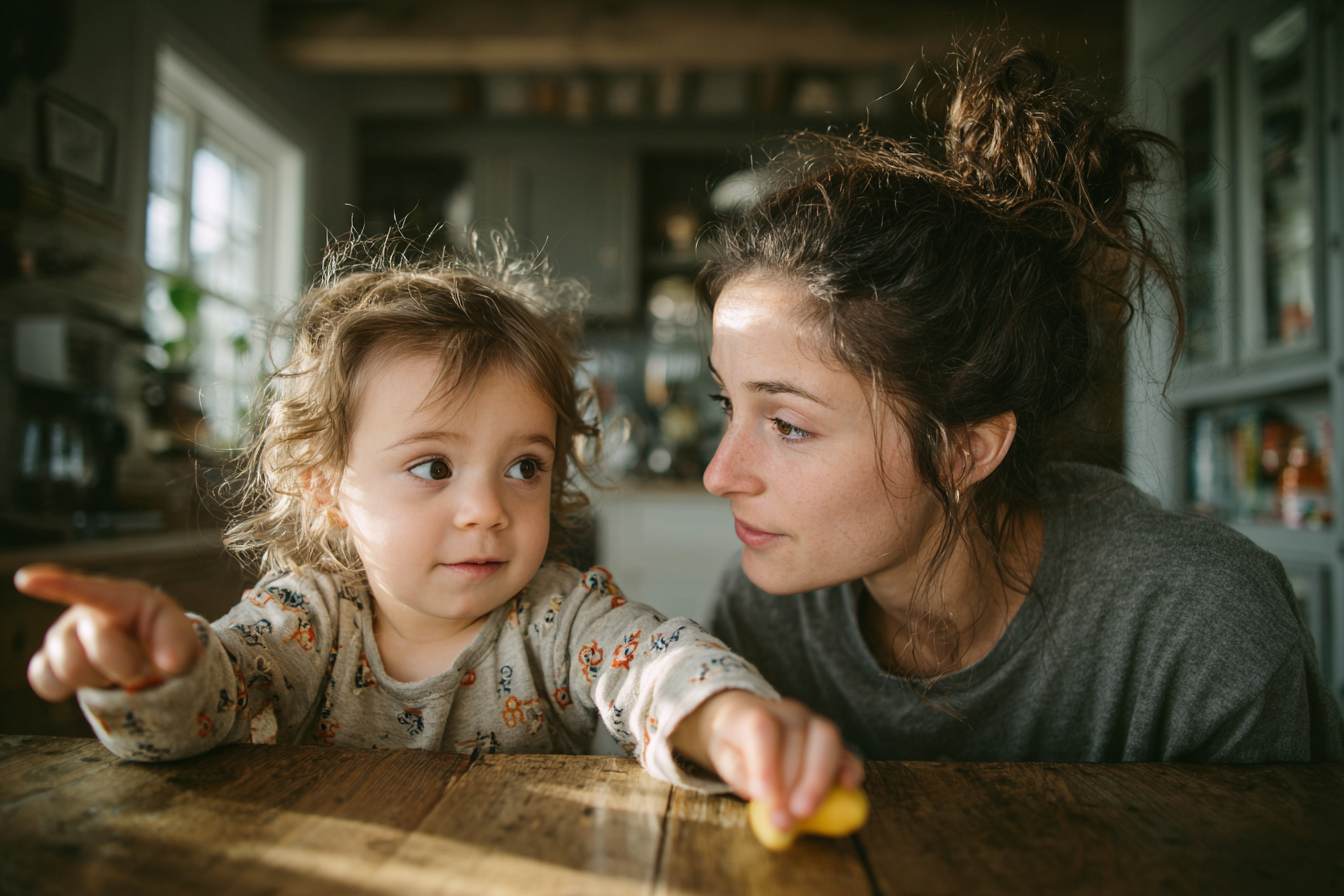
Five Things Screens Often Replace — And Why Each One Matters
This is not a list of things you need to fix. It is a map of what language development actually needs — so that when screens are present, you can see what they are quietly crowding out.
Back-and-forth conversation
It is 7.40am. Your toddler picks up a spoon and drops it. Picks it up and drops it again. In that moment — in an ordinary kitchen, before the day has properly started — there is a language opportunity. Not because the spoon is educational. Because you will say something, and they will respond, and that exchange is one of hundreds that together wire the rhythm of conversation into a very young brain.
Toddler language develops through what researchers call conversational turns — the small exchanges where a child makes a sound or gesture, a parent responds, and the child responds back. Even before a child has real words, these turns are shaping the architecture of language. A screen cannot take a turn. It continues whether your child is paying attention or not, whether they vocalize or go silent, whether they point or look away.
The number of back-and-forth exchanges a child has in a day — not the quality of the content they consume — is one of the strongest early predictors of language development.
The rhythm of conversation. How to take a turn. How to wait for a response. How their sounds and words have the power to change what happens next.
During breakfast, let there be a pause after your child makes a sound or reaches for something. Instead of naming it immediately, wait. See if they try again. The wait is where the turn-taking lives.
Shared attention
You are at the crosswalk with your toddler in the stroller. There is a dog across the street — big, unhurried, pulling gently at a lead. Your toddler sees it and makes a sound. You both look. Dog, you say. Big dog. And in that moment, with both of you focused on the same thing, with the same small scene holding both of your attention — that word lands differently than it does from a screen.
Joint attention is one of the foundational building blocks of early language. When a parent and toddler look at the same thing together, knowing they are both looking, the word offered inside that shared moment carries more weight. It is connected to a real experience that two people just had together.
When a toddler watches a screen alone, attention is directed at the screen only. The shared element — the parent present alongside, noticing the same thing — is missing. Not catastrophically. Just quietly.
Following another person’s gaze. Connecting language to shared experience. Understanding that words refer to something real that two people can both see.
When you watch alongside your child — even occasionally, even for a few minutes — you restore the shared attention element. Your response to what is on screen becomes a turn. The viewing becomes a small conversation.
Waiting and responding
You are getting shoes on before a walk. Your toddler wants their red shoes. They know which ones they want. They don’t have the word yet — but they try anyway: a sound, a point, a look. And you respond. You follow their gaze to the shoes. You say the word. You hand them over. This exchange takes about twelve seconds and contains most of what language development actually needs: communication, response, a felt sense that the trying was worth it.
A screen does not wait. It moves at its own pace, independent of the child. There is always something new, always movement, always stimulation. This is part of what makes it so engaging — and it is also what makes it unable to give a child the experience that matters most: the experience of communication causing something to happen.
Children talk more when they have learned that talking works.
Communication as agency. The understanding that their voice changes what happens next. The willingness to try again when a first attempt doesn’t land.
During one interaction today — any one — pause just a beat longer than usual after your child communicates. Don’t fill the silence immediately. Let them notice that you noticed. That noticing is the whole thing.
Real-world vocabulary
In the grocery store, your toddler reaches for an orange. They hold it with both hands. It is heavy and cool and smells like something they cannot name yet. You say orange. They look at it. You say it again. They say something close to it — something with the right vowel, close enough. This is how vocabulary settles in: through touch, weight, smell, the particular quality of a real thing in a small person’s hands.
A screen can teach a child the word “orange.” But the word that came from the real orange — held, smelled, tasted — is connected to a whole sensory memory. It lives differently in the brain. More durably. More richly.
This is not an argument against learning words from screens. It is an observation about depth. Words offered inside real experience tend to root more reliably than words offered on a flat screen, however vivid the animation.
Connecting language to sensory experience. Building vocabulary with emotional and physical memory attached. Learning that the same word applies to many different versions of the same thing.
The most language-rich moments in your toddler’s day are probably the ones that already involve their hands: meal preparation, getting dressed, sorting laundry, being outside. These are already vocabulary-building activities. The screen competes with these moments — not by being harmful, but simply by being present when they could be.
Observation and curiosity
A toddler in a room without a screen tends to find something. A shadow. A sound from outside. The way laundry folds. The sound of water in a pipe. They wander toward things with a particular quality of attention that is hard to describe — not productive, exactly, but not idle either. Something between wondering and investigating.
This wandering is language preparing to happen. The curiosity comes first. The noticing comes first. The reaching-toward-something comes first. Words come after — offered by an adult who is also there, also watching, ready to name what the child has just found.
A screen holds attention in a particular way: absorptively. It is very good at capturing focus and holding it in place. Which also means that during screen time, the wandering stops. The noticing stops. The wondering stops. Not permanently. But for now.
Boredom, for a toddler, is often the entry point to curiosity. The moment of not knowing what to do with yourself is also the moment of noticing something worth wondering about. It is not something to engineer — just something worth protecting occasionally.

The Same Day, Two Different Language Environments
This is not a before-and-after. It is a map of the same ordinary day, held two different ways. Neither version is perfect. But the difference in language opportunity is worth seeing clearly.
None of these individual moments is decisive. What matters is the cumulative pattern — how many of these small language opportunities exist across a day, and how many have been quietly replaced.
What Research Actually Suggests
This is not a scare piece, and there are no alarming statistics here. But the science is worth understanding simply — because it explains why the conversation above is the right one to be having.
Children learn language best through what researchers call responsive interaction — exchanges where an adult responds to what the child says or does, contingently and warmly. The responsiveness is the active ingredient, not the vocabulary input alone.
Studies that have given families with young children access to recordings of their home environments consistently find the same thing: the number of conversational turns a child participates in — not the number of words they overhear — is most strongly associated with language outcomes at age three.
Screens provide words. They do not provide turns. This is the core of the issue, stated as plainly as possible.
There is also consistent evidence that screens playing in the background — when no one is actively watching — reduce the quantity of parent-child conversation in a room simply by being present. Not dramatically. But measurably. This is worth knowing without turning it into guilt.
Many children who watch screens heavily still develop language well, because the other hours of their day are full of responsive interaction. The question is always about the balance of the whole day — not any single activity in isolation.
The Better Question
Instead of asking “how many minutes of screen time is too many?” — which has no clean answer and tends to produce anxiety rather than clarity — try asking this instead:
Most days, the answer is yes — because life with a toddler is inherently full of interaction. The morning rush, with all its friction, is packed with language. Transitions, choices, objects, emotions — a parent and a child moving through a shared task together, both of them slightly late, both of them speaking.
The screen conversation matters most on days when the balance has tipped — when screens have replaced a significant proportion of the ordinary moments that language usually lives inside. And knowing what those moments are makes it easier to see when they have gone missing.
Language opportunities already exist in every part of your toddler’s day:
- – Meals: pointing, naming, choosing, refusing, the back-and-forth of wanting something and waiting
- – Getting dressed: body parts, textures, sequences, the small negotiation of which shoes
- – Bath time: action words, cause and effect, one of the most naturally language-rich moments in the day
- – Walks and errands: noticing, naming, wondering, the slow observation of ordinary things
- – Play: narrating, following, commenting, waiting for what happens next
These moments are already happening. They do not need to be optimised or scheduled or made more intentional. They need only a little more language inside the time that is already there.
A simple printable with prompts for the ordinary parts of your toddler’s day — mealtimes, bath time, getting dressed, the grocery run. Not a curriculum. Not a schedule. Just small reminders for the interactions that are already happening, waiting to become a little richer.
If you enjoy having simple prompts nearby during ordinary routines, the Toddler Language Prompt Cards were created for exactly that purpose. Not lessons. Not scripts. Not another thing to keep up with. Just gentle reminders that help everyday conversations happen a little more naturally.
See the prompt cards on Etsy →Tiny Changes That Matter More Than Cutting Screens Completely
Screen reduction for its own sake is not the goal here. These are the shifts that actually change the language balance in your toddler’s day — most of them taking under a minute to begin.
- Watch together sometimes. Sit alongside your child for a few minutes and comment on what is happening on screen. “Oh, the bear is looking for something.” This restores the shared-attention element that makes a screen moment more like a conversation.
- Pause and comment. During a screen moment, say one thing out loud about what you notice. This creates a conversational turn even in a mostly passive setting.
- Narrate one everyday task a day. Choose one routine moment — making lunch, folding a cloth, walking to the car — and narrate it quietly. Not as a lesson. Just as company. Just as someone who is here and noticing.
- Protect one screen-free routine. Mealtimes are the most natural choice — they are already conversational, already interactive, already full of language when no screen is competing for attention.
- Follow your child’s interest afterward. If they watched something and seem interested, talk about it later. “You saw a duck on that show — do you remember the duck at the park?” This bridges screen vocabulary to real experience and real memory.
- Notice background noise. A screen playing in a room, even when no one is actively watching, tends to reduce parent-child conversation measurably. Switching it off when it is not being watched is a surprisingly significant change.
- Let yourself off the hook. A parent who uses screens and feels guilty about it tends to be less present during non-screen time. The guilt is not neutral. Understanding the actual issue — what is being replaced — is more useful than managing a rule.
None of these changes require more time. They require only a slightly different quality of attention inside the time that already exists. That shift — from passively nearby to quietly responsive — is where most of the language growth happens.

Keep Nearby
If keeping a few prompts somewhere visible would help — near the dinner table, by the bath, or beside the morning shoes — there is a free set made for exactly these moments. Small enough to use this week. Specific enough to actually help.
The goal was always more connection.
You do not need to become a different parent. You just need to notice a little more of what is already here.