
What Actually Helps With Toddler Speech Delays
If you’ve been quietly worrying about your toddler’s speech, you’re not alone — and you’re not powerless. Here’s what we know, what helps, and what to do right now.
It usually starts as a quiet thing — a niggling feeling at a playgroup when another child the same age seems to say more words, or a comment from a relative that lands heavier than it should. And then you find yourself counting words, replaying conversations, wondering whether what you’re seeing is just your child’s pace or something worth paying attention to.
This post won’t tell you not to worry. It will try to give you something more useful: an honest picture of what’s typical, what’s worth watching, and what actually helps — both at home and with professional support.
What’s typical — and what’s a wide range
One of the most disorienting things about toddler language development is how wide “normal” actually is. The range of typical development is genuinely broad, and a child who sits at one end of that range and a child who sits at the other can both be developing perfectly well.
| Age | Typical range | Worth noting |
|---|---|---|
| 12 months | 1–3 words with meaning; babbling with consonants; responds to name | No babbling, no pointing, not responding to name |
| 18 months | Around 10–20 words; uses words consistently; points to show you things | Fewer than 5–6 words; no pointing to request or share |
| 24 months | Around 50 words; starting to combine two words (“more milk,” “daddy go”) | Fewer than 50 words; no two-word combinations at all |
| 30 months | Using short sentences; most speech understood by familiar adults | Mostly unclear speech; not combining three words; significant frustration |
| 36 months | Using sentences; strangers can understand most of what they say | Still largely unclear; limited vocabulary; not asking questions |
These are guidelines, not cutoffs. One child might have 15 words at 18 months and 200 by 22 months — that’s a common pattern. Another might have 50 words at 18 months but develop them more slowly from there. What matters over time is trajectory, not a single snapshot.
Signs that warrant a conversation with your pediatrician
Most language differences resolve on their own. But some signs — particularly when they appear together — are worth raising with your child’s doctor sooner rather than later. Earlier is genuinely better when it comes to speech support.
- No babbling by 12 months, or babbling that stops and doesn’t resume
- Not responding to their name consistently by 12 months
- No pointing, waving, or reaching to communicate by 12–14 months
- Fewer than 6 words by 18 months
- Loss of words or communication skills they previously had — at any age
- No two-word combinations by 24 months
- Frequent, intense frustration around communication that isn’t improving
- Difficulty understanding simple instructions by 24 months
The rule of thumb: if you’re consistently concerned — not just occasionally, but regularly — it’s worth saying so to your pediatrician. The conversation costs nothing. Waiting to see if it resolves, when early support is available, costs more.
“Asking early is never a mistake. The worst outcome is being told everything looks fine.”
What actually helps — at home
Whether your child has a formal speech delay, is a “late talker” who will catch up naturally, or is simply on the quieter end of typical, these approaches are consistently supported by research and used by speech-language pathologists. They don’t require training to implement — just intention.
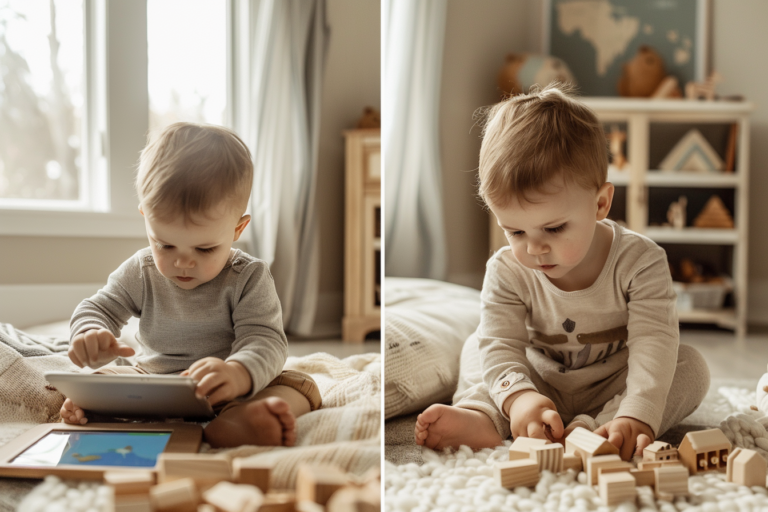
Sit at your child’s level. Watch what they’re doing. Comment on it without redirecting or testing. “You’re putting the block in the box. In. Out. In.” This kind of child-directed interaction — where the adult follows rather than leads — is one of the most evidence-backed approaches for supporting language. It reduces pressure and increases a child’s motivation to communicate.
Most of us ask our toddlers a lot of questions — “what’s that? what color is it? what does it do?” This is natural, but it can create low-level pressure that actually suppresses communication in quieter or later-talking children. Try replacing some questions with observations: “that truck is big” instead of “what’s that?” Comments invite response without requiring it. The difference in how a child engages can be noticeable within days.
If your child is using single words, model two-word phrases. If they’re using two-word phrases, use three. This is called “expanding” — meeting them where they are, then showing them the next step. You’re not correcting them. You’re demonstrating. “Ball!” — “Big ball.” “More!” — “More banana, please.” This is gentle, natural, and builds both vocabulary and sentence structure.
If you anticipate every need before your child has a chance to ask, you inadvertently reduce the reasons they need to communicate. Pause before handing them things. Put a desired toy in view but slightly out of reach. Offer choices with two options. Look at them expectantly when they reach for something. These small moments of “communication opportunity” are valuable practice — just make sure they feel playful and not withholding.
Joint book reading is one of the highest-impact activities for language development. The key word is “joint” — it should be a two-way exchange. Point at pictures and name them. Wait for your child to look. Ask “what’s that?” and accept any response — a look, a sound, a point, a word. Books expose children to vocabulary they don’t encounter in everyday conversation and create a natural, low-pressure space for language practice.
The evidence on this is consistent: passive screen viewing does not support language development the way human interaction does, and high amounts of solo screen time can crowd out the interactive exchanges that do. This doesn’t mean screens are harmful — it means the time spent in front of a screen is time not spent in conversation. If screens are part of your day, watch together and talk about what you’re seeing.
What doesn’t help — or makes things harder
Repeatedly asking “say ball, say ball, can you say ball?” creates pressure without creating learning. If a child could say the word easily, they would. Pressure tends to make communication harder, not easier.
Saying “no, say it properly — truck, not tuck” can embarrass or discourage. Instead, just model the correct word naturally in response: “yes, a truck! a big truck.” The repetition does the work without the correction.
The “wait and see” advice is common and sometimes appropriate — but it has a quiet cost when it becomes the default. Speech therapy is most effective when started early. If concerns persist past two or three check-ins with yourself, it’s time to bring them to a professional.
You already know this one, but it’s worth naming: other children’s word counts are not a useful benchmark for your child. The range is too wide, the contexts too different, and the emotional cost of comparison too high for what it offers.
When professional support makes sense
A speech-language pathologist (SLP) is the right person to evaluate and support toddler speech delays. If your pediatrician refers you to one, or if you seek out an evaluation independently, here’s what that typically looks like:
An initial evaluation usually takes 60–90 minutes and involves observing your child in structured and unstructured play, a standardized assessment, and a detailed parent interview. The SLP will tell you what they observe, whether they see a delay, and if so, what they recommend.
Therapy for toddlers typically looks like play. It’s not drills or worksheets — it’s guided interaction designed to build the specific skills your child needs. Parents are almost always involved, because generalization of skills into everyday life is the real goal.
Most toddlers who receive early speech support make strong progress. Many late talkers — children who are late to speak but have typical comprehension and social communication — do catch up without intervention. The hard part is knowing which category your child falls into, which is exactly what a professional evaluation can clarify.
You don’t need to wait until you’re certain something is wrong. Asking for an evaluation is not an alarm — it’s information. And having information is almost always better than not having it.
One last thing
If you’ve been worrying quietly about your toddler’s speech, the fact that you’ve noticed, paid attention, and are looking for answers already puts you in the position most likely to help them. The thing that makes the biggest difference for toddlers with language delays is not a program or a product. It’s a parent who pays attention, responds consistently, and seeks support when they’re not sure.
That’s you. You’re already doing the most important part.
7 daily habits that support toddler speech
If you want to start with something concrete at home, our first post in this series covers seven simple daily habits — the same ones speech therapists recommend — that you can weave into your existing routine.
Read: 7 Daily Habits That Help Toddlers Talk → Or download our free daily language routine card