
7 Daily Habits That Help Toddlers Talk
Simple things you can do inside your ordinary day — no special activities, no flashcards, no schedule overhaul required.
Most of what helps a toddler’s language develop isn’t a curriculum. It isn’t a program or a product. It’s the texture of your daily life together — the way you talk during breakfast, the pause you leave after asking a question, the words you reach for when your child points at something across the room.
This matters because it means you’re already doing a lot of this. You may just need a few small shifts to make your everyday interactions work harder for your toddler’s language — without working harder yourself.
Here are seven habits worth weaving in. None of them require extra time. Most of them will feel natural within a week.
Running commentary is one of the most powerful tools you have. “I’m putting your shoes on. First this foot. Now the other one.” You’re not teaching — you’re just describing. Your toddler is building an internal map: words attach to actions, objects, sequences. Over thousands of repetitions, that map becomes language.
Try it at: diaper changes, meals, getting dressed, putting groceries away.
After you ask a question or make a comment, wait. Count to five in your head if you have to. Most of us fill silence automatically — it feels awkward, so we answer for the child or move on. But toddlers process language more slowly than we do. That silence is where the attempt is forming. Give it room.
This one is harder than it sounds, especially on rushed mornings. Even three seconds helps.
When your toddler babbles, points, grunts, or makes any communicative gesture, respond as if it was a complete sentence. “Oh, you want the red cup? Here it is — the red cup.” You’re not just responding to words. You’re building the understanding that communication works: I say something, something happens. That’s motivating. That’s what keeps toddlers trying.
It doesn’t matter if you get the meaning wrong sometimes. The response itself is what matters.
“Language develops through thousands of small exchanges — not one perfect teaching moment.”
Reading to toddlers is well-known. What’s less talked about is that the conversation around the book matters as much as the words on the page. Point to pictures and name them. Ask “what’s that?” and wait. Follow their gaze. Repeat words slowly when they seem interested. A five-minute book that turns into a back-and-forth conversation is more valuable than a twenty-minute story read straight through.
Let your toddler turn pages, point at things they like, and set the pace. The goal isn’t finishing the book.
When your toddler says “ball,” you say “big ball” or “red ball” or “throw the ball.” When they say “more,” you say “more banana.” This technique — called expansion — is simple and quietly powerful. You’re meeting them exactly where they are, confirming their attempt was understood, and gently modeling the next step. One word further. Not a grammar lesson. Just one more word.
Match their energy. If they’re excited, be enthusiastic. If they’re calm, stay calm. The emotional tone matters too.
“You’re frustrated — the block isn’t fitting. That’s hard.” “You look so happy right now.” Emotion words are vocabulary too. Toddlers who hear their internal experiences named regularly develop both emotional literacy and richer language. They also tend to be calmer, because they feel understood. You don’t need a script — just notice what’s happening and say the word.
Keep emotion labels simple and accurate. You don’t need to fix the feeling — just name it.
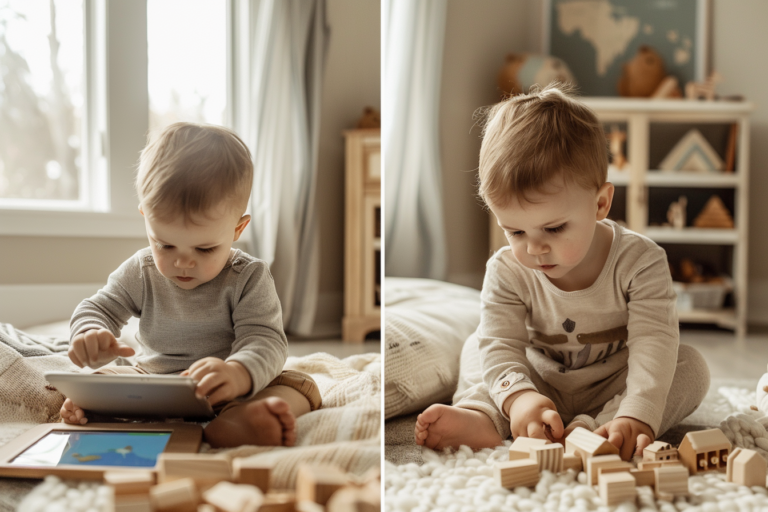
After screen time, toddlers often need 20–30 minutes before their language processing is fully re-engaged. This isn’t about screen time being harmful — it’s about timing. If you want a rich conversation, or if your child seems to be struggling to express something, moving away from screens first can make a real difference. Meals, outdoor time, and play are naturally good windows.
You don’t have to eliminate screens. Just notice the best conversational windows in your day and protect them.
What “enough” actually looks like
On a good day, you’ll do most of these. On a hard day — when you’re tired, when the morning went sideways, when your toddler is in a mood and so are you — you might manage two. That’s fine. Language development is not built on perfect days. It’s built on consistency over time.
The goal isn’t a flawless language-rich home. It’s a home where your child feels safe to try, where their attempts are noticed and responded to, and where words show up naturally in the fabric of your day.
Most of the time, that’s exactly what you’re already doing.
Quick Reference — 7 Habits
- Narrate what’s happening during daily tasks
- Pause and wait after questions — count to 5
- Respond to babble and gestures like communication
- Make book-reading a two-way conversation
- Expand their words by adding one more
- Name emotions as they happen, simply
- Protect good conversational windows (after screens, use a buffer)
A note on timing
Every child develops language on their own timeline. Some toddlers say twenty words at twelve months. Others have five at eighteen months and then suddenly have fifty at twenty months. Wide variation is normal.
That said, if you have consistent concerns about your toddler’s speech — very few words for their age, no gesture communication, not responding to their name — it’s always worth a conversation with your pediatrician. Early support, when needed, makes a significant difference. There’s no harm in asking.
Want a simple daily routine card?
We made a free printable language routine — 10 minutes a day, built around these habits. Great for sticking on the fridge as a gentle reminder.
Download the free routine card →