Toddler Independence
40 Ways To Build Toddler Independence At Home
Toddler independence does not have to look like a perfect routine or a child who does everything alone. Often, it begins with one small chance to try — pouring water, carrying socks, wiping a spill, choosing between two shirts, or helping in a way that actually matters.
Many parents want their toddler to become more independent, but home life is already full. There are meals to make, laundry to fold, mornings to survive, and spills to clean. Independence can sound like one more thing to teach — one more system to build, one more thing to get right.
But for toddlers, independence is not a separate lesson. It grows inside ordinary routines that are already happening in your home, whether or not you plan for them.
A child who carries their own spoon is practicing responsibility. A child who pulls a sock halfway on is practicing body awareness. A child who wipes a tiny spill is learning that they can affect the world around them — that their hands matter, that their effort matters, that they belong to the life of the household and not just to the sidelines of it.
None of this requires a shelf of matching baskets or a color-coded routine chart. It requires one small, real chance, offered again and again, inside the life you are already living.
In this article
What toddler independence really means
It is easy to picture toddler independence as a finished skill — a child who dresses themselves, eats neatly, and cleans up without being asked. That picture is not wrong, exactly. It is just years away, and it is not where independence actually begins.
At this age, toddler independence does not mean:
- doing everything alone
- obeying quickly
- being mature
- not needing help
- finishing a task perfectly
It means something smaller, and in some ways more important:
- having small chances to participate
- trying part of a task, not the whole thing
- making simple, safe choices
- using the body with purpose
- feeling trusted inside real family life
Gentle Reminder
At this age, independence is not the absence of help. It is the presence of real participation.
A toddler who is handed one true, doable piece of a task — not the whole job, not a scaled-down pretend version of it — is being told something quiet but powerful: you are capable, and this family needs you too.
Before you start: make independence smaller
The most common mistake is not a lack of patience. It is scale. Parents often offer a toddler the whole task, watch it fall apart, and quietly conclude that their child “isn’t ready yet.”
The task usually isn’t the problem. The size of it is.
Don’t give the whole task. Give one reachable part.
- Not “get dressed by yourself” → “push one arm through”
- Not “clean the table” → “wipe this small spot”
- Not “make breakfast” → “put banana slices into the bowl”
- Not “pack your bag” → “put your water bottle inside”
- Not “tidy the room” → “put the blocks in this basket”
Gentle Reminder
Independence grows best when the task is small enough to succeed, real enough to matter, and repeated often enough to become familiar.

By The Way
If you’d rather have these ideas somewhere you don’t have to scroll for, there’s a free printable checklist version further down in this article.
40 ways to build toddler independence at home
These are grouped by the moments that already exist in your day — getting dressed, eating, washing up, cleaning small messes, helping with real work, making choices, moving through routines, and managing feelings. None of it requires new equipment. Most of it requires only one small adjustment: offering a real part instead of doing it all yourself.
Group 1 of 8
Getting Dressed
Dressing builds body awareness, sequencing, choice-making, and patience — and it happens at least twice a day, whether anyone is teaching or not.
Two options, held up at the same time, turns a rushed moment into a small decision your toddler gets to make. It doesn’t slow mornings down as much as it seems like it would — and it gives them a real say in something that happens to their body every day.
You hold the shirt open; they do the pushing. It is a small physical task with a clear beginning and end, which makes it a good first piece of a much bigger skill.
Removing is almost always easier than putting on, which makes it a gentle entry point. Bath time already has built-in patience, so it’s a forgiving place to practice.
This one small drop teaches a whole sequence — clothes come off, clothes go somewhere, clean clothes come from somewhere else. It’s a quiet lesson in how a household actually works.
A simple carrying task with a clear destination. It builds the habit of shoes having a place, long before “put your shoes away” means anything as an instruction.
Group 2 of 8
Mealtime Independence
Meals repeat every day, which makes them one of the richest independence routines you already have — no extra time required, just a different way of doing what’s already happening.
A short walk with one object and one job. If it drops, it drops — that’s part of the practice, not a failure of it.
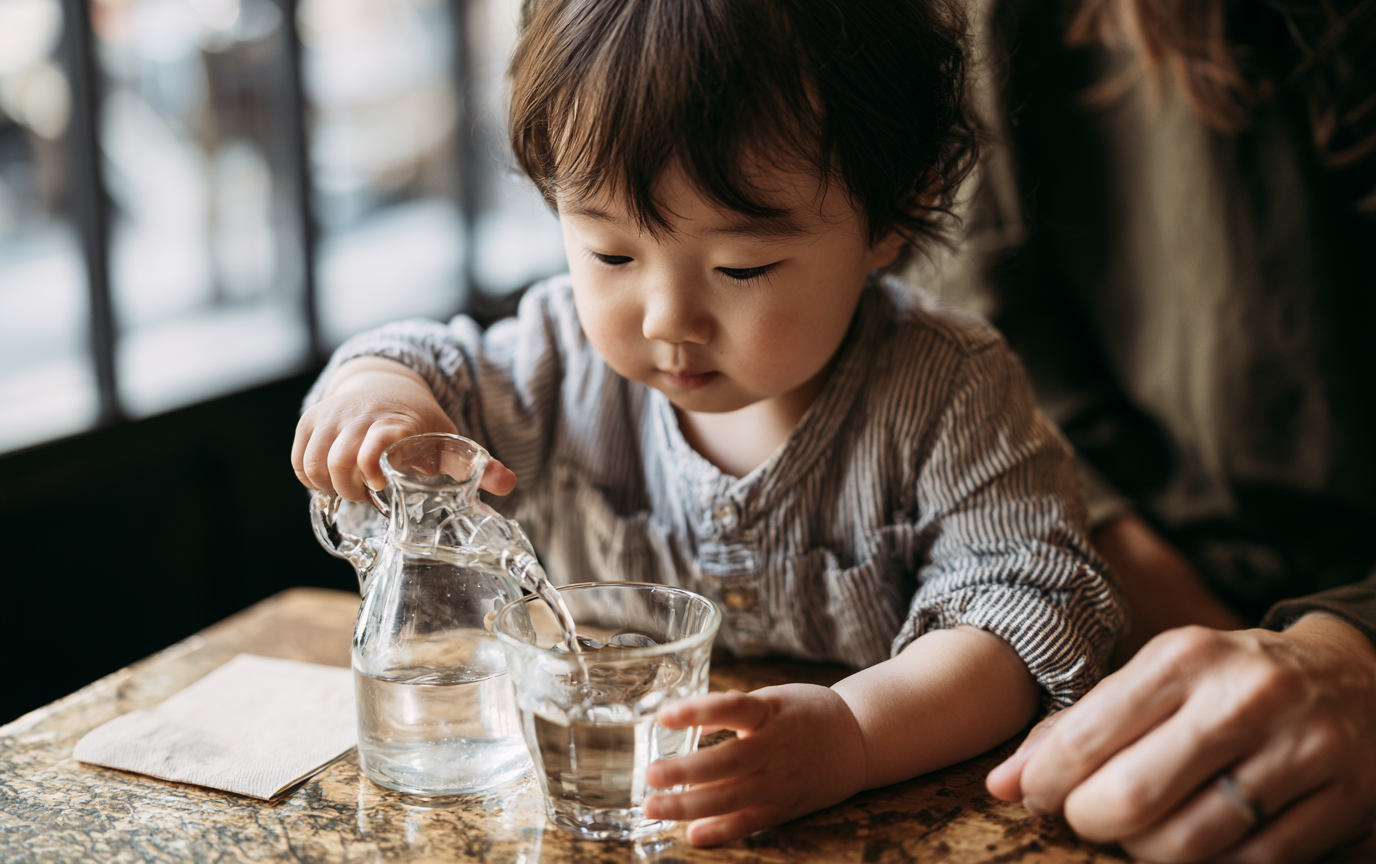
Use a small, light jug with a little water in it. Spills are part of learning how much is too much — a cloth nearby matters more than a perfect pour.
Pre-cut, soft pieces work best. This gives them a real role in the meal before it’s even served, not just at cleanup.
It won’t be thorough, and that’s fine. The point is the reach for self-care, not the result.
A short, low-stakes walk that closes the loop on the meal. It quietly teaches that a task has a beginning and an end, and that they can be part of both.
Group 3 of 8
Washing & Self-Care
Self-care teaches a quiet but important idea: my body belongs to me, and I can care for it.
Your hand nearby, their hand on the tap. It’s a shared action before it becomes a solo one.
This is more about sensation and sequence than cleanliness at first. The washing habit builds slowly, one repeated motion at a time.
A hook at their height turns “hang up your towel” from an abstract instruction into something they can physically do without help.
Their turn first, your turn to finish. This keeps the task theirs while still protecting their teeth.
Small, satisfying, and complete in seconds. It’s an easy way to feel useful many times a day.
Group 4 of 8
Cleaning Up Small Messes
Cleanup is not punishment. It is participation in shared life — a way of saying, this home is yours too, and its care belongs to all of us.
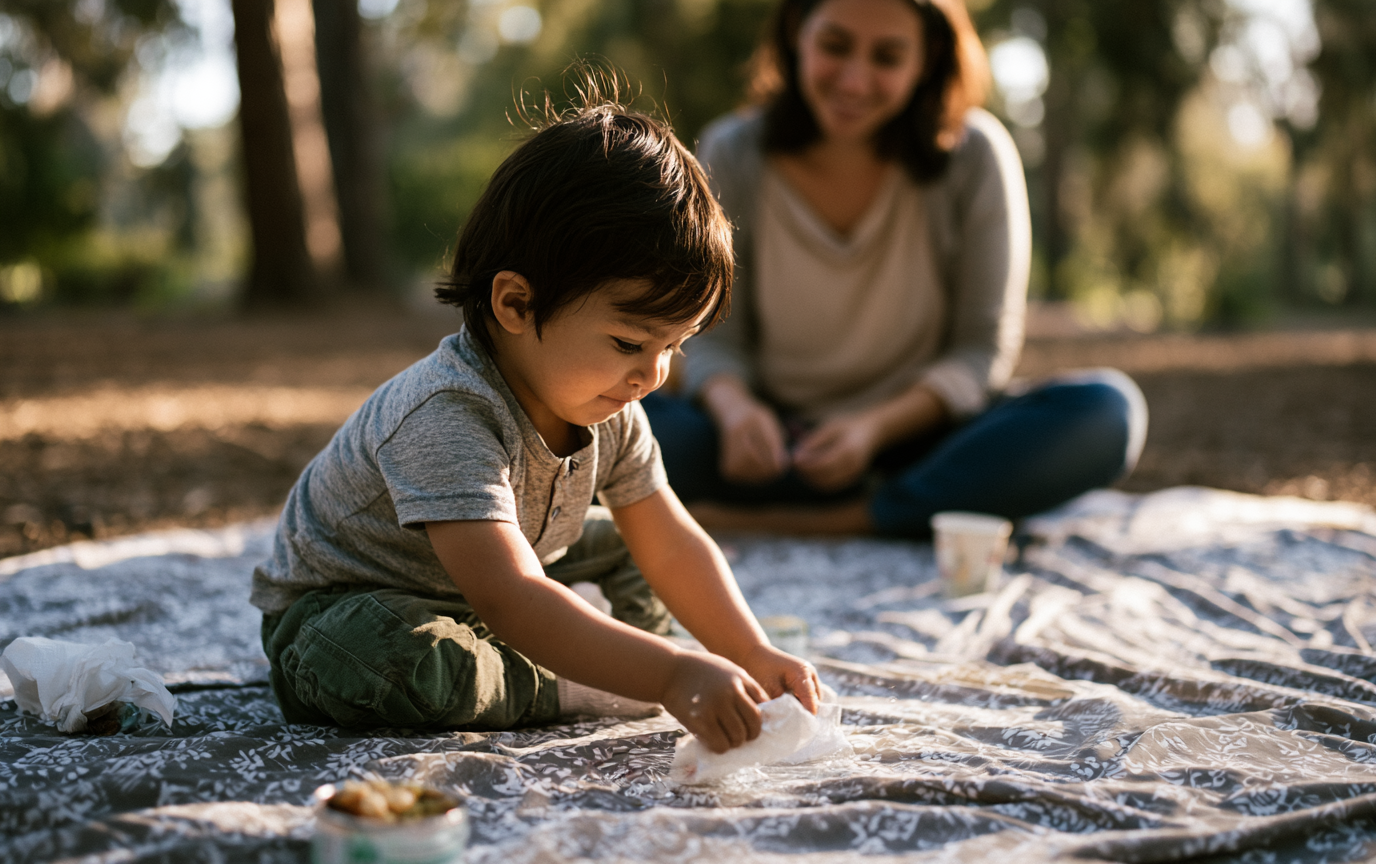
Keep a small cloth within reach at all times. Spills stop being emergencies once your toddler knows they can be part of solving them.
A child-sized dustpan and brush make this genuinely doable, not just a pretend chore handed to them for show.
One basket, one category, is far more doable than “clean your room.” Specificity is what makes cleanup possible at this age.
A shelf they can reach turns “put your books away” into something achievable rather than something they need help with every time.
One item, one destination. This is often the entire task a toddler can hold in their mind at once — and that’s enough.
Group 5 of 8
Helping With Real Household Work
Toddlers often want to help because they want to belong — not because they understand the task, but because they understand being included.
A simple sorting game hidden inside a real chore. Matching builds visual comparison skills while genuinely helping you.
One napkin per seat is a task with a natural rhythm and a visible result they can be proud of before the meal even starts.
A box of pasta, a bag of bread. Something unbreakable and light enough that dropping it isn’t a disaster.
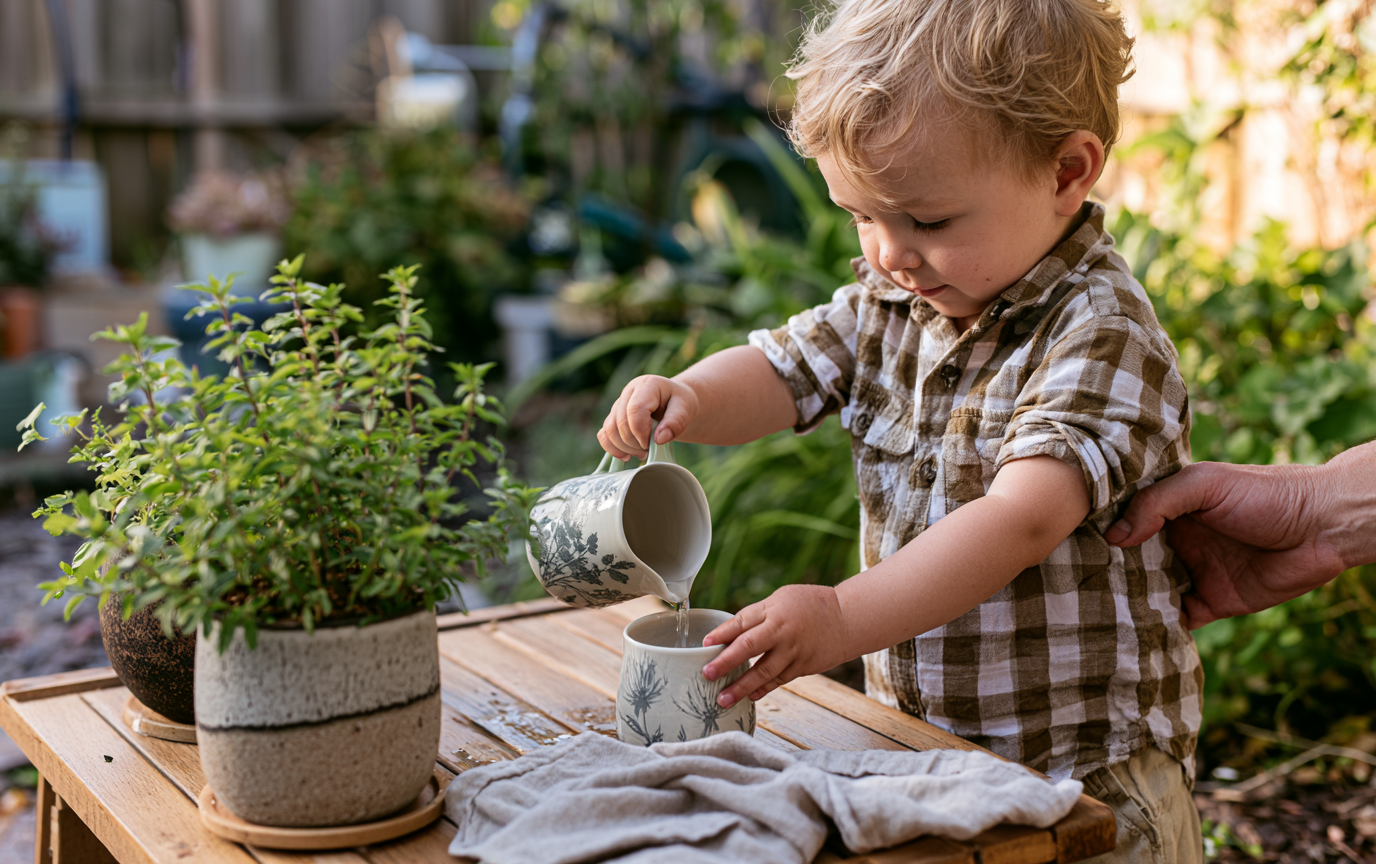
One plant, one small cup of water. It’s a caretaking task on a scale a toddler can actually manage and understand.
A shared moment inside a task that would happen anyway. Being the one who “starts” it gives a toddler a sense of real contribution.
Group 6 of 8
Making Choices
Choice-making is independence when the choices are small, clear, and safe — not when a toddler is left to decide something too big for them to hold.
Two, not five. Too many options overwhelm; two feel manageable and still real.
A small ritual choice at a predictable moment in the day, which makes transitions feel less like something being done to them.
A tiny decision that costs you nothing and gives them something — a small sense of control inside a day that mostly isn’t theirs to direct.
Bath time already has a rhythm; this adds one small decision point without adding any real complexity.
A short, clearly bounded distance where either choice is genuinely fine. This is choice-making without risk.

Group 7 of 8
Moving Through Routines
Transitions feel less like battles when toddlers have a role inside them, instead of just being moved from one place to the next.
Even a nearly empty bag becomes a job when it’s theirs to carry through the door.
A tiny, satisfying moment of agency inside a transition that otherwise has none.
A consistent spot turns this into a habit rather than a request that has to be repeated every single day.
One object, one home. Small repeated placements like this build real order over time, without a single lecture about tidiness.
A shared closing motion — your hand guiding, theirs pushing. It teaches gentleness and completion in the same small gesture.
Group 8 of 8
Emotional Independence
Independence is not only physical. It also means learning that effort is safe, even when it doesn’t go well.
Wait a beat before stepping in. That pause is where a toddler learns they have a voice to ask, not just a parent who anticipates everything.
One real attempt, even a clumsy one, matters more than a smooth result you achieved for them.
Frustration is not a sign that something is wrong. It is often a sign that something is being learned.
Naming the effort, not the outcome, teaches a toddler that trying is worth noticing on its own.
Independence is not a straight line. Walking away from a hard task and returning to it later is still part of building it.

What to say while your toddler is trying
The words around the task often matter as much as the task itself. Constant praise can quietly turn trying into performing. Observational language does something different — it gives a child language for effort, not pressure to perform.
What not to expect yet
It helps to know, ahead of time, what this stage actually looks like — so you don’t mistake normal toddler behavior for a sign that something isn’t working.
Toddlers may still:
- refuse help they asked for a moment earlier
- spill water while pouring, even after weeks of practice
- take a long time over something quick and simple
- get upset when something turns out to be hard
- want independence one day and full help the next
- make the task messier before it gets easier
Gentle Reminder
A toddler who is becoming independent will not always look calm, efficient, or grateful.
When independence gets messy
There will be days when the spilled water soaks the table, the sock ends up inside out and stuck, and the whole thing takes four times longer than if you’d just done it yourself. This is normal, not a sign to stop.
A few things help on those days:
- Slow down when you actually can, even by two minutes.
- Step in without hesitation when safety is involved — independence never needs to include real risk.
- Offer one small part instead of the full task, especially when everyone is tired.
- Resist turning the moment into a test of whether they “did it right.”
- If it falls apart, return to the same routine tomorrow. One hard day doesn’t undo the pattern.
Gentle Reminder
You are not failing when you help. You are still building independence when you give your toddler one real part of the task.
Free Printable
The Toddler Independence At Home Checklist
40 small ways to help your toddler participate in real family life.
Want a simple version to keep on the fridge? Get the free Toddler Independence At Home Checklist — 40 small, realistic ways to help your toddler participate in daily routines without adding more to your day.
No spam. Just the checklist, straight to your inbox.
If your toddler loves having a real job, printable practical life cards can make these moments easier to remember and repeat. They are not a chore system — just small visual invitations for the everyday work toddlers already want to join.

Frequently Asked Questions
What age should toddlers start becoming more independent?
Small independence can begin as early as 12–15 months, with simple actions like putting an object in a bin or carrying something light. By 18–36 months, most toddlers can take on several small, real parts of daily routines — not the whole task, but one true piece of it.
How do I encourage independence without forcing my toddler?
Offer chances instead of expectations. Hand over one small, doable part of a task and let your toddler decide whether to take it. Some days they will, some days they won’t — both are part of the process, and neither needs to be pushed.
What are examples of toddler self-help skills?
Carrying a spoon to the table, pulling off socks, wiping a small spill, pushing an arm through a sleeve, and rubbing soap between their hands are all early self-help skills. They look tiny, but each one builds coordination, sequencing, and confidence.
Is toddler independence the same as Montessori practical life?
They overlap, but they aren’t identical. Practical life is a Montessori framework built around real household tasks. Toddler independence is broader — it includes practical life, but also choice-making, emotional effort, and everyday participation that doesn’t need any special materials at all.
What if my toddler refuses to do things independently?
This is common and usually temporary. Refusal often means the task felt too big, too rushed, or simply mistimed. Offer a smaller version, try again another day, and avoid making it feel like a test either of you needs to pass.
How can I build independence when mornings are rushed?
Pick one small task, not several. Letting your toddler carry their own shoes to the door or choose between two shirts adds almost no time, but still offers a real chance to participate, even on the busiest mornings.
A gentle closing thought
Independence is not built in one perfect routine. It is built in the small chances a child receives again and again — to carry, choose, wipe, pour, try, pause, ask for help, and begin again.
Your home already contains the lessons. Your toddler only needs one small real part.