Practical Life · In The Kitchen
Kitchen Practical Life Activities For Toddlers
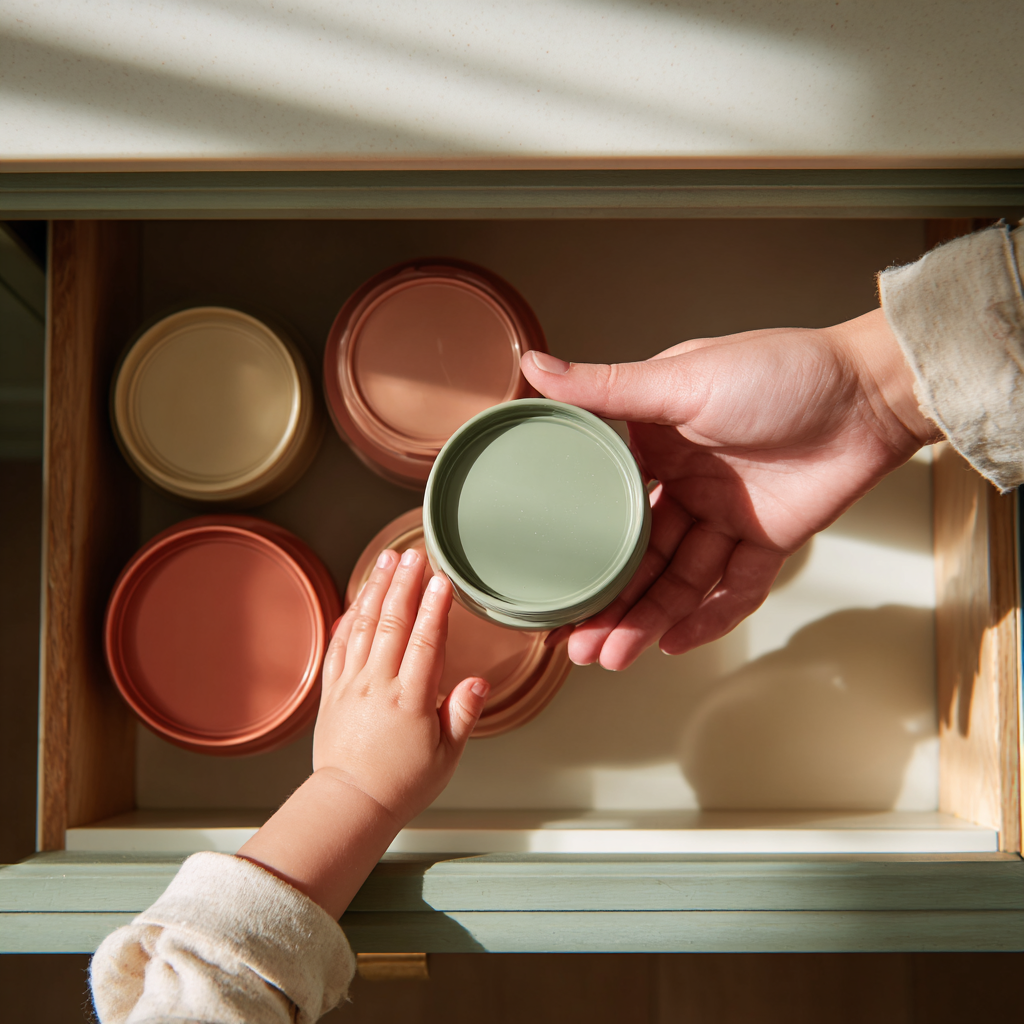
You do not need a learning tower full of prepared trays. A low drawer, a small bowl, or one meaningful kitchen job, offered alongside you, can be enough for a toddler to feel like a real part of the family kitchen, before, during, and after the meal.

The Kitchen Is Already Full Of Practical Life
Practical life is not a category of activities you add to your toddler’s day. It is the name for something that is already happening — the carrying, washing, pouring, wiping, sorting, and returning that make up an ordinary kitchen. Long before a toddler can name a vegetable or count to five, they are watching how a bowl gets from the counter to the table, how a lid finds its container, how a cloth gets wrung out and hung to dry.
A toddler standing at the edge of this work is not idle. They are studying a sequence — what comes first, what comes next, what it looks like when a job is actually finished. They are beginning to notice that actions happen in an order and that objects have places to return to.
What makes the participation meaningful is not the activity itself. Carrying two potatoes to a basket may use some of the same coordination and problem-solving a toddler practices in play. What makes this moment different is that the potatoes are real, and they are needed. Someone in the house is genuinely glad the basket is full. That difference, between practicing and contributing, is where belonging often takes root.
“A toddler does not need to run the kitchen. They only need one small part of it that truly belongs to them.”
Over time, and without any of it being labeled a lesson, kitchen participation can offer practice with coordination (carrying and pouring ask a lot of small muscles), often helps children notice how words connect to action (words are often easier to understand when they are connected to something a child can see, feel, and repeat), and may strengthen a child’s ability to stay with one task (a toddler wiping one spill will sometimes stay with it longer than expected).
None of this requires a special corner of the kitchen. It requires noticing what is already happening at counter height, and handing over one small, real piece of it, with you close by.
What Makes A Good Kitchen Job For A Toddler?
Not every kitchen task makes a good toddler job. Watching real families in real kitchens reveals a simple pattern. We call it The CCBR Small Real Job Test.
A good toddler kitchen job should be real: an actual, needed piece of the work, not a task invented to keep small hands busy. Real jobs may feel especially meaningful because a child can see where their contribution belongs.
It should be safe within close, attentive supervision. A suitable job should remain low-risk while an adult is nearby and paying attention. If one brief shift of attention could lead directly to a burn, cut, fall, poisoning risk, or choking hazard, the setup is not appropriate yet, no matter how simple the job looks.
It should be repeatable. A job that needs heavy setup each time will not become part of the kitchen’s rhythm; the best jobs show up again and again, in more or less the same form.
It should have a visible beginning and end, so it is finishable — the basket goes from empty to full, the drawer goes from open to closed. A job with no clear endpoint is much harder for a young child to hold onto.
And it should remain genuinely useful even done imperfectly. If a crooked napkin or an unevenly filled bowl still works for the meal, the job survives a toddler’s real skill level. If it has to be quietly redone by an adult anyway, it was never really theirs to begin with.
Before Food Preparation
Before You Start
All toddler kitchen participation requires close adult supervision, even when the task itself is simple. You do not need to introduce all of the jobs below — choose one that already fits the rhythm of your kitchen, and let repetition do the rest.
Before a single ingredient is touched, there is already real work happening — groceries arriving, containers waiting to be opened, a bowl waiting on the counter. This is often the easiest place to start, because nothing here is hot, sharp, or urgent.
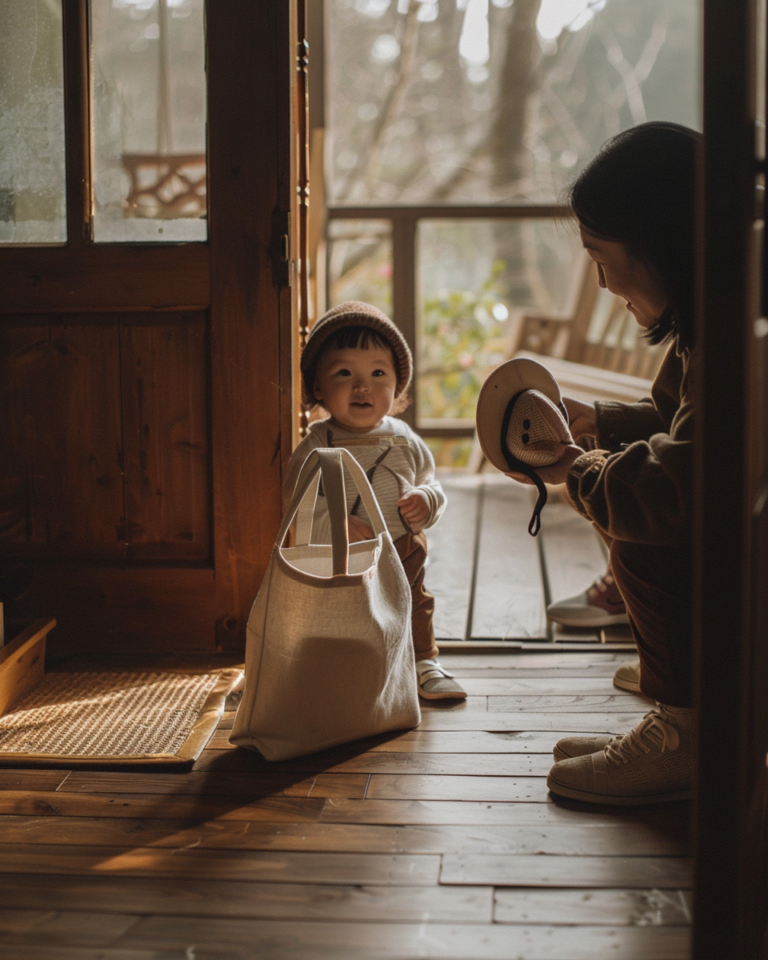
1. Carrying Lightweight Groceries
What they can do: Carry one or two lightweight items, a bag of apples or a box of pasta, from the entryway or grocery bag to the counter.
Simple setup: Keep heavier or breakable items for yourself, and hand over one item at a time.
What it may support: Early practice with whole-body coordination, and a sense of contributing before the “real” work even begins.
A phrase to try: “This one is yours to carry.”
Safety note: Save glass jars and heavy items for yourself, and stay within arm’s reach.
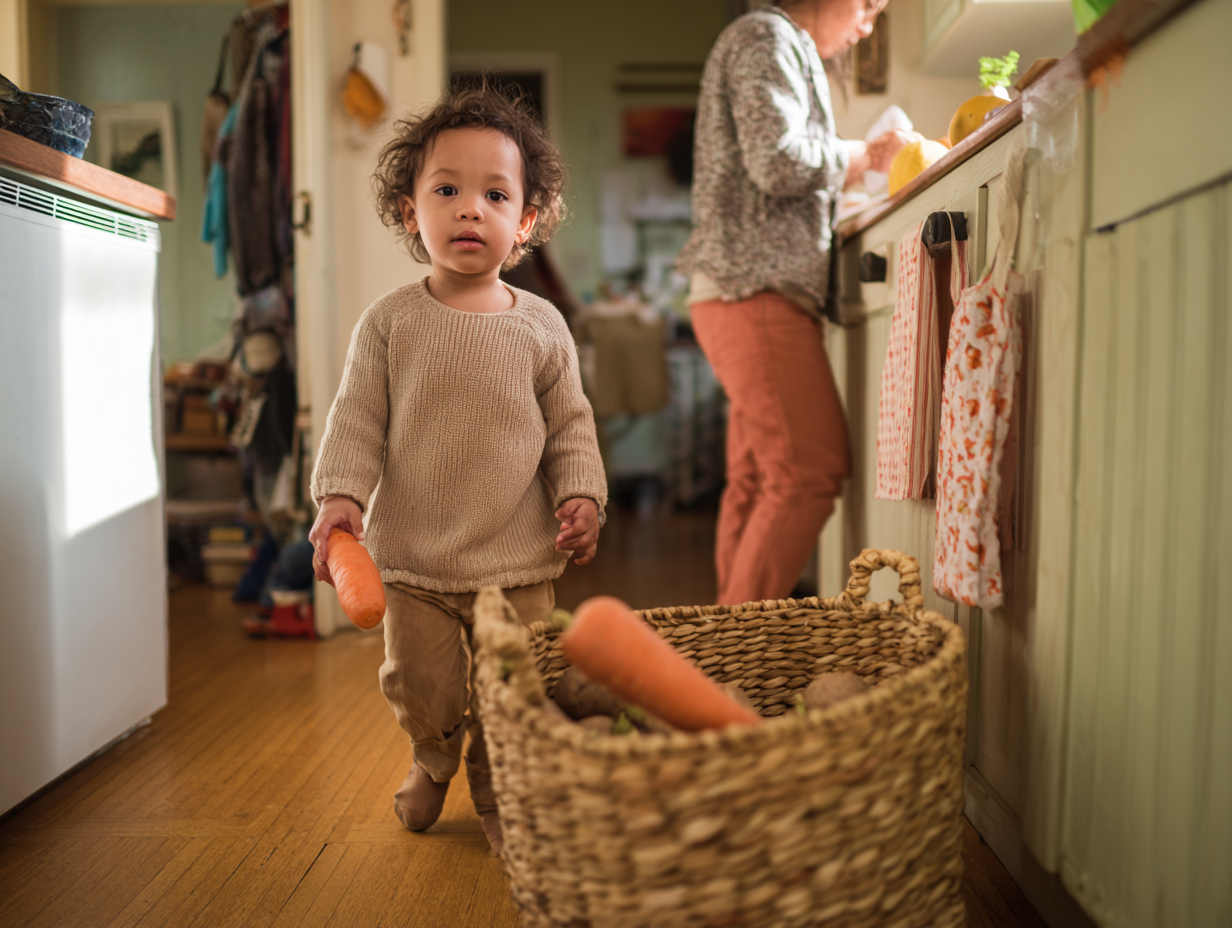
2. Putting Firm Produce Into A Low Basket
What they can do: Transfer firm produce, apples, potatoes, oranges, from a counter or bag into a low basket or bowl.
Simple setup: Keep a basket at floor or low-shelf height near where groceries land.
What it may support: Practice with sorting by feel, wrist control, and patience with a repeated motion.
A phrase to try: “One more for the basket.”
Safety note: Choose produce too large to swallow whole, avoid anything small or round that could pose a choking risk, and stay close by.
3. Matching Food Containers With Lids
What they can do: Find the lid that fits a container, and press it into place.
Simple setup: Two to four lightweight plastic containers with lids, kept in a low drawer.
What it may support: Visual matching, trial-and-error problem-solving, and fine motor pressing.
A phrase to try: “The lid fits this box.”
Safety note: Use unbreakable containers only, with no small removable parts.
4. Taking Napkins To The Table
What they can do: Carry one folded napkin to each place at the table.
Simple setup: A basket of folded cloth or paper napkins, within easy reach.
What it may support: Purposeful walking, early one-to-one correspondence, and table awareness.
A phrase to try: “Each place gets one.”
Safety note: Keep the walking path clear of trip hazards.
5. Choosing Between Two Safe Ingredients
What they can do: Choose between two options an adult offers, such as banana or orange.
Simple setup: Present two real, safe choices rather than an open-ended question.
What it may support: A felt sense of agency inside a limited, safe choice.
A phrase to try: “Would you like to carry the banana or the orange?”
Safety note: Keep it to two options; more than that tends to overwhelm rather than help, and keep both choices age-appropriate in size.
6. Carrying A Small Empty Mixing Bowl To The Preparation Area
What they can do: Carry an empty, lightweight bowl from a cabinet to the counter or table.
Simple setup: Store one unbreakable bowl at toddler height.
What it may support: Two-handed carrying, spatial awareness, and anticipating what comes next.
A phrase to try: “The bowl is ready. First, we bring it to the table.”
Safety note: Use an unbreakable bowl only, and keep the walking path clear.
Washing And Preparing
This is usually the part parents picture first when they imagine a toddler “helping cook,” and it is worth saying plainly: this is not a toddler cooking tutorial, and knives are not required for any of it. A few foods tend to work especially well at this stage: cucumber, carrots, potatoes, apples, oranges, lettuce, herbs, bananas, cooled boiled eggs, grated cheese, and yogurt mixtures, soaked oats, mashed avocado, and other cool foods that are already safe to taste.
Raw eggs, raw flour, raw meat or fish, and any ingredient that needs strict contamination control should stay adult-handled; a toddler’s role begins once these are cooked, cooled, or otherwise made safe to touch.
7. Rinsing Firm Produce
A shallow bowl of water at the table, with one cucumber or a firm carrot, gives a toddler a simple, low-risk washing job within close adult supervision. Little hands rubbing a vegetable under water rarely need correcting; it gets clean enough, and that is the point.
Safety: use only a shallow amount of water, keep the floor dry, and remain beside your child.
8. Pulling Leaves From Herbs Or Greens
Pulling basil or parsley leaves from their stems is slow, repetitive work, and exactly the kind of task small fingers are built for right now. Dinner genuinely ends up with a few more leaves in it than it would have otherwise.
9. Peeling Easy Foods By Hand
Cooled boiled eggs, clementines, and ripe bananas can usually be started by an adult and finished by small fingers. The satisfaction of getting a piece of peel all the way off tends to outweigh how long it takes.
10. Tearing Soft Foods
Bread, lettuce, and cooked pasta can be torn instead of cut, which keeps the job entirely toddler-safe while still doing something the meal needs. “Tear it into pieces this big” is often all the direction required.
11. Scooping Ingredients Into A Bowl
A small scoop or spoon moving oats, shredded cheese, or dry pasta from one bowl to another can offer practice with the same wrist control a toddler will later use pouring their own cereal, without the mess of a full pitcher.
12. Pouring From A Small Pitcher
A pitcher that is never more than half full, held with two hands, lets a toddler pour a little water, milk, or another ready-to-eat liquid into a bowl without a large spill. Some will miss the bowl. That is part of learning to pour, not a sign it went wrong.
Safety: use a lightweight, unbreakable pitcher filled no more than halfway, and stay within arm’s reach while your toddler pours.
13. Stirring Thick, Cool Mixtures
Yogurt, mashed avocado, softened cream cheese, or soaked oats offer enough resistance for a spoon to feel purposeful in a toddler’s hand, without the splash risk of a thin liquid.
Safety: keep the bowl on a stable, non-slip surface and use only cool, ready-to-eat food.
14. Mashing A Soft Food With A Fork
Pressing a fork into a ripe banana or a cooked, cooled potato is one of the most satisfying jobs on this list: visible transformation, real muscle effort, and a result the family can actually eat.
Safety: use a blunt-edged toddler fork and stay close enough to guide the motion if needed.
15. Transferring Prepared Ingredients With A Spoon
Moving mashed avocado from a bowl to a plate, one spoonful at a time, closes the loop between preparing something and getting it to the table, which is often the part a toddler cares about most.
Safety: use a small amount of cool food and an unbreakable bowl and plate.
It is worth repeating what this section is not. Do not overuse cutting activities, and do not present a knife as something a toddler needs. Hot appliances, sharp tools, and choking hazards belong outside the child’s reach entirely, and an adult stays within arm’s reach for every item on this list; more on the full boundaries in the safety section below.


Setting The Table
Table setting rarely feels like a lesson to a toddler, which is part of why it works so well.
- Carrying one safe item at a time. A napkin, a spoon, an unbreakable cup, one object, one trip, one small success.
- Matching table items to their places. Placing one spoon at each seat mirrors the same matching work as lids and containers, just at the table instead of the drawer.
- Filling a napkin basket. Folding is optional. Getting them into the basket is the job.
- Placing fruit in a shared bowl. A bowl that will be passed around gives a toddler’s contribution somewhere visible to land.
- Bringing an empty compost bowl to the table. Setting the stage for what happens after the meal is as much a job as setting the stage before it.
- Setting out lightweight placemats. Straightening one at a time, in whatever order makes sense to a toddler, still gets the table ready.
- Counting how many cups are still needed. Not a quiz, just thinking out loud together: “Grandpa’s here, so we need one more.”
Together, these small jobs can support controlled movement across a short distance, a sense of sequence (this comes before that), a growing awareness of who is coming to eat, an early and informal sense of one-to-one correspondence, and, quietly underneath all of it, the feeling of belonging to a table that is about to be shared.

During Meals
- Serving one safe food with soft tongs. Soft, child-safe tongs used only with cool, soft food, bread, orange slices, or crackers, let a toddler serve without going anywhere near hot serving dishes.
- Passing a small basket. Handing a basket of rolls to the next person at the table is a small social job with a real audience.
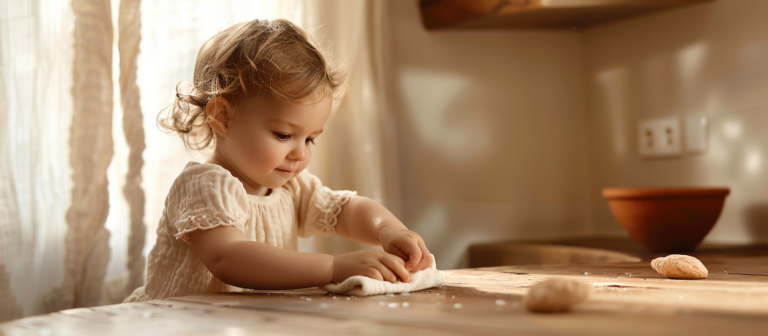
- Wiping a small water spill. A cloth kept within reach turns spills into something ordinary rather than something dramatic.
- Carrying their own safe cup to the sink. Use an unbreakable cup and keep the path short, clear, and supervised, so one trip at the end of the meal reinforces “this is mine to manage.”
- Placing food scraps into the compost bowl. Only cool, soft, non-choking scraps belong in a toddler’s hands; skip bones, pits, and anything hard or hot.
Gentle Reminder
“Spills are not an interruption to practical life. Cleaning them is practical life.” A spill wiped calmly, without a sigh or a rush, teaches a toddler far more than a spill that never happens at all.

After The Meal
Most articles about toddlers and the kitchen stop once food reaches the table. In a real family kitchen, the meal is only half finished at that point.
28. Scraping Soft Leftovers Into A Compost Bowl
The same fork or spoon that helped mash an avocado earlier can now help clear the plate. The sequence comes full circle.
Safety: only cool, soft, non-choking scraps, no bones, pits, skewers, or hot food.
29. Sorting Safe Dishes
Grouping unbreakable cups in one place and unbreakable bowls in another is sorting work with an obvious, useful result.
30. Loading Lightweight Items Into A Low Dishwasher Rack
A low rack and a few plastic items make this one of the easiest real jobs in the whole kitchen.
Safety: only with the dishwasher off and the interior cool, no knives or sharp utensils present, detergent and dishwasher pods completely inaccessible, your toddler handling only lightweight unbreakable items, and you staying right beside them the whole time.
31. Wiping A Low Table Or Cabinet Front
A damp cloth and a few swipes at toddler height finish the meal the way it started, with something to carry and something to wipe.
32. Hanging A Kitchen Cloth To Dry
A low hook or rail turns “where does this go” into a job with a clear, physical answer.
33. Returning Containers To A Low Drawer
The same containers that were matched with lids before the meal now go back to exactly where they were found.
34. Putting Clean Napkins Into A Basket
Folded or not, a stack of napkins finding their way back to the basket closes another small loop.
35. Carrying An Empty Lunchbox To Its Storage Place
For toddlers who join a sibling’s routine, walking an empty lunchbox back to its shelf is a quiet, real contribution to tomorrow morning.
“The kitchen job ends where the next one will begin.”

Kitchen Jobs By Age And Readiness
These bands are starting points, not a checklist. A toddler might be entirely ready to wipe a spill and still be a few months away from pouring confidently from a pitcher, and that is completely normal.
Around 15–20 Months
- Carry one napkin
- Place fruit in a bowl
- Put a spoon on the table
- Wipe one small spill with help
- Return a light container to a drawer
- Carry an empty bowl
Around 20–28 Months
- Rinse vegetables
- Tear greens
- Scoop dry ingredients
- Match lids
- Carry their own safe cup
- Wipe a low surface
- Place scraps into a compost bowl
Around 28–36 Months
- Pour from a small pitcher
- Stir a cool mixture
- Peel a cooled boiled egg
- Set several places
- Scrape leftovers
- Load safe dishwasher items
- Hang a cloth to dry
Readiness matters more than age. A toddler’s balance, impulse control, previous experience, ability to follow a simple boundary, the kitchen’s layout, the height of the work surface, and how much attention you have available in that moment all shape which job actually fits today, regardless of what the calendar says. Every job on this page, at any age, happens with an adult close by.
Not sure where to begin? Start with one job that matches your child’s current stage.
What Toddlers Should Not Handle Yet
None of this is meant to frighten anyone away from letting a toddler help. A suitable job should remain low-risk within close adult supervision; if one brief shift of attention could lead directly to a burn, cut, fall, poisoning risk, or choking hazard, the setup is not appropriate yet. The list below is simply the clear, calm boundary that makes everything above safe to offer in the first place.
Toddlers should not yet have access to:
- Sharp knives
- Hot pots or pans
- Boiling water
- Hot trays
- Blenders or food processors
- Thin glass
- Heavy cookware
- Cleaning chemicals
- Dishwasher pods
- Raw eggs, raw flour, raw meat or fish, or other ingredients that require strict contamination control (adult-handled only)
- Choking hazards
- Unstable stools or platforms
- The active stove area
Green Zone
Low drawer, low table, cool preparation area, safe storage basket.
Adult-Shared Zone
Sink, main counter, supervised food preparation.
No Toddler Access
Stove, oven, knives, chemicals, hot appliances.
Kitchen Practical Life Builds Language Too
This kitchen work connects naturally to a broader idea in toddler language development: words are often easier to understand when they are attached to something a child can see, feel, move, or finish. A toddler carrying a bowl meets the word “carry” inside a real action, rather than only hearing it in isolation.
Movement Words
carry, lift, tip, pour, stir, wipe, pull, push, place, scrape, hang
Sequence Words
first, next, then, last, before, after
Position Words
in, on, under, beside, inside, back
A few natural phrases tend to work better than questions:
- “You carried it carefully.”
- “The lid fits this box.”
- “There is one more.”
- “The cloth feels wet.”
- “First we wipe. Then we hang it.”
- “You found where it belongs.”
- “The bowl is ready for the table.”
- “You are putting it back.”
It helps to notice what these avoid: “What color is this?”, “What is this called?”, “Can you say spoon?” Unnecessary testing tends to pull a toddler out of the work rather than deeper into it. For more on mealtime language specifically, see what to say to your toddler at mealtime.
“Language often becomes easier to understand when a word is connected to something the child can see, feel, move, and repeat.”
Free Guide
A Small Place To Help
A one-to-two page, quick-reference guide, sorted by age and readiness, with a safe setup checklist and eight phrases worth keeping nearby, so you are not deciding what to hand your toddler in the middle of making dinner.
Free printable · Instant access · No pressure to do every activity
When Your Toddler Does Not Want To Help
Some days, none of this will look the way it does in a photograph. A toddler may only want to watch from a step back, join in for ten seconds and wander off, repeat one part of a job happily and flatly refuse the next, want the job you are doing instead of the one offered to them, or become upset the moment you finish something they wanted to do themselves. Some days a real job turns into pretend play halfway through.
None of this means the approach isn’t working. A few responses tend to help more than pushing through:
- Reduce the task to one single step instead of the whole sequence.
- Let observation count as participation, even if no hands ever touch anything.
- Offer two safe choices instead of one fixed task.
- Keep the safety boundary firm, even while staying flexible on everything else.
- Avoid forcing a job to be finished once interest has genuinely moved on.
- Invite participation again another day, without commentary about today.
- End calmly when you no longer have the attention to supervise safely.
Small Shift
“Participation is an invitation, not a performance.” A toddler who watches today and joins in three weeks from now has not fallen behind. They were simply still deciding.
When Helping Makes Everything Slower
It is worth saying plainly: toddler help almost always slows dinner down. Ingredients spill, items go back in the wrong drawer, a five-minute job stretches into fifteen. None of that is a sign anything has gone wrong, but it is real, and it deserves acknowledgment rather than cheerful denial.
Your toddler does not need to be included at every meal for any of this to matter. Practical life is not meant to become another parenting obligation layered on top of an already full evening. Some nights, there simply isn’t the time or attention to spare, and that is a reasonable, ordinary choice, not a missed opportunity.
Gentle Reminder
Some days, your toddler can carry the napkins. Some days, dinner simply needs to reach the table. Both belong in a real family kitchen.
How To Set Up One Small Kitchen Area
None of this requires a renovation or a set of dedicated Montessori furniture. Most kitchens, including small apartments, already have what is needed.
- One low drawer or basket
- Two or three lightweight containers
- One small cloth
- One safe, unbreakable cup
- One small bowl
- One child-sized or easy-grip spoon
- One low, stable place to work, or an age-appropriate secured toddler platform used with close adult supervision
- No access to chemicals, knives, breakables, or hot zones
Beyond the kitchen, many of the same principles show up throughout the house; see practical life activities for 2 year olds at home, and more ideas appear in the related reading section below.
Start Here This Week
Choose one low storage place.
Add three safe items.
Invite your child to return one item.
Add one real before-meal job.
Repeat the same job instead of adding a new one.
Frequently Asked Questions
What kitchen activities can a 2 year old do?
Around age two, many toddlers can rinse firm vegetables in a shallow bowl, tear lettuce or bread, scoop dry ingredients with a spoon, match lids to containers, carry their own unbreakable cup, and help wipe a low surface, always with an adult close by. Readiness varies more than age does, so let balance, patience, and interest guide which jobs you introduce first.
Do toddlers need a learning tower to help in the kitchen?
No. A learning tower can be useful if your family already has one, but it is not required. Most jobs in this guide can happen at a low table, on the floor, or beside a low drawer. If a toddler platform is used, it should be age-appropriate, properly secured, and used with close adult supervision.
Are Montessori kitchen activities safe for toddlers?
They can be, when the job matches the child’s current skill, an adult stays close by, and the setup keeps sharp tools, hot surfaces, and choking hazards out of reach. Safety comes from the setup and supervision, not from the Montessori label itself.
What can an 18 month old help with in the kitchen?
Around 18 months, jobs tend to be simple and short: carrying one napkin, placing a piece of fruit in a bowl, putting a spoon on the table, wiping a small spill with a hand over theirs, or returning a light container to a low drawer, always alongside an adult.
How do I let my toddler help without making a huge mess?
Keep the amount small, a few tablespoons rather than a full cup, a shallow bowl rather than a full sink. Choose thick or dry ingredients over thin liquids while pouring is still new, and keep a cloth within reach so spills stay ordinary rather than stressful.
What should toddlers not do in the kitchen?
Toddlers should stay away from sharp knives, hot pots and pans, boiling water, the active stove and oven, blenders and food processors, thin glass, heavy cookware, cleaning chemicals, and dishwasher pods. Their job should happen beside the cooking, not inside it, and always within close adult supervision.
How can kitchen activities support toddler language?
Action words such as carry, pour, wipe, and stir are often easier to understand when a child is physically doing them. Simple narration, like “you carried it carefully,” can connect new words to real, felt experience rather than asking a child to name or perform on command.
What if my toddler loses interest quickly?
That is completely normal. Let a ten-second contribution count as real participation, and resist the urge to have them finish the whole task. Most toddlers return to kitchen jobs more readily when there is no pressure to complete them the first time.
How often should toddlers help in the kitchen?
There is no required frequency. Some families involve their toddler most days for a small job; others do it once or twice a week when there is time and attention to spare. What matters more than frequency is that the job, when offered, is real, finishable, and supervised.
Are toy kitchens the same as practical life?
Not quite. Toy kitchens support imaginative play, which has its own real value, but practical life specifically means participating in the actual, needed work of the household, using real food, real dishes, and a real outcome the family uses.
A Small Place To Help
A simple age-by-age guide to choosing safe, meaningful kitchen jobs, without turning dinner into a lesson.
- Kitchen jobs for 15–20 months
- Kitchen jobs for 20–28 months
- Kitchen jobs for 28–36 months
- A safe setup checklist
- Eight useful kitchen phrases
- A “choose one job this week” box
Free printable · Instant access · No pressure to do every activity
Start With One Drawer
Put three lightweight containers inside it. The next time you cook, let your toddler carry one thing back.
That is the whole starting point. Not a shelf, not a system, not a rotation of prepared trays, just one drawer, one job, repeated enough times that it becomes familiar.
Independence rarely begins with a large task. It begins when a child realizes: there is something here that I know how to do.

For the ordinary moments that shape a child.