

Practical Life · Age Three · At Home
Practical Life Activities for 3-Year-Olds in a Real Home
Small, real jobs that fit into meals, laundry, getting ready, and caring for the rooms you share—so your child can take part long before they can do the whole thing.

The cooking is finished, and you are getting the table ready for dinner. Your three-year-old comes over and asks what they can do.
You hand over four napkins. “One at each chair.”
They carry them with both hands, as if napkins could spill. The first lands where it should. The second goes on top of your fork. The third ends up on a chair seat instead of the table. The fourth, after some thought, is kept.
You could fix it now. Instead you point: “That one goes by Dad’s cup.” They put it there. Later, while they climb into their seat, you move the one off the chair. Nobody mentions it.
Dinner starts with napkins in almost the right places, and a child who helped set the table.
What practical life looks like at three
Practical life is the everyday work of caring for yourself, other people, and the place you live: meals, clothes, shoes, spills. For a three-year-old, it means joining that work while it is actually happening, not practicing it as a separate lesson.
The important word is part. A child can carry napkins without setting the whole table, put socks in a drawer without doing the laundry, or wipe their own place without cleaning the kitchen. You still hold the job together. Your child holds one real piece of it.
Three-year-olds vary widely, and so does any one child from day to day. Treat the ideas below as invitations, not a checklist to master by a certain birthday.
In the kitchen and at the table
The kitchen holds more real work than any other room, and more things a three-year-old should not touch. Every job here stays away from the stove, knives, appliances, and cleaning products, with you close by. For more ideas in this room, see our guide to kitchen practical life activities for toddlers.

-
Wash fruit or vegetables in a bowl
Choose firm produce you would prepare anyway—a mango, carrots, or potatoes. Your child can help wash it; you finish the food preparation.
- Child’s part
- Rubbing each piece of produce in a shallow bowl of water, then moving it to a colander.
- Adult’s part
- Setting the bowl on a towel at table height, and all peeling and cutting.
- Try saying
- “Rub the dirt off, then it goes in here.”
- If today is harder
- One piece of produce and a damp cloth, no bowl of water.
-
Transfer ready-to-eat food with a spoon
Serving is satisfying because the result goes straight to the table. Spoon from a container, never from the cooking pot.
- Child’s part
- Spooning cooled pasta into a serving bowl, or fruit you have already cut into small bowls.
- Adult’s part
- Cooking, cooling, and cutting, and choosing a spoon big enough to scoop but easy to hold.
- Try saying
- “Three spoonfuls in each bowl.”
- If today is harder
- They fill only their own bowl.
-
Place napkins and safe utensils
This is the job from the opening, and its mistakes are harmless. A napkin in the wrong place is still a napkin on the table.
- Child’s part
- Carrying napkins, spoons, and forks to the table and putting one at each place.
- Adult’s part
- Plates, glasses, and knives. Handing over only what fits in one trip.
- Try saying
- “One spoon for each person.”
- If today is harder
- They set only their own place.
-
Wipe their part of the table
The patch in front of their plate is a job small enough to actually finish, which is rarer than it sounds.
- Child’s part
- Pushing crumbs toward the edge with a damp cloth, or wiping in slow circles.
- Adult’s part
- Clearing plates, wringing out a cloth dampened with plain water, and a proper clean later if needed.
- Try saying
- “Wipe where your plate was.”
- If today is harder
- They wipe one spot you point to. You do the rest.
With clothes and laundry
Laundry offers soft, unbreakable things to handle and a job that comes back every few days. Your child handles the clothes; the machine and detergent stay with you. Our article on laundry practical life activities for toddlers goes further.

-
Put worn clothes in a reachable basket
This job depends on where the basket lives. Put it where clothes come off.
- Child’s part
- Dropping pajamas or the day’s clothes into the basket after changing.
- Adult’s part
- A low, open basket in the right spot. Turning sleeves right side out later, if you care.
- Try saying
- “Pajamas go in the basket.”
- If today is harder
- Hold the basket out to meet them.
-
Match pairs of socks
A whole pile is too many choices. Start with a few pairs that look clearly different from one another.
- Child’s part
- Finding two socks that are the same and laying them side by side.
- Adult’s part
- Pulling three or four pairs from the clean laundry, and rolling them afterward.
- Try saying
- “Where’s the other striped one?”
- If today is harder
- Hold up one sock and offer two to choose its partner from.
-
Put folded clothes into an accessible drawer
The folding is yours. The carrying and putting away can be theirs, especially when each drawer holds one kind of thing.
- Child’s part
- Carrying a small folded stack to a low drawer and setting it inside.
- Adult’s part
- Folding, keeping stacks small, opening a stiff drawer, and making sure the dresser is anchored to the wall.
- Try saying
- “T-shirts live in this drawer.”
- If today is harder
- They put in one item. You do the rest.
In the bathroom and by the door
Getting clean and getting out the door are often the most rushed moments of the day, so these jobs are quick on purpose.
-
Hang a towel on a low hook
Towel bars are hard for small hands. A hook is not, and a towel with a sewn-on loop is easier still.
- Child’s part
- Hanging their own towel after a bath or handwashing.
- Adult’s part
- Putting a hook at about shoulder height for your child. Drying off and bath supervision stay with you.
- Try saying
- “Your towel goes on your hook.”
- If today is harder
- You drape it on the hook; they tug it straight.
-
Return shoes to their place
A fixed spot matters more than a shoe rack. A tray, a small mat, or a strip of tape by the door is enough.
- Child’s part
- Carrying their shoes to the spot once they are off.
- Adult’s part
- Choosing the spot, and helping with straps, buckles, or laces.
- Try saying
- “Shoes rest on the mat.”
- If today is harder
- They carry one shoe, you carry the other.
-
Choose and pack one thing for going out
Open choices slow down a departure, so offer two. The job means more when the item actually gets used on the outing.
- Child’s part
- Picking between two hats, or finding their water bottle, and putting it in the bag.
- Adult’s part
- Packing everything else, and offering only choices that suit the weather.
- Try saying
- “Sun hat or cap? Put it in the bag.”
- If today is harder
- Hand them the item and hold the bag open.
Caring for shared spaces
These are small jobs in rooms everyone uses. A child can see what changed afterward: a dry floor, a book back on its shelf, soil that looks darker than before.
-
Wipe a small water spill
A spill your child can help clean is easier to accept. Keep a small cloth within their reach.
- Child’s part
- Fetching the cloth and pressing or wiping until the spot is dry.
- Adult’s part
- Anything hot, sticky, or broken. A last check so no one slips.
- Try saying
- “Water on the floor. Here’s the cloth.”
- If today is harder
- Lay the cloth down; they press it with both hands.
-
Return books to a low shelf
A short row of books, or a basket, is far easier to put away into than a full, tightly packed shelf.
- Child’s part
- Carrying a book back when reading is done, in any direction it happens to face.
- Adult’s part
- Keeping the shelf low and roomy, and rotating books so there is always space.
- Try saying
- “Can this one go home to the shelf?”
- If today is harder
- They carry the last book. You carry the others.
-
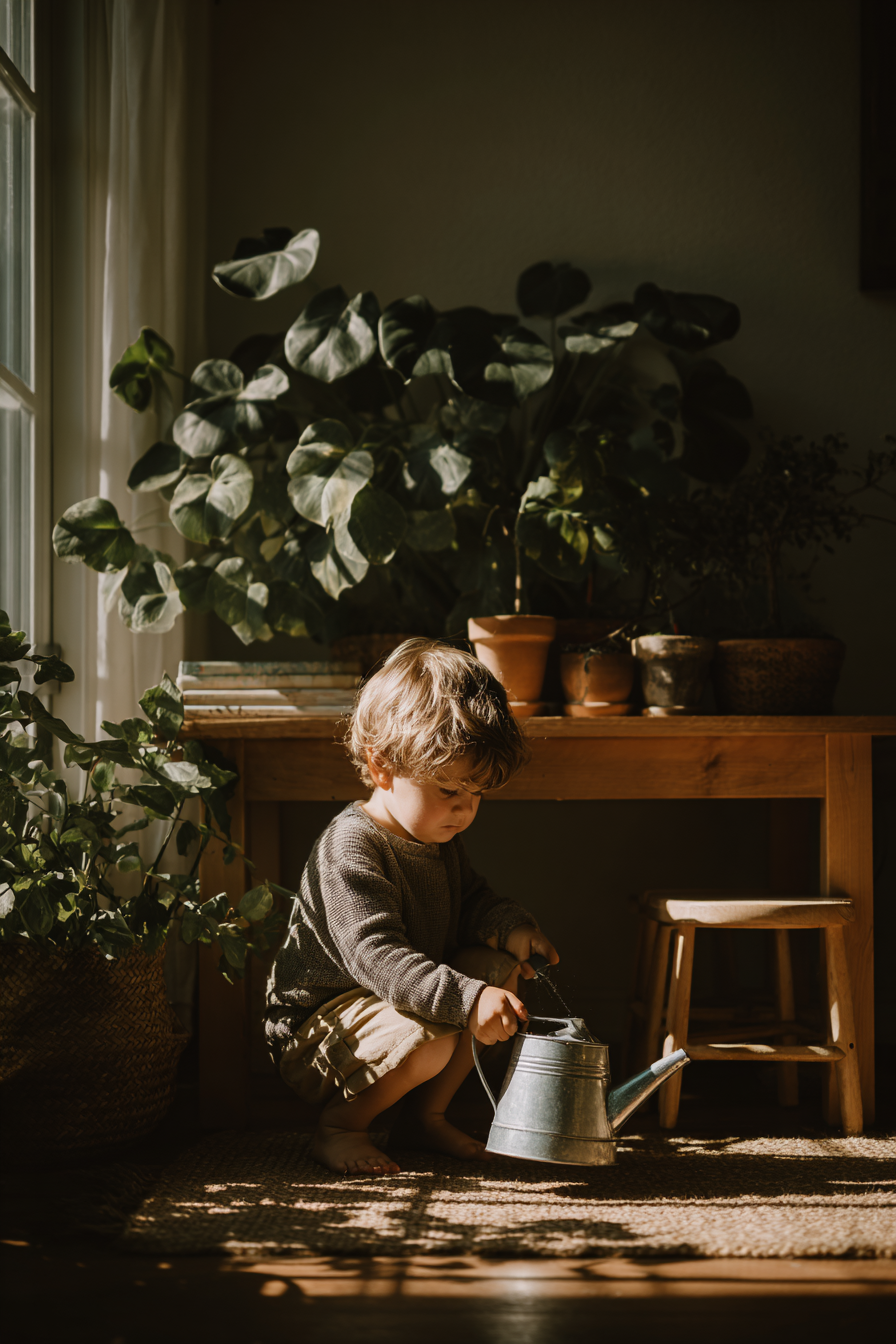
Water one plant
You measure, they pour. That one division prevents the usual result, which is a very wet plant and a puddle.
- Child’s part
- Pouring a small cup of water onto the soil of one plant.
- Adult’s part
- Choosing a sturdy plant that is safe within a child’s reach, measuring the water, and keeping the pot low and stable.
- Try saying
- “Pour it on the soil, near the stem.”
- If today is harder
- Pour together, with your hand around the cup.
When your child says, “I do it”
Sometimes a three-year-old wants the whole job, including the parts that are not safe or not possible yet. You do not have to choose between stepping back and taking over. Divide the job out loud, and give them the part that is theirs.
- “You hold the cup; I’ll pour.”Your hand manages the pitcher. Theirs keeps the cup steady.
- “You start the sock; I’ll help it over your heel.”They do the part their hands can manage; you do the stubborn bit.
Name the division before you start, not after something goes wrong. If they reach for your part anyway, say it once more—“The pitcher is my job. The cup is yours”—and carry on.
The aim is not to push a child toward doing more alone. It is to keep them inside the job, with your help where it is needed.
When real life gets messy
When there is a spill, or more mess than before
Expect it, and keep amounts small so the mess stays small too. Hand over a cloth without much comment: “Water spilled. Let’s wipe it.” If it is more than a small child can handle, clean it up yourself while they wipe one corner.
When they walk away halfway through
Three-year-olds often stop when their interest ends, not when the job does. You can say, “I’ll finish the socks,” and simply do it. There is no need to call them back. The part they did still counts.
When they say no
Offer once more, maybe with a smaller part: “Want to carry just the spoons?” If the answer is still no, try “Okay, I’ll do it today,” and move on. No sticker chart, no bargaining. The same job will come around again tomorrow. If “no” is the word of the week, what to say when your toddler says no all day may help.
A five-minute way to begin this week
You do not need a plan for every room. Five minutes of thinking, once, is enough:
- Choose one recurring moment. Something that happens most days, at a time that is not your most rushed.
- Give your child the same part each time. The napkins at dinner, or the towel after the bath. Repetition does more than variety here.
- Notice what help they need. A basket moved closer, the drawer opened first, a word or two of reminder.
- Adjust, and keep going. Make the part smaller if it keeps falling apart, or add a step if they start doing it before you ask.
Notice what makes joining easier, then adjust the job to fit your child and your day.
The napkin by your plate
None of this will look impressive, and it does not need to. Many of these jobs you will finish yourself.
But look at the table tonight. Somewhere there is a napkin a little off-center, or a spoon facing the wrong way, or a pair of socks that is almost a pair.
It is there because a three-year-old put it there—one small, real part of the evening your family shared.
Questions parents ask
What if my three-year-old does not want to help?
That is common, and often about timing rather than the task. Offer a smaller part once, then let a no be a no. Watching the work still counts.
Are these activities suitable for a small apartment?
Yes. A basket, a low hook, and a cloth within reach cover most of them. In a small home, everything is closer, which often makes jobs easier.
How much should a three-year-old do independently?
There is no set amount. Many three-year-olds manage one or two steps of a job with an adult nearby, and it changes day to day. If you have questions about your child’s development, ask your pediatrician.
Do I need Montessori materials?
No. Everything here uses what most homes already have: napkins, spoons, socks, a towel, a small cup.
Sources and further reading
- Centers for Disease Control and Prevention. Milestones by 3 years, including parenting tips on simple meal-prep tasks such as washing fruits and vegetables.
- American Academy of Pediatrics, HealthyChildren.org. Age-appropriate chores for children, on letting young helpers pitch in without expecting perfection.
- American Academy of Pediatrics, HealthyChildren.org. Kitchen safety, on keeping cleaners, knives, appliances, and hot liquids away from young children.


