
A simple Montessori language routine for ordinary days
No special materials. No prepared environment. Just the conversation that was already going to happen.
He pulled a wooden cylinder off the shelf and held it up. Not toward me exactly — more toward the light. He turned it once, set it down, then picked it up again. Cylinder, I said quietly. He didn’t look at me. He turned it again.
That was the routine. That was all of it. No lesson, no circle time, no deliberate intent. Just an ordinary morning, a shelf, a child turning an object in the light — and someone nearby who knew the word.
Montessori language routines look different from the inside than they do in photographs. From the inside, they are mostly invisible. They feel like nothing in particular. And that, it turns out, is exactly the point.
“The most productive language routines don’t look like routines. They look like ordinary mornings.”
Chichiberry Parenting
Why repetition in ordinary moments works better than formal lessons
There is a version of Montessori language work that lives in Pinterest images and homeschooling guides — a tray with three objects, a parent kneeling beside a child, a three-period lesson executed with precision. That version is real and valuable. But it is not where most language acquisition actually happens.
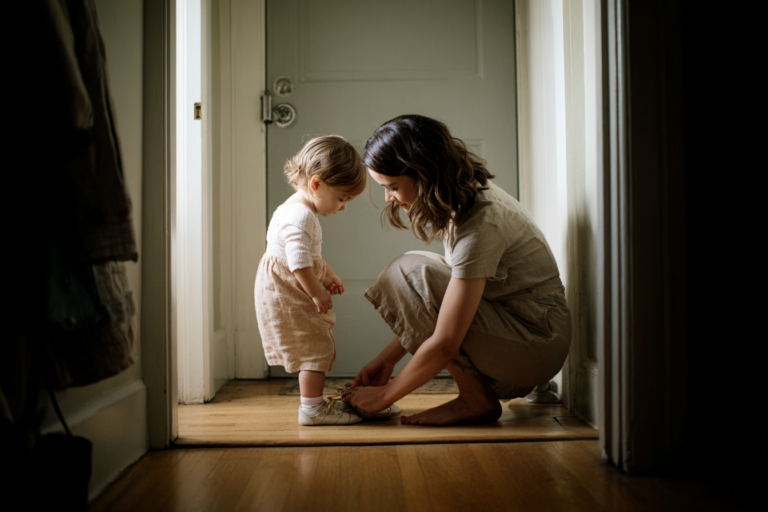
Most language happens in the gaps. In the ten seconds between putting on a shoe and opening the door. In the moment a child picks up a spoon and you say heavy without thinking. In the repeated geography of an ordinary day — breakfast, shelf, garden, bath — where the same words come back in the same order and slowly become the child’s own.
Neuroscience supports what Montessori observed. Repetition across naturalistic contexts — the same word in ten different ordinary moments — builds a different quality of memory than deliberate study. The word lands in the body as well as the mind. It becomes available under pressure, in excitement, in tiredness. It is truly known.
Children build language most deeply inside ordinary repetition — not because the repetition is designed, but because it is trusted.
The low shelf. The wooden objects. The child who keeps returning to the same one, for reasons entirely their own.
The rhythm of a calm language routine
A Montessori-inspired language routine doesn’t begin with the shelf. It begins earlier — in how the day is narrated. The words you say in passing, the objects you name without ceremony, the pauses you allow before filling silence. These are the structure.
Below is one version of what this looks like across a morning. It isn’t a schedule. It’s more like a posture — a set of moments where language can move naturally between adult and child without anyone deciding that language should happen now.
Name what’s there before anything is needed
Before instructions begin — before come on or time to get dressed — there’s a moment of just noticing. The light. The quiet. The familiar objects of the room. These early-morning namings are among the most absorbed of the day.
Narrate the physical world as it unfolds
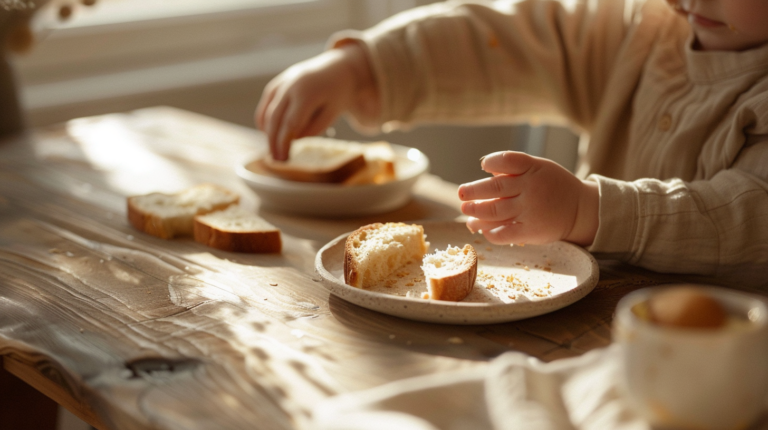
Pouring. Stirring. The weight of a bowl. The sound of spoon on ceramic. These are not vocabulary lessons — they are a live description of a world the child is already experiencing. The language sticks precisely because the sensation confirms it.
Follow the child’s attention rather than directing it
When a child picks something up, they have already told you where their language is ready to grow. The object they’re examining is the word they are closest to acquiring. Be nearby. Wait. Name it when the moment is genuinely open.
Prepare the moment before it becomes a struggle
Language during transitions — in a few minutes, we’ll put the things away — does something important. It gives the child a cognitive map. The transition becomes less rupture, more rhythm. The words reduce friction by making what comes next legible.
These aren’t teaching sentences. They’re the sentences that happen naturally when someone is genuinely paying attention — and that’s exactly what makes them work.
When the routine falls apart — which it will
There will be mornings when the shelf is ignored completely and no one says anything interesting and the day moves from chaos to sleep without a single Montessori moment in sight. This is not a problem. It is just Tuesday.
The routine is a posture, not a performance. It doesn’t require every morning to work. It requires enough mornings — enough repetitions across enough ordinary days — that the pattern accumulates. And the pattern is surprisingly patient.
A child who absorbed no visible language today may produce three new words next week from something they heard this morning. The delay is structural, not a sign of failure. Language moves on its own schedule, and it keeps moving even when you can’t see it.
What matters is returning to the posture when the day allows — without guilt about the days it didn’t. The routine is whatever the family actually does, consistently enough that the child knows what to expect and can be present inside it.
The days the routine disappears are part of the routine too. Children learn from the returning, not just the consistency.
Worth saving
“You don’t need a Montessori room. You need ordinary days and someone who knows the word for what the child is already holding.”
Save this for the days when the shelf is untouched and the routine didn’t happen. Those days count too.
The quiet language prompts
One card for each ordinary moment in your day. Small enough to keep nearby. Specific enough to actually use.
Sent once. Yours to print and fold away somewhere useful.
From the same collection
For the ordinary moments around this one.
Language development
7 things to say when your toddler can’t find the word
Read →
Daily routines
What to say during the morning rush — when you have 90 seconds
Read →
Language development
Why toddlers repeat words — and what to say back
Read →
Stay nearby.
Occasional resources and quiet observations — sent only when there’s something worth keeping.
Chichiberry Parenting — Connection over instruction. Presence over perfection.