
The Morning Routine We Use When Everyone Is Tired
Not a perfect morning. Not a productive morning. Just a gentler one — where the goal is getting everyone through the door while keeping the connection mostly intact.

Some mornings, someone wakes up before it’s really light. You hear the sound — a small thump, a voice calling — and you’re already calculating: how many minutes before we have to leave, and how many things still need to happen before then.
Some mornings the milk goes over. Some mornings a sock is simply wrong — the wrong sock, in a way that cannot be explained, only felt deeply, by a two-year-old who was managing fine until this moment. Some mornings you’re the one who slept badly, and the patience you were counting on isn’t quite where you left it.
These are not unusual mornings. These are most mornings.
For a while, I kept looking for a routine that would fix this — something efficient and calm, something that would make the mornings feel less like we were moving through wet concrete together. What I found, slowly, was that the problem wasn’t the routine. It was what I thought the routine was supposed to do.
The morning is not there to run smoothly. It is there to begin the day still connected.
What a successful morning actually looks like
When I started paying attention to the mornings that felt good — not efficient, not perfectly timed, but actually good — I noticed they didn’t share a particular structure. They shared a quality. A feeling that everyone was mostly okay. That we’d moved through something together without losing each other in the process.
A successful morning, I started to understand, is not one where:
- everyone cooperated immediately
- nothing was forgotten
- we left on time
- the kitchen was clean
A successful morning is one where:
- each person felt seen, even briefly
- the child could predict what came next
- we moved forward together, even if slowly
- the hard moments didn’t swallow the whole thing
Predictability is not about rigidity. It is about a child being able to trust what comes next — which, in a small body that cannot yet manage time or transitions on its own, is a profound form of safety.
The morning rhythm, as it actually goes
What follows is not a schedule. There are no times attached. What there is: a sequence of moments that tend to create connection rather than friction, in an order that my particular child has come to understand and lean into. Some of these will apply to your mornings. Some won’t. Take what’s useful and leave what isn’t. If you’re also thinking about how the home itself supports language, How To Build A Language-Rich Home Without Buying More Toys is a quiet companion piece to this one.
Before the to-do list begins — before you check the time or remember about the packed bag — there is a moment with the child who is right here, right now, freshly awake. It does not need to be long. A minute or two. Lying beside them, or lifting them, or simply being present in whatever way the morning allows.
This is not lost time. This is the investment that makes everything after it slightly easier.

Getting dressed with a toddler is one of those tasks that resists efficiency — and the sooner you stop fighting that, the easier it gets. The sock that is wrong. The preference for the blue one, not the red one, even though they are identical. The complete abandonment of the task to investigate something on the floor.
What helps: naming each step before it happens. “Now the socks. Now the shoes.” Simple language, said calmly, one step at a time. And where possible — where the morning allows — letting them do as much as they can manage.
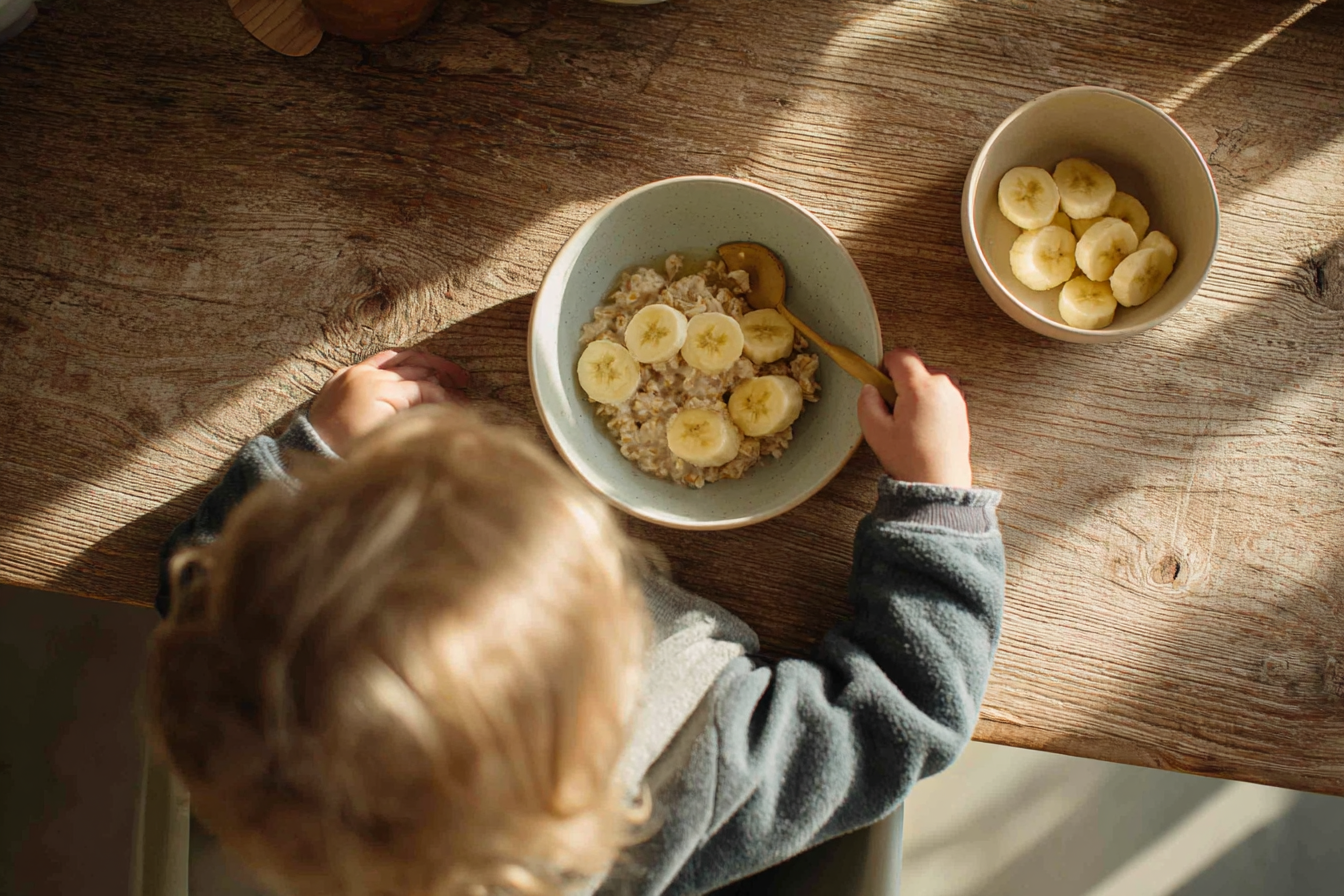
Breakfast is often the most unhurried part of a morning — the stretch where the day hasn’t started pressing yet. This makes it the best time for language. Not lessons. Not quizzes. Just ordinary conversation that expands vocabulary without the child knowing that’s what’s happening.
What this looks like: naming what’s on the plate. Describing the temperature of the milk. Asking simple questions that don’t demand correct answers. “The banana is yellow, like the sun.” “Is your porridge warm?” Conversation that follows the child’s lead rather than testing what they know. For more on this approach, 5 Ways To Encourage More Words Before Age 2 has a gentler breakdown of how these moments add up.
Transitions — from play to getting dressed, from breakfast to shoes, from inside to outside — are among the hardest moments for toddlers. Not because they are being difficult, but because transitions require a child to stop something absorbing and start something unknown, without yet having the internal language to manage that shift.
A transition warning gives the child’s nervous system time to prepare. “Five more minutes, then we put shoes on.” “When you finish the banana, we’ll get our coats.” It is not a guarantee against protest. It is a reduction in the shock of the change. The same logic applies at bedtime — The Calm Bedtime Routine That Changed Everything uses the same transition principles for the evening.
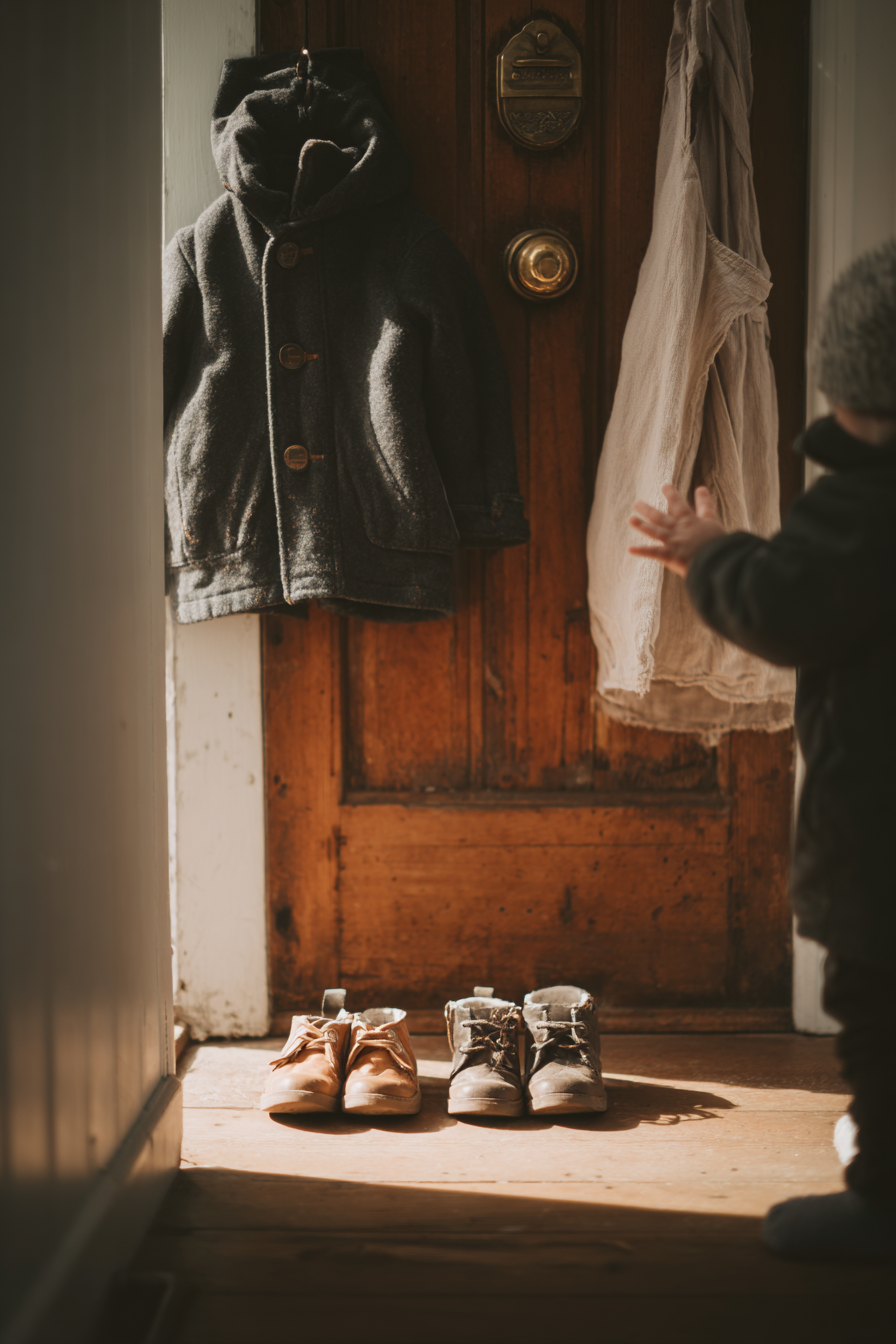
The moment of leaving is its own ritual in most families — coats, shoes, bags, the possibility that someone has already removed their shoes. Rather than fighting the chaos of departure, it helps to give this moment a consistent shape. The same words in the same order. The same small sequence before the door opens.
This might be as simple as: “Shoes on. Coat on. Say goodbye to the house.” That last one sounds small, and it is — but a toddler who has a chance to say goodbye to something is a toddler who has been given a transition, not had one imposed.
If your morning ends with a handover — to a childminder, a nursery, another parent — the goodbye is its own moment. Most toddlers seem to do better with a goodbye that is warm, clear, and confident. When we stay too long, trying to make the separation easier, we sometimes communicate the opposite message: that perhaps this moment isn’t safe after all. The confident goodbye communicates: this is okay, I will come back.
This doesn’t mean suppressing your own feelings about the goodbye. It means choosing, in that moment, to offer the child the thing they most need: the belief that they are going to be fine.
- 1Wake-up connection, before anything else
- 2Getting dressed, slowly
- 3Breakfast as a language moment
- 4The transition warning
- 5Shoes and the door ritual
- 6The goodbye, done well
Some mornings still fall apart
There will be mornings when someone cries at the shoes, and then at breakfast, and then at the door, and for reasons that remain unclear across the entire morning. There will be mornings when the routine is a memory and the actual experience is just managing, moment to moment, until everyone is where they need to be.
The routine is not there to prevent these mornings. It is there to make them feel less catastrophic. A child who knows what generally comes next, in a household that generally moves the same way, has more internal resource available when the morning does fall apart. The structure they’ve absorbed becomes the scaffolding when the scaffolding is needed.
A hard morning is still a morning you got through together. That counts.
What they’ll remember
There is a quieter question underneath all the practical advice about morning routines. It is this: years from now, when your child thinks about mornings at home — this home, at this age — what will they have kept?
They probably won’t remember:
- whether the bag was packed the night before
- whether the kitchen was tidy
- whether they were on time
- whether you said the perfect thing during the hard moment
What tends to stay — what research on childhood memory and what most adults will tell you — is texture. The feeling of mornings. Whether they were warm or anxious. Whether there was a parent who was there, who noticed them, who made space for them even in a hurry. The particular light in the kitchen. The sound of your voice.
The goal of the morning routine, underneath everything practical, is to make the morning feel like somewhere safe to begin from. Not perfect. Safe.
That is something a child can carry all day.
12 transition phrases. 6 breakfast conversation starters. A calm goodbye ritual. Print it once. Keep it near the door. Use what fits your real morning.
Many of the language prompts in this article — the breakfast conversation starters, the transition phrases, the goodbye rituals — come from the same place as the Toddler Language Prompt Cards. They are designed for the moments that already happen in your home every day, to make those moments slightly richer without requiring anything extra of you.
See the prompt cards on Etsy →The morning does not need to be beautiful to matter. It just needs to be yours — imperfect, ordinary, and moving forward together.