

Toddler Development
Why Toddlers Carry Random Things Everywhere
That rock, spoon, leaf, or tiny toy may look meaningless to adults.
But to a toddler, it often represents memory, comfort, curiosity, identity, and learning all at once.
It was just a rock. Small, smooth, grey — the kind you find by the thousands at the edge of any park path. Her daughter had picked it up near the swings, turned it over twice in her fingers, and then held it with a grip that suggested it was not going anywhere.
It came home in the stroller. It sat beside the dinner plate. It was placed carefully on the edge of the bathtub while the bath ran. And that night, it was placed on the nightstand with the same quiet deliberateness that you might use to put down something fragile and irreplaceable.
At some point — probably around day three of the rock’s residency — the question formed. Not an anxious question. More of a curious one. Why this rock? Why now? Why does it matter so much?
The rock itself isn’t the point. What the rock represents is.
Toddlers live in a world of constant change. Every day brings new people, unfamiliar places, unexpected textures, unpredictable sounds, and experiences their brains are still making sense of. The sheer volume of novelty in an ordinary toddler’s day is, by adult standards, extraordinary.
An object — especially a small, portable one — becomes something stable inside all of that motion. It can be held. It can be taken from room to room. It can be brought from home to the car, from the car to the park, from the park back to the dinner table. In a life where so much is decided by someone else, the object stays constant.
Developmental researchers sometimes call this concept portable familiarity — the idea that children use known objects as anchors when the environment around them shifts. The object becomes more than an object. It becomes a reference point, an emotional reminder, a piece of yesterday carried into today.
Carrying an object isn’t usually a sign of dependency. It’s often a sign that a child is learning how to create security for themselves — and that is worth noticing quietly.
The same object can look like two entirely different things depending on who is looking at it.
Six Things Toddlers May Be Practicing When They Carry Objects
The behavior is consistent across cultures, ages, and temperaments. Toddlers carry things. They collect things. They bring things from one room to another with great intentionality. And while the object changes — sometimes it is a rock, sometimes a particular crayon, sometimes a small plastic dinosaur that must accompany dinner — the underlying impulse is worth understanding.
Remembering
Objects help toddlers hold on to experiences. When a child finds a small shell on a beach walk, picks it up, and carries it home, the shell is not just a shell. It is the walk. It is the cold sand and the sound of the waves and the moment their parent said “you found one.”
This is early memory-making in action. At this age, episodic memory — the ability to mentally replay a past experience — is still developing. A physical object functions as an external memory anchor, a tangible cue that allows the experience to be revisited. When the toddler turns the shell over at breakfast, they are, in some meaningful sense, going back to the beach.
Carrying the object is not hoarding. It is remembering by touching what they remember.
Comparing
Your toddler collects two rocks. Then holds them side by side. Then puts one down, picks up another, holds those two together. They may not say anything. They may just look — turning one, then the other, then back again.
This is early classification thinking. The child is noticing attributes — smooth versus rough, heavy versus light, dark versus pale — and building a mental framework for sorting the world into categories. Scientists do the same thing, with more expensive equipment.
A toddler who habitually carries objects is often a child who is actively comparing them — against each other, against memory, against what they expected to find. The object in the hand is always being measured against something. This is the quiet beginning of logical thinking.
Observing
There is a particular quality of attention that toddlers bring to objects they have chosen themselves. They look at them in different lights. They rub them against different surfaces. They hold them up near windows. They bring them to show other people, then take them back.
This repeated, close-range investigation — which can look obsessive to adults — is the scientific method in its earliest form. A naturalist in the field does exactly this: returns to the same specimen again and again, noticing something new each time. The toddler with their rock is doing the same.
What looks like obsession is often just patience. What looks like attachment is often just curiosity that has found a worthy subject.
Feeling In Control
Toddlers own very little in any real sense. Their meals are decided. Their bedtimes are decided. The route to the park is decided. Which shoes they wear is, in many households, decided only after significant negotiation that exhausts everyone involved. The amount of genuine autonomy in a toddler’s day is, when you look closely at it, quite small.
This connects directly to what Montessori philosophy calls practical life — the principle that children need to feel genuinely capable and genuinely in charge of something. The carried object is often the one domain in a toddler’s day where ownership is absolute. Respecting that — even when the object is a slightly damp stick — is a quiet act of respect for the person who chose it.
Building Identity
A toddler’s favorite object is often one of the earliest expressions of personal preference. Not a preference that was suggested to them, or handed to them, or chosen by someone who loves them. A preference that emerged entirely from their own noticing.
Before a child can say I like this with words, they say it with their hands. They pick up the object. They hold it close. They bring it with them. In this quiet way, the object becomes a mirror — it reflects something back about who this particular child is and what they find worth caring about.
This is worth pausing on. The child who always gravitates toward smooth stones, or who consistently seeks out the smallest possible things, or who fills containers with collections of identical objects — they are already telling you something about how they experience the world. The object in their hand is an early draft of a self.
One child carries a smooth blue stone everywhere she goes. Another fills every pocket with acorns — methodically, deliberately, one by one. Another insists on bringing the same small toy giraffe to every meal, every errand, every ordinary afternoon. The objects are different. The message is often the same: “This matters to me.” And that, quietly, is the beginning of knowing who you are.
Feeling Safe
The classic transitional object is a blanket or a stuffed animal — a soft, scented, comforting presence that a child carries from the familiar into the unfamiliar. But transitional objects do not have to be soft, and they do not have to be obvious.
A favorite rock can serve the same emotional function as a beloved stuffed rabbit. A particular toy car, a small piece of ribbon, a smooth wooden block — all of these can become objects a toddler uses to regulate their nervous system when the environment feels overwhelming or unpredictable.
The distinction between “a toy” and “a transitional object” is not what the thing is made of. It is what the child has invested in it. An object becomes emotionally significant when a child has decided, in their own way, that it matters. And that decision is worth honoring.
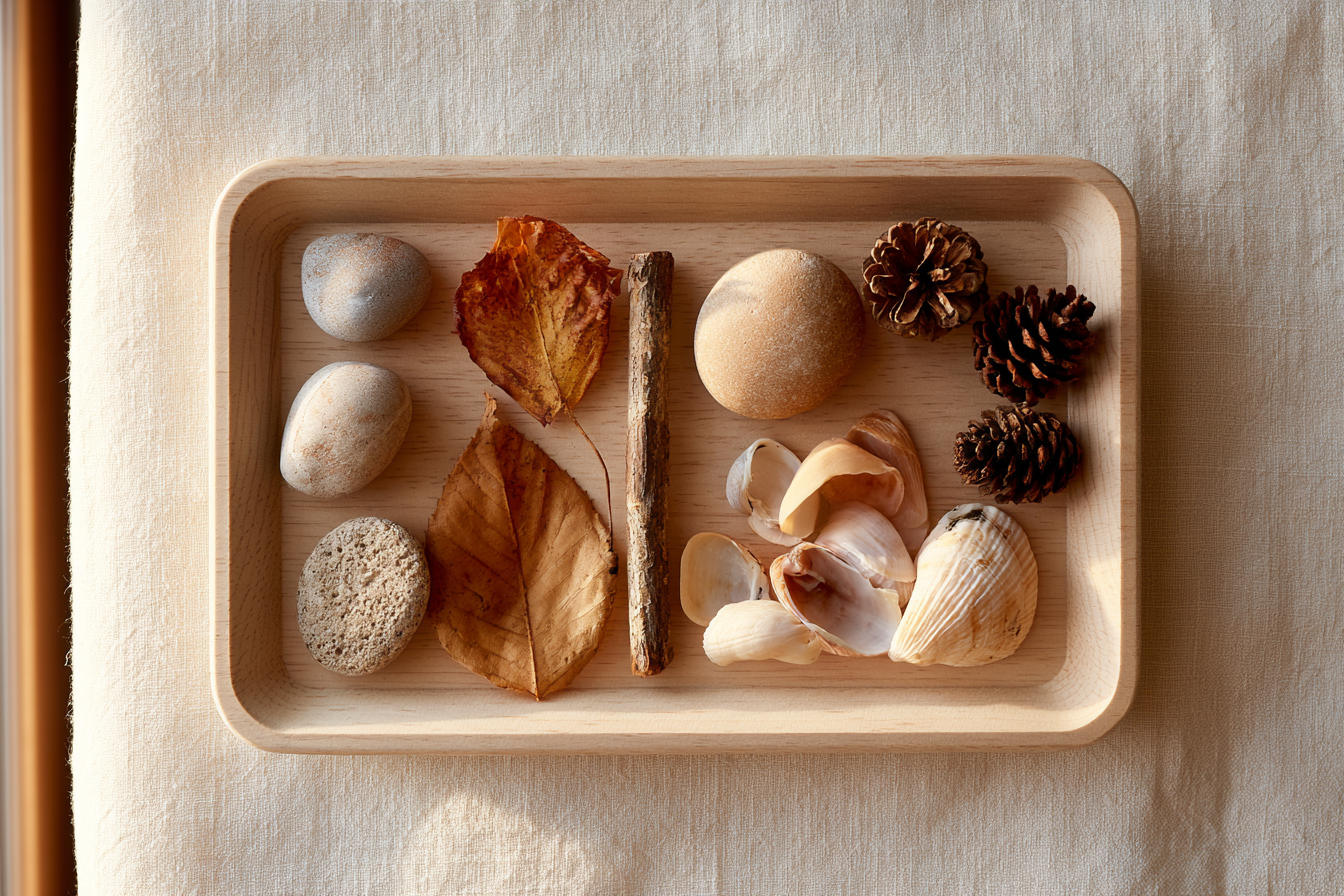
A toddler’s collection often tells the story of what captured their attention this week.
A Toddler Treasure Field Guide
There is no fixed dictionary of toddler objects. Every child is different, and every object carries personal meaning shaped by experience and context. That said, there are patterns worth noticing — and noticing, rather than interpreting, is the more useful habit here.
Why Repetition Is Part Of The Same Story
The same toddler who carries the same rock for two weeks is the same toddler who asks for the same story seventeen nights in a row. Who wants the same song at bathtime. Who requests the same route to the park even when there is a shorter one. Who stacks the same blocks in the same order every morning before breakfast.
This is not coincidence. Toddlers revisit — objects, words, stories, routines, experiences — for the same underlying reason: repetition is how they build understanding. Each repetition is slightly different from the last because the child doing it is slightly different. They notice something new. They make a connection they could not make before. They understand something they had previously only encountered.
Seen this way, the child who has carried the same stick for six days is not stuck. They are thorough. They are patient with an investigation that adults have already closed. They are being, in the truest sense, a very small scientist who is not ready to move on until the data is complete.
They carry objects because they are building relationships with experiences.
When To Simply Notice — And When To Ask
Object attachment in toddlers is, in the overwhelming majority of cases, a sign of healthy development. It reflects memory, agency, sensory curiosity, and emotional self-regulation — all of which are things we actively want to see. But parents reasonably wonder where ordinary attachment ends and something worth discussing begins.
If your instinct tells you something is worth asking about, asking is always the right choice — not because something is necessarily wrong, but because good pediatricians appreciate attentive parents, and you know your child better than any article does.
What To Do Instead Of Taking The Object Away
The instinct to remove the rock, redirect the attachment, or explain why the spoon doesn’t belong at dinner is understandable. But there is a different approach — one that treats the object as what it often is: a window into what your child is currently working on.
Name what you observe without evaluating it. This communicates that you see them — not just the object.
Open-ended questions invite language and reveal what the child is actually thinking. You may be surprised by the answer.
The most information comes from observation, not intervention. Let them show you what the object means before you decide it means nothing.
A small tray or shelf where treasures can live — and be found again — honors the child’s instinct to collect without creating chaos.
Turn the object into a conversation, a walk, a collection. Let it be the beginning of something, not just a thing to manage.
Attention is the invisible part.
And attention is where learning begins.
What Is The Object Telling You?
You don’t need a journal for this. But these questions are worth sitting with — either mentally, or on paper — the next time your child is deeply absorbed in something you might otherwise redirect.
That’s exactly why we created this journal.
Questions Parents Often Have
What looks like a random rock, leaf, spoon, or battered little toy may actually be helping your child build memory, develop the early architecture of scientific thinking, practice emotional self-regulation, assert a sense of ownership and identity, and carry comfort across the changing landscape of an ordinary day.
Not every object matters forever. Most are forgotten within weeks, replaced by something new and equally urgent. But while the attachment lasts, it is real — and the development happening inside it is real too. Even when the object is a slightly damp stick that has somehow ended up at the dinner table.
You don’t have to understand exactly what it means. You just have to leave space for it to mean something.
Toddlers carry objects for the same reason adults carry photographs, keep a particular mug they could easily replace, or return to the same spot on a walk they’ve taken a hundred times. The object itself is rarely the whole story. It is the meaning attached to it that matters — and meaning is one of the ways children build a relationship with the world, long before they have words for it.