30 Tiny Phrases That Teach Toddlers New Words Every Day
You may already say some of these phrases without thinking.
What matters is not the phrase itself.
It is the language opportunity hidden inside the moment.
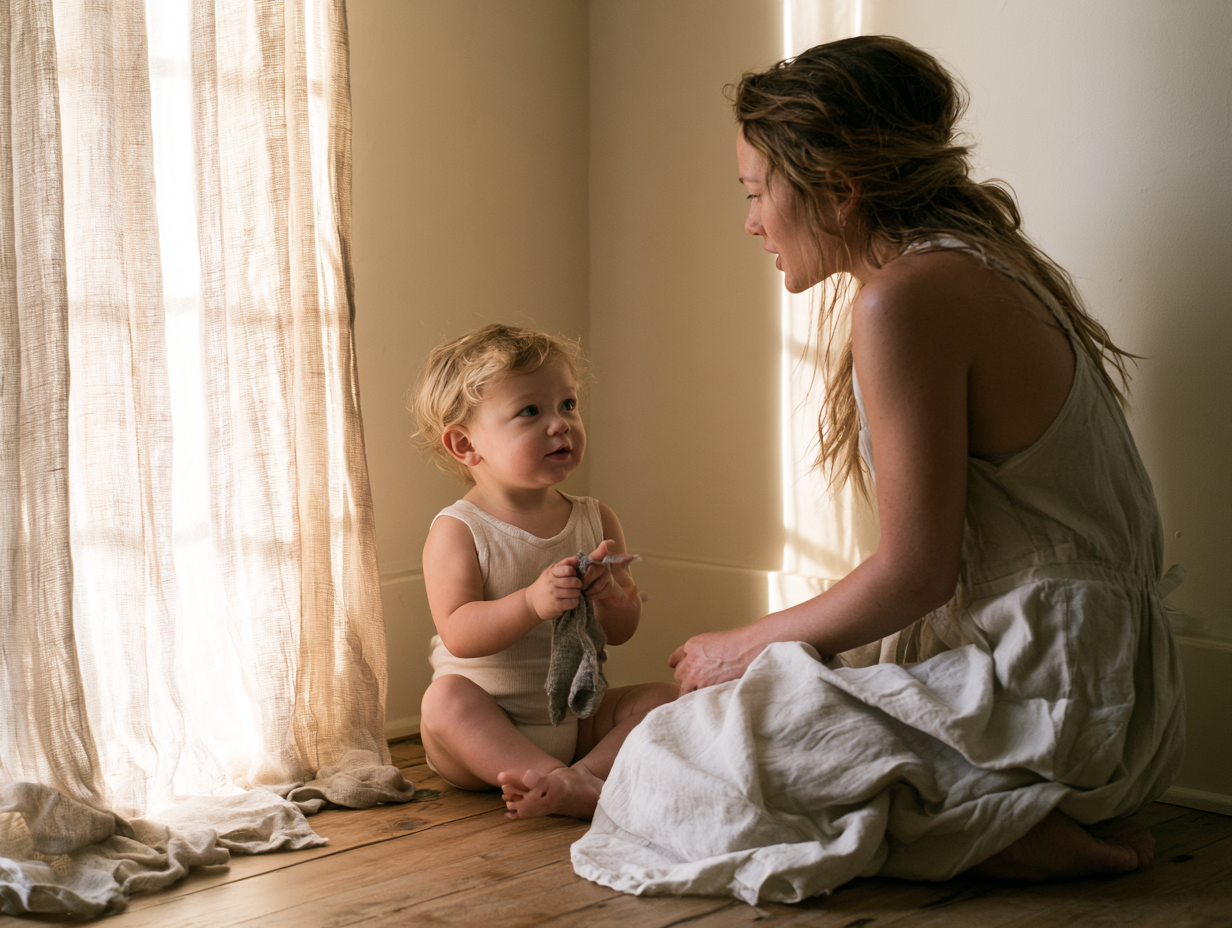
A toddler picks up a sock.
She turns it over once, presses it against her cheek, and holds it out toward you.
You could say nothing. You could say “yes, that’s your sock.” Or you could kneel down, meet her eyes, and say something slightly different:
“You found a soft sock.”
That sentence lasts about two seconds. It will not appear in any parenting course. No one will applaud it. You will likely forget you said it by lunchtime.
But inside those five words is more than a label. There is an object — sock. There is a descriptor — soft. There is an action — found. There is shared attention, because you stopped what you were doing to look at what she was holding. And there is connection, because for two seconds, the two of you were paying attention to the exact same small thing.
This is not a teaching moment. It is not a lesson. It is something quieter and, it turns out, considerably more powerful: an ordinary sentence, said in passing, that happens to carry an entire language curriculum inside it.
This article is about five phrases like that one — phrases many parents already say, in some form, without realizing what they are doing. The goal is not to add five more things to remember. It is to help you notice the language opportunity that was already there, so that what once felt automatic starts to feel meaningful. (If this idea feels new, it builds on the bigger picture in Language Grows in Moments, our complete roadmap for how toddler language develops between 12 and 36 months.)
At a Glance: What Tiny Phrases Are Really Teaching
Before going moment by moment, here is the shape of what’s actually happening — the path a single ordinary sentence travels, from something you say without thinking to something that becomes part of how she talks.
Each of the five phrases ahead sits somewhere on that same path — and each one happens to teach a slightly different kind of vocabulary. Here’s the map of which is which, so you can spot the pattern as it shows up in your own week.
The 5 Phrases and the Skills Hidden Inside Them
The Biggest Misunderstanding About Toddler Language
Most parents are told, in one way or another, that toddler language develops through input — and that more input is better. More flashcards. More educational apps. More vocabulary toys that light up and say the word back. The implicit message is that language is something to be delivered, like a vitamin, in concentrated doses.
It is an understandable thing to believe. Toddlers do, after all, eventually know thousands of words they were never directly taught. Something must be teaching them. The instinct is to look for a method — a curriculum, a product, a system — because methods feel controllable in a way that ordinary days do not.
But toddlers do not build vocabulary primarily through structured teaching sessions. They build it through repeated, embodied, emotionally connected interaction — the kind that happens not despite the chaos of an ordinary day, but inside it. A flashcard can show a child the word “cup.” It cannot show them the word attached to the weight of a real cup in their hand, the temperature of what’s inside it, the moment it tips and spills, and the parent’s calm voice saying “oh, it spilled” right as it happens. That convergence — word, sensation, emotion, timing — is what a flashcard cannot replicate and a tiny phrase, said at the right moment, can.
What Research Consistently Shows
Decades of language development research point in the same general direction: vocabulary grows fastest in children whose caregivers talk with them, not at them — narrating real moments, responding to what the child is already looking at, and following their interest rather than redirecting it toward a lesson. This pattern is often called “serve and return”: the child serves attention toward something, and the adult returns language about that exact thing.
What makes this finding reassuring rather than another task to perform is this: serve-and-return moments are not rare. A toddler reaches toward something, looks at a texture, points at a dog, drops a spoon — dozens of times an hour. The opportunity is not scarce. What’s scarce is the parent’s awareness that the opportunity is happening at all, because it looks like nothing. It looks like a sock. This same serve-and-return pattern is also central to brain development more broadly — we go into the wider picture in What Actually Builds a Toddler’s Brain.
There is also a quieter, less discussed finding underneath the headline research: the words children eventually speak tend to come from a fairly narrow band of categories — the names of things they touch, the descriptions of how those things feel, the actions they perform on them, and the people and feelings present when it all happens. Toddlers are not building a dictionary at random. They are building a vocabulary of their own daily life, word by word, in the order their life actually presents it to them. A child who spends her days near water, dirt, fabric, and food will speak fluently about water, dirt, fabric, and food — not because someone planned a unit on those topics, but because those are the textures her hands have actually known.
I spent the first year of my daughter’s toddlerhood quietly convinced I wasn’t doing enough. I’d read about “language-rich environments” and pictured something elaborate — color-coded vocabulary cards, dedicated reading time, an app that tracked word counts. What I had instead was laundry, lukewarm coffee, and a toddler who wanted to be near me constantly. It took longer than I’d like to admit to realize that what I had was already enough — that the running commentary I gave without thinking, the “oh, that’s heavy” and “careful, it’s hot,” was the language-rich environment the whole time. I just hadn’t recognized it because it didn’t look like anything I’d been told to look for.
“You don’t need a vocabulary plan.
You need to notice the moments that are already arriving.”
What Happens Inside a Tiny Phrase
Take the sock sentence apart and something becomes visible that disappears the moment you say it out loud and move on with your day. A single five-word phrase is doing five separate jobs at once.
No part of that breakdown required planning. It required noticing what she was already doing and adding five ordinary words on top of it. This is the pattern beneath every phrase in this article: object, descriptor, action, emotion, relationship — not because you need to recite all five every time, but because seeing how they stack inside one sentence makes it easier to recognize when a moment is offering you the chance to add one in.
Here is the same anatomy inside a different ordinary sentence, said while pouring juice:
This is what a tiny phrase is doing underneath the surface. It is rarely about the word itself. It is about the word arriving at the exact moment the child’s attention, body, and emotion are already converged on the thing the word describes. That convergence is what makes the word stick — not the number of times it is repeated, but the precision of its timing.
It is worth sitting with how different this is from the way many parents were taught to think about “teaching” a word. Repetition drills assume the word needs to be said many times in a row to be learned. Tiny phrases work differently: a single well-timed instance, attached to a real sensation and a real relationship, can do more than a dozen disconnected repetitions said while the child’s attention is elsewhere. This doesn’t mean repetition has no value — it clearly does, especially over days and weeks. It means the timing matters at least as much as the count.
The Language Skills Hidden Inside Tiny Phrases
It can help to see the whole curriculum at once — not because you need to track it like a checklist, but because naming what’s actually being built underneath the words tends to change how a parent hears their own voice. You are not just talking. You are building, one ordinary sentence at a time, the foundations underneath everything she will eventually say.
You’re not just talking. You’re building the foundations underneath everything she will eventually say.
Ten vocabulary domains. One ordinary day. You’re not running a curriculum — you’re already living one, every time you talk to her.
Save the 30 tiny phrases as a simple guide for the moments when your own words run out — breakfast, bath time, walks, getting dressed, and the small in-between parts of the day.
- 30 phrase prompts organized by everyday routines
- A quick fridge-friendly reference for tired days
- Gentle language ideas that do not feel like teaching
No spam. Just gentle, useful resources for real-life toddler language moments.
The 5 Tiny Phrases
What follows are five ordinary sentences, each one a small window into a different kind of language growth — sensory description, conceptual contrast, functional communication, spatial vocabulary, and emotional naming. None of them require a toy, a flashcard, or a session. They require only that you say them at the moment they are already true.
Each phrase below gets its own chapter, told a different way — a story, a side-by-side comparison, a developmental ladder, a visual board, a dialogue. The variety is intentional. Language itself doesn’t arrive in one shape, and neither does the way it’s worth thinking about.

Descriptive words are some of the earliest, richest vocabulary a toddler can absorb — not because parents drill them, but because toddlers are constantly handling textures, temperatures, weights, and sounds, and someone needs to be the one putting language on what they’re already noticing.
This is sensory vocabulary: soft, rough, cold, sticky, heavy, smooth, scratchy, slippery. These words are not abstract. A toddler does not need to imagine “soft” — she is holding it. The word and the sensation arrive together, which is exactly why they stay together in memory.
One evening, a toddler picked up her father’s wool sweater off the laundry pile and pressed it flat against her cheek, eyes half closed, the way she does with anything new. He almost said “put that down, it’s dirty.” Instead he said, “that’s scratchy, isn’t it.” She pulled back, looked at the sweater, looked at him, and pressed it to her cheek again — testing the word against the feeling a second time, like checking her work.
Toddlers often touch or hold something a second time right after you name it. That return touch is not random. It is a child checking whether the word matches the sensation — an early, wordless form of vocabulary testing.
Object Labeling Without Quizzing
There is a meaningful difference between “what color is this?” and “that’s a soft sock.” The first is a test. The second is a gift. Questions ask a toddler to produce language she may not yet have; descriptive narration simply offers the word and lets her decide what to do with it — repeat it, store it, or ignore it for now. All three are fine outcomes.
Language Expansion Examples
- “You found a soft sock.” → “It’s so soft and warm from the dryer.”
- “That blanket is fuzzy.” → “Fuzzy and a little scratchy on this side.”
- “This spoon is cold.” → “Cold because it was just in the fridge.”
Each expansion adds one new layer rather than five. A toddler does not need the full sentence rewritten into something complex — she needs the same idea, stretched just slightly further than what she already has.
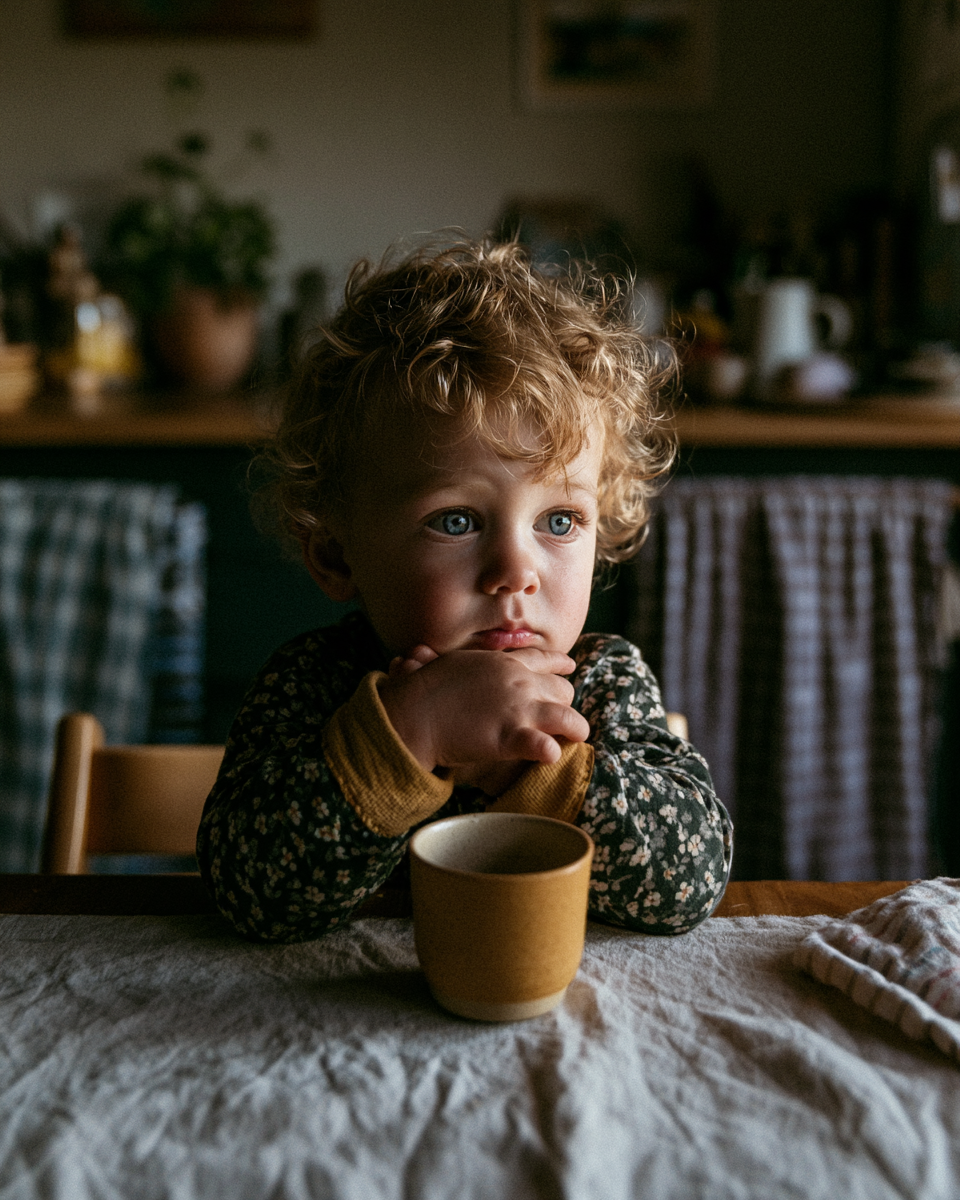
Before a toddler can reason abstractly, she reasons through contrast — and “empty” only makes sense beside “full.” Concept words like this are some of the most efficient vocabulary a parent can offer, because each one comes with a built-in opposite that doubles the learning in a single observation.
This is not formal teaching. It looks, from the outside, like commentary. “The cup is empty.” “Now it’s full.” “The basket was full, now it’s empty.” Said across a week, in a dozen unrelated contexts, the concept becomes load-bearing — something she can apply to a cup, a basket, a bathtub, a plate, without ever being taught the rule explicitly.
Opposite pairs are not a curriculum to march through in order. They show up constantly, on their own schedule — a drawer left open then shut, a glass that goes from full to empty over breakfast, a sock that is on and then off. The structure is already built into ordinary life. Naming it as it happens is the only step required.
A toddler stacked two blocks, then four, then watched the tower wobble and fall. “It got too big,” her mother said, “and now it’s small again — just one block.” A small thing to say, except that two weeks later, watching her own tower of stacked cups collapse in the bath, the toddler said it herself, almost word for word: “too big.” She hadn’t been taught the phrase. She had heard it once, attached to the exact feeling of watching something topple, and it came back to her at the moment it was true again.
Concept words tend to resurface in a child’s own speech weeks after they were first modeled — often in a completely different context than where she first heard them. This delay is normal. It does not mean the word didn’t land. It means it was stored, waiting for the next moment it would be useful.
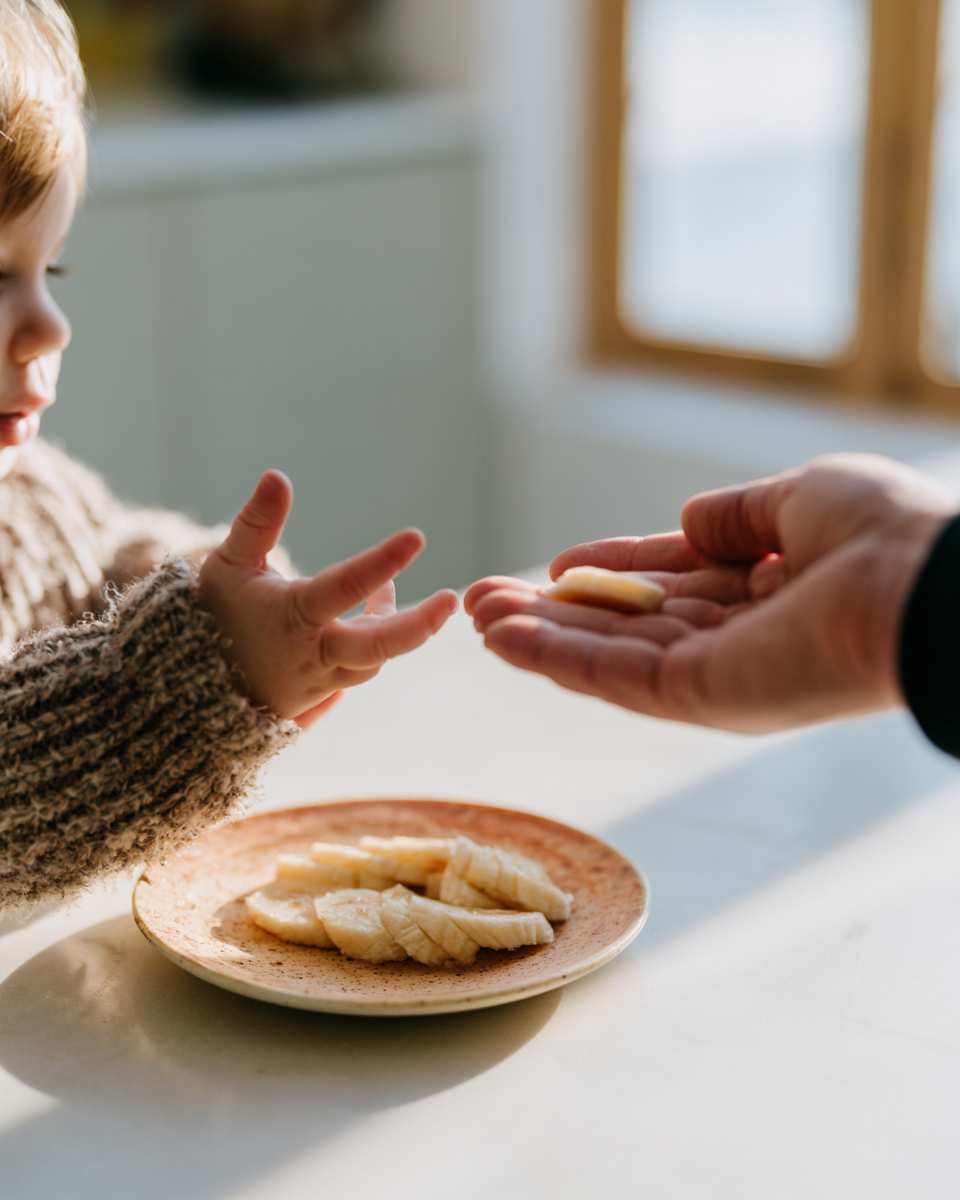
Not every tiny phrase needs to come from the parent first. Some of the most important language growth happens when a parent models the exact words a toddler is reaching for but doesn’t have yet — turning a grunt, a point, or a whine into a recognizable shape of communication.
“More banana?” said gently, in response to a toddler pointing and fussing at an empty plate, does something quietly significant: it shows her that her frustration has a word attached to it, and that the word works better than the fuss did. This is functional language — language that exists to get a need met, not to describe the world for its own sake. It is often the very first kind of language to emerge, and it deserves more respect than it usually gets.
If a toddler points at something and you immediately hand it over without saying anything, the moment passes without language. If you pause for even one second and say the word the gesture is asking for, you’ve turned a request into a language opportunity — without slowing anything down or making her wait uncomfortably.
Requesting language is sometimes dismissed by parents as “just asking for things,” as though it doesn’t count the way describing or storytelling does. But functional language is the doorway every child walks through first. The toddler who can reliably get a need met with a word is also the toddler who is beginning to trust that words are useful — which makes her more likely to reach for more of them.
For weeks, a toddler’s only way of asking for more food was to bang his palm flat on the high chair tray and look at his mother with an expression somewhere between hope and frustration. She started narrating it every time: “more banana? You want more.” One Tuesday, mid-bang, he stopped, looked at her, and said “mo” — half a word, barely audible, but unmistakably aimed. She gave him more banana immediately, not because the word was perfect, but because it was a beginning.
“Communication starts long before complete sentences.”

Position words — under, over, through, behind, inside, beside — are some of the hardest concepts to teach in the abstract and some of the easiest to absorb in motion. A toddler’s body is constantly demonstrating spatial relationships before her vocabulary catches up: she crawls under a table, climbs over a step, reaches behind a cushion. The words simply need to arrive while the body is doing the thing.
This is why position vocabulary grows fastest during active, physical play rather than during quiet, seated moments. The word “under” attached to an actual ducking motion lands differently than the same word read aloud from a board book while sitting still.
A toddler shoved a wooden ball under the living room chair, then dropped to her stomach to chase it, narrating nothing because she didn’t have the words yet. Her mother, folding laundry nearby, said it for her: “you pushed it under the chair — now you’re going under too.” By the third time the ball rolled under something that week, the toddler said “under!” before her mother had the chance to.
Action words grow alongside position words in exactly this way — pushed, rolled, crawled, climbed, squeezed. None of it needs to be staged. The chasing, hiding, and climbing toddlers already do all day is the activity. The only addition is language, narrated at the moment the body is already proving the meaning of the word.
There is a second, less obvious benefit to position language: it tends to make toddlers feel more capable rather than more corrected. “You went under the table” describes what she did with evident interest and approval. “Get out from under there” describes the same physical reality but frames it as a problem. Both are technically accurate. Only one of them teaches a word while also strengthening her sense that her body’s movement through the world is something worth narrating, not something to be managed.
The next time your toddler crawls under, climbs over, or squeezes through something, resist the urge to redirect first. Narrate first. The position word and the developmental milestone are happening in the same instant — you only get one chance to catch them together.
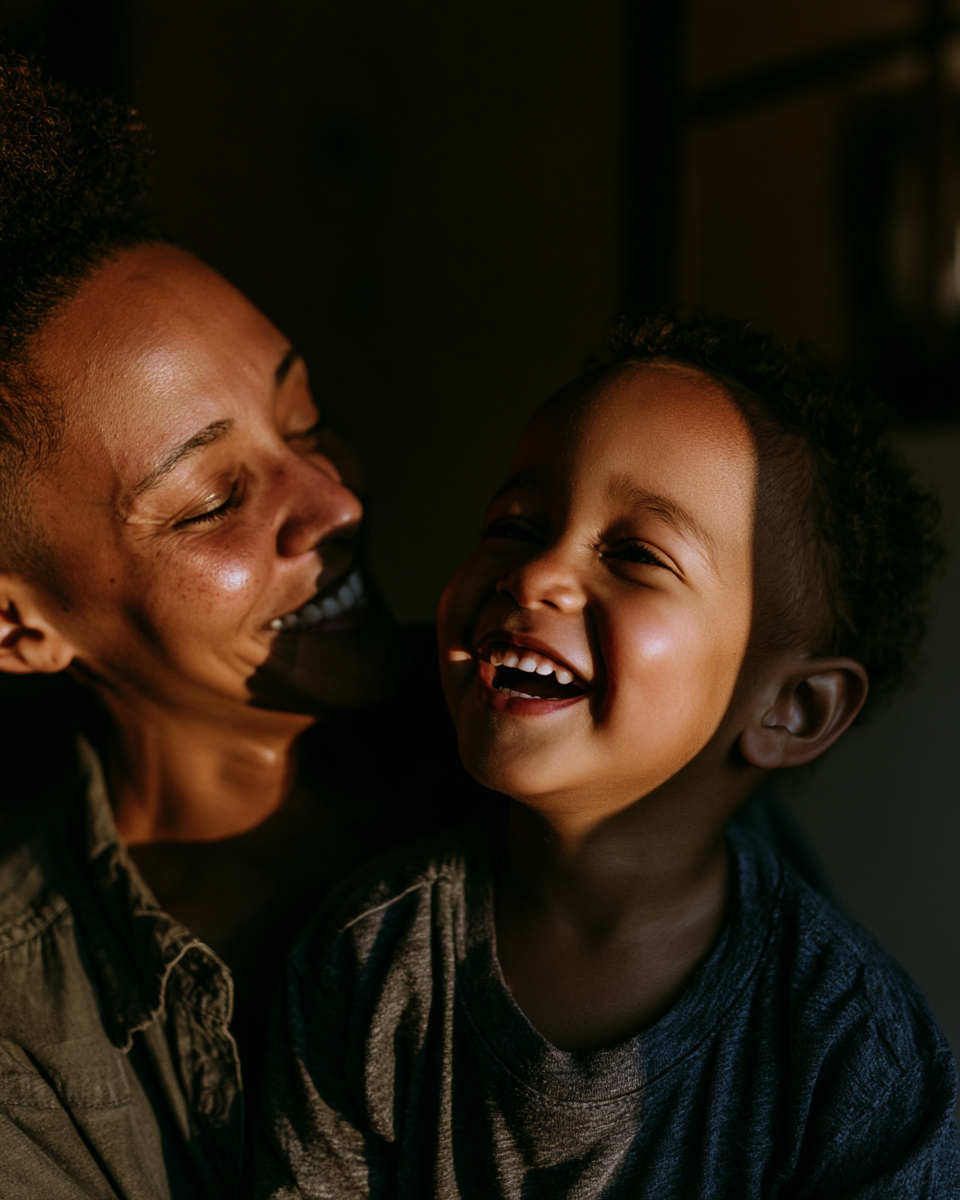
Emotional vocabulary may be the most overlooked language category of all, in part because feelings seem like they should be obvious — a toddler crying is clearly upset, a toddler giggling is clearly happy. But “obvious” to an adult is not the same as “named” for a child. Without the word attached to the feeling, the feeling stays a sensation in the body rather than something she can eventually talk about, ask for help with, or regulate.
Naming an emotion as it happens — rather than after it has escalated into a meltdown — gives a toddler an early, low-stakes vocabulary for her own internal states. Happy, excited, surprised, frustrated, disappointed. These words matter enormously later, when “frustrated” becomes the difference between a toddler who can say “I’m frustrated” and one who can only show it.
Notice that none of this requires the child to repeat the words back, agree with them, or perform understanding in any visible way. The phrase is offered, not extracted. Over weeks and months, “happy,” “surprised,” and eventually “frustrated” and “disappointed” begin to surface in her own speech — not because she was taught them in a single sitting, but because they were modeled across dozens of real emotional moments, each one small enough to pass without ceremony.
There’s a practical payoff to this years later, though it isn’t really the point. Children who have a working vocabulary for their internal states tend to have more tools available in the moments that matter most — the overwhelmed, overtired, can’t-quite-explain-it moments that every toddler has and every parent dreads. A child who has heard “frustrated” named calmly a hundred times in low-stakes situations is more likely, eventually, to reach for the word instead of only the meltdown. That isn’t a guarantee. It’s a possibility worth building toward, one ordinary moment at a time.
You are not teaching her to feel. She already feels everything, fully. You are simply handing her the word for what she’s already experiencing — so that one day, she can hand it back to you herself.
The Everyday Language Map
None of the five phrases above need a special setting. They live inside routines that already happen, every single day, with or without any language attached to them. Below is a map of where language opportunities tend to cluster — not a checklist, just a way of seeing the day differently.
What makes routines such fertile ground for language is repetition without rigidity. Breakfast happens every day, but it is never quite identical — the toast burns one morning, the milk runs out the next, the banana is too ripe on Thursday. That gentle variation inside a stable structure is exactly what builds robust vocabulary: the same general words (hot, empty, sticky, more) reappearing across slightly different real situations, until the toddler understands not just the word but its range — that “hot” applies to soup and to sunlight and to a radiator, not only to the one bowl where she first heard it.
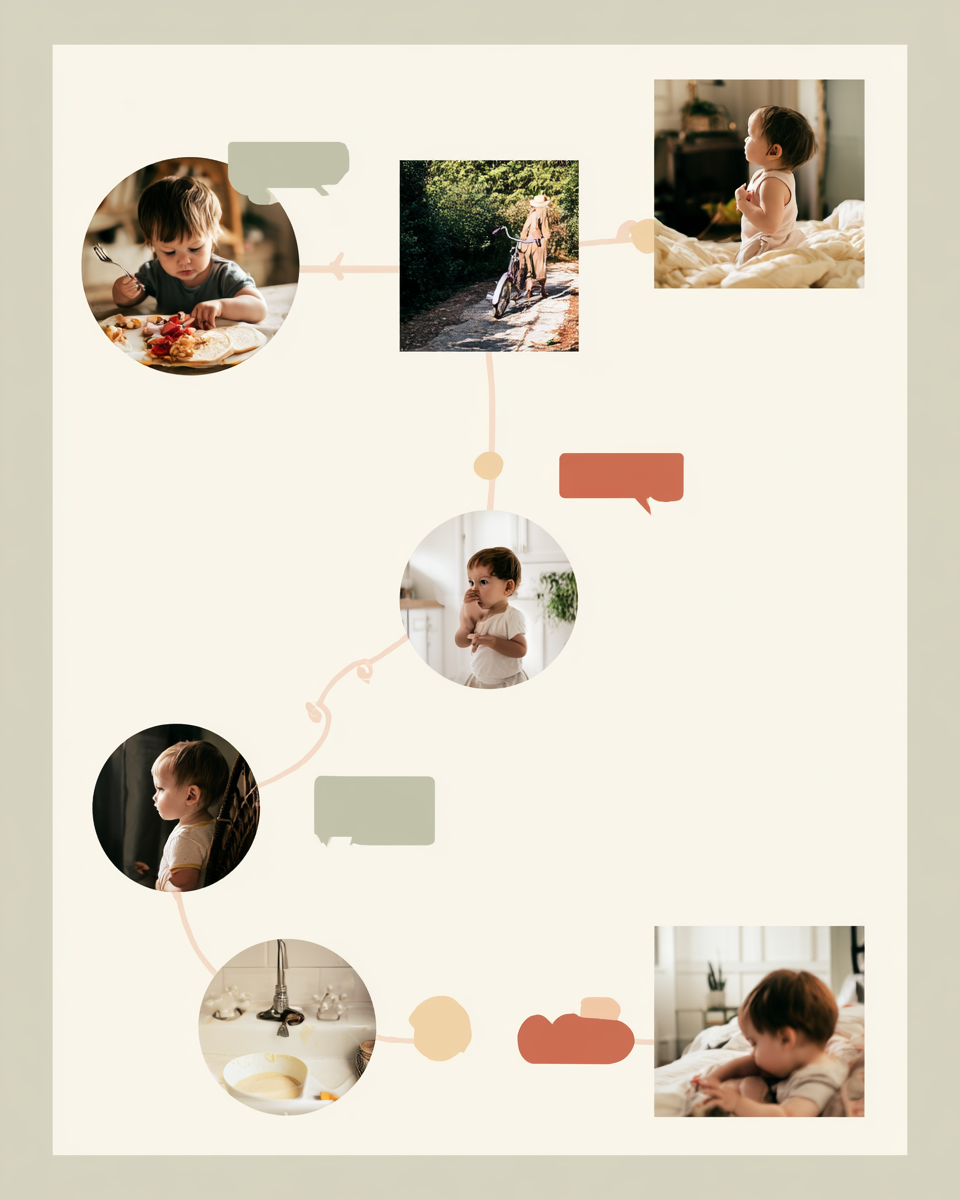
Pick one routine from this map — just one — and notice, for a single day, how many tiny phrases naturally fit inside it. You are not adding a new task. You are noticing a task that was already there.
A Full Day of Language Opportunities
The map above shows where language clusters by routine. This one walks straight through an ordinary day, start to finish, so you can see just how many of these moments are already built into hours you’re living through anyway.
Eight stops, eight ordinary moments, eight different vocabulary domains — and that’s a conservative count of a single day. Nothing on this timeline required a special setting or a planned activity. It required only the noticing that was already available, at moments you were already present for. For a closer look at five of these routines specifically, The 5 Everyday Language Routines That Build Communication Naturally goes deeper into each one.
“The best language curriculum is often hidden inside an ordinary day.”
30 Tiny Phrases Worth Borrowing
If five phrases feel like a start, here are thirty more — organized by the moments where they tend to fit naturally. None of these need to be memorized. Skim the category that matches whatever is happening in your house this week.
Thirty phrases is more than anyone can hold in working memory while also getting a toddler dressed, fed, and out the door. That’s the point of writing them down rather than memorizing them — so they’re available on the days your own words run out, which, if you’re anything like most parents reading this, happens more often than the milestone charts ever let on.
Use it as a quiet reference, not a script. Keep it near the table, beside the changing basket, or anywhere your toddler language moments already happen.
- 30 tiny phrase prompts organized by daily routine
- Mealtime, bath time, outdoor play, and bedtime language prompts
- Language observation journal pages
- My Toddler’s Favorite Words tracker
- Quick-reference fridge page
No spam. Just gentle, useful resources for real-life toddler language moments.
What to Do If Your Toddler Isn’t Talking Much Yet
If you’ve read this far while quietly wondering whether your own toddler is behind, this section is for you. It is the part of the article that matters most, and the part most likely to be skipped.
Take a breath. Most of what feels alarming about a quiet toddler is not alarming at all — it is simply less visible than talking, which makes it harder to trust.
A Few Things Worth Knowing
None of this is meant to replace a professional opinion when one feels warranted. If a toddler shows little interest in communicating at all — not pointing, not gesturing, not responding to her name, not engaged with people around her — that pattern, not vocabulary size alone, is worth raising with a pediatrician. But quiet, watchful toddlers who are clearly tuned in, gesturing, laughing at jokes, and following directions are very often simply on their own timeline, building a vocabulary they have not yet decided to speak out loud.
My daughter said almost nothing until she was nearly two, and I spent most of that year quietly bracing myself for bad news. What I didn’t understand yet was how much she was taking in — how she’d point at the right animal in a book, follow two-step instructions, laugh at the exact right moment in a story. She was listening the entire time. The words, when they came, came fast, and most of them I recognized immediately as things I’d said to her months earlier, word for word.
Keep talking to her the way you already are. Not more intensely, not more anxiously — just as warmly and as often as before. The words are landing, even when they aren’t yet coming back.
What Language-Rich Parenting Really Looks Like
It’s worth being explicit about what this article is not asking you to do, because the phrase “language-rich” can sound, from the outside, like one more performance to get right.
- Constant quizzing
- Testing vocabulary
- Correcting every mistake
- Forcing repetition
- Flashcards all day
- Noticing
- Describing
- Responding
- Expanding
- Following the child’s attention
This is the entire method, in five words and five arrows. Nothing here requires a session, a schedule, or a single piece of equipment. It requires only the willingness to follow what she’s already paying attention to, instead of redirecting her toward what you think she should be paying attention to.
The CCBR Language Loop
If there’s one thing worth carrying away from this entire article, it’s this five-step loop — the same shape underneath every phrase, every routine, every ordinary moment described above.
Notice. Name. Respond. Expand. Repeat. Five words, one loop, and an entire approach to toddler language — small enough to remember in the middle of a bath, a walk, or a meltdown.
Language Grows in Moments
Language does not arrive all at once, the way a milestone chart might suggest — a sudden leap from no words to many. It grows the way most things that matter grow: quietly, unevenly, one shared moment at a time.
One phrase about a soft sock. One observation about an empty cup. One conversation that started with a single word and a hand reaching for more banana. One moment under a chair, one moment of shared laughter. None of it dramatic. All of it adding up.
“You don’t need to teach more. You need to notice more.”
The five phrases in this article were never the point. The point was always the noticing — the small shift that happens when an ordinary moment, the kind that used to pass without a second thought, starts to look like exactly what it is: a tiny, ordinary, completely sufficient language lesson, delivered by someone who already knows her best.
You will not remember most of the phrases you say to her this week. She may not remember them either, not as individual sentences, not as moments she could describe later. What she will carry forward is something less specific and more durable: the felt sense that her world came with words attached, that someone was paying enough attention to notice the sock, the empty cup, the laugh — and that noticing, repeated enough times across enough ordinary days, is what language actually is.
Before You Go
Three questions worth sitting with, not answering out loud — just noticing.
What phrase did you say today without noticing?
What moment could become a language moment tomorrow?
What word is your toddler trying to learn right now?
At Chichiberry Parenting, we believe language grows in moments long before it appears in milestones.
You do not need to remember every phrase from this article. Let the printable hold the ideas for you, so the next small moment is easier to notice.
No spam. Just gentle, useful resources for real-life toddler language moments.