
Play & Language
Vehicle Activities for Toddlers: 10 Simple Ways to Play, Talk, and Explore
Simple vehicle play with things you already have — and little phrases to share along the way.
Your toddler has a little car in one hand. Back and forth it goes across the floor, over the same short stretch, again and again. You have already said “red car” and asked “What’s that?” a few times, and now you are wondering what else there is to do.
Often, not much needs to change. A road drawn on a piece of cardboard gives the car somewhere to go. A rectangle on paper becomes a parking space. A few blocks in the back of a truck become a small delivery. Each one adds a reason to move, and a few easy words to share while you play.
The ten ideas below use things most homes already have. Start with whichever one suits your child today.
Start with what you have
For most of these activities, you will only need:
- A few toddler-safe vehicles
- A cardboard box, a book, or a piece of paper
- One idea your child wants to try
Gather only what your chosen activity needs. If something is missing, swap in something similar.
A note on safety. Choose vehicles suited to your child’s age, and large play pieces without loose small parts. An adult prepares any cut cardboard and stays nearby during play. For the walk, keep to a safe pedestrian area away from traffic.
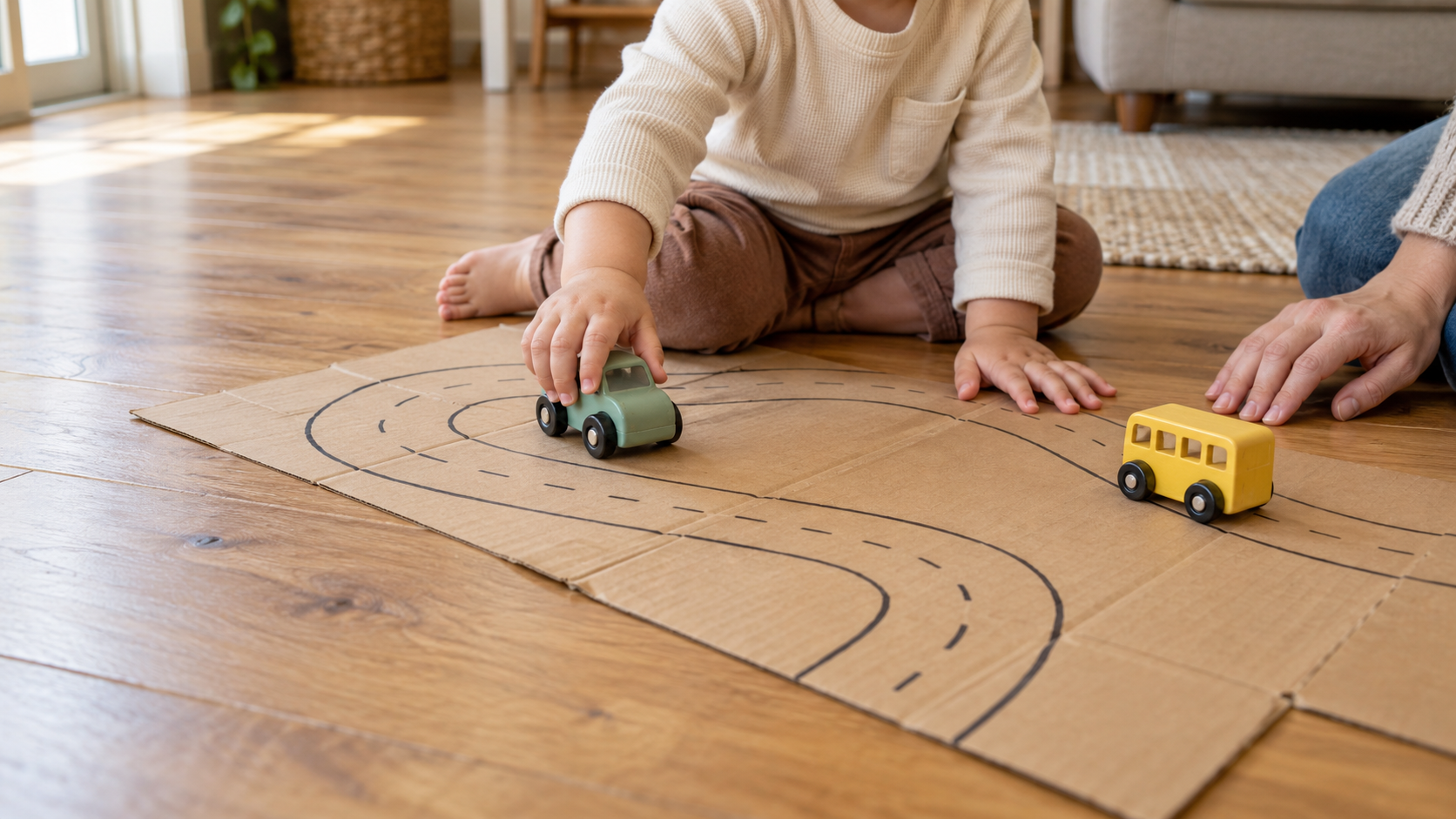
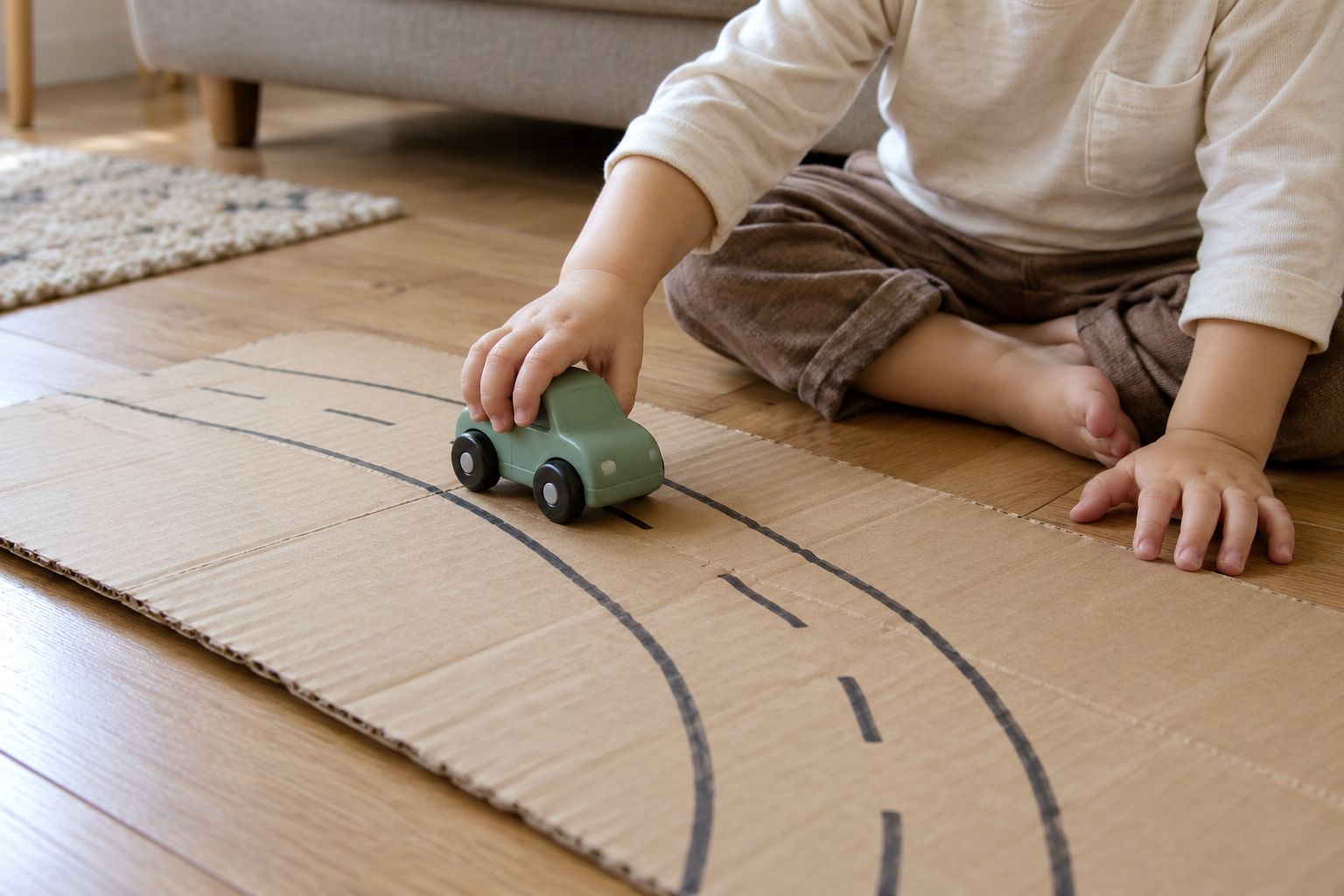
01 Make a Road and Follow It
With a road, a car suddenly has a corner to turn, a place to stop, and a reason to start again.
You’ll need
One or two toy vehicles, plus a large piece of cardboard and a marker, or tape that is safe for your floor. On wooden or delicate floors, test a small strip first.
Try it
- Draw one broad road with a single turn, wide enough for the wheels.
- Drive a vehicle slowly along it once, then let your child take over.
- With one vehicle, you can take turns if your child is interested. With two, follow behind their vehicle with yours, and stop when they stop.
Words to share
- “Around the corner.”
- “Your car stopped.”
- “Off you go.”
Make it simpler
One short, straight road from one edge of the cardboard to the other.
Add a little more
Draw a destination at the end, like a house or a shop, or add a fork so your child chooses which way to go.
02 Build a Little Parking Lot
Parking is a game of in and out, full and empty, and many toddlers are happy to repeat it again and again.
You’ll need
A sheet of paper or a flattened box, a marker, and two or three vehicles.
Try it
- Draw two or three large parking spaces side by side, roomy enough for a vehicle to fit easily.
- Drive one vehicle into each space.
- Take them out again, one at a time, and notice which spaces are now empty.
Words to share
- “One space for your bus.”
- “This space is empty.”
- “Your car fits here.”
The spaces don’t need numbers. One vehicle per space is enough.
Make it simpler
Two unlabelled spaces and two vehicles.
Add a little more
Draw one longer space for a bus and a shorter one for a car, then see which vehicle fits where.
03 Roll Down a Ramp
A ramp turns letting go into something to watch.
You’ll need
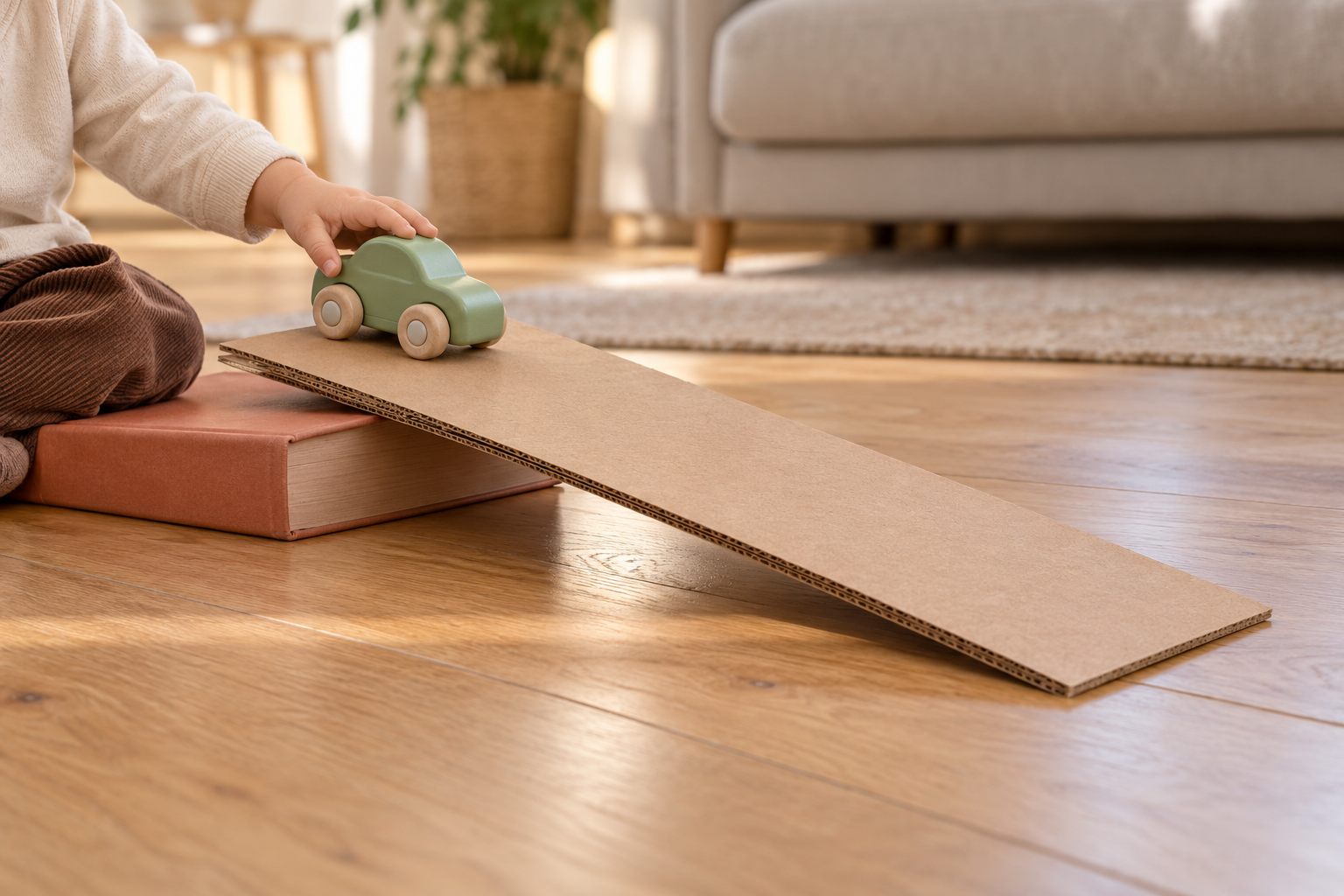
A sturdy piece of cardboard and a low, stable book. Keep the ramp low so nothing can topple.
Try it
- Rest one end of the cardboard on the book to make a gentle slope.
- Hold a vehicle at the top, pause for a moment, and let go.
- Watch together where it stops, then fetch it and try again.
Words to share
- “Ready… let go.”
- “Down it goes.”
- “That one went farther.”
Make it simpler
Use one vehicle on the same ramp, over and over. The repeating is the game.
Add a little more
Add or remove a thin book to change the slope slightly, then send the same vehicle down again and see where it stops this time.
04 Load, Deliver, and Unload
Toddlers often love filling things up and tipping them out. A delivery game gives that somewhere to go.
You’ll need
A toy truck, a few large toddler-safe blocks, and one or two cardboard boxes to be houses. No truck? A small box pulled along the floor can be the delivery van.
Try it
- Set a box house a short distance away.
- Load blocks into the truck, one at a time.
- Drive to the house, take the blocks out, and leave them at the door.
Words to share
- “One more block.”
- “The delivery is here.”
- “Let’s take it out.”
Make it simpler
One block and one house. Load, drive, unload, done.
Add a little more
Add a second house, or make a simple request: “This house needs two blocks.”
05 Open a Little Car Wash
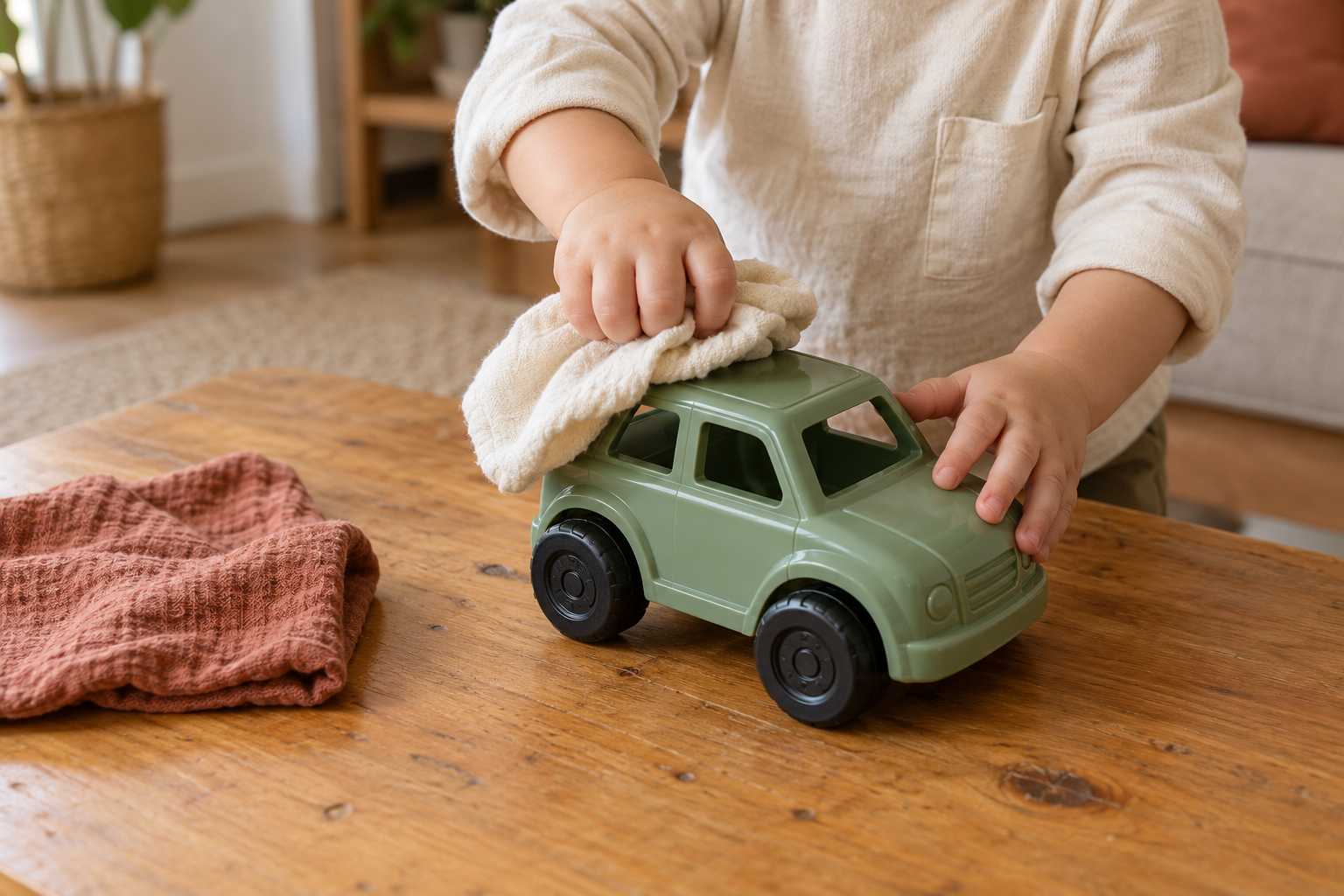
Toy cars get grubby, and wiping one clean is real care for a real object. No tub of water needed.
You’ll need
A slightly damp cloth, a dry cloth, and a few toy vehicles that are fine to wipe. Leave out anything with batteries, lights, or sounds.
Try it
- Wipe one part of a car together, like the roof, then the wheels.
- Swap to the dry cloth and dry it off.
- Take a look at the clean car, then send it on its way.
Words to share
- “Wipe the wheels.”
- “This part is wet.”
- “All dry. Ready to go.”
Make it simpler
Wipe one vehicle together, with your hand close to theirs on the cloth.
Add a little more
Set up a short line: wash, dry, then drive the clean car into a parking space from activity 02.
06 Drive Through a Tunnel
A short tunnel gives your child a place to send a car out of sight and watch it appear again.
You’ll need
A cardboard box with both ends open. An adult does any cutting beforehand and checks that the edges are smooth.
Try it
- Lay the box on its side, making sure the opening is wide enough for your vehicles to pass through easily.
- Push a car in at one end.
- Wait at the other end together and watch for it to come out.
Words to share
- “Into the tunnel.”
- “Where did it go?”
- “Here it comes!”
Let “Where did it go?” stay playful. You can answer it yourself.
Make it simpler
A very short tunnel, with both ends easy to see from where your child sits.
Add a little more
Try different vehicles and see which ones fit through without pushing or squeezing. A vehicle that doesn’t fit is worth noticing too.
07 Make a Stop-and-Go Bus Route
A bus route brings in waiting, stopping, and starting again, plus someone to visit along the way.
You’ll need
A toy bus or any vehicle, and two “stops” in the room, such as a cushion and the doorway. A large stuffed animal can wait beside one stop as a pretend passenger.
Try it
- Choose two stops and sit Teddy beside one of them.
- Drive the bus slowly toward Teddy and pause at the stop for a moment.
- Set off again for the other stop, and pause there too.
Words to share
- “The bus is stopping.”
- “Next stop: Teddy’s house.”
- “Time to go.”
Make it simpler
Use one stop beside Teddy. Drive toward Teddy, pause, then drive away again.
Add a little more
Add a third stop, or a tiny story: Teddy is going to the shop to buy bananas.
08 Match a Vehicle to Its Picture
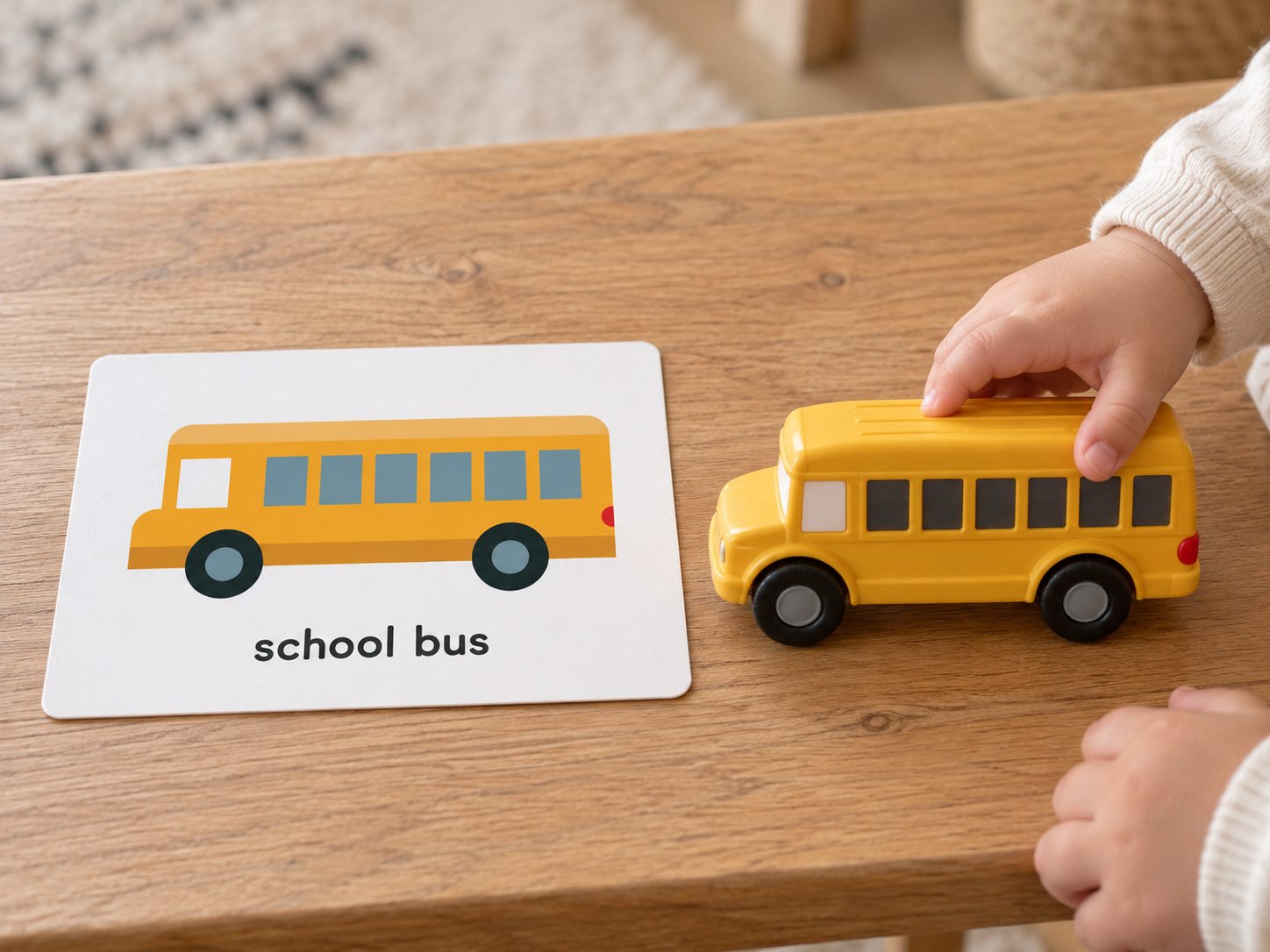
Finding the same kind of vehicle in a picture connects the toy in your child’s hand with the one on the page.
You’ll need
A toy vehicle and a picture of the same type of vehicle, in a book or on a card you already have. Printed vehicle cards, like Chichiberry’s, work too.
Try it
- Set out two pictures that look very different, such as a car and an airplane.
- Hold up the toy and look at both pictures together.
- Let your child place the toy beside the picture that matches.
The toy and the picture don’t need to match in colour or design. A blue toy bus still goes with a yellow bus in a book; shape and parts, like wheels, windows, or wings, make them the same kind.
Words to share
- “You found a bus.”
- “Both have lots of windows.”
- “This one has wings.”
Make it simpler
A car and an airplane: two shapes that are easy to tell apart.
Add a little more
Try two vehicles that are more alike, such as a bus and a truck, and look together at what is different.
09 Explore Land, Water, and Sky
Cars, boats, and planes each have their own place to travel, and a little room to imagine.
You’ll need
Three sheets of paper. Coloured paper is nice, but a quick drawing on each works too: a road, a few waves, a cloud. Add whatever vehicle toys or pictures you have.
Try it
- Lay the three sheets in a row and name each one as you set it down.
- Pick up a vehicle and wonder aloud where it travels.
- Let your child place it, then move it along its sheet together.
Words to share
- “The boat goes on water.”
- “Up goes the plane.”
- “The car follows the road.”
If the boat ends up in the sky, enjoy it. “A flying boat! I usually see boats on the water.” This is play, not a sorting test.
Make it simpler
Use two settings that look very different, like road and sky.
Add a little more
Act out a short journey together: drive to the shore, sail across the water, then fly home.
10 Take a Vehicle-Spotting Walk
Outside, vehicles are big, noisy, and real. A walk lets you notice them together, with no list to finish.
You’ll need
A familiar walking route with a safe pedestrian area, such as a wide footpath or a park path set back from the road. Hold hands wherever traffic is close.
Try it
- Walk at your child’s pace, listening as well as looking.
- When a vehicle catches their eye, pause and watch it together.
- Say one short thing about it, then keep walking.
Words to share
- “I hear a truck.”
- “The bus is driving away.”
- “That bicycle has two wheels.”
On days when going out isn’t practical, watch together through a closed window. Choose a safe spot, such as standing on the floor or sitting on your lap, with you right beside them.
Make it simpler
Notice just one vehicle and stay to watch it until it has gone.
Add a little more
Back at home, find a toy or picture that matches something you saw: “We saw a bus like this one today.”
If your toddler only wants to repeat one game
If your child finds one game and asks for it every day, that is a perfectly good place to stay.
When they seem open to something new, change just one small thing. If the road game is the favourite, draw a parking space at the end of the road: the same game, with one new place to drive. If they would rather go back to the old version tomorrow, follow their lead.
More vehicle play at home
Keep the vehicle play going
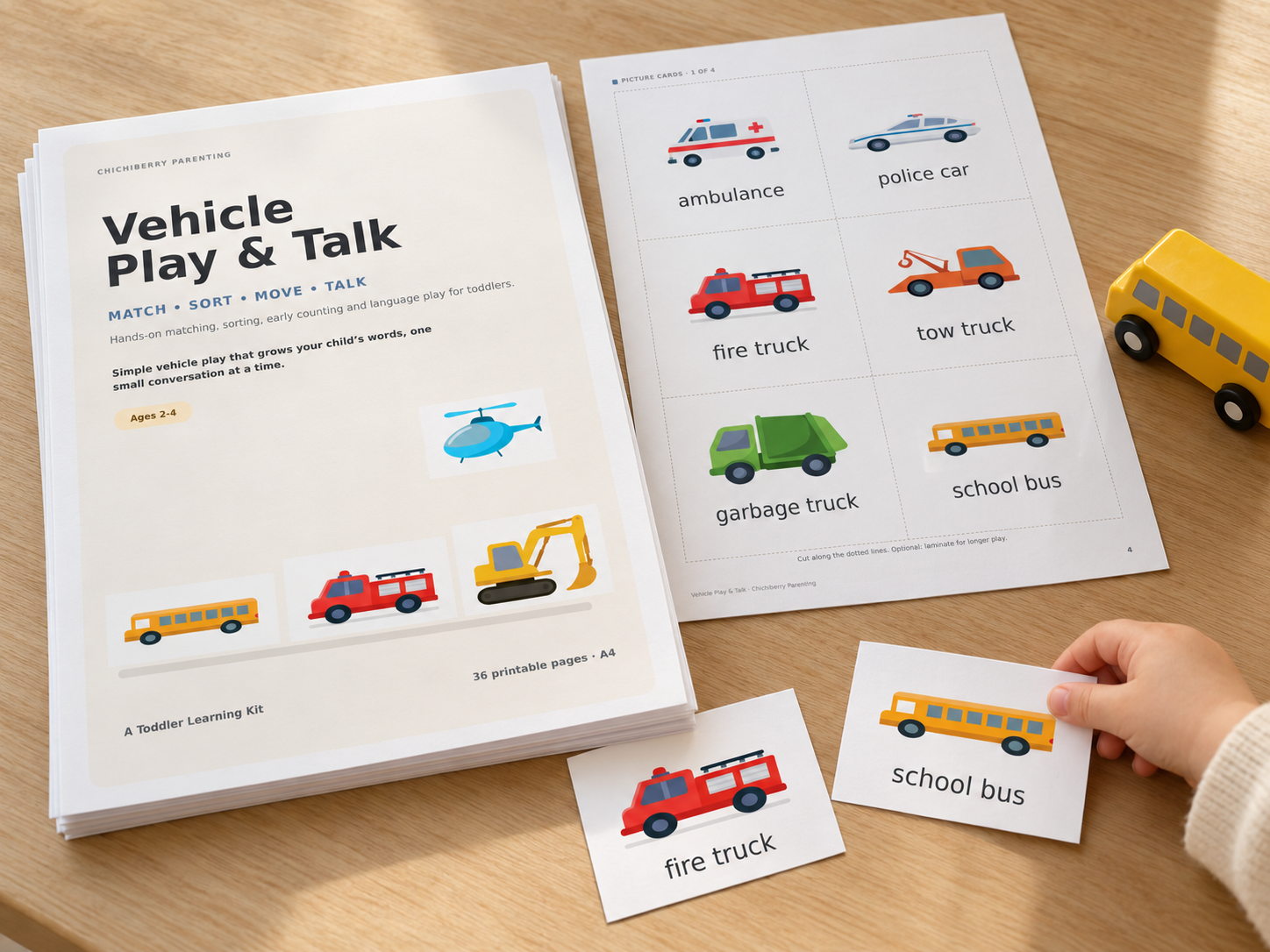
Vehicle Play & Talk — A Toddler Learning Kit
Vehicle Play & Talk brings together vehicle picture cards, matching and shadow activities, and simple counting games for ages 2–4. The kit also includes parent prompts for talking about vehicles and building on a child’s words.
Start with two picture cards and a toy vehicle. Match the toy to its picture, name one thing you notice, and leave room for your child to respond. Keep the other pages for another day.
Choose one for today
Look around the room. A car under the sofa and a box by the door may be all you need to begin.
One road, one ramp, or one small delivery is plenty for today.