Practical Life
Practical Life Activities for Toddlers at Home: 25 Everyday Ways to Build Independence
Every time your toddler reaches for the broom, the cup, or your shoe, they may be asking for one thing: a real place inside the work of the house.
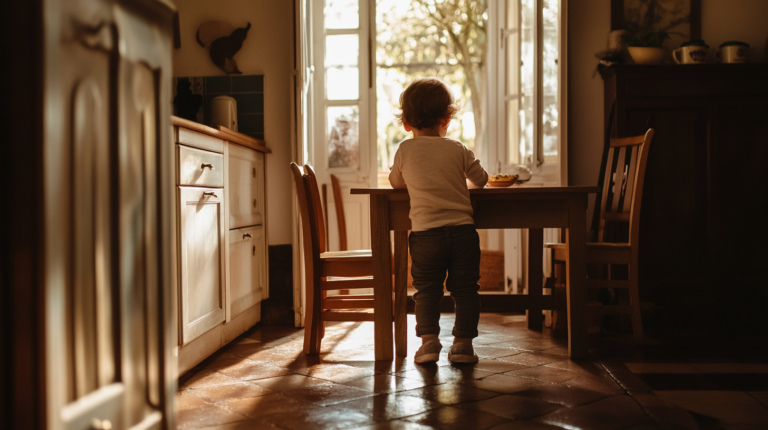
It is 7:42 on a Tuesday morning, and your toddler has planted both feet in front of the dishwasher and will not move. There are spoons in there, and spoons need to go somewhere, and today, that job seems to matter enormously.
You have a bag to pack, a coat to find, and roughly four minutes before you are officially late. And still, something in you pauses at the kitchen doorway and watches a nineteen-month-old carry one spoon at a time to the drawer, slow and serious, as if the task carries real weight.
This is practical life. Not a curriculum, not a shelf of matching wooden trays. Just a child who wants a place inside the ordinary work of the house, and a parent deciding, moment by moment, whether there is room to make that possible.
The practical life activities for toddlers at home in this guide come from exactly that kind of ordinary moment — no special room, no matching materials, just the routines already happening in your kitchen, entryway, and laundry pile.
In this article
- What practical life really means for a toddler
- Why toddlers want to join real work
- What makes an activity toddler-ready
- Practical life by age: 12–36 months
- Caring for their own things
- Helping with meals
- Caring for the home
- Laundry and clothing routines
- Everyday family participation
- How to invite without turning it into a demand
- What to do when helping creates more work
- Safety boundaries
- You do not need a Montessori home
- A simple way to begin this week
- FAQ
What Practical Life Really Means for a Toddler
In a Montessori classroom, practical life refers to the everyday, purposeful tasks of caring for oneself, others, and the environment: pouring, wiping, carrying, folding, sweeping. At home, the idea is simpler than it sounds. It is ordinary work, sized down to a child’s hands and reach.
Pretend play has its own important place. A toy kitchen, a play broom, a stuffed animal being “fed” — these support imagination and narrative in ways that matter. Practical life offers something different: a real action with a visible, real-world consequence. A cloth that actually picks up water. A spoon that actually needs to go in the drawer.
A toddler does not necessarily experience carrying the napkins to the table as a chore. For many children, it seems to register instead as something closer to belonging — evidence that they are a working, contributing part of this particular household, at this particular age, right now.
Why Toddlers Want to Join Real Work
Long before a toddler can explain it, many seem to feel it: the adults in this house are doing something, and it looks important, and they want in. This is not necessarily a phase to manage. Repeated participation in real tasks can give toddlers ordinary opportunities to practise concentration, sequencing, and a felt sense of competence — none of which require a lesson to develop.
It may also help explain a pattern many parents recognize: a toddler who resists a toy clearly built for them, then lights up at the chance to hold the real hand brush, carry the real napkins, or bring a lightweight grocery item from the entryway to the kitchen. The realness itself often seems to be part of the appeal.
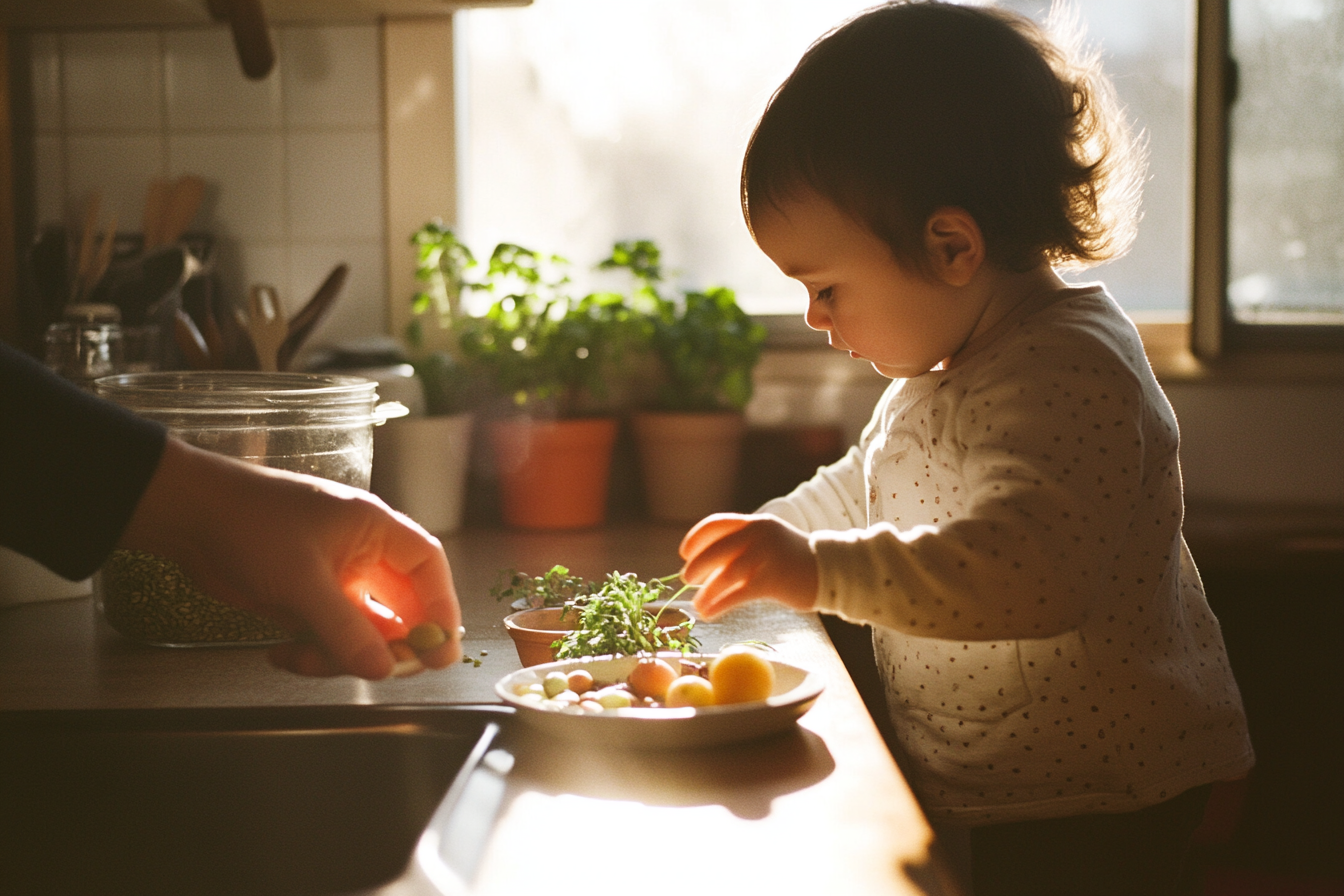
Consider the physical layers packed into a single ordinary action. Carrying a lightweight bowl with two hands asks a child to coordinate balance, visual attention, and movement control at the same time. Placing spoons beside bowls around a table involves a simple form of sequencing and one-to-one correspondence. Wiping a table in one direction, then another, uses hand strength and bilateral coordination — the two sides of the body working together toward one goal. None of this needs to be named for the child. It simply happens, quietly, inside the task.
Observation Box
What this might reflect
The insistence on doing something “myself,” even slowly and imperfectly, may reflect a growing desire for agency — even when the timing is genuinely inconvenient for the adult nearby.
What Makes an Activity Toddler-Ready
Not every real-life task is ready to hand to a toddler, and not every toddler-ready task needs to be simplified into something fake. A few things tend to separate a task that works from one that quietly frustrates everyone involved. A toddler-ready activity usually:
- Has a visible, understandable purpose. The table gets wiped. The plant gets water. The child can see that something changed because of what they did.
- Allows the child to join one manageable part, rather than the entire task from start to finish.
- Uses tools sized to their hands and body — a pitcher they can lift, a shelf within reach, a cloth that fits a small hand.
- Has a reasonably clear beginning and ending, so the child can sense when the task is done.
- Allows safe, low-consequence mistakes. Spilled water is a fine mistake to make. A hot pan is not.
- Can be supervised calmly, without an adult hovering anxiously over every step.
- Is offered, not used as a test of how well the child can perform.
The One-Step Rule
For a younger toddler especially, one meaningful step can be a complete practical-life experience on its own — it does not need to expand into a full routine to count. Some examples of a single, whole step:
- Put the spoon on the table.
- Drop the sock into the basket.
- Carry one napkin.
- Wipe one small spill.
- Place one piece of fruit in the bowl.
Each of these has a clear start, a clear finish, and a visible result — everything a toddler-ready task needs, without requiring the whole job.
Prepare Less, Not More
None of this requires new purchases. Most homes already have what a first set of practical life invitations needs:
- a small cloth
- a lightweight bowl
- a low basket
- a shallow tray
- a small pitcher, filled with very little water
- a hand brush
- a low hook
- a stable stool, used only with close supervision
The goal is not to build a system. It is to notice what is already within reach and lower it, just slightly, into a toddler’s world.

Practical Life by Age: 12–36 Months
The desire to help shows up early, but what a toddler can actually do with that desire changes a great deal across these two years. These ranges are starting points, not deadlines. The right task is one a child can join safely, willingly, and with enough support today — not a milestone every child of that age is expected to have reached.
12–18 Months
Carrying, dropping, placing
Focus: carrying, dropping, placing, opening and closing, wiping with support, following one familiar direction.
Examples: a sock into the basket, a spoon onto the table, a cloth handed to an adult, one book into a basket.
18–24 Months
Familiar routines, early pouring
Focus: familiar one- or two-step routines, transporting objects, early pouring with tiny quantities, simple matching, participating beside an adult.
Examples: washing fruit, wiping a spill, carrying napkins, putting books away.
24–36 Months
Short sequences, start to finish
Focus: short sequences, more controlled pouring, simple food preparation, meaningful sorting, completing one small task from beginning to end.
Examples: setting two places, matching a few socks, watering one plant, sweeping crumbs, putting one familiar grocery item away. For more ideas at this stage, see our guide to practical life activities for 2-year-olds at home.
Avoid treating these ranges as a checklist that every child within them should match evenly. Two children at the same age can have very different comfort levels with pouring, sequencing, or sustained attention, and both are within the ordinary range of development.
A Small Place to Help
A calm printable guide with 15 everyday invitations, age adaptations, a toddler-ready task checklist, and a one-week observation page.
Printable guide coming soon.
No elaborate setup. Just a few small ways to make everyday participation more possible.
Caring for Their Own Things
The first real ownership most toddlers experience is not a toy. It is a small set of belongings that are unmistakably theirs to care for. Correct orientation is not the goal here — a basket is often more accessible than a hook, and one object returned to its place is enough. Putting belongings away is best thought of as a closing sequence, not a test of tidiness.
-
12–36 months
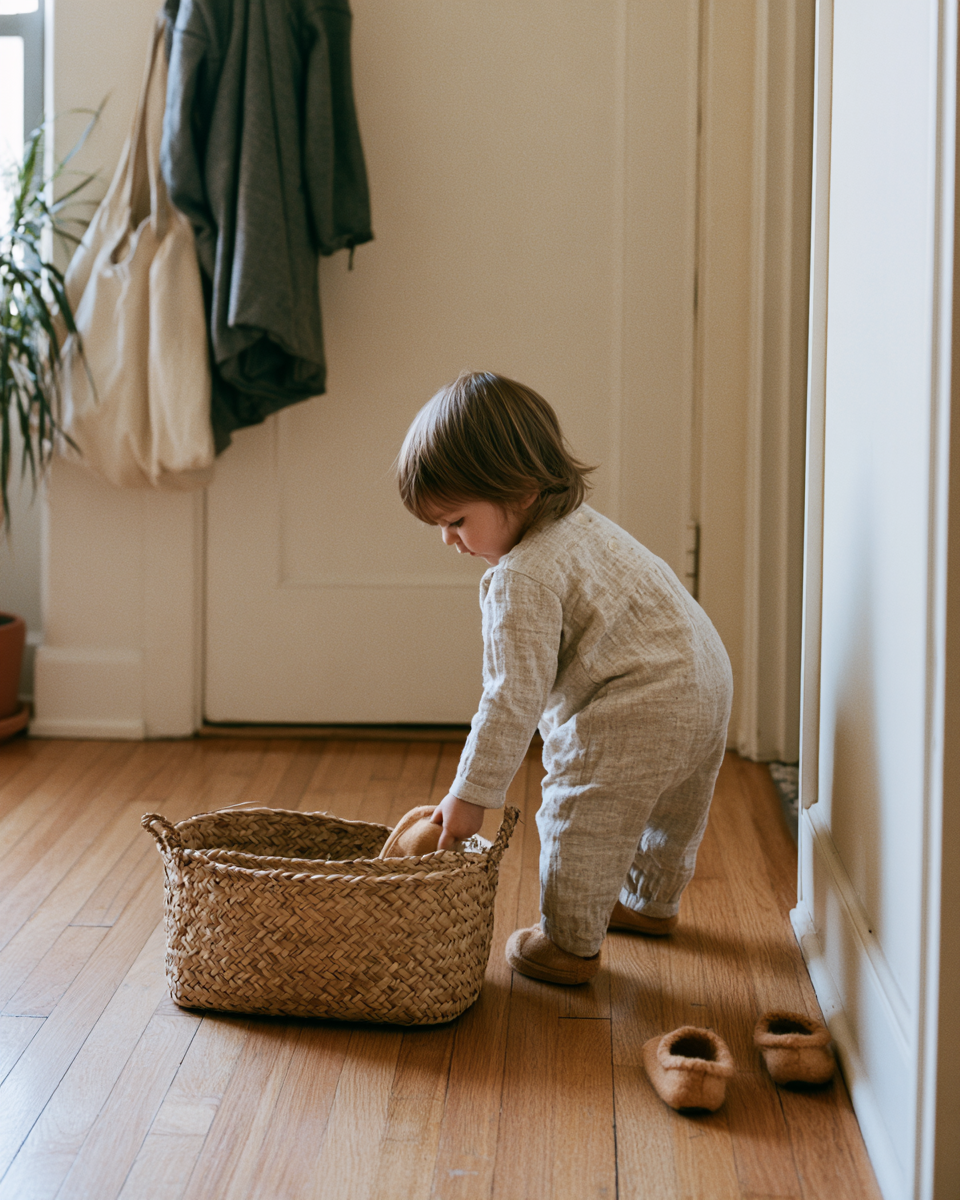
1. Putting shoes into a low basket or designated place
A basket at floor level, kept in the same spot, turns “put your shoes away” into something a toddler can simply do without help.
Younger toddlers may only manage dropping one shoe in; older toddlers can often return both shoes and place the pair together.
-
18–36 months
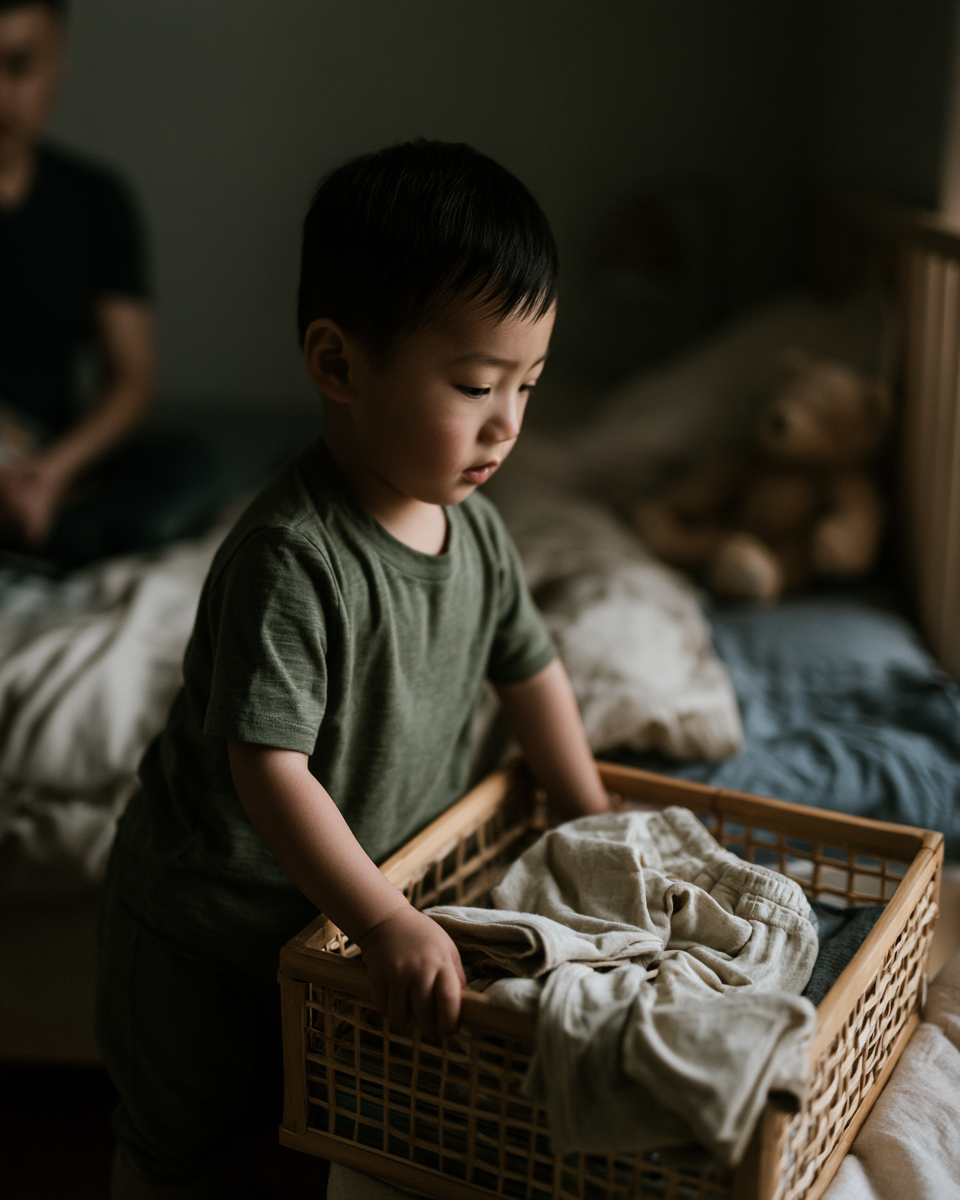
2. Dropping clothes into a laundry basket
A low hamper, kept in their room or bathroom, so undressing ends with a real task rather than a pile on the floor.
A useful phrase: “Your part is the shirt — right in the basket.”
-
12–24 months
3. Carrying a diaper, bib, or clean shirt
A short carry from one spot to another, delivered to a waiting adult.
This asks a child to manage weight, balance, and a short distance all at once — a small, complete piece of coordinated movement.
-
18–36 months
4. Hanging a hat or small bag on a low hook
A hook mounted at toddler height, used every time they come through the door.
If reaching a hook is still difficult, a basket underneath works just as well — the goal is a returned object, not a particular technique.
-
18–36 months
5. Returning books to a reachable basket
One basket, one clear home, so tidying becomes a task with a beginning and an end rather than an open-ended request.
Naming the book as it goes in — “the dog book goes here” — links the action to ordinary language comprehension.
Helping With Meals
Mealtimes offer some of the most repeatable practical life work available, because they happen every single day, more than once.
-
18–36 months
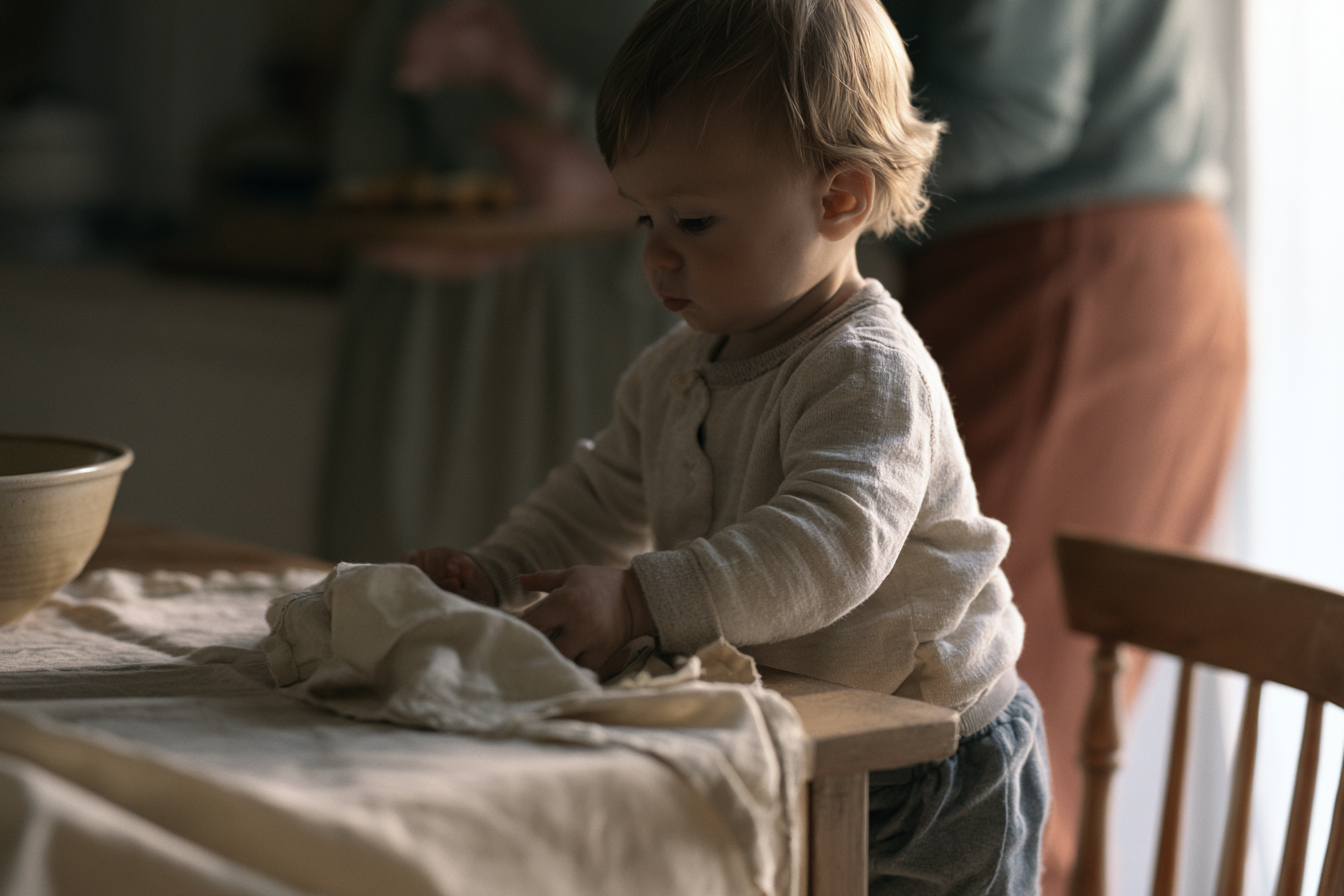
6. Carrying napkins to the table
One napkin per trip, delivered to each place setting.
A useful phrase: “Would you like to carry the napkins?”
-
24–36 months
7. Placing spoons beside bowls
One spoon per bowl, moving around the table in order.
This is an early, physical form of sequencing and one-to-one correspondence — long before it looks like counting.
-
12–24 months
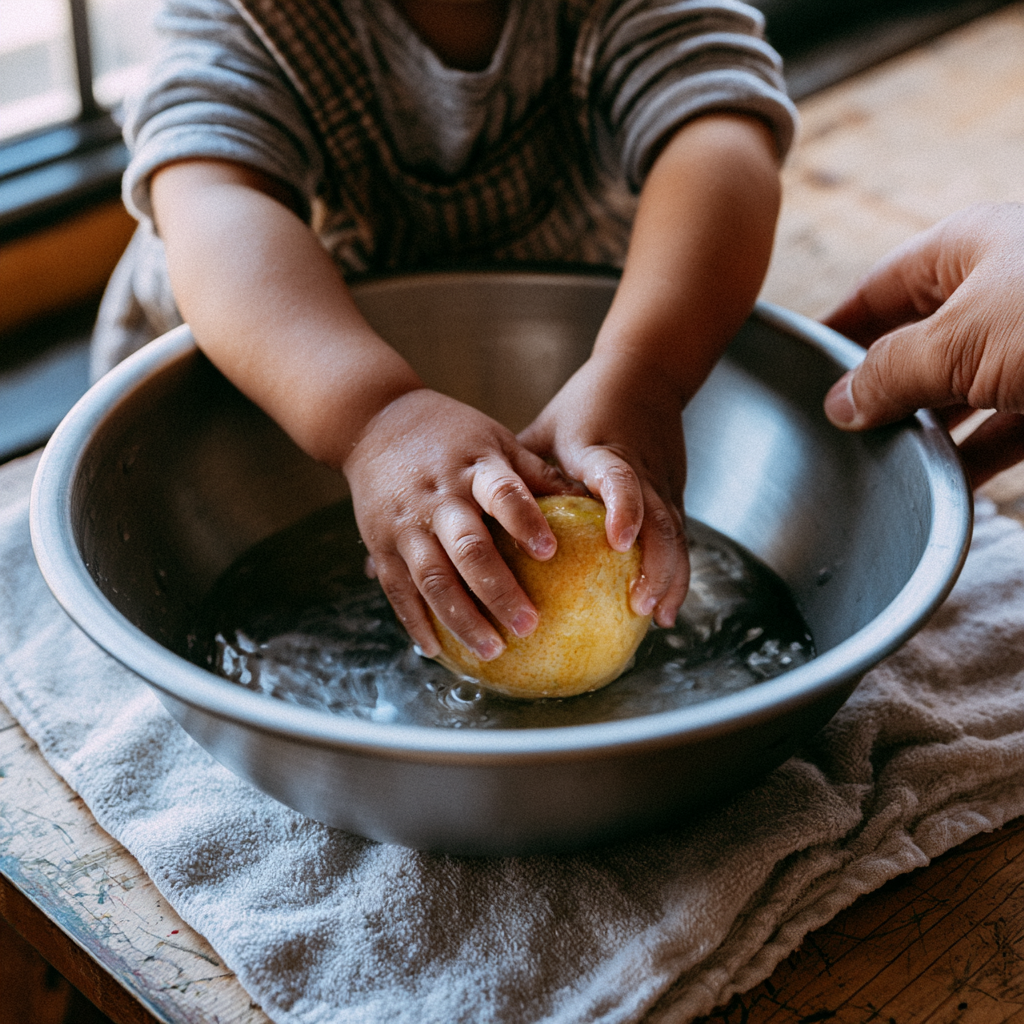
8. Washing a firm fruit in a shallow bowl
A vegetable brush or simple scrub, a shallow bowl of water, and something sturdy like an apple or a potato.
Younger toddlers may only splash and pat; older toddlers can often scrub with real purpose and rinse it themselves.
-
24–36 months
9. Peeling a banana or easy-to-peel fruit
An adult starts the peel; the child pulls the rest away.
This builds hand and finger strength in a way that later supports tasks like buttoning and drawing.
-
18–36 months
10. Pouring a very small amount of water
A lightweight, stable pitcher holding only a few tablespoons of water, poured on a tray or an easy-to-wipe surface, with direct adult supervision throughout. No hot liquid, and no breakable vessels.
Spilling here is information and feedback, not misbehavior or failure — it is simply part of how pouring is learned.
Caring for the Home
These are the tasks that most visibly say: this house is also yours to look after.
-
18–36 months
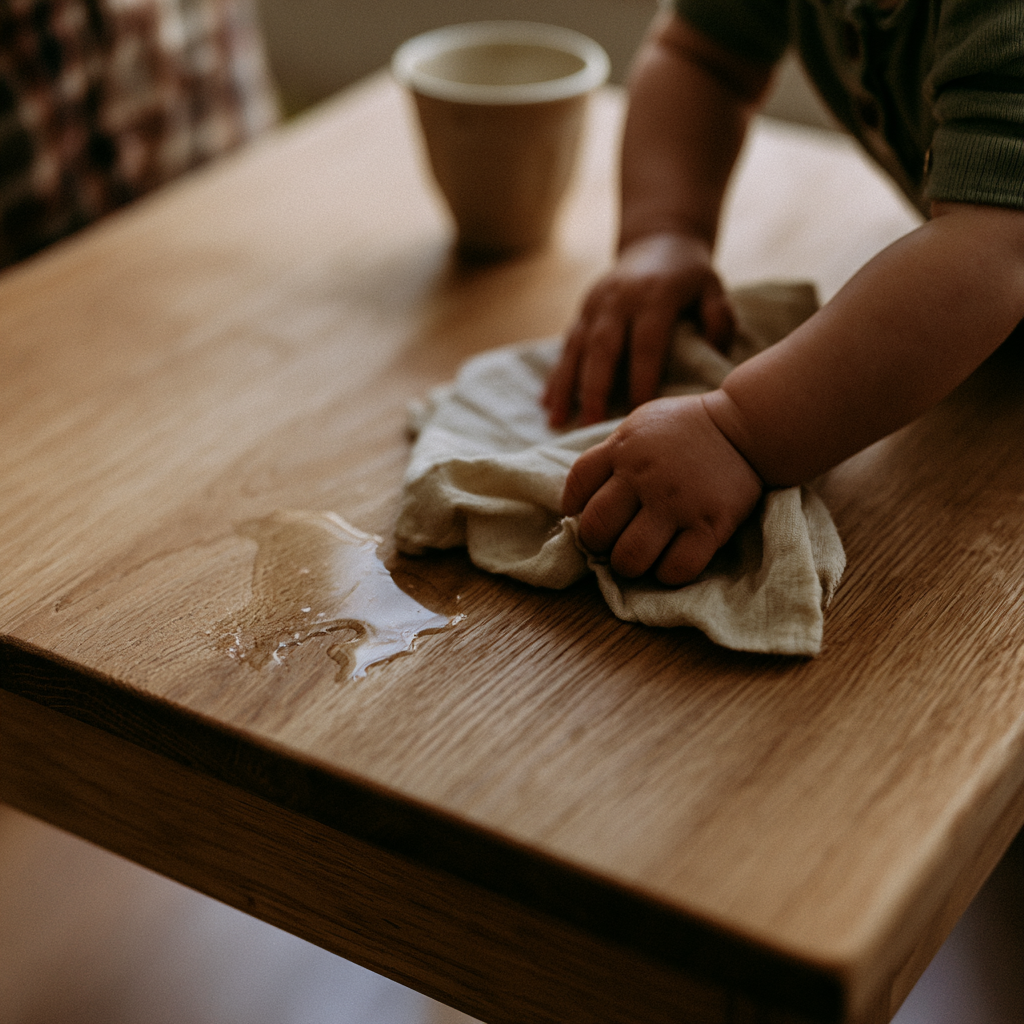
11. Wiping a small spill
A small cloth kept within reach, used the moment something spills.
A calm phrase such as “the water spilled — let’s get the cloth” tends to work better than language that implies fault.
-
18–36 months
12. Wiping one area of the table
One section, wiped in whatever direction feels natural to the child.
The back-and-forth motion uses visual attention and movement control together, even if the result is streaky.
-
18–36 months
13. Sweeping crumbs with a hand brush
A child-sized brush and dustpan, kept somewhere reachable, ready for the inevitable.
Holding a brush in one hand and a dustpan in the other asks both sides of the body to work toward one shared goal.
-
18–36 months
14. Returning safe household objects to a basket
A basket for a specific, repeatable category of object — soft toys, wooden blocks, cloth napkins.
Choose only objects that are not sharp, not a choking hazard, and not breakable, and keep cleaning chemicals completely out of this rotation.
-
18–36 months
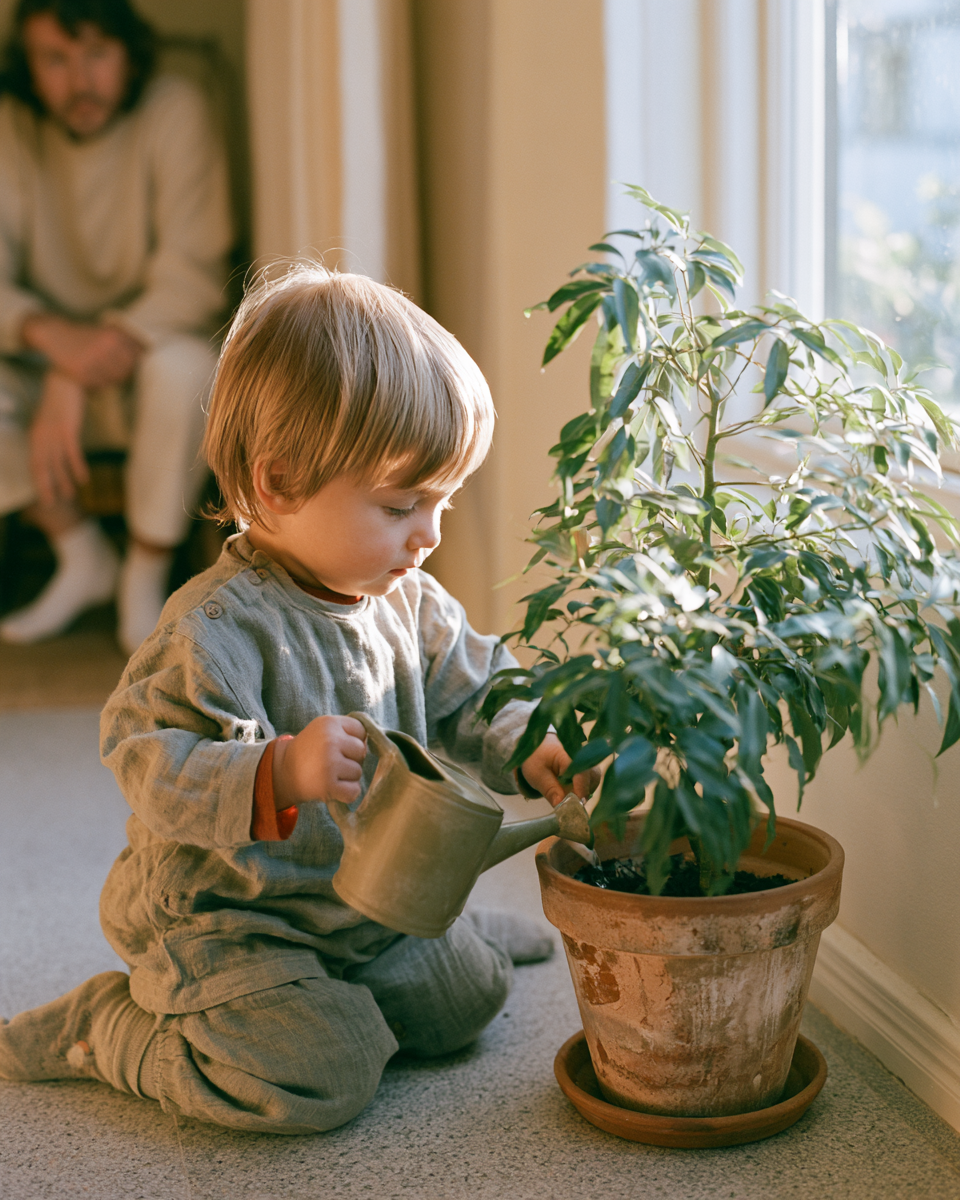
15. Watering one hardy plant
One sturdy, low-maintenance plant and a small watering can.
The adult controls how much water goes into the can beforehand, so the plant’s wellbeing is never the cost of the activity.
Laundry and Clothing Routines
Laundry offers a clear rhythm of carrying, matching, sorting and putting away — all without requiring a toddler to interact with an appliance.

-
24–36 months
16. Matching a few visually distinct pairs of socks
Start with only two or three clearly different pairs rather than a whole basket, so the task stays within reach.
Matching by color or pattern asks a child to hold one sock in mind while searching for its partner — an early form of working memory.
-
18–36 months
17. Carrying one clean clothing item to a drawer
A single folded item, carried from the laundry basket to an open drawer.
Younger toddlers may only manage the carry; older toddlers can often place the item inside the drawer themselves.
-
18–24 months
18. Putting washcloths into a basket
A small stack, carried carefully and placed into a basket at their height.
A useful phrase: “The cloth goes back in the basket.”
-
24–36 months
19. Sorting dry laundry into two small groups
Place a few dry items on the floor or a low surface: washcloths in one basket, socks in another. Keep the set small enough that the child can clearly see where each item belongs.
Younger toddlers can carry one item to the matching basket; older toddlers can sort two clearly different categories. This offers a simple, meaningful experience of classification without involving appliance access.
-
24–36 months
20. Folding one small cloth together
One fold, done side by side with an adult’s hands guiding gently if needed.
One fold is enough — there is no need to work toward a perfectly folded stack.
Everyday Family Participation
The last category is less about a single task and more about being counted on — a small but real role inside the family’s daily rhythm.
-
24–36 months
21. Carrying one lightweight grocery item from the entryway to the kitchen
Bread, a light bag of produce, or an empty reusable bag, handed to the child once groceries are already safely inside the entryway.
Keep this activity indoors — a toddler should not be walking independently in a driveway or parking area, even for a short carry.
-
24–36 months
22. Putting one familiar grocery item away
One item, placed in its usual cupboard or shelf spot.
Knowing where the crackers or the tissues belong draws on categorizing and sequencing — sorting the world into “this goes here.”
-
18–36 months
23. Adding one safe item to a going-out bag
A hat, a closed water bottle, a small cloth, or a board book, added to the bag before heading out.
A short, repeatable errand with a clear beginning and end.
-
18–36 months
24. Bringing a tissue or cloth when someone needs one
A small, kind errand offered as an option, never a requirement.
This is optional participation and kindness — the toddler is not responsible for managing an adult’s needs or emotional state.
-
18–36 months
25. Resetting one small space before bedtime
One closing action — books into a basket, pajamas placed on the bed, soft toys into one container, or a cup returned to its designated safe place.
Keep this to one small, specific action rather than the broad instruction to “clean your room.”
How to Invite Without Turning It Into a Demand
There is a real emotional difference between an invitation, participation, performance, testing, and forced compliance, even though the words offered can look similar on paper. An invitation leaves room for a no. Participation is simply joining in, without needing to be evaluated. Performance and testing ask a child to demonstrate skill for an audience — which can quietly change how the task feels. Forced compliance removes choice altogether. Toddlers tend to sense these differences, even without the vocabulary to name them.
For more everyday ways to build this kind of independence into ordinary routines, see 40 ways to build toddler independence at home.
Try This Today
Phrases worth borrowing
“Would you like to carry the napkin?” · “You can put this one here.” · “Let’s wipe it together.” · “Your part is the spoon.” · “You carried it all the way.” · “The cloth goes back in the basket.”
A few phrases tend to work against this feeling, even when well-intentioned: “You’re a big girl now, so you should do it.” “Show me how well you can clean.” “No, not like that.” “You made a mess again.” “Finish it before you can play.” An invitation preserves the child’s sense of participation. A test changes the emotional meaning of the same work. None of this requires perfect language every time — only a general direction to lean toward.
Timing also does a lot of quiet work here. A task offered mid-meltdown will usually fail, not because the task was wrong, but because the moment was. The same task offered calmly, five minutes later, often lands completely differently.
What to Do When Helping Creates More Work
It will, some days. Water spreads farther than expected. Crumbs scatter instead of gathering. A folded cloth gets unfolded again. Objects go to the wrong place, or the toddler wants to repeat the same action many times, or loses interest halfway through, or helps eagerly one day and refuses entirely the next. None of this means the activity was a bad idea.
Three reframes tend to help when a task feels like it is generating more work than it saves:
- Measure participation, not efficiency. The value is in the joining, not in how quickly or neatly the job gets done.
- Reduce the task before frustration grows. A smaller version offered early is easier than a full version abandoned in tears.
- Stop while the experience is still calm. Ending a good moment early tends to preserve more goodwill than pushing to the finish.
Gentle Reminder
Concrete ways to reduce the task
Less water. Fewer objects. A smaller surface. One step instead of three. Let the adult quietly finish the rest later, out of view, if needed. There is no requirement to make a child complete a task simply because they started it.
Some mornings there genuinely is not time for the slower version, and that is a fair and realistic read of the morning you are actually having — not a failure of intention.
Safety Boundaries
Practical life at home works best inside a few clear, non-negotiable limits. Practical life should increase meaningful participation, not transfer adult responsibility to a toddler.
Keep Off-Limits or Closely Supervised
- Hot surfaces, hot food, and hot drinks.
- Sharp knives and breakable glass.
- Household chemicals and cleaning sprays.
- Detergent and laundry pods, kept completely inaccessible.
- Heavy containers and unstable stools — use only a stable stool with close, direct supervision.
- Choking hazards and small breakable objects.
- Unsupervised water of any kind.
- Electrical appliances and appliance controls of any kind.
- Washing machines or dryers while running.
- Parking areas and driveways.
- Balconies, without close and constant supervision.
- Pet food and water areas, unless an adult is directly supervising.
You Do Not Need a Montessori Home
None of this requires perfect shelves, matching wooden tools, a neutral playroom, a separate activity corner, elaborate trays, a collection of miniature household tools, or a perfectly cooperative toddler.
What it actually requires is one real routine, one manageable step, one safe object, slightly more time than the adult version would take, realistic expectations, and a willingness to accept a result that is not tidy.
Small Shift
It is not about the setup
A practical life environment is not defined by how Montessori it looks. It is defined by how possible it feels for the child to participate. For more low-setup ideas along these lines, see 7 Montessori activities for toddlers at home.
A Simple Way to Begin This Week
If twenty-five activities feels like too many decisions for a Tuesday, it usually is. A short, flexible sequence of noticing is often a gentler place to start than a whole new system.
Try This Today
A five-day observation sequence
Day 1: Notice one household routine the toddler already watches closely.
Day 2: Offer one small object to carry or place within that routine.
Day 3: Repeat the same invitation, without increasing the difficulty.
Day 4: Allow the child to stop whenever interest ends, without needing to finish.
Day 5: Notice which part of the task the child returns to on their own.
This is not a rigid program, and skipping a day changes nothing. Start with one place to participate, not a whole new activity system. Everyday routines also carry more of this kind of learning than they get credit for — see what toddlers learn in an ordinary day and motor activities hidden inside everyday chores for more on this.
A Small Place to Help
A calm printable guide with 15 everyday invitations, age adaptations for 12–18, 18–24, and 24–36 months, a toddler-ready task checklist, and a one-week observation page.
Printable guide coming soon.
No elaborate setup. Just a few small ways to make everyday participation more possible.
FAQ
What are practical life activities for toddlers?
Practical life activities are ordinary, purposeful household actions — carrying, wiping, pouring and sorting — that a toddler is invited to join using safe, real household objects adapted to their size and ability.
What practical life activities can a 1-year-old do?
Around 12 to 18 months, many toddlers can carry a light object, drop something into a basket, hand an item to an adult, or help close a drawer or cupboard. One small, single-step action is usually enough at this age.
What practical life activities can a 2-year-old do?
Two-year-olds often manage familiar one or two-step routines, such as washing a piece of fruit, wiping a spill, carrying napkins, or putting a few books away. For more ideas at this stage, see our guide to practical life activities for 2-year-olds at home.
What practical life activities can a 3-year-old do?
By 24 to 36 months, many children can complete short sequences from beginning to end — setting two places, matching a few socks, watering one plant, or sweeping crumbs into a dustpan with support.
Do I need special Montessori materials?
No. A small cloth, a lightweight bowl, a low basket, and a little water are enough to begin. The value comes from real participation, not from matching wooden trays or a dedicated activity shelf.
What if my toddler is not interested?
That is common and not a sign that something is wrong. Interest in practical life tends to come and go. Offering the same small task again another day, without pressure, usually works better than trying to encourage it in the moment.
Is cleaning up considered practical life?
Yes. Returning an object to its place — a book to a basket, a cloth to a hook — is one of the clearest and most repeatable forms of practical life, because it has a visible beginning and end.
Are practical life activities the same as chores?
Not quite. Chores are usually framed as obligations tied to a household running smoothly. Practical life is framed as an invitation tied to a child’s own development — the household benefits, but that is not the primary point.
How long should a toddler practical-life activity last?
Often only a few minutes, and that is enough. A short, complete action tends to matter more than a long one that has to be rushed or abandoned partway through.
Tomorrow, you may not need to prepare another activity. You may only need to pause before automatically placing the spoon, wiping the spill, carrying the laundry, or putting the books away. There may be one small part your toddler can hold. It may take longer. It may not look tidy. But being given a real place inside family life is meaningful work.
Independence does not begin with doing everything alone. It begins with being trusted to take part.